News From the Self-Publishing World: 11/23/15

This week in the world of self-publishing:

We pretty much love i09, the millennial go-to forum for all news fandom-related.  And when an article begins with the line, “At an anti-library closure protest, local magician and comics legend Alan Moore had some surprising words” you can bet we sit up and pay attention––particularly when those “surprising words” end up rallying support to the self-publishing cause.  The article by Kaila Hale-Stern, which posted to i09 on November 19th, records Moore as saying “Publishing today is a complete mess. I know brilliant authors who can’t get their books published [….] Publish yourself. Don’t rely upon other people.”  Says Hale-Stern, “It’s rare and refreshing for an established writer to promote the potential boons of self-publishing and be honest about their perception of what lies behind the industry curtain.”  Moore’s words aren’t exactly  hot off the press (the protest actually took place back in 2011), but Hale-Stern’s decision to resurrect them––and to a high-traffic website like i09––says a lot about what millennials are hungering for.  HINT: It’s not more bureaucratic red tape and rejection by traditional publishers.  For more of Hale-Stern’s article, visit her article here.

In another article published on the 19th, GalleyCat contributor Dianna Dilworth updates readers on the latest development for self-publishing authors looking to break into the audiobook market––and, fittingly enough, this week that involves the launch of a new self-publishing tool by the audiobook industry supergiant, Audiobooks.com.  (When you own the domain name, you must be close to the top of your pyramid.)  The platform is being called Author’s Republic, and according to Dilworth it will allow self-publishing authors to “submit titles to Audiobooks.com, Audible, iTunes, Amazon, Barnes & Noble, Scribd, Downpour, and tunein, as well as library providers such as Findaway and Overdrive.”  The benefits seem (from a cursory glance at least) to be notable: “Most of these platforms will pay authors an average of 35 percent royalty on what their titles are sold for. iTunes and Amazon will pay a 25 percent royalty.”  Only time will tell if this new service measures up to existing competitors, of course.  For more information, follow the link.

Self-publishing made it into the Huffington Post this last week!  In an article for HuffPost Books on November 20th, contributor Brooke Warner writes that “Most writers have traditional publishing aspirations” in that “They want an agent to fall in love with their project and champion their work; they’re looking for the external validation of being accepted by a publishing house; their fantasies about getting published involve a red carpet experience that’s increasingly elusive in this industry.”  But so few aspiring authors receive that validation, despite having genuinely rich material to submit.  The solution?  According to Warner, you can fine-tune your approach to agents and publishers alike, but the one option which will always be open to you is that of the indie, hybrid, and self-publishing market.  Says Warner, “Independent publishing is a blossoming middle ground for authors, and in many cases you can replicate the experience you always dreamed of having–though you pay for it instead of being paid for it.”  Obviously we’re a little biased here at SPA, but we fully advocate for more creative control!  To catch more of Warner’s article, check out the original post.

When it comes to self-publishing, or publishing in general, “art books” don’t get a lot of love or attention.  But they should!  I mean, what’s more eye-catching and giftable than a beautiful oversized book full of illustrations and photographs?  And with the digital revolution has come a parallel evolution in the creation and editorial tools now available to artists and photographers––so really, seeing someone pay attention to them is both refreshing and necessary.  In this November 20th piece for Publisher’s Weekly,  Ryan Joe writes that “despite the amount of work that goes into such an endeavor, numerous creators—some big names in their respective fields, others up-and-comers—are taking matters into their own hands when it comes to getting their art books published.”  He goes on to document the ways and means in which several of these creators have trailblazed the way for other artists to follow, and in so doing Joe creates a summary guide for authors looking to flex a different self-publishing muscle.  Well worth a second look, we’d expect!


As a self-publishing author, you may find it helpful to stay up-to-date on the trends and news related to the self-publishing industry.This will help you make informed decisions before, during and after the self-publishing process, which will lead to a greater self-publishing experience. To help you stay current on self-publishing topics, simply visit our blog every Monday to find out the hottest news. If you have other big news to share, please comment below.

KellyABOUT KELLY SCHUKNECHT: Kelly Schuknecht is the Executive Vice President of Outskirts Press. In addition to her contributions to the Outskirts Press blog at blog.outskirtspress.com, Kelly and a group of talented marketing experts offer book marketing services, support, and products to not only published Outskirts Press authors, but to all authors and professionals who are interested in marketing their books and/or careers. Learn more about Kelly on her blog, kellyschuknecht.com.
In Your Corner : Do I need a ghostwriter?

How do you know if it’s time to seek out a ghostwriter to help you complete your book?  And what all is involved in the process of ghostwriting, anyway?  Is it really any different from detailed copyediting?

If you’re asking these questions, I hope what I write here will help to answer at least a few of them.

As with any writing venture, ghostwriting is a unique experience that presents unique challenges in addition to unique benefits.  You won’t ever find me pretending otherwise, just as you won’t find me beating around the bush when it comes to recommending a thorough and professional edit of your manuscript once it’s been written––and just as I held no punches when I worked to draw a dividing line between copyediting and proofreading in my blog post two weeks ago.

So, what is ghostwriting?  It is, according to the “Publishing” page on About.com, “the practice of writing for and in the name of someone else. It is most commonly associated with book publishing, but today it is also widely used in public relations, corporate communications, social media, and many other industries and fields that are producing greater and greater amounts of written content.”  Many of our most prolific “superstar” genre specialists, like John Grisham and Tom Clancy and Nora Roberts (and so on and so on to infinity) employ a combination of understudies, assistants or secondary writers, and ghostwriters.  They are called upon to generate, quite simply, too much material for a single human being to keep pace.  But many if not most niche storytellers––whether famous or indie, traditionally published or self-publishing––lead hectic and busy lives that keep them from writing the books that they want to.  We just can’t ignore the fact that self-publishing authors deserve to know that there is another option out there for them!

ghostwriting

The process is relatively simple: most ghostwriters work on a contract or freelance basis for companies like Outskirts Press, so the fastest way to get yourself set up with an accomplished and expert ghostwriter is to go through one of these established websites.  Perhaps the best reason of all to go with someone who has been vetted and proven trustworthy is this: ghostwriting is, at its core, a collaborative venture between you (the author) and your ghostwriter.  How you choose to work depends more on you and what your vision for a piece demands than it does on time constraints, or one hopes for such a truth in a perfect universe.  (Being too rushed for time to go it alone is a wholly valid reason to hire a ghostwriter!)

Ghostwriting has been around awhile.  Long enough, in fact, that industry supergiants like Forbes have taken a look at it––and, circling back to my comment about collaboration:  In this article for Forbes, contributor Sydney LeBlanc writes that “you can turn [your] entire book project over to the writer (research and writing) or you can provide research, notes, periodicals, etc that will help the writer.”  That’s one option, but “You can also have regular ‘interviews’ with the writer who will take notes or record conversations with you about the topic. The writer will write draft chapters for you to review, edit, or make suggestions.”  LeBlanc says that, ultimately, “There are many ways to work with a ghostwriter; it all depends on what is convenient or best for you and what is in your budget.”  (Emphasis mine.)

Hopefully this is enough to convince you that seeking out a ghostwriter is a simple and easy thing to do, and that therefore we can move past one of several possible obstacles to taking that course of action!

(PERSONAL ASIDE & RANT: Enough with the stigma, already!  Everyone’s writing method looks different, anyway, so why do we feel guilty over choosing to bring someone else in on the process?  Let’s celebrate diversification through collaboration rather than taking ghostwriting as a marker of a lack of creativity!)

So, how do you know it’s time to start researching ghostwriting as a viable option for your book?  Well, here’s a simple rule of thumb: if you can answer all or even most of the following questions with “yes,” then it might be time:

  1. Are you overworked, overstressed, or overcommitted?
  2. Do you have a story to share?
  3. Do you need a little help developing your ideas beyond the outline or draft stage?
  4. Do you believe in artistic collaboration?
  5. Can you trust the ghostwriter you pick to do justice to your vision?

Here’s where ghostwriting diverges from that other industry-specific term, “copyediting” : a copyeditor’s job is to take a finished draft and polish it up for final publication.  A thorough copyedit involves more than just shuffling commas around, but it won’t substantially change the core content of a piece.  Ghostwriting, on the other hand, involves the conceptualization and generation of a great deal of new material.  Your ghostwriter becomes your collaborator and your partner in crime, your sounding board and scribe.  Ghostwriters become folded into your stories, and it is in their best interest as paid professionals to deliver the best service they can––but if you’re both lucky, your ghostwriter might even become your ally and friend.  And what could be better than that?  Writing can be such an isolating experience, but I’d like to assure you as I do each and every week:


You’re not alone. ♣︎

ElizabethABOUT ELIZABETH JAVOR: With over 18 years of experience in sales and management, Elizabeth Javor works as the Manager of Author Services for Outskirts Press. The Author Services Department is composed of knowledgeable publishing consultants, pre-production specialists, customer service reps and book marketing specialists; together, they all focus on educating authors on the self-publishing process to help them publish the book of their dreams. Whether you are a professional looking to take your career to the next level with platform-driven non-fiction or a novelist seeking fame, fortune, and/or personal fulfillment, Elizabeth Javor can put you on the right path.

From the Archives: “Self-publishing, Literature and Pop Culture”

Welcome back to our new Tuesday segment, where we’ll be revisiting some of our most popular posts from the last few years.  What’s stayed the same?  And what’s changed?  We’ll be updating you on the facts, and taking a new (and hopefully refreshing) angle on a few timeless classics of Self Publishing Advisor.

∗∗∗∗∗

[ Originally posted: August 19th, 2009 ]

I opened the Books section in yesterday’s New York Times “Urban Eye” to read the headline, “Why Literature Doesn’t Matter.” Really? How sad. It matters to me. It matters to my family, friends, and colleagues. It matters to the self-publishing authors I work with every day. Literature doesn’t matter…. I wish someone would have told me.

According to “Urban Eye,” a recent Sunday Book Review article penned by novelist Kurt Anderson was to fill me in. Anderson writes, “During the 1960s and ’70s…people who hadn’t read a word of a first-rate contemporary novel — no Cheever, no Bellow, no Salinger, Heller, Styron, Doctorow, Updike or Roth — nevertheless knew the novelists’ names… And then everything changed.”

But book sales in the US have remained strong, and are even growing over previous years in Europe. Despite the current recession effects, statistics show that readers are still buying books. Not matter? Anderson goes on to claim, “But irony of ironies, after literature was evicted from mass culture, pop culture itself began to fragment and lose its heretofore defining quality as the ubiquitous stuff that everybody consumed.”

Ah, I’m seeing to whom, or rather to what, Literature doesn’t matter to – pop culture. Wait, then this is a good thing for authors and readers. The fragmentation that Anderson talks about is the segmenting of consumers into smaller, more clearly defined profiles. What that means to self-publishing authors of fiction, non-fiction, etc., is not that your work doesn’t matter, that Literature doesn’t matter, but that it doesn’t matter to everyone. Perfect, now you can coordinate and focus your subject matter and marketing efforts to readers who will benefit from, and buy your books.

Talk to your self-publisher early on about your custom marketing plan.

Karl Schroeder


Interior detail of antique and vintage books and ornaments on a shelf in a Cotswolds country cottage

When Karl Schroeder first wrote this blog for us back in 2009, the market for self-publishing authors had already begun to (in his words) “fragment” into smaller and smaller niche genres and industries.  Authors were on the lookout for that “big hit wonder” element for their books to tap into, the mode that we’re often taught to expect or at least reach for as writers in the modern West.  But despite appearances–despite the rise of J.K. Rowling and Stephanie Meyer and E.L. James and Gillian Flynn and too many others to name–the superstar writer has mostly receded into the background.  What we have today is a (more) stable, (more) diverse, and (more) opportunity-rich industry, and this holds true even for the oft-neglected self-publishing author.

So, yes, what Karl said remains true: literature does still matter, though not to everyone.  What may have, perhaps, changed is that it no longer matters just to connoisseurs of hyper-specialized niche genres and so on … literature does in fact have a profound impact upon and presence within pop culture.  And I’m not just talking about Young Adult Literature or the ever-popular megagenre of crime fiction … I’m talking about the supposedly “forgotten” or “neglected” classic literature.

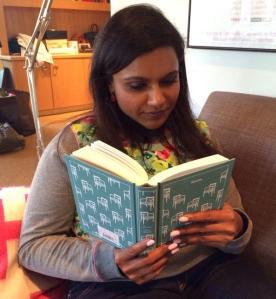
Ever heard of the #IReadEverywhere hashtag?  Well, it’s a thing.  A very, very big thing … because it demonstrates that our favorite pop culture icons–whether Mindy Kaling or or–read.  A lot.  And they read a pretty fantastic cross-section of all genres, including, yes, classic literature.  For example, we have:

ireadeverywhere1

Mindy Kaling reading Jane Austen (it doesn’t get more classic than that).  And …

ireadeverywhere2

Judy Blume reading Wally Lamb. And …

ireadeverywhere3

The Big Bang Theory’s Mayim Bialik and Melissa Rauch reading Jonathan Safran Foer and Julia Child, while their co-star …

ireadeverywhere4

Jim Parsons reads Buster Keaton.

And they’re not the only ones!  The #IReadEverywhere campaign has generated hundreds of pictures of celebrities catching a few classic words between subway stops, while sipping mochas at coffee shops, or playing on the floor with their cats.  The age of the book may vary (Foer and Childs never overlapped with Jane Austen in the historical record, let’s just say), but the tenor of the trend remains the same: everyone reads, and a lot of people read everywhere and perhaps even often.  You can’t despair for the state of classic literature or any literature at all when it’s literally a marker of “cool” to snap a selfie of you toting Hemingway along to a hip bar in NYC of a Saturday night.

And yet, Karl’s ultimate point remains as valid as ever: you still need to “[t]alk to your self-publisher early on about your custom marketing plan” if you want to create and maintain a steady stream of book sales.  And you can do that most effectively by narrowing your gaze to a specific, manageable target audience.  It’s better to start with a handful of very interested, very invested readers than to spread your fairy dust thinly among people who are only marginally interested.  Invested fans will (sometimes quite literally) sell your book for you, and that has historically been how self-published works have come to receive broad acclaim.  Think of Andy Weir and his blog readers.  Think of E.L. James and her fanatically excited followers on FanFiction.net.  Think of John and Jennifer Churchman and The SheepOver.  You can do everything right as an author and still not sell books if you haven’t gotten your fans on board.  On the flip side, you can invest just a little time and energy in wooing your readers and seizing opportunities when they arise, and sell books like hotcakes by doing so.  Talk to a marketing expert at your self-publishing company, and see what magic you can make happen, together! 

KellyABOUT KELLY SCHUKNECHT: Kelly Schuknecht is the Executive Vice President of Outskirts Press. In addition to her contributions to the Outskirts Press blog at blog.outskirtspress.com, Kelly and a group of talented marketing experts offer book marketing services, support, and products to not only published Outskirts Press authors, but to all authors and professionals who are interested in marketing their books and/or careers. Learn more about Kelly on her blog, kellyschuknecht.com.

News From the Self-Publishing World: 11/16/15

This week in the world of self-publishing:

In true entrepreneurial fashion, superstar actress and businesswoman Gwyneth Paltrow has decided to start yet another new venture … and this one’s into our world, the world of self-publishing.  According to Andrea Mandell in a USA Today article from November 10th, Paltrow will be calling her self-publishing line “Goop”––the same name as her existing fashion/beauty/lifestyle website.  It’s unclear at this point whether Paltrow will open up the new company for other aspiring authors, and how content will be selected and curated, but for now there are plans in the works for a cookbook and a beauty book at some later date.  Goop (the self-publishing company) will exist in partnership between Paltrow and existing publishing powerhouse, Grand Central Publishing.

On November 11th, Jessie Rosen of Bustle published a meme-rich list of reasons why authors should write that long-delayed YA novel … and now.  I’m happy to report that point #6 is, in her words, “You Can Self-Publish and See Just as Much Success.”  (The accompanying GIF image is, interestingly, pulled from the recent 50 Shades of Grey film––and keeps company with other GIFs on the list from Pretty Little LiarsDivergent, and Harry Potter.  It’s nice to know once and for all that popular culture has officially been infiltrated by Our People.)  Anna Banks and Amanda Hocking also win mentions.  And if this list isn’t enough to convince you that writing a YA novel is a worthwhile investment of time and energy, perhaps it will provide a good dollop of inspiration to publish whatever other kind of book you want to write.  (Hint: it doesn’t have to be YA!)

“There is proper etiquette on approaching a bookseller with a request to stock a self-published title,” writes Sue Corbett in this November 10th Publisher’s Weekly piece on the runaway self-publishing success, The Sheepover.  The joy of this sweet little picture book’s journey to an international market with Little, Brown and Company is in fact a story of the authors’ local Vermont community: when the husband and wife team first approached a local indie bookstore owner with their book, it was an eavesdropping customer who purchased the first copy, pulled in a friend to buy a second copy, and convinced the bookstore owner not only to stock a handful but to write a blog post about the book––a blog post which ended up capturing a lot of attention both at Publisher’s Weekly and among those who subscribe to PW emails.  And those original eight copies?  Paid for by a Kickstarter campaign linked to the authors’––John and Jennifer Churchman––Facebook account.  And if this story doesn’t warm the cockles of your heart, even after the first Autumn snow, then perhaps it will at least inspire you to try self-publishing a picture book of your own!

On a more “serious” newsy note, a decision has been made in respect to a long-running lawsuit leveled against self-publishing supergiant Author Solutions that has far-reaching implications for indie authors looking to publish in the near future.  In his November 13th article for Publisher’s Weekly, Jim Milliot charts the progress of the lawsuit, which was filed in 2013 by three authors accusing the company of fraud, and how this case intersected with the company’s transition to a new president and CEO––Andrew Phillips.  While the case has been dismissed, Phillips admits that he is “happy to be able to focus entirely on growing the company’s business.”  Author Solutions, which was first formed by the merger of AuthorHouse and iUniverse in 2007, has since gone through sequential ownership by Pearson, Penguin, and finally, Penguin Random House.  With all the resources of one of the Big Five publishers behind it, Author Solutions has instituted something called the “Author Care Initiative,” with the goal of improving customer satisfaction and retention in the face of an increasingly competitive market.  And they’ve seen measurable improvement in their numbers, which speaks to the value of actually caring about the authors!  You can read about the full set of measures as instituted by Phillips in the article.


As a self-publishing author, you may find it helpful to stay up-to-date on the trends and news related to the self-publishing industry.This will help you make informed decisions before, during and after the self-publishing process, which will lead to a greater self-publishing experience. To help you stay current on self-publishing topics, simply visit our blog every Monday to find out the hottest news. If you have other big news to share, please comment below.

KellyABOUT KELLY SCHUKNECHT: Kelly Schuknecht is the Executive Vice President of Outskirts Press. In addition to her contributions to the Outskirts Press blog at blog.outskirtspress.com, Kelly and a group of talented marketing experts offer book marketing services, support, and products to not only published Outskirts Press authors, but to all authors and professionals who are interested in marketing their books and/or careers. Learn more about Kelly on her blog, kellyschuknecht.com.
In Your Corner : Speaking Out and Speaking Strong

For those of you who are new to self-publishing and who are new to writing book-length manuscripts as well, the act of cultivating of a resoundingly authentic and consistent voice can present a particularly difficult (and ongoing!) struggle.  What is voice?  And how do we go about cultivating one, much less stick with it through chapter after chapter while negotiating other, competing concerns?

Voice, simply put, is your personality made manifest in the style, characterization, plotting, and point of view that emerges over the course of your book.  Voice is the unique approach that distinguishes one author from another, even when they’re writing the same story.  Voice sets Jackson Pearce’s Sisters Red apart from Marissa Meyer’s Scarlet apart from Angela Carter’s The Bloody Chamber apart from the Brother’s Grimm and their transcription of the original Red Riding Hood tale.  Distinctive voices allow us to revisit even a familiar, beloved storyline and get something new from it each and every time.

But authors are very rarely the written equivalent of a Maybelline commercial: nobody, and I repeat, nobody is “born with it” in the sense that a kitten is born adorable and fire is born when a lit match touches a candlewick.  Which is not to say any of us use cosmetics companies as standards for authorial experience, but we do sometimes fall into the trap of comparing ourselves to other authors that we respect and admire as if those authors were delivered into the universe with the tools and skill and voice requisite to connect them with their readers in later life.  It simply doesn’t happen that way!  And a captivating voice, like every other aspect of good writing, takes time and work to acquire.

david mccullough

In order to develop clear thinking and therefore a clear voice, an author must do two things that might, at first glance, seem contradictory: pay close attention to detail, and relax into the writing process.  Whoa there, you’re thinking.  I can’t do both at the same time!  And this may in fact be true: everyone’s writing process looks different.  (And mine, I must admit, even looks different from one day to the next.)  Whether you apply yourself to both of these things at the same time or separately doesn’t matter so much as ensuring that you do them both at some point.  And I personally lean heavily towards relaxing first, and then applying a microscope later––but some authors prefer to go into the drafting stage with a rigorous outline and a bundle of research already in hand, which is perfectly wonderful too.

The benefit of paying close attention is that you’ll notice when your voice changes.  I find this particularly applies when reading aloud a passage I’ve written, although that might take more time than you have if you’re reading an entire manuscript.  Keep a weather eye out for shifts in tense, plurality, characterization, and vocabulary as well as sentence structure as you go along––a sudden jump in any of these things can give a reader pause, and halt the flow of your prose.  And sometimes, these shifts slide completely under the radar; after months or even years of writing our manuscripts, we as authors simply cannot edit our own books!  It becomes impossible to hold both the big picture and the finer points of editorial expertise in mind when writing––we tend to either fixate on all the little flaws that only we can see, or our eyes skip over plot holes and inconsistencies in voice because we know what’s going on and our minds fill in the gaps automatically.  This is where a professional editor, like the ones I work with over at Outskirts Press, comes in handy.

Editing is not optional for the dedicated author, but there are all sorts of reasons––including the ones stated above––why we need to seek out fresh sets of eyes in addition to our own during the editing and revision processes.  Casual editors and first readers, such as friends and family, can be useful during the early stages, but what we all really need––what self-publishing authors specifically need––is someone on hand who can recommend changes based on years of experience and a wealth of industry expertise.  Not to mention, someone who will help you spot the points in your manuscript when you need to circle back around to a consistent voice.  A good editor may recommend changes, but ultimately, the author’s wishes and vision for a book are respected––and that is what is published.  A captivating voice is, when push comes to shove, something that taps into a shared relationship between author and text … and that sort of relationship cannot be manufactured.

voice in self publishing

Which brings me to my second point.  To create a unifying and consistent voice, an author really must relax and let the inspiration flow uninterrupted.  Jack Kerouac’s On the Road may be an extreme example of continuity in writing leading to continuity in voice, but it does illustrate the point that whatever you can do to limit your exposure to emotional and physical disruptions while writing––do.  Kerouac locked himself away for three weeks while he typed up the continuous “scroll” that would eventually form the base manuscript for his book, but you don’t have to go to such extreme measures to write a good book or to relax into the writing process!  You know the boundaries of your own mind and attention best, so you know what must be done to cut through all of the white noise generated by everyday life.  And not to harp on like a broken record, but seeking a professional editor for your book will lift the burden of obsessing over the details and leave you free to do what you do best: write.  That’s it, that’s really it: you write books, and you’ll write better books when you’re “in the zone,” or when you’re physically and emotionally free to stack word on word until something beautiful and unexpectedly perfect happens––and you have a book.

Writing is hard.  Writing well is even harder.  But you have a voice that the world needs to hear, and a book that the world needs to read.  And always remember:

You’re not alone. ♣︎

ElizabethABOUT ELIZABETH JAVOR: With over 18 years of experience in sales and management, Elizabeth Javor works as the Manager of Author Services for Outskirts Press. The Author Services Department is composed of knowledgeable publishing consultants, pre-production specialists, customer service reps and book marketing specialists; together, they all focus on educating authors on the self-publishing process to help them publish the book of their dreams. Whether you are a professional looking to take your career to the next level with platform-driven non-fiction or a novelist seeking fame, fortune, and/or personal fulfillment, Elizabeth Javor can put you on the right path.