In Your Corner: The Guts of the Thing

Welcome to the sixth episode in our ongoing series about the myriad difficult decisions a self-publishing author makes in the process of pursuing publication!  In previous weeks, we’ve discussed:

But just as the decisions about the outside of your book are important, so too are the decisions you make about the inside.  That’s right, we’re talking about:

Illustrations & Formatting

OR: the ‘look and feel’ element.

We all know how important it is that your book look good on the outside, so that new readers will pick it up off of the bookstore shelf (or the library shelf) and have that immediate “AHA!” moment.  The problem is, while first impressions like these are one make-or-break moment for your relationship with your reader, so too is the moment when they thumb through the pages and take a look at the actual pages.  Most readers I know will crack a cover open before committing to taking a book to the check-out (or circulation) counter, so–what gives?  What elements of your book’s interior design will give a resounding second cheer to the good impression made by your book’s beautiful front cover?

ILLUSTRATIONS

As good a place to start as any, let’s take a look at illustrations and what role they play in a reader’s impression of your book.  First off, let’s clear the air: we recognize that the appeal of any single illustration is largely a matter of taste, and we’re not here to cast aspersions or shame at any self-publishing author’s style of illustration.  Many self-publishing authors crave the option to illustrate their own books, so there’s a wholeness of purpose sometimes behind illustrations that don’t immediately appeal to us–but again, that’s not what we’re really talking about here.

Take a look at these illustrations, all of which are courtesy of books my employer (Outskirts Press) has published in the past:

You can see that’s there no one common thread connecting them all.  They’re all different styles, all different degrees of visual impact.  They’re as unique as the books that give them a home.

Professional illustrations like these give your book an oomph–a real kick of appeal–that your book wouldn’t have without them.  But are they appropriate for every book?  Probably not.  You might see how one style of illustration–simple, cartoonish, minimal–might fit perfectly in a children’s picture book, and how something a little more stylistically complicated–with detailed, fine pencil work–might fit well in a book for older readers, perhaps young teens.  Novels for adults don’t often have illustrations–which isn’t to say they shouldn’t–but this may also be a question of audience.  And one might imagine contexts–a cookbook with historic recipes, for example, or a book involving complicated geography–might benefit from a couple of beautiful illustrations.  The key is to know thy audience and to make sure any illustrations you include are as polished and professional as they can be.

FORMATTING

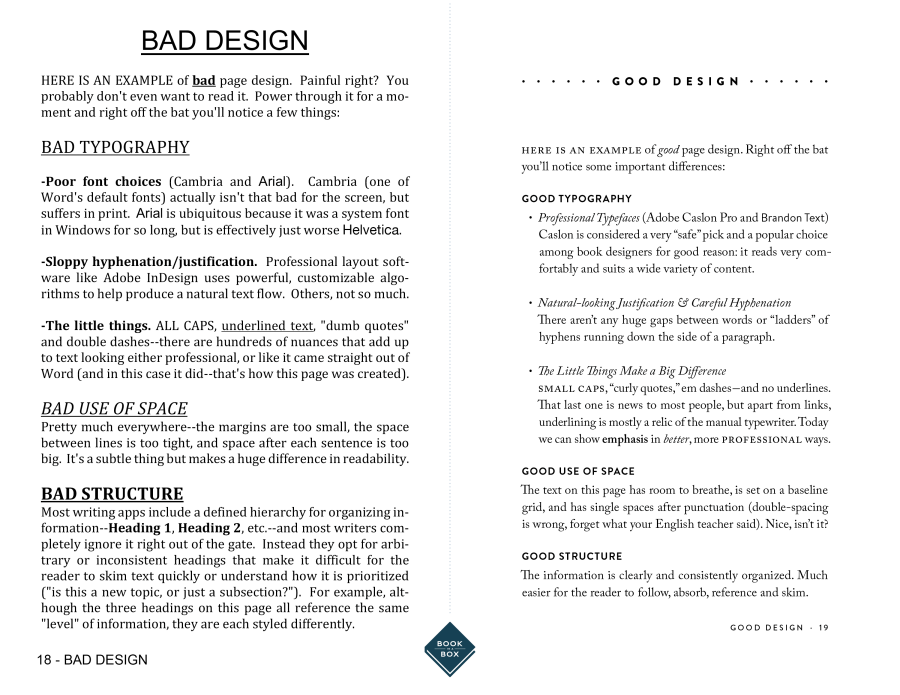
Ugh, now we’re really getting down to the nuts and bolts of your book aren’t we?  But your book’s formatting is a vital component of whether it can hold a new reader’s attention or not.  There’s nothing more frustrating than feeling like you’re being made uncomfortable by a book’s layout–and there are some rather well-research theories out there to explain why dense paragraphs, poor kerning or character spacing, poor font choices, and a poor handle on the virtues of white space can doom a book.  Without getting lost in the details, it’s rather easy to summarize the visual impact of bad vs. good formatting with the following comparison:
book formatting

Sound complicated?  It can be.  But it’s mostly a matter of balance, and consistency.

If you’re feeling … at sea, don’t worry.  As with good cover design and illustrations, there are quite a few resources out there to help you navigate the decisions that await–including whether or not you should outsource some of your design sensibilities to a paid professional.  We’re one resource, and companies like Outskirts are another, and there are plenty–and I mean an almost obscene number–of self-help guides out there.  The problem is, as it is with many things in the Internet age, that it’s almost impossible to know where to start.  And that’s why we’re here!  If you have design or formatting questions, give me a shout-out here on our blog, or track me and my compatriots down where we work.

You are not alone. ♣︎


Elizabeth

ABOUT ELIZABETH JAVOR: With over 18 years of experience in sales and management, Elizabeth Javor works as the Manager of Author Services for Outskirts Press. The Author Services Department is composed of knowledgeable publishing consultants, pre-production specialists, customer service reps and book marketing specialists; together, they all focus on educating authors on the self-publishing process to help them publish the book of their dreams. Whether you are a professional looking to take your career to the next level with platform-driven non-fiction or a novelist seeking fame, fortune, and/or personal fulfillment, Elizabeth Javor can put you on the right path.

Ringing in the Holidays!

The trees have shed their colorful fall foliage, the air has grown crisp, the kids are back in school, and you know what that means? The holidays are just right around the corner. This is a time of year to celebrate, not only because it means the return of pumpkin spice lattes and apple crisp, but because it is a time of year devoted to giving thanks, sharing delicious food and thoughtful gifts, and it is a time to gather with and spend time with those we love and cherish.

You can further celebrate this time of year as an author by innovating your marketing strategies, as there are certain advantages to marketing this time of year that aren’t available to you on just any summer day.

With an increased amount of shoppers trying to fill stockings and fill out the base of their Christmas trees, it is imperative that you’ve nailed down who exactly your audience is. Is your book a children’s book? Make sure your book is made available in local toy stores and maybe put some flyers up in local day care centers, libraries, and schools. Also, think of how great your book could be as a stocking stuffer for family members; being generous with your book this time of year could lead to more readers not only within your family, but whoever your family ends up sharing it with as well.

This is also a great time of year for holiday giveaways online. Vamp up your blog with relevant tags, and host your giveaways there! Post on pages relevant to your story–this could be anything from a Facebook page of the state your book takes place in, a Facebook group of readers that your book might appeal to, or maybe even to a Facebook event in your area that fits the theme of your book.

Remember that Christmas stockings are often full of Amazon gift cards; do you have an ebook to offer all these new potential buyers? Going digital means that there were literally be MILLIONS of people who will have access to your book, who never would’ve come across it otherwise. If you already have an ebook version, ask your readers for a priceless holiday gift: a good review online.

We know here at Outskirts Press how busy this time of year is. We know that you’re also out shopping for you families, preparing turkey feasts for your families, carving pumpkins for your porches, etc. etc. Don’t hesitate to treat yourself to the gift of our services that can help you with these marketing tasks that are so important this time of year!

holiday sales marketing

At Outskirts, we have a marketing package that includes a custom press release, an author platform setup through social media, a book trailer with social network distribution, AND you get 5 hours with your own personal marketing elf…I mean, assistant. This is a great way to ensure you don’t miss out on the perks of holiday marketing, but also ensuring that you don’t miss out on the holiday cheer because you’re too busy worrying about marketing your book!

Click here to find out more:
http://outskirtspress.com/book-marketing.html


Thank you for reading!  If you have any questions, comments, suggestions, or contributions, please use the comment field below or drop us a line at selfpublishingadvice@gmail.com.  And remember to check back each Wednesday for your weekly dose of marketing musings from one indie, hybrid, and self-published author to another. ♠


Kelly

ABOUT KELLY SCHUKNECHT: Kelly Schuknecht is the Executive Vice President of Outskirts Press. In addition to her contributions to the Outskirts Press blog at blog.outskirtspress.com, Kelly and a group of talented marketing experts offer book marketing services, support, and products to not only published Outskirts Press authors, but to all authors and professionals who are interested in marketing their books and/or careers. Learn more about Kelly on her blog, kellyschuknecht.com

From the Archives: “Self Publishing for the Eco-Conscious”

Welcome back to our Tuesday segment, where we’ll be revisiting some of our most popular posts from the last few years.  What’s stayed the same?  And what’s changed?  We’ll be updating you on the facts, and taking a new (and hopefully refreshing) angle on a few timeless classics of Self Publishing Advisor.

∗∗∗∗∗

[ Originally posted: December 6th, 2011 ]

As our society becomes more concerned with environmental issues such as climate changes, pollution and land use, many authors want to know how they can publish a book that fits their environmental values. These authors want to know about the practices of the companies they publish with as well information about the materials used to print their books. If sustainability and conservation are important to you, here are a few things to consider before publishing your book.

1) Ask About the Ink – Some self-publishing companies use non-toxic ink. This is important for many reasons. For instance, it means…

  • Your book can later be recycled or composted without the fear of toxic ink seeping into the soil.
  • Once recycled, the finished product will not have a grayish-yellow appearance like the recycled papers of the ’90s.
  • The ink in your book will pose no threats to those who come in contact with it. (If your two-year-old child decides to nibble on the pages, he or she is perfectly safe.)

2) Ask About the Paper – Some self-publishing companies will print your book on recycled paper. There are also companies that use certified paper products. For instance, Outskirts Press uses bookblock paper that is Sustainable Forestry Initiative (SFI) Certified and Forest Stewardship Council (FSC) Mixed Credit. These practices are important to prevent deforestation, which causes global warming and species endangerment.

3) Ask About Certifications – It is important to find out about the practices and products used by your self-publishing company. One way businesses prove that they use environmentally conscious practices and products is certifications such as SFI Certified and FSC Mixed Credit. Most companies will be more than willing to share this information with you, so ask your publishing company what certifications they have.

4) Ask About Best Practices – There are plenty of ways individuals and businesses can help the environment. Just a few ideas include energy-efficient appliances, telecommuting and recycling. Ask yourself-publishing company what they do to reduce their carbon footprint. Do they value sustainability and conservation? Do they encourage their staff to share their values by taking small, eco-conscious actions?

When choosing a self-publishing company, it is important to find a company that shares your goals and values. Before committing to aself-publishing company, do your research. Find out about their practices and products. Don’t be afraid to ask questions. An honest company will be more than happy to answer them.

– by Cheri Breeding

eco friendly

If we’ve learned anything in the half decade since Cheri first wrote on our blog about the environmentally friendly potential of self-publishing, it’s that the imperative to do what we can to mitigate the damaging effects of our art has only increased. The world is feeling the effects of what we do, and if we have the opportunity to reduce those effects, we have a moral and ethical responsibility to seize upon that opportunity.

Cheri was right, too, to point self-publishing authors towards the questions of paper, certifications, and best practices. Many companies, traditional and indie alike, preach a message of going green–but few enough actually follow through when the chips are down and it’s time for the serious work of publishing your book. Or worse, they offer their promise of being eco-friendly as a lure to get you to commit, and then only offer green options for a pretty price above and beyond the usual.

These days, most “green” schemes in self-publishing focus on choosing better, more environmentally-conscious materials. They preach the values of recycled papers and nontoxic inks. But the materials your books are made up form just one small slice of the larger publishing picture, and the choices you make are surrounded by a looming bulk of practices that can pose significant environmental threats. It’s a balancing act; wise choices on your end often lead to offenses committed during resource acquisition, printing, manufacturing, transport, assembly, packaging, storage, distribution, warehousing, retailing, and disposal–not by you, of course, but by the company you hire to print and distribute your book.

Think about it: we’re talking about companies that, ultimately, have to look after their shareholders and the bottom line. It is every company’s operational imperative to maximize benefits to shareholders and customers alike in order to maintain a steady flow of business, and to minimize expenses so as to reap the greatest possible profit. This isn’t a bad thing–necessarily. But not every company builds in to its framework the understanding that what’s good for the environment is also good for its financial stakeholders, and what’s bad for the environment is also bad (very, very bad) for its (past, present, and future) customers. Recycled materials costs a lot, relatively speaking. It takes energy to collect and process them into their new form, and sometimes there are chemical hazards created as well. It stands to reason that companies would look to make up for the energy-hungry recycling process by scraping a few extra pennies from their customers … assuming those customers have the money to spend and are none the wiser. But this system sets up a world in which self-publishing authors are actually more likely to choose eco-unfriendly options because those are the ones they can afford.

Not good.

Ultimately, the best thing you can do as a self-publishing author interested in pursuing eco-friendly printing and distribution practices is to talk about it.  Talk about it with your Publishing Consultant and with your friends, family, fans, and fellow authors. See what eco-friendly options are available, and whether or not your chosen self-publishing company is interested in rising to a higher standard. Don’t settle for pat lines and shrugs. Hold your industry accountable! The only way forward is to make these practices accessible and sustainable for everyone. You can be a green champion today!

eco friendly

Thanks for reading.  If you have any other ideas, I’d love to hear them.  Drop me a line in the comments section below and I’ll respond as quickly as I can.  ♠


Kelly

ABOUT KELLY SCHUKNECHT: Kelly Schuknecht is the Executive Vice President of Outskirts Press. In addition to her contributions to the Outskirts Press blog at blog.outskirtspress.com, Kelly and a group of talented marketing experts offer book marketing services, support, and products to not only published Outskirts Press authors, but to all authors and professionals who are interested in marketing their books and/or careers. Learn more about Kelly on her blog, kellyschuknecht.com.

Self-Publishing News: 10.10.2016

And now for the news!

This week in the world of self-publishing:

If you’ve ever wondered about the peculiar and wonderful niche works that self-publishing makes possible, this article from Tom Seymour for the British Journal of Photography on October 4th might provide an insight. Seymour follows the work of Czech photographer Stanislav Bříza, who self-publishes through a platform called “BFLMPSVZ” (which we’re assuming either stands for something or operates on an Eastern European pronunciation with which we’re not as familiar as we’d like to be). According to Seymour, Bříza uses the edgy possibilities of the indie universe to publish a “chronicle of a joint road trip through America, and through the dark recesses of a relationship ‘that goes beyond the confines of the road,'” here quoting Bříza himself:

The series documents what is very much the liberated youthful dream of discovering the continent itself of America – a photo diary of the pair as they hitchhiked, ate wild mushrooms, slept under the sky, or, when that got too much, gorged on McDonalds or checked into the relative luxury of cheap roadside motels.

But the trip was about H, and her struggle with her body that, at times, felt like it could threaten her very life. “Her problems were crucial for the whole journey, her life and our relationship,” Stanislav says.

The female body has long been an object of the male gaze in print media, but as Bříza notes (through Seymour), going indie offers the chance to break the accepted perspective and offer fresh insights into the sometimes disturbing realities of life. For more of Seymour’s piece on Bříza and H. and the vagaries of their publishing choices, follow the link. (It’s fascinating!)


“We all wear masks, whether to seem more corporate in the workplace by covering up tribal tattoos or simply to fit in with friends by pretending to like EDM music that you actually hate,” writes Rebecca Brown in this September 27th article for PopSugar. Brown, who began writing her memoir eight years ago but only reached the point of publication earlier this year, decided to go indie after facing an all-too-familiar routine from the traditional publishing institution: rejection, followed by the cold shoulder. Even after reaching a breaking point with this system, however, Brown wasn’t automatically drawn to self-publishing. She admits: “Self-publishing felt like a huge failure.” But she grew past this knee-jerk reaction to disappointment to reach a more comprehensive revelation: “My end goal was to share my work with the world — or some minuscule fraction of the world — and while Simon & Schuster would have been an incredible resource to help usher the project through, I didn’t have to have them. If my goal was really just to publish a book, I had the resources to do it.”

And so do you! For the rest of Brown’s excellent piece, including insight into dealing with the most common fears associated with going indie, access the original article here.


spa-news

As a self-publishing author, you may find it helpful to stay up-to-date on the trends and news related to the self-publishing industry. This will help you make informed decisions before, during and after the self-publishing process, which will lead to a greater self-publishing experience. To help you stay current on self-publishing topics, simply visit our blog every Monday to find out the hottest news. If you have other big news to share, please comment below.


Kelly

ABOUT KELLY SCHUKNECHT: Kelly Schuknecht is the Executive Vice President of Outskirts Press. In addition to her contributions to the Outskirts Press blog at blog.outskirtspress.com, Kelly and a group of talented marketing experts offer book marketing services, support, and products to not only published Outskirts Press authors, but to all authors and professionals who are interested in marketing their books and/or careers. Learn more about Kelly on her blog, kellyschuknecht.com.

“Discovering the It Factor within You: Developing Your Charismatic Personality” : A Saturday Self-Published Book Review

Book reviews are a great way for self-publishing authors to gain exposure. After all, how can someone buy your book if he or she doesn’t know it exists? Paired with other elements of your book promotion strategy, requesting reviews is a great way to get people talking about what you’ve written.

When we read good reviews, we definitely like to share them. It gives the author a few (permanent) moments of fame and allows us to let the community know about a great book. Here’s this week’s book review, courtesy of OnStage:

discovering the it factor leesa rowland

Discovering the It Factor Within You: Developing Your Charismatic Personality

by Leesa Rowland

Publisher: Outskirts Press

ISBN: 978-0578156293

Synopsis*:

Discovering the It Factor Within You : Why do some people light up a room instantly, while others shrink into the shadows? The answer is the “It factor.” The “It factor” is that inner, positive light that illuminates the darkness and dispels the negative. That vibrant sunshine of charisma resides within every individual soul – and it only waits to be revealed within you! Author Leesa Rowland shares her own compelling journey and helps readers reveal their own inner light to the world in Discovering the It Factor within You: Developing Your Charismatic Personality. The inspirational memoir should serve as a go-to guidebook for anyone starting a personal journey or striving to be the best they can possibly be. The book incorporates Rowland’s secret methods – from spirituality and religious views to auras and chakras to mantras and more – to help each reader build their charismatic personality, discover their own bright light and excel in life.

Critique:

Have you ever seen a Broadway performance, or seen an actor who just filled the stage with their presence? They light up the room with their inner glow and light within them.  They have something inside them that sets them apart and makes you pay attention. That is called charisma.

When I saw the title of this book; Discovering the It Factor within You: Developing Your Charismatic Personality, I knew it would be a great book for performers, designers, and other theatre hobbyists and professionals.  I was delighted when author and actress Leesa Rowland graciously provided a sample copy for review.

Rowland has a wonderful voice that shines through her writing. Her tips are gentle but firm, soft but straightforward. I found myself highlighting a great deal of the text, as I found much of the book to be very moving and a joy to read.

When I was in my first year of undergraduate school, a friend of mine and I were in both a world religions class along with our basic acting class. One day during a lecture, my classmate and I just couldn’t believe how much the religion class lined up with our acting class.  Our professors were saying almost the exact same things, just using slightly different vocabulary.  I was remembered of this serendipitous union while reading this book. Rowland writes lovingly of deeply spiritual feelings and a strong belief in God. It also includes wisdom from Eastern philosophy that adds to the development of charisma.

An artist sometimes needs a mentor, someone with experience, wisdom, and knowledge to help guide us along the way. Discovering the It Factor is a mentor in book form.  While this book could help people in many professions, I feel that it could be a very helpful tool in aiding performers to give a more authentic performance and avoid burnout.

I am hopeful that it can help other stage performers find their inner glow, and light up the room from within.

reviewed by Brittany Strelluf at On Stage ]

Here’s what other reviewers are saying:

While it’s probably true that some people are simply born with the “It Factor” right on the surface and have no pains in finding their charisma, I believe wholeheartedly that we all have it within us. We each have the God-given ability to be great and to influence others with our words and actions. This is an idea that is expressed so well in author Leesa Rowland’s new book “Discovering the It Factor within You”.

An incredibly insightful look at just what charisma is by taking a look at some of those people who we are pretty clear about having “it”, such as Oprah, Andy Warhol, and even Abraham Lincoln. Rowland spends time dissecting charisma, giving us a list of the qualities that constitute charisma and how they are tied to our personalities. Some of the key areas in her book deal with developing and enhancing charisma for those of us who are not those natural born charismatic giants. There are some solid ideas and action steps given for anyone interested in developing and nurturing charisma in their lives. Equally as important, I found the discussion on spirituality and knowing oneself to be indispensable. In truth, aren’t we more confident and “alive” when we are comfortable with our surroundings and who we are? I know I am.

I found this to be the most thorough, well-researched and well written book on the subject of charisma and the “it factor” that I have seen to date. It covers all of the bases and does so with ease. Rowland is an excellent writer and brings a personal touch to her work. I think it’s safe to say that she is a credible source as someone who has “It”.

Amazon Reviewer TFLReader

One of my favourite things that I like to read is the occasional self-help book, not the type that try to get you looking from negative to positives but the type that help you discover an even more amazing side of you that you had hidden away, or that you didn’t even know had existed. Books like Leesa Rowland’s Discovering the IT Factor helps readers like yourself take one step closer and examine yourself carefully and with that positive energy and enthusiasm that you already have for life with your addictive and bubbly personality and turn it into something more fantastic – a ‘Charismatic” personality where others around you will find you their beacon point and they wont be able to help it but be happy and bask in your presence when they are near you. Each and everyone has a talent, whether you believe it to be a talent is up to you, but we all have one thing that we are amazing at and if you are lucky – you may have more than one. For me , my talents are Reading and Writing – they are my passions. One of my hobbies is self-discovery and reading about how we can better ourselves which is why Leesa Rowland’s book “Discovering the IT Factor” appealed to me. Leesa Rowland’s book, Discovering the IT Factor brings to light all the intricate details of how to access our personal uniqueness – the stuff that makes us who we are and the individual we all strive to be as no-one wants to be called a lemming , charisma, and ultimately own it! Every reader here will learn how to harness their authentic power and with that, become fearless and excel in life. This book can make all the difference-it’s not to be missed. Like most self-discovery books , Leesa’s book is not only inspirational but also motivational and scattered throughout the pages are anecdotes and stories from her experiences.

So readers, what are you waiting for – today is the day where you can Discover the IT factor within you and unlock that charismatic personality that you have been hiding away or didn’t know existed until now.

– Amazon Reviewer Paula L. Phillips

Book Tour Interview:

* = courtesy of the book’s Amazon book page.


saturday self-published book review

Thanks for reading!  Keep up with the latest in the world of indie and self-published books by watching this space every Saturday!

Self Publishing Advisor

selfpubicon1