In Your Corner : On Marketing


importance of marketing

Marketing, for the self-publishing author, is a many-headed hydra and prompts endless questions and dilemmas.  Major publishing houses have plenty of time and money to throw into marketing (although they would argue otherwise), particularly in comparison to you or me and any other self-publishing author out there.  They hire people whose entire careers revolve around taking care of the marketing process for their A-list authors, an enviable prospect because all we really want to do is write more books, right?  And yet, instead, we have both the blessing and the burden of running our own publicity campaigns.

Sometimes, I wake to a new day packed full with plans and routines to balance against each other, and I wonder:

  1. Aren’t we always told that the hardest part of writing a book is writing the first paragraph?  (Whoever says such things has clearly never attempted to tackle the tricky beast of self-promotion.)
  2. Are there ideas I can steal from others about how to be more effective, so that I have more time to spend on what I actually love?  (Which is, of course, writing.)
  3. Who gave the world permission to make me wake up to an empty coffee pot?

In all seriousness, though: the way we approach marketing, as self-publishing authors, matters.  Because it’s not optional.  It’s not something we can get away without doing.  We won’t sell books, and we won’t make room in our lives for the next book, either, if we don’t give some of our time over to marketing.

As Gareth Howard over at Infinity Publishing puts it: “Would you bake a delicious cake and not even eat it?  Would you revise for important exams and not bother sitting them?  Would you book an exotic vacation only to stay at home, wasting that precious deposit?”  The answer is, of course, no.  No, you wouldn’t want to waste the precious time and energy you’ve invested in crafting a beautiful manuscript–you want it to be read.  You want your ideas to reach your readers!  And sadly, we still haven’t figured out a way to guarantee authors that their books will just magically sell once they’re published.  There’s still a vital legwork and elbow-grease component to the whole thing.

You do, thankfully, have an advantage over the enormous publishing houses with their big budgets and their paid professionals: You can make it personal.  You can lend the marketing process a human touch, and you can take advantage of the most effective means of self-promotion known to humankind: your existing social network.  You can also pick the things you do well, and reach out for professional help (with a shout-out to my day job) only when you really need it.  The key is, of course, being prepared to work and work hard to achieve your marketing goals.

Others here on the SPA blog have written about marketing before, and have presented a number of ideas on how we can all be more effective at self-promotion as self-publishing authors.  This holiday season, however, I’d like to issue a specific challenge to you (and myself!): Let’s figure out the next workable, manageable, and sustainable step that we can use to bolster our existing strategies.  It’s no good if we have lofty goals that we never reach, so let’s be specific even while we’re also being optimistic.  I bet you my best unsharpened pencil that we can do better in 2016!

There is, of course, a danger in all of this:

Once we acknowledge just how important marketing is, the process has a tendency to take over our lives and erode away all semblance of spare time we might have.  Fortunately, there are a whole host of resources out there for you–to get you started, and to help you along once you’re already partway down the path.  And of course, I’m here for you too–and the SPA email as well as comments section is always open to lend you a listening ear.

You’re not alone. ♣︎

ElizabethABOUT ELIZABETH JAVOR: With over 18 years of experience in sales and management, Elizabeth Javor works as the Manager of Author Services for Outskirts Press. The Author Services Department is composed of knowledgeable publishing consultants, pre-production specialists, customer service reps and book marketing specialists; together, they all focus on educating authors on the self-publishing process to help them publish the book of their dreams. Whether you are a professional looking to take your career to the next level with platform-driven non-fiction or a novelist seeking fame, fortune, and/or personal fulfillment, Elizabeth Javor can put you on the right path.

Demystifying the Digital Census : A House Divided

We’re in the future-making business.  As indie, hybrid, and self-publishing authors, we have to look ahead, and we have to take an active hand in surfing that cutting edge in an industry that sometimes seems bent on keeping its authors penned up in the early decades of the Twentieth Century.  That publishers have reasons for this goes without saying, but those reasons don’t always equate to satisfactory treatment when we really examine how things play out for authors–traditionally published authors included.  (Ever heard of “publishing hell” and the dreaded “midlist“?  I rest my point.)

For the last couple of weeks I’ve been taking a look at the FutureBook‘s compendium of results from its Digital Census of 2015.  The FutureBook, an offshoot of its famous cousin The Bookseller, examines current publishing trends with a particular eye for how these trends intersect with an international readership and the rise of digital technology.  We’ve already looked at the first three points:

One: Mobile overtakes tablets and dedicated e-readers as the device of choice

Two: Digital sales are still growing, but they are also slowing

Three: Self-love levels recede as many indie authors report lower satisfaction levels

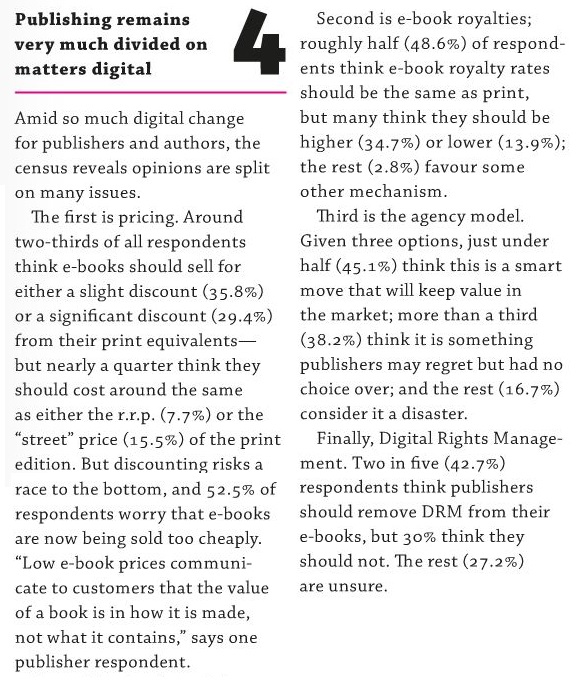
This week, we’re here to examine the fourth conclusion reached by the FutureBook editors: “Publishing,” it argues based on extensive survey data, “remains very much divided on matters digital.”  The full FutureBook publication, which is put together by The Bookseller’s Porter Anderson and Philip Jones, spells things out a bit more for us self-publishing authors:

futurebook


Division is rarely a good thing, when it comes to an emerging (but still fringe) market niche–tension between supporters of indie publishing tends to undercut our collective ability to make big gains in reaching new readers, and winning a broadened cultural acceptability.  There are some times, however, when division may be less of a “bad thing” than it is an indicator of something very, very positive: growth and market dominance.  The fact that we’re suffering from (seemingly petty) infighting over discounts shows that we’re now a force to be reckoned with–we’ve moved past being able to use words like “new” and maybe even “emerging” in reference to self-publishing.  (We’re here; we’ve emerged.  Hear us roar!)

And make no mistake, traditional publishing platforms as well as corporate giants (like Amazon) with a stake in the self-publishing game want us to keep fighting among ourselves over these things … because ultimately, if we’re fighting among ourselves we’re not fighting them.

tension

Yes, that’s right: All of these little squabbles benefit the Big Five and the Corporate Heavyweights.  Which is not to say that the concerns being fought over aren’t valid–we just can’t let them do what fights are always at risk of doing: keeping us stagnant.  If we are to remain the future-makers that The Bookseller and the FutureBook celebrate, we need to reach consensus and then act on that consensus.

And here’s some good news: We already are making progress!  In early October, 2015, a judge ruled against Apple for conspiring with the Big Five traditional publishing houses to artificially inflate e-book prices (the dividends of which were not trickling down to authors).  Prices for e-books have been climbing at least since April (although the jury’s still out on how effective these price hikes have been at increasing net profits for self-publishing authors).  More than ever before, indie authors are aligning to bring the full weight of our collective interest to bear on decisions and trends like these.


Thank you for reading!  If you have any questions, comments, suggestions, or contributions, please use the comment field below or drop us a line at selfpublishingadvice@gmail.com.  And remember to check back each Wednesday for your weekly dose of marketing musings from one indie, hybrid, and self-published author to another. ♠


KellyABOUT KELLY SCHUKNECHT: Kelly Schuknecht is the Executive Vice President of Outskirts Press. In addition to her contributions to the Outskirts Press blog at blog.outskirtspress.com, Kelly and a group of talented marketing experts offer book marketing services, support, and products to not only published Outskirts Press authors, but to all authors and professionals who are interested in marketing their books and/or careers. Learn more about Kelly on her blog, kellyschuknecht.com.

From the Archives: “‘Tis the SEASON to …”

Welcome back to our new Tuesday segment, where we’ll be revisiting some of our most popular posts from the last few years.  What’s stayed the same?  And what’s changed?  We’ll be updating you on the facts, and taking a new (and hopefully refreshing) angle on a few timeless classics of Self Publishing Advisor.

∗∗∗∗∗

[ Originally posted: December 6th, 2013 ]

‘Tis the SEASON to …

Last year I pretty much gave up shopping—well shopping in the marketing-media frenzy sense, anyway.  My passion for books—and the authors I’ve worked with—inspired me to buy their books and send them to family and friends.  I enjoyed the “holiday bargains,” of course, but much more than that, I felt as if I was passing forward the legacy of writing (and good story telling) that my self-publishing clients represent.

It was also last year that I seemed to hit a wall of mounting disappointment as I listened to the younger generations of my family and friends talking about their “exasperating,” even “frightening”, holiday shopping experiences.  A long-hidden rebellion within me grew and my fingers flew over the keyboard writing op-ed pieces to send to every daily or weekly print publisher.  I wanted to make a statement!  I wanted THE SEASON to be different!  I wanted it to be PEACEFUL!  Full of GOOD CHEER!  LOVE and LAUGHTER abounding on every block, in every city, town and nation!  However, to my own discredit, not one of my pieces was sent.  Too many last minute details derailed my fervor.  However, this season, I’m thinking of pulling out those pieces—developing them into a book—and self-publishing it in plenty of time for next year’s marketing-media-frenzy.

In the meantime, I hope you’ll join me in a taste of rebellion and allow your thoughts to stroll back to your favorite Holiday Season(s)—and WRITE about them.  Besides finding “just what you wanted” under the tree, what other memories do you see?  A favorite aunt bringing her deee-licious walnut fudge to Christmas dinner?  Your grandmother telling her version of “naughty” stories about your dad?  The next door neighbor stopping by with a handmade toy carved from oak wood just for you!

Over the years our family has enjoyed many traditions such as the youngest child placing the ceramic Baby Jesus in the manger on Christmas Eve and attending Christmas Eve church services.  One fairly new tradition in our house is watching a made-for-TV movie titled Silent Night.  This true-story, produced in 2002, stars Linda Hamilton as the German mother of a young son (age 12) who will soon be conscripted into Hitler’s army.  She takes him out of the city to a cabin in the woods—not far from “enemy” lines.  It is Christmas Eve, 1944, and unexpected guests arrive: first three American soldiers, then three German soldiers.  She demands a truce between them—for this one night.

You may be wondering why this movie?  Simple answer.  It inspired me.  This movie was created from an oral history interview with a high school student!  Her subject was Fritz Vincken, the boy in the “story,” and the one thing he remembered most about his childhood was war.  Many of us—many of our neighbors—and too many the world over hold such memories or actually live in war zones today.  I don’t want to forget that.  I don’t want to get so caught up in shopping or party-planning that I misplace my compassion for those who are hurting.  And, for me, seeing/experiencing a well-written, well-directed, well-acted movie such as Silent Night helps me hold my center; helps me appreciate the gifts I’ve been given that cannot be wrapped.

Plus, realizing that this story was developed (written/scripted) from a collection of oral histories done by high school students is exceptionally inspiring to me.  Important, vital, must-be-told stories are out there waiting for the right person to write them!  Is that YOU?

– ROYALENE DOYLE

snight1

It may only have been two years since our friend Royalene first posted this piece for us on Self Publishing Advisor, but I personally think it’s worth bringing back every Christmas.  Why?  Because storytelling is what we do, and there’s simply no more fertile ground for storytelling than the holiday season.

“Holidays bring holiday memories, and, often a sense of nostalgia for good times long gone, perhaps even loved ones long gone,” writes Wynne Parry over at LiveScience.  “This bittersweet nostalgia helps us feel connected, both around the holidays and at other times. And, it can be a salve to those suffering through hard times,” says Parry, quoting psychology professor and “nostalgia expert” Krystine Batcho, of Le Moyne College in New York.

According to Batcho, “whenever there is a major change it can be very helpful to kind of keep grounded in the sense of who you are. That sense of nostalgia helps to link you to your own personal past; it helps you remember who you have been.”  By that definition, nostalgia is both an important element to our scientific understanding of the human brain and consciousness, and an important element of the way we tell stories about ourselves and to each other.

My thoughts, as we progress into yet another holiday season, following a year of both fantastic “highs” and incredible “lows”–personally, as self-publishing authors, and simply as human beings on this planet–are as follows: We ought not to be afraid of nostalgia.  We should use the nostalgic impulse as we use all others: that is, we should allow it to spur us on in our writing, to compel us to create new things that make the most of old things.  Do the holidays–does Christmas, specifically–make you feel something?  Use that as fodder for prose.  Do the holidays leave you hungering after something more substantial or just something different in your own life?  Use that as impetus for transformation, as a writer as in all other things.

And yes, be a rebel.  If the popularity of dystopic young adult literature has taught us anything, it’s that people–our readers–are thirsty for change, to see the world move away from the sorrows and griefs and injustices that sometimes rule it.  Readers are rebels, too, and they love it when they stumble across that voice which perfectly captures the carpe diem spirit of a spirit in search of positive change.  Just as that German mother portrayed in Silent Night brought a small slice of peace and change to that cabin in the woods, you can do great things in this world.  We’re excited to see where the holiday nostalgia leads you! ♠

Silent Night (2002) with Linda Hamilton


KellyABOUT KELLY SCHUKNECHT: Kelly Schuknecht is the Executive Vice President of Outskirts Press. In addition to her contributions to the Outskirts Press blog at blog.outskirtspress.com, Kelly and a group of talented marketing experts offer book marketing services, support, and products to not only published Outskirts Press authors, but to all authors and professionals who are interested in marketing their books and/or careers. Learn more about Kelly on her blog, kellyschuknecht.com.

News From the Self-Publishing World: 11/30/15

This week in the world of self-publishing:

In this November 29th article for the Belleville News-Democrat, Teri Maddox writes from across the pond of Deborah Heal’s work.  Heal, who has self-published both what she calls the three-book “History Mystery Trilogy” and the “Rewinding Time Series” of four books, is a retired English teacher from Waterloo now fulfilling her dreams of becoming an author––and finding a great deal of success in it.  Maddox prompts her readers at BND: “Imagine being able to fire up your laptop and experience history in real time, whether at the Old Slave House near Equality or on the Trail of Tears in Golconda.”  And this is just what happens in Heal’s books, to Southern Illinois woman Merrideth Randall and her friends, “But their magic software works only when they’re visiting old homes.”  The premise is plenty interesting on its own, but what follows––Heal’s own story and route to success––is equally fascinating!  Heal isn’t content merely to use a textbook; she does her own research.  Maddox quotes Heal’s husband, Bob, as saying: “Debbie does a lot of deep research [….] The history is right. She makes up the characters, but she doesn’t fudge on the facts.”  The hard work has more than paid off; as Maddox chronicles, “More than 3,000 people have downloaded the Kindle version of ‘Time and Again’,” Heal’s first book––and now, of course, she’s making news across England for her unique approach to (religously-infused) history.  To read Maddox’s original article, follow the link.

Not every foray into self-publishing is made in the serious spirit of authors seeking self-actualization (although those forays are lovely, too).  According to Peggy Sturvidant in this November 27th piece for the Ballard News-Tribune, we have a new self-published entry into both our holiday canon and our updates-of-classic-science-fiction canon: Santa Meets Frankenstein.  The book, put out by illustrator Jan Harvey-Smith and Q13 morning meteorologist (turned author) M.J. McDermott, is shaking things up in the seasonal literature department––and raising eyebrows, in the best of all possible ways!  Says Sturvidant of McDermott, “She bubbles with the creative juices that led her into majors in drama, atmospheric sciences, and fuels her love of writing. She calls it ‘writing in the cracks,’ between work and family.” (Emphasis mine.)  What a beautiful way of expressing what so many of us indie and self-publishing authors know to be a daily reality!  And the spirit of the book, according to author and illustrator, could be considered a modern “Christmas fable, ‘for middle readers and the young at heart.'”  For more information, check out Sturvidant’s original piece!

Do you know how to find Reykjavík on a map?  Well, it’s a beautiful place and absolutely chock-full of brilliant writers––writers as diverse as Nordic Council Literature Prize winners Gyrðir Elíasson, Sjón and Einar Már Guðmundsson.  In this November 28th post to the Reykjavík Grapevine, Kári Tulinius writes a brief but to-the-point piece to all fellow Icelandic authors in search of that “next step”––and actively advocating for indie, hybrid, and self-publishing platforms while at it.  Tulinius, a poet himself, writes that “generally, if it is a good book, Icelanders do not look down on writers who self-publish […] so if you have no patience for regular publishing, go for it.”  His piece is straightforward, to-the-point, and––I think––perfectly on point for anyone (in Iceland or outside of it) looking for that final word of encouragement to pursue a non-traditional mode of publishing.

Esther Ashby-Coventry, contributor to the New Zealand-based paper The Timaru Herald, documents the self-publishing adventures of the Geraldine Writers’ Club members Edna Huber, Bernadette Joyce, Faye McGunnigle, and Judith Farley.  According to Ashby-Coventry’s November 27 article, which went on to be re-posted to the even more widely-read Stuff.co.NZ, these four women don’t think of self-publishing as “their only option,” but rather “the best option” available to first-time authors themselves.  The distinction may seem like semantics, but we happen to think this particular set of semantics is an important one!  “It’s a catch 22,” Ashby-Coventry quotes Farley as saying: “If you are not known the publisher won’t take you on but how do you get known?”  While the article closes with somewhat depressing words from HarperCollins’ New Zealand marketing manager Sandra Doakes (“It is rare to make a genuinely good living in New Zealand; a lot of authors still have day jobs.”) it doesn’t seem that the Geraldine Writers’ Club is suffering because of their decision to seek success outside of mainstream publishing.  Current members like Huber look to the example of Alice Mabin, who moved from New Zealand to Australia and whose 2014 novel, The Drover, has sold more than 21,000 copies.  “Success is not in bookshops competing with every other book,” Ashby-Coventry quotes Mabin as saying.  And that is, we think, a very wise final thought to close out this week’s news!


As a self-publishing author, you may find it helpful to stay up-to-date on the trends and news related to the self-publishing industry.This will help you make informed decisions before, during and after the self-publishing process, which will lead to a greater self-publishing experience. To help you stay current on self-publishing topics, simply visit our blog every Monday to find out the hottest news. If you have other big news to share, please comment below.

KellyABOUT KELLY SCHUKNECHT: Kelly Schuknecht is the Executive Vice President of Outskirts Press. In addition to her contributions to the Outskirts Press blog at blog.outskirtspress.com, Kelly and a group of talented marketing experts offer book marketing services, support, and products to not only published Outskirts Press authors, but to all authors and professionals who are interested in marketing their books and/or careers. Learn more about Kelly on her blog, kellyschuknecht.com.

Conversations With A Self-Publishing Writer: 11/27/2015

SEASONS Part IV


Thomas Edison once said, “The three great essentials to achieve anything worthwhile are, first, hard work; second, stick-to-itiveness; third, common sense.” This clear and truthful statement applies to every writer/author no matter what season of life we are in. If you’ve read any of my previous blogs you may remember me writing about Lois Beebe Hayna. This author of poetry, fiction, essay and gardening advice will soon be 102 years young—and she continues to write and publish her poetry.

royalene5

So how do we who are much younger (yes, if you’re 92, you are much younger) encourage ourselves to keep writing? How do we avoid looking at the winter season of our lives and write for all seasons? Here are a few quotes I’ve saved to encourage myself. I hope they will encourage you, too.

  • From Laura Ingalls Wilder, who published her first novel at the age of 65:
    • “The real things [of life] haven’t changed. It is still best to be honest and truthful; to make the most of what we have; to be happy with simple pleasures and to be cheerful and have courage when things go wrong.”
      • When my characters are arguing with me (the writer), this statement brings them in line.
  • From C.S. Lewis, author of The Chronicles of Narnia series and Screwtape Letters, who wrote until his passing at the age of 65:
    • “A pleasure is full grown only when it is remembered.” “Love is something more stern and splendid than mere kindness.”
      • The many layers of meaning within these thoughts continue to help me create authentic characters. Plus, Lewis’ life-journey and his “collection of author-friends” is an example for all authors to consider.
  • From Alice Ann Munro, a Canadian short story author who, in 2013 at the age of 82, was awarded the Nobel Prize in Literature:
    • “People are curious.…They will be driven to find things out, even trivial things.” “Always remember that when a man goes out of the room, he leaves everything in it behind… When a woman goes out she carries everything that happened in the room along with her.” “…if she let go of her grief even for a minute it would only hit her harder when she bumped into it again.”
      • These statements give me even deeper insights into the creation of characters and the circumstances that can be written for them—the corners to back them into.


After Munro received her Nobel Prize, the Swedish Academy applauded her as the “master of the contemporary short story.” When asked about that statement, she gave writers further encouragement: “I would really hope that this would make people see the short story as an important art, not just something that you played around with until you’d got a novel written.”

So it is that in closing this month’s series of Blogs on Seasons, I hope you’ve been inspired in your own writing life. Being a writer is part of our DNA and becoming the best writer we can be is a life-long process—a process that leads us to be published authors at a variety of steps along the way. ⚓︎

RoyaleneABOUT ROYALENE DOYLE: Royalene has been writing something since before kindergarten days and continues to love the process. Through her small business—DOYLE WRITING SERVICES—she brings more than 40 years of writing experience to authors who need “just a little assistance” with completing their projects. This is a nice fit as she develops these blogs for Outskirts Press (OP) a leading self-publisher, and occasionally accepts a ghostwriting project from one of their clients. Her recent book release (with OP) titled FIREPROOF PROVERBS, A Writer’s Study of Words, is already receiving excellent reviews including several professional writer’s endorsements given on the book’s back cover.  

Royalene’s writing experience grew through a wide variety of positions from Office Manager and Administrative Assistant to Teacher of Literature and Advanced Writing courses and editor/writer for an International Christian ministry. Her willingness to listen to struggling authors, learn their goals and expectations and discern their writing voice has brought many manuscripts into the published books arena.