Conversations: 11/11/2016

FEEDING THE HUMAN SPIRIT and IMAGINATION

I had barely completed last week’s blog—which focused on True-Story-Real-Life nonfiction—when I recalled a marvelous novel that has continued to feed my spirit and imagination for years. It comes from the genre of fictionalized history (or True Stories that read like fiction). The title is The Scarlet Pimpernel of the Vatican, first published in 1967 by J. P. Gallagher. Even though it is a true story  this book crosses multiple genres from Biography to Social Issues and The Vatican/Christianity. It also has all the hallmarks of a best-selling fictional thriller: espionage, conspiracy, a struggle against evil powers, and undercover work by dark of night. The author presented the story of it all and because of his passion for the real characters and his research into the facts, this novel has inspired the human spirit and imagination around the globe. When a nonfiction (or fiction) book leaves the Reader with “What if I were in that situation” the author has crafted a great piece of work!

Now back to my original idea for today’s blog. I have another high tails of high adventure karl kronfussfavorite category that nurtures my human spirit and that is stories about our animal companions. Yes, these pull on my heart-strings. But that is an excellent marketing tool that authors should not
underestimate. My most recent discovery in this genre is titled: High Trails of High Adventure by Karl Kronfuss. When I saw a promotion that this book is “Snappy satire that meets swashbuckling bravado…and leave you laughing with a new appreciation of the wondrous creature known as The Pug,” I had to take a look. The cover photo opens the “plot” in ways that I could never have imagined—with several moments that lift the human spirit.

Why am I talking about Pet Stories? Publishers Weekly gave us an interesting statistic in January 2015 presenting the fact that Animal Stories rose in sales by 19% in the 2013-14 publishing year. Example: the New York Times Bestseller, A Street Cat Named Bob. This stray cat story was on England’s bestseller lists for 52 consecutive weeks and sold well in 26 countries around the world. You see, there is something almost miraculous about the power of love between humans and animals. The connection lifts our human spirits and peaks our imagination as we personify the thoughts and actions of the animal companions in our lives. Mac The Pug is seen as a “diplomat, a conqueror of all he sees with towering intelligence, athletic prowess and undaunted courage.” Bob, the stray street cat, was just looking for a warm place to sleep when he met the human named James. Both had been living hand-to-mouth for a long time. Then the healing began—in both their lives.

I’m hoping you’ll catch the vision of these very different genres and their authors. The character traits they built into their humans and animals are an excellent way to pull our writing-selves out of the ruts or blockades we face when creating our books. I’m certain you can recall several such novelized histories and/or pet stories that have impacted your life. Pull them out and read them again. Use them as enjoyable lesson plans for excellent story development. And remember—the things you are passionate about have meaning in the lives of a whole lot of other people who don’t have the gift of writing that you do. They can’t express what they see and feel, and hope and dream. You can! And if you need more plot and character development specifics take another look at previous Friday Conversations blogs. They’ve been written to inspire your Writer’s spirit and imagination. ⚓︎


Royalene

ABOUT ROYALENE DOYLE: Royalene has been writing something since before kindergarten days and continues to love the process. Through her small business—DOYLE WRITING SERVICES—she brings more than 40 years of writing experience to authors who need “just a little assistance” with completing their projects. This is a nice fit as she develops these blogs for Outskirts Press (OP) a leading self-publisher, and occasionally accepts a ghostwriting project from one of their clients. Her recent book release (with OP) titled FIREPROOF PROVERBS, A Writer’s Study of Words, is already receiving excellent reviews including several professional writer’s endorsements given on the book’s back cover.  

Royalene’s writing experience grew through a wide variety of positions from Office Manager and Administrative Assistant to Teacher of Literature and Advanced Writing courses and editor/writer for an International Christian ministry. Her willingness to listen to struggling authors, learn their goals and expectations and discern their writing voice has brought many manuscripts into the published books arena.

In Your Corner: Making Your Presence Felt

It would be hard to get to 2016 and not feel convicted of the importance of social media in selling books–and, just as importantly, in selling readers on you, the author. The power and influence of social media is uncontested–after all, it has helped feed and foment revolutions in the Middle East, toppling dictators and spinning the mythological webs that create internet celebrities. They have also, demonstrably, created the framework by which self-published authors become self-sufficient and successful. Authors like Lisa Genova (Still Alice) and Hugh Howey (Wool) often credit their devoted social media fanbase for moving their books out of obscurity and into the blockbuster realm.

With that kind of a recommendation on the table, it almost seems a waste to not partake in the wave of social media platforms developing today, right? But wanting to start developing your social media strategy and actually building it from the ground up are two separate propositions. And ultimately, it’s hard to know where to start.

Luckily, there’s not so much one way to get it wrong, but rather so many ways to get it right. This is because there are so many platforms out there, including:

And so many more! Because social media is a moving target–for example, the short-video-hosting platform Vine, owned by Twitter, was shut down recently for its inability to turn a profit for company shareholders–there’s no predicting which platforms will be on the ascent in a given year and which will be on its way out, like the age-old example of Myspace, a platform which more or less lost all of its users once Facebook became peoples’ primary conduit of digital social contact.

This changing landscape isn’t a bad thing, in the end. It’s a strength! It means that yes, you need to be willing to continually adapt to new platforms and to pick up new skills, but it also means that if you’re not all that good at one, you can always capture your readers by making a comprehensive social media presence, rounded out with a variety of different smaller presences that weave together into something greater than the sum of their parts.

I guess what I’m saying is: Try everything. Try everything, and don’t hold on too tightly to any one of those things. Experimentation is the mother of invention, as is necessity, and these two forces will keep your social media presence in a constant state of evolution, well-suited to the M.O. of the Internet itself. Maybe soon we’ll have options to network not just with our friends and our refrigerators, but with our books as active participants themselves. Can you imagine what that might look like? I’d bet you five dollars that someone out there is already figuring out how to make it happen. And that’s the wonderful thing about change: it’s wild and wonderful and asks very little of us except the will to keep up!

You are not alone. ♣︎


Elizabeth

ABOUT ELIZABETH JAVOR: With over 18 years of experience in sales and management, Elizabeth Javor works as the Manager of Author Services for Outskirts Press. The Author Services Department is composed of knowledgeable publishing consultants, pre-production specialists, customer service reps and book marketing specialists; together, they all focus on educating authors on the self-publishing process to help them publish the book of their dreams. Whether you are a professional looking to take your career to the next level with platform-driven non-fiction or a novelist seeking fame, fortune, and/or personal fulfillment, Elizabeth Javor can put you on the right path.

Ringing in the Holidays: Thanksgiving Edition!

This Thanksgiving when you’re preparing to gather with family and friends, tummies longing for turkey and pie, you are most likely looking into recipes to satisfy those appetites. You may be collecting ingredients such as pecans, canned pumpkin, potatoes, gravy, or big birds. You don’t want anyone leaving your home hungry and you sure don’t want to show up to any one else’s home empty handed.

These same preparations and considerations should also be taken if you’re planning on staging any events this holiday season. Book readings also have a list of crucial ingredients that will ensure success in the form of a satisfied audience. A gathering for your audience should receive the same care and attention that a gathering for your family would, especially if your audience includes your family.

Just like any recipe, there are a few ingredients that can’t be substituted for anything else. Without them, you won’t be making much of anything. One of these ingredients is a location. A space that can both accommodate your audience and also set the mood for your event is fundamental. Don’t be afraid to utilize this holiday–which gathers those closest to us in a warm and welcoming space–to read some short snippet or your work aloud. Insert it before the meal when people say grace or express gratitude for food and family.

thanksgiving table

This brings me to another essential ingredient: an audience. Self-promotion of your event is essential, without it, don’t expect a crowd. While reading to yourself in front of the mirror is always good practice, it’s no substitute for the ears of others. Our books aren’t written for ourselves, but to share with others. Consider showing your gratitude for your family this Thanksgiving by sharing copies of your work with them.

Sharing your work implies another essential ingredient: books. This is another no-brainer. Make sure you have copies of your book to provide to those who have been inspired enough by your reading that they want to see more. If this means simply giving them away on the holiday or ordering copies for an upcoming event you have planned, always make sure at least enough on hand to supply your demand. If Thanksgiving has anything to teach us, it is that leftovers are never a bad thing.

In short, we all know we put in more time during the holidays making sure our homes look nicer for our mother-in-law’s approval and we make sure we have bountiful supplies of food to feed our nephew’s with bottomless guts. You perform the task of host during the holidays. This performance can teach us a lot about what makes a successful authorial performance. You want people who feel satisfied after they’ve received your offerings–be them of food or words–and it’d be ideal if they took home some leftovers–be them from your refrigerators or libraries.


Thank you for reading!  If you have any questions, comments, suggestions, or contributions, please use the comment field below or drop us a line at selfpublishingadvice@gmail.com.  And remember to check back each Wednesday for your weekly dose of marketing musings from one indie, hybrid, and self-published author to another. ♠


Kelly

ABOUT KELLY SCHUKNECHT: Kelly Schuknecht is the Executive Vice President of Outskirts Press. In addition to her contributions to the Outskirts Press blog at blog.outskirtspress.com, Kelly and a group of talented marketing experts offer book marketing services, support, and products to not only published Outskirts Press authors, but to all authors and professionals who are interested in marketing their books and/or careers. Learn more about Kelly on her blog, kellyschuknecht.com

From the Archives: “4 Things NaNoWriMo Authors Should Never Do”

Welcome back to our Tuesday segment, where we’ll be revisiting some of our most popular posts from the last few years.  What’s stayed the same?  And what’s changed?  We’ll be updating you on the facts, and taking a new (and hopefully refreshing) angle on a few timeless classics of Self Publishing Advisor.

∗∗∗∗∗

[ Originally posted: November 7th, 2012 ]

It’s hard to believe the first week of NanoWriMo is behind us already! How are you doing so far? I hope you are enjoying the challenge and that your manuscript is coming along. As you’ve been writing your draft, you may have noticed that it is easy to get distracted or discouraged, but a few simple changes can help you succeed. Here are four things you should never do if you want to finish NaNoWriMo (and maybe even self publish your book someday).

1. Skip a writing session. Unless it is an emergency, you must always stick to your writing schedule. If you must miss a writing session for an important reason, make sure you reschedule it. Ideally, you should reschedule it for another time that day or week. You don’t want to have to play catch up at the end of the challenge because you missed too many writing sessions.

2. Become jealous. Connecting with other writers is a great a way to find encouragement and inspiration during NaNoWriMo, but don’t let their progress discourage you. Some people write faster or have more time to commit. Try not to compare word counts. Focus on your success, and trust that your approach to writing is best for you.

3. Worry about editing. As you write your first draft, it is tempting to think about all the things you need to go back and fix. You should not be worrying about editing right now. You need to focus on writing. There will be plenty of time to worry about editing later. If the thought of editing really discourages you, treat yourself to professional editing services  after you achieve your goal.

4. Give up. There will be days when you become frustrated and consider giving up. Don’t do it! You can and will succeed as long as you keep trying. If you need some motivation, talk to people who believe in you, read about other successful authors, or take some time to relax and come back refreshed.

Remember, your goal isn’t just writing 50,000 words this month. Your ultimate goal is to write a novel (and self publish it). That goal takes time, dedication, and possibly hundreds of cups of coffee, but it is an achievable goal. Stay focused and trust yourself, and you will succeed.

I’d love to know, what habits are interfering with your NaNoWriMo goals?

– by Kelly Schuknecht


nanowrimo

This post goes live the first day of the second week of NaNoWriMo, and I’m willing to bet that those of you who have decided to participate this year are beginning to find the cold hard facts of extended writing sessions unbearable. Or, perhaps, you’re the opposite: you feed on pressure, and deadlines. But no matter where you’re at and what perspective you take of NaNoWriMo—participant or abstainer—one thing certainly remains true:

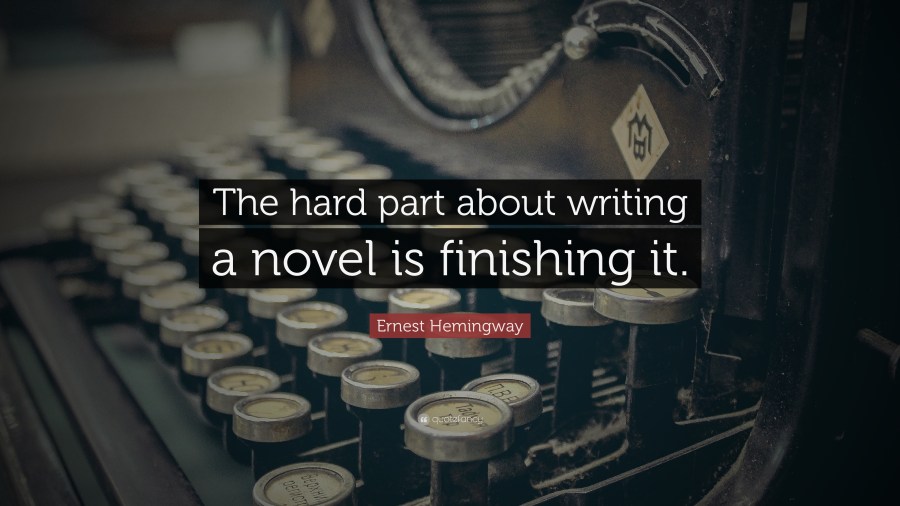
Writing is Hard.

If you need any proof, just look at what some of our most respected writers have to say on the matter:

And:
writing is hard ernest hemingway

No literary blog is complete without a reference to Ernest Hemingway, right?

My point isn’t to make you feel depressed over the inevitability of struggles cropping up during NaNoWriMo and all other writing projects, but instead to remind you that even the great All Stars of creative writing face the same challenges, and they struggled too. Which means that you’re not doing anything wrong, even if the worst happens and you make one of the four mistakes I first wrote about back in 2012.

There is always a way forward, and we’re here to help you find it! Clue us in on where you’re at with NaNoWriMo and your other projects, and we’ll pull out all the stops to find you resources, advice, and those tangible actionable ways forward!

Thanks for reading.  If you have any other ideas, I’d love to hear them.  Drop me a line in the comments section below and I’ll respond as quickly as I can.  ♠


Kelly

ABOUT KELLY SCHUKNECHT: Kelly Schuknecht is the Executive Vice President of Outskirts Press. In addition to her contributions to the Outskirts Press blog at blog.outskirtspress.com, Kelly and a group of talented marketing experts offer book marketing services, support, and products to not only published Outskirts Press authors, but to all authors and professionals who are interested in marketing their books and/or careers. Learn more about Kelly on her blog, kellyschuknecht.com.

Self-Publishing News: 11.7.2016

And now for the news!

This week in the world of self-publishing:

This week, hear the stories of authors who have chosen self-publishing. From Veronica R. Wells who wanted to share the story of her grandmother’s life to various horror authors who were fed up with being turned down by traditional publishing companies, find out why self-publishing provides something unique for varying authors. After reading those stories, the last article on the rise of self-publishing as an industry will perhaps come as no surprise to you.

Self-publishing isn’t the easiest avenue for publishing a book, that we all know, but this delightful interview with Veronica R. Wells sheds light on why the challenges presented by self-publishing are worthwhile. Wells says, “I had more control, freedom and autonomy in how and when the book came out.” She admits that those freedoms also meant “the very necessary and expensive process of promoting this book, fell on my shoulders.” However, Veronica had a story that she felt compelled to tell: the story of her grandmother’s struggles, dysfunctions, encounters with abuse, etc. Through writing this story, she realized that this was a story not particular to her family, but something shared by women everywhere. Wells wasn’t concerned with having her first book be the picture of perfection, she encourages authors to dive in head first. The lessons she learned and her to impact her audience were well worth the anxieties and stresses of publishing the book on her own. Having a full time job wasn’t something that Wells let get in the way of her writing or of her self-publishing efforts. I would be surprised if her story doesn’t inspire you to try and do the same. Wells doesn’t sugarcoat the process, she admits that “the psychological challenges were probably the greatest and hardest to overcome.” She insists that we quiet the voices of doubt and distraction, something I think we all need to be reminded of from time to time.

So if you’re anything like me, you’re a stranger to all the subgenres of horror fiction, which apparently range from “supernatural horror, postapocalyptic horror, fantasy horror, sci-fi horror, comedy horror, and then all the vampire, werewolf, and zombie horror.” If you haven’t heard of or read any books that fit under those headings, you won’t be shocking any horror authors. Horror authors have begun to perceive themselves as the misfits of the authorial world, after receiving all too many rejections from traditional publishing companies. As Joe Schwartz, horror author, says, “The odds of getting someone substantial to publish your work when you’re basically just getting started are less than awful.” This band of merry misfits has turned to self-publishing after not being able to make it into traditional presses. They’ve made this turn knowing that they wouldn’t be slaying as salesmen, but these “obsessive authors” are committed to their “rabid, but small, fan bases.” Hear the thoughts and opinions of many of these dedicated authors who have turned to self-publishing after rejection, only to realize self-publishing was the route they should’ve taken first and foremost. Horror author Jason S. Ridler says, “I’m not aggressively promoting, and I don’t care about being a rock star bestselling author. The time I have left on this planet has to be spent doing things I care about. Relentless promotion and book tours aren’t bad things, but I’d rather spend time being better as a writer.” Ridler’s message is an important one, don’t let rejection or fear of not being able to promote your book stop you from doing what you love.

Self-publishing companies, such as Boss of Me, are noticing a rise in customers which they attribute to an increasingly educated population combined with the ease of self-publishing and the autonomy it provides authors over the finished product. This low-cost alternative ensures that the majority of the profits go to the authors directly, rather than to the publishing company. According to Mr. Goh of Rank Books, it is not only an increase in profits that self-published authors can expect, but also a lower initial investment. Mr. Goh says, “Previously, a minimum run of 500 books would cost at least $3,000 to print. Now, a minimum run of 50 costs just $1,288, making it easier on the wallet for self-publishing authors.” Considering that some authors don’t have commercial interests with their books, this cutting of costs can be a big incentive to go for the DIY approach of publishing. If self-expression is your main motivation, or if you happen to be someone who is writing a book just to give to family and friends, then self-publishing is probably the route you should take, and this article clearly and succinctly explains why that is.


spa-news

As a self-publishing author, you may find it helpful to stay up-to-date on the trends and news related to the self-publishing industry. This will help you make informed decisions before, during and after the self-publishing process, which will lead to a greater self-publishing experience. To help you stay current on self-publishing topics, simply visit our blog every Monday to find out the hottest news. If you have other big news to share, please comment below.


Kelly

ABOUT KELLY SCHUKNECHT: Kelly Schuknecht is the Executive Vice President of Outskirts Press. In addition to her contributions to the Outskirts Press blog at blog.outskirtspress.com, Kelly and a group of talented marketing experts offer book marketing services, support, and products to not only published Outskirts Press authors, but to all authors and professionals who are interested in marketing their books and/or careers. Learn more about Kelly on her blog, kellyschuknecht.com.