This Thanksgiving when you’re preparing to gather with family and friends, tummies longing for turkey and pie, you are most likely looking into recipes to satisfy those appetites. You may be collecting ingredients such as pecans, canned pumpkin, potatoes, gravy, or big birds. You don’t want anyone leaving your home hungry and you sure don’t want to show up to any one else’s home empty handed.
These same preparations and considerations should also be taken if you’re planning on staging any events this holiday season. Book readings also have a list of crucial ingredients that will ensure success in the form of a satisfied audience. A gathering for your audience should receive the same care and attention that a gathering for your family would, especially if your audience includes your family.
Just like any recipe, there are a few ingredients that can’t be substituted for anything else. Without them, you won’t be making much of anything. One of these ingredients is a location. A space that can both accommodate your audience and also set the mood for your event is fundamental. Don’t be afraid to utilize this holiday–which gathers those closest to us in a warm and welcoming space–to read some short snippet or your work aloud. Insert it before the meal when people say grace or express gratitude for food and family.
This brings me to another essential ingredient: an audience. Self-promotion of your event is essential, without it, don’t expect a crowd. While reading to yourself in front of the mirror is always good practice, it’s no substitute for the ears of others. Our books aren’t written for ourselves, but to share with others. Consider showing your gratitude for your family this Thanksgiving by sharing copies of your work with them.
Sharing your work implies another essential ingredient: books. This is another no-brainer. Make sure you have copies of your book to provide to those who have been inspired enough by your reading that they want to see more. If this means simply giving them away on the holiday or ordering copies for an upcoming event you have planned, always make sure at least enough on hand to supply your demand. If Thanksgiving has anything to teach us, it is that leftovers are never a bad thing.
In short, we all know we put in more time during the holidays making sure our homes look nicer for our mother-in-law’s approval and we make sure we have bountiful supplies of food to feed our nephew’s with bottomless guts. You perform the task of host during the holidays. This performance can teach us a lot about what makes a successful authorial performance. You want people who feel satisfied after they’ve received your offerings–be them of food or words–and it’d be ideal if they took home some leftovers–be them from your refrigerators or libraries.
Thank you for reading! If you have any questions, comments, suggestions, or contributions, please use the comment field below or drop us a line at selfpublishingadvice@gmail.com. And remember to check back each Wednesday for your weekly dose of marketing musings from one indie, hybrid, and self-published author to another. ♠
ABOUT KELLY SCHUKNECHT: Kelly Schuknecht is the Executive Vice President of Outskirts Press. In addition to her contributions to the Outskirts Press blog at blog.outskirtspress.com, Kelly and a group of talented marketing experts offer book marketing services, support, and products to not only published Outskirts Press authors, but to all authors and professionals who are interested in marketing their books and/or careers. Learn more about Kelly on her blog, kellyschuknecht.com
Why am I thankful for self-publishing? Let me count the ways!
I’m thankful because I don’t have to wait for an agent to read and accept my next book. We just need to write a book in order for that book to exist out there in the world and be read by others!
I’m thankful because I get to keep my rights and royalties. In a competitive market, this gives us both a leg up over authors who are published through traditional forms and processes, and a leg up on an industry that constantly seeks to inflate the profit margin for the publisher or film house–at the expense of ideas and the author at the heart of it all.
I’m thankful because I will maintain control over every aspect of my book that I want to, and I have a whole host of options to turn to (including my own employer, Outskirts Press) if there are aspects I don’t want to control.
I’m thankful for more flexibility. We get to work from home, on our own timeline, meeting our own personal goals and performing according to our own expectations–and not racing to constantly measure up to someone else’s designs, or match our schedules with someone else’s calendar.
I’m thankful that we don’t live in fear of progress, but rather surf the cutting edge of the digital and silicon revolutions. We are innovators, ambitious dreamers who make change happen and get stuff done. Right now we self-publishers are masters of the ebook, including the e-audiobook. What’s next? We’ll figure it out. And we’ll embrace it, I guarantee you, before anyone else in the publishing world.
I’m thankful that as a part of my job I get to help others sidestep the “information gatekeepers” who have historically limited access to publication for reasons to do with bias, influence over the industry, and profit. When has a small group of people determining the parameters of another, larger group of peoples’ lives ever turned out well? Vive la révolution! The more voices we hear, the more lives we witness, the more we know of the world and the way other minds work, the better we can live as individuals and a collective whole. I really believe that.
I’m thankful that this has been a big year for breakthroughs in terms of mainstream recognition and presence. Ridley Scott’s adaptation of self-publishing superstar Andy Weir’s The Martian is still rocking the box office. A film adaptation of Lisa Genova’s Still Alice received its wide release this year, too, and walked away with an Oscar, a BAFTA, a Golden Globe, and a Screen Actors Guild Award (among others). And that’s just two of many self-published works that have been adapted for the big screen (and television) this year–a great litmus test and indicator of mainstream success. Countless other self-published books have seen more moderate success, too, and the indie industry is as a whole seeing diversification and stabilization.
And lastly, it wouldn’t be Thanksgiving if I didn’t mention one of my greatest joys: the indie, hybrid, and self-publishing authors that I work with day and day out throughout the year at Outskirts Press. As a company, we are so very thankful for the authors that have made us a leading self-publisher in an energetic and ever-expanding market. We never tire of learning how we have helped authors realize their dreams, how we have helped author after author to put their ideas and words into beautifully bound books to be enjoyed by others. You inspire us to better ourselves every day. You inspire me to believe in the power of the written word, and in the power of helping others sound their voices throughout the world.
I hope that you have a splendid Thanksgiving Day today. As it is at all other times of year, it’s important to remember one simple fact this holiday season: You’re not alone. ♣︎
ABOUT ELIZABETH JAVOR: With over 18 years of experience in sales and management, Elizabeth Javor works as the Manager of Author Services for Outskirts Press. The Author Services Department is composed of knowledgeable publishing consultants, pre-production specialists, customer service reps and book marketing specialists; together, they all focus on educating authors on the self-publishing process to help them publish the book of their dreams. Whether you are a professional looking to take your career to the next level with platform-driven non-fiction or a novelist seeking fame, fortune, and/or personal fulfillment, Elizabeth Javor can put you on the right path.
There are a lot of reasons why looking to the past for role models can be problematic, particularly (in our case) when looking for legendary figures for us to admire as self-publishing authors.For one thing, the world simply looked … well, different back then.Whether we’re talking about Gutenberg and the Fourteenth Century or Austen, Dumas, Thoreau, and Potter in the Eighteenth, Nineteenth, and Twentieth centuries, we must admit that the everyday fabric of human existence has been altered––and therefore, the nature and appearance of the publishing industry.Calling certain (late & great) authors “self-published” is unlikely to do justice to the whole picture.
But let’s take a second to look at those points, two per author, which I plucked from each (late & great) author’s life story and publishing history.
—
From Johannes Gutenberg, we learned to:
Use the tools at hand, and use them well, but don’t become shackled to any existing paradigm.
Pay attention to the market; listen to both your readers’ needs and those of your own practical enterprise.
From Jane Austen, we learned to:
Adapt as you go.
Use what you have.
From Alexandre Dumas, we learned to:
Own it.Bring it.Fight for your place in the sun.
Flee to Belgium when you need to.
From Henry David Thoreau, we learned:
Optimism is a discipline, not a fragile state to be moved through and discarded.
We must write what we feel compelled to write.
And (last but not least) from Beatrix Potter, we learned to:
Not let others change you without your permission.
Keep it relational.
—
Are these points still valid, when pulled out of context?Factually, I think they are.They may sound a bit like lines from the latest cheer squad movie, or chapter titles from a self-help book, and I’m okay with that.Because you know what?We can all do with a little direction, and a little encouragement.(I’m most definitely the proof in the pudding.And of course, I’m *completely* objective about my own opinings, right?)
Loosely, these ten points fall into one-word attributes: flexibility, attentiveness, adaptability, pragmatism, determination, forgiveness, optimism, fidelity, authenticity, and relationality.These qualities are timeless; they will always, always, workin your favor as a self-published (or self-publishing) author.No matter what century you’re born into.
Of course, when it comes to interpreting the past, any decent scholar and historian can tell you that the act of interpretation says far more about the interpreter than the interpreted.It tells us what we need, rather than what really happened.(It might also show us what “really happened,” but that’s secondary and beside the point.)So I suppose this list tells you what I, specifically, need to hear when it comes to icons of self-publishing––and, more broadly, what the culture that produced and sustains me probably also needs to hear.
The point of looking back is to look forward, with a clarity of vision and insightfulness of spirit.Each and every one of the five authors I have examined over the last five weeks was human, and therefore not always liable to be warm and fuzzy when dispensing with advice for other and future authors, but they were also rather generous and kind to those they knew would pick up the torch of literary ambition.They each would want you to persevere, to exercise wisdom, and above all, to write.
And of course, to see your writing through, from beginning to end––dream to publication.
This concludes my series on the Late Greats of self-publishing! If you have any comments, reflections, or suggestions for future series, I’d love to hear them. Drop me a line in the comments box, and watch this space on Wednesdays in 2015!
ABOUT KELLY SCHUKNECHT: Kelly Schuknecht is the Executive Vice President of Outskirts Press. In addition to her contributions to the Outskirts Press blog at blog.outskirtspress.com, Kelly and a group of talented marketing experts offer book marketing services, support, and products to not only published Outskirts Press authors, but to all authors and professionals who are interested in marketing their books and/or careers. Learn more about Kelly on her blog, kellyschuknecht.com.
Sometimes, the fiercest battles are fought over the sweetest of rabbits.
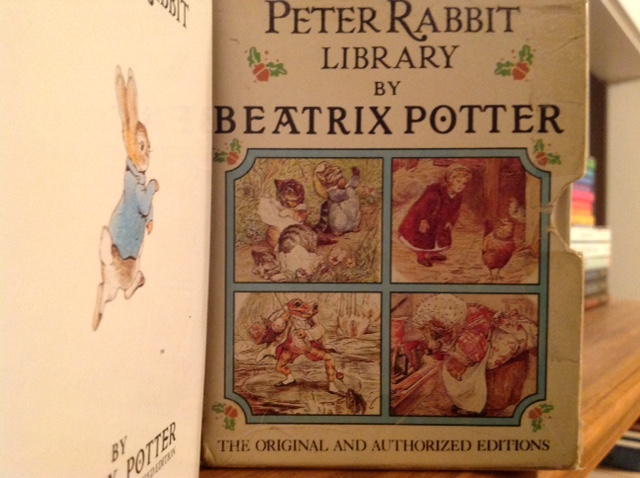
Ah––and there you have it, my fifth and final late great champion of the self-published or otherwise non-traditional author: Beatrix Potter. A titan in the world of children’s books, Potter’s hand-illustrated flights of fancy have found their way into the homes of millions––millions––of readers. The Tale of Peter Rabbit alone has sold over 45 million copies and been translated into dozens of languages*––and it all started as a quiet private venture, financed by Potter herself.
Beatrix Potter’s legacy is a rich one. She was a rather wealthy heiress, and waited until 47 to marry––a radical choice for the time. She was also a dedicated, if amateur, environmentalist. Mostly, today we remember her for her books, but we also remember her for her mammoth lifetime work of preservation; it is in large part because of Beatrix Potter, and her dual income as both an heiress and a successful children’s book author, that we have England’s Lake District National Park.
While we know her mostly for the products of her lifetime labors, I might suggest that we remember more than just the books themselves, but also the place which they occupied in Potter’s life. As both author and illustrator, she was responsible for more than just the text on the page; she was responsible for its artistic direction, and in many ways, its actual production. And then there’s the small matter of financing; while her later books were picked up rather quickly, Potter had first to overcome extreme prejudices against both her gender (women were discouraged from involvement in the business side of publishing, at the time) and her vision for the book (which was exacting, down to the page number, the types and quantity of illustrations, and the physical dimensions of the page). She operated in somewhat of a vacuum, without the enormous mechanism of the picture book industry as it exists today.
And yet, she persisted. With a little help and quite a lot of her own money, Potter printed 250 copies of The Tale of Peter Rabbit, produced to her exact specifications. The book was so popular that within a year, she was approached by one of the publishing companies who had turned her down and forced her into self-publication. By the time of her death in 1943, she had radically reshaped the author/publisher relationship––rather luckily for us, in the here and now––into something much more like a partnership than it had been. There are manifold lessons we can learn from Miss Potter, but here are the two that rise to the top:
Don’t let others change you without your permission. The publishing companies that Potter attempted to sell The Tale of Peter Rabbit to had plenty of suggestions on how she could make the book better––or rather, more salable. They suggested she cut down on the number of illustrations, and alter the book’s size and the number of pages. She stuck by her guns, self-published her book, and later of course history has proven that her vision for children’s book was the future of the industry. You too must stick by your guns, when it comes to the fundamental elements of your book that make it, well, yours. This isn’t to say you shouldn’t listen and internalize the suggestions of others––specifically, publishers––but remember, they’re in the market to sell books and make a profit (or as many companies might say, to recover their investments). A self-publisher chooses to cover those initial expenditures, and retain the work intact. That’s both a radical and rewarding idea. The danger for self-publishers is just as great, however, when it comes to finding themselves on the firing line for making bold (or distinctive) artistic, aesthetic, or other content-related choices. You’ll receive a lot of advice. It’s important to give yourself permission to not follow those suggestions that lead you away from your own vision.
Keep it relational. Potter wrote The Tale of Peter Rabbit for an acquaintance’s sick child, and published it because she felt that the scope of the book might touch the lives of others. She was briefly engaged to one of her eventual publishers at F. Warne & Co., (Norman), who died of leukemia less than a month after they announced their engagement––but she stayed with that publisher afterwards, and even left her collected manuscripts and so forth in trust to them after her death. Which is to say: she found her people and built a lasting legacy with them, one that continues to bear fruit, generations later. (The 1989 edition of her Peter Rabbit collection sitting on my bookshelf is proof of that.) She didn’t just write to write, or publish to publish; she wrote and published in partnership, in response to, or conversation with, the lives of others. They enabled her to write more of what she wanted to write, and that’s not always an easy groove for a writer (or illustrator) to fall into. We all know that self-publishing can be an exhausting experience, and it’s easy to find yourself carrying the burden of responsibility alone. In the spirit of Beatrix Potter, I encourage you to find your people. Find those kindred spirits, whether fellow self-publishers or lay editors or bloggers or random accidental acquaintances (we’re here for you, I promise), and let them engage with you as a writer and as a person. You don’t need to go through this process alone.
This is the last author in my current series (previous authors have included Johannes Gutenberg, Alexandre Dumas, Jane Austen, and Henry David Thoreau). Check back next week as I wind up the series by recapping the ‘greatest hits’ of self-publishing inspiration, so to speak, that these authors have provided! And then––in two week’s time––drop on by as I launch into a new series!
If you have any comments, reflections, or suggestions, I’d love to hear them. Drop me a line in the comments box, and watch this space on Wednesdays in 2015!
ABOUT KELLY SCHUKNECHT: Kelly Schuknecht is the Executive Vice President of Outskirts Press. In addition to her contributions to the Outskirts Press blog at blog.outskirtspress.com, Kelly and a group of talented marketing experts offer book marketing services, support, and products to not only published Outskirts Press authors, but to all authors and professionals who are interested in marketing their books and/or careers. Learn more about Kelly on her blog, kellyschuknecht.com.
This morning marks the fourth installation and therefore the fourth author in my ‘late greats’ series.I’ve already examined the lives of Johannes Gutenberg (b. ca 1390), Jane Austen (b. 1775), and Alexandre Dumas (b. 1824), with a specific eye for the ways in which these authors do or do not conform to the archetype of the self-published author, and an ear for lessons they have to teach us in the current world of self-publishing.
This week, I want to examine someone a little more … controversial.A lot of names get thrown around in the self-publishing world as antecedents for us to look up to, glittering stars on the horizon that prove it can be done, it will be done, and thou shalt do it too—but often, it seems as though we play a little too fast and loose with the facts in an attempt to provide a sense of solidarity and affirmation.(And indeed, the knowledge that one’s favorite author or authors have gone through the same struggles can be a powerful incentive to carry on.)You might not, then, be surprised to find out that the case of Henry David Thoreau (b. 1817) has provoked claims that he is both the prototypical self-published author—and that he is no such thing at all, but rather an incredibly mainstream example of the traditionally published author.
Thoreau, circa 1856
Unfortunately, we’re unlikely to clear up the matter, even with all of the facts in hand.Thoreau’s earliest publications were comprised of a motley mess of short pieces, of which some were published (anonymously) in respected print journals and some were (sort-of?) self-published in Dial, a local Concordian Transcendentalist journal with only two editors, of which he was one.For the majority of his life, he was known mostly for his impassioned speech in defense of the violent abolitionist John Brown—and for his equally impassioned delivery of “Slavery in Massechusetts” at a rally in Framingham.He then published a whole clutch of articles and essays and books around the same time, of which he self-financed at least one (A Week on the Concord and Merrimack Rivers).But the waters are muddied when it comes to public lectures and rally speeches: where do they fit on the Traditional vs. Self-Published spectrum?We may never have a definitive answer to that question.
At the site of Walden Pond (courtesy of Wikipedia)
So if the waters are muddied, what can we learn from Thoreau?I have two primary takeaways from the Thoreauvian saga, both of which I hope embody the spirit of his work as much as the fact:
1) Optimism is a discipline, not a fragile state to be moved through and discarded.“There is an incessant influx of novelty into the world,” wrote Thoreau in his conclusion to Walden, “and yet we tolerate incredible dulness.”His primary interest—or rather the locus of this particular chapter—was political in nature, but what element of life isn’t?(In some small way, at least.)And yet for Thoreau, admitting the nature of politics and even our stagnant investment in politics was not a cause for ultimate despair.Invoking his own amazement, he writes also that “We do not believe that a tide rises and falls behind every man which can float the British Empire like a chip, if he should ever harbor it in his mind.”The implication being, of course, that such a tide does indeed rise and fall—in you.I don’t know about you, but I can’t quite resist such a potent call to arms!
To be clear, Thoreau didn’t equate optimism with naïveté or ignorance.It was a virtue to be cultivated, as a mental and physical and even spiritual posture.He wasn’t a success by worldly standards, particularly as a writer, and he knew it.But instead of succumbing to a broken system with its equally broken standards of success, he chose to reframe and redefine both system and standard.He operated on the assumption that humanity is a force of nature, and that we therefore have the agency to invest our choices with meaning.That sounds about right to me.
2) We must write what we feel compelled to write.Thoreau didn’t believe in catering to trends, or to any external systemic expectations.This isn’t to say he endorsed opposing every element of the system simply to oppose it; but he did believe in acting according to individual conscience (“…I am as desirous of being a good neighbor as I am of being a bad subject…”), in questioning everything (and I mean everything), and in seeking out a richly textured life.
Our interests may indeed align with those that have reached critical mass at the popular level—which currently includes Young Adult literature, dystopias, romance, and a number of other genres—or they may not.We must allow ourselves the opportunity to color in and outside of the lines—and live in fervent belief that we define the framework of our own success (as self-published authors, among other things).This is Thoreau’s legacy, as muddled of a self-publishing icon as he may be: writing is not a game of comparison, in which we win or lose.
Thoreau’s fusty vocabulary and complex argumentative structure might prove a barrier to a modern reader of Walden, but it has routinely defied the odds and repeatedly surged in popularity.This is a book that hasn’t been out of print since 1862, the year of Thoreau’s death.(It was originally published in 1854.)Still, he rattles off a few zingers that leave me breathless.I’m going to close today’s blog in his words—and in what I think makes for a resounding metaphor for rejecting any institution—including, perhaps, the institution of traditional publication?—that has lost touch with its participants:
“Rather than love, than money, than fame, give me truth.I sat at a table where were rich food and wine in abundance, and obsequious attendance, but sincerity and truth were not; and I went away hungry from the inhospitable board.The hospitality was as cold as the ices.I thought that there was no need of ice to freeze them.They talked to me of the age of the wine and the fame of the vintage; but I thought of an older, a newer, and purer wine, of a more glorious vintage, which they had not got, and could not buy.The style, the hosue and grounds and ‘entertainment’ pass for nothing with me.I called on the king, but he made me wait in his hall, and conducted like a man incapacitated for hospitality.There was a man in my neighborhood who lived in a hollow tree.His manners were truly regal.I should have done better had I called on him.”
* NOTE: all quotations sourced from The Norton Anthology of American Literature, Vol. I (2008 edition).
If you have any comments, reflections, or suggestions for this new series, I’d love to hear them. Drop me a line in the comments box, and watch this space on Wednesdays in 2015!
ABOUT KELLY SCHUKNECHT: Kelly Schuknecht is the Executive Vice President of Outskirts Press. In addition to her contributions to the Outskirts Press blog at blog.outskirtspress.com, Kelly and a group of talented marketing experts offer book marketing services, support, and products to not only published Outskirts Press authors, but to all authors and professionals who are interested in marketing their books and/or careers. Learn more about Kelly on her blog, kellyschuknecht.com.




 Self Publishing Advisor