In Your Corner : Celebrate National Reading Month With These Marketing Tips! (part one)

March is National Reading Awareness Month!  Here at Self-Publishing Advisor, we love the fact that there’s an entire month devoted to celebrating the written word–as well as the ways in which we can spread the joy of literacy–and I would like to invite you to join me in making reading a focus all month long, here in our Thursday blog post slot.  

As writers, we’re not just people who produce stories; we also consume them, share them, and advocate on their behalf.  As writers, March of 2016 is the ideal time for you to not only finish your book and start publishing it, but also to promote yourself and your book while encouraging everyone to read.  

Think this sounds like a challenge?  Maybe it is.  But I have some pointed ideas to get you started.  This is doable.  I promise you!  All you need to do is dedicate some time each day this month to pursuing the marketing and promotion tips I’ll be posting here for the next four weeks.

GETTING STARTED : Become the local expert.  

If you haven’t heard of National Reading Awareness Month or know the details of its longstanding connection to Dr. Seuss’ birthday, the history of the National Education Association, and how you can participate … well, it’s time to you pay a visit to the NEA’s website and browse through the plentiful promotional materials, media tips, press release tips and fact sheets the NEA has posted there in order to introduce you and other acolytes to the Read Across America celebration.  

Another tip?  It’s well worth offering to speak at local schools and NEA events, or to local organizations on the importance of childhood reading skills.  Many schools, libraries, bookstores, and other organizations welcome the outside help in putting on events of this kind, and yes–there’s something in it for you, too.  The more you make yourself indispensable to your local literary and literacy-building community, the more likely you are to be called on again in the future, and to get word of your own work before fresh eyes.  Best of all, there’s a great deal of satisfaction in knowing you’re helping to foster the next generation of readers–some of whom may go on to read your book!  Which leads me to ….

First Lady Michelle Obama takes part in Read Across America 2012

TIP TWO: GET ‘EM WHILE THEY’RE YOUNG 

Yesterday was Read Across America Day!  Writers are some of the biggest supporters of this day and event.  While you may have missed the boat for 2016, there’s no better time to prepare for the next year than now, when the opportunities (even the missed ones) are fresh on parents’ and teachers’ minds.  Contact local schools, libraries, and nonprofits to find out how you can help promote reading, writing, and kindergarten readiness in general–not just today, but throughout the entire month of March.  Ask if you might partner with some of them in throwing an event next year, in 2017, and start lining up the logistics.  When it comes to scheduling things in March, which is testing season for many American schools, the earlier you get started the better an outcome you can expect.
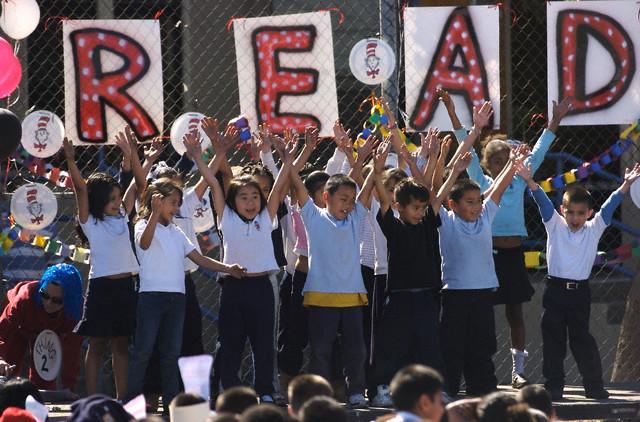
Read Across America 2007

TIP THREE: CONSIDER ONLINE ADVERTISING  

The last two tips built upon a foundation of interpersonal networking–that is, meeting people face to face and using this method to benefit everyone.  But what about those readers beyond your immediate sphere of influence?  How can you get them reading–and reading your book in particular?  Here’s a thought: Once your book is published, consider whether it might benefit from any online advertising.  You can set up ads on sites like Facebook, Google and Goodreads easily, or with some assistance from your self-publishing company and the marketing consultants they likely keep on staff.  If you’ve published through a company like Outskirts Press (my own stomping grounds), you can count on their staff to help you make your book more discoverable on Google with something like the Google Books Preview Program.

Reading in Madrid

TIP FOUR: INTRODUCE NEW FORMATS OF YOUR BOOK 

You know how it goes: The more easy a thing is to buy, and the more accessible it is to a large number of people, the more sales of that thing will jump.  It’s a well-demonstrated fact that self-publishing authors can reach a larger audience of readers by offering additional formats such as Kindle, Apple iPad or NOOK editions of your book.  And if you’ve only ever published your book digitally, perhaps it’s time you branched out into Print on Demand (POD) copies of your masterpiece!  Consider which formats you want to offer and add them before or after your hardcover format hits the virtual shelves.  If you feel inexpert in how to make the most of a multiplatform, multiedition publication, don’t hesitate to turn to those with the most wisdom to share: your fellow self-publishing authors!  We’re here for you.

Always remember: you are not alone. ♣︎

ElizabethABOUT ELIZABETH JAVOR: With over 18 years of experience in sales and management, Elizabeth Javor works as the Manager of Author Services for Outskirts Press. The Author Services Department is composed of knowledgeable publishing consultants, pre-production specialists, customer service reps and book marketing specialists; together, they all focus on educating authors on the self-publishing process to help them publish the book of their dreams. Whether you are a professional looking to take your career to the next level with platform-driven non-fiction or a novelist seeking fame, fortune, and/or personal fulfillment, Elizabeth Javor can put you on the right path.

Marketing BASICS : Call Your Own Shots

Last week, I tackled a fairly unpleasant reality when I itemized a few reasons why paying for a little advice isn’t such a bad idea––why it is, in fact, a fantastic idea––but I wanted to follow that lengthy tidbit up with an equally lengthy reminder that the whole reason self-publishing is worth exploring is the fact that it allows us––the authors––to call the shots when it comes to our own work.  And there’s no getting around the fact that free things are wonderful, just as there’s also no denying the reality that sometimes it’s best to do a few things really well and bring others alongside who can do the rest instead of doing everything decently and nothing exceptionally well (or worse, doing everything poorly).

Paying a little out of pocket doesn’t negate the value of an author’s hard work, and it certainly doesn’t erode our creative control, but rather reinforces it; when we foot the bill, graphic designers, copyeditors, and other paid publishing consultants become our employees, and our vision becomes their mission.


Welcome back to my series on marketing B.A.S.I.C.S.!  This is the fifth in a series of blog posts where I tackle the fundamentals of marketing in hopes of making things a little more manageable for you, the self-publishing author.  Four weeks ago I launched the series with this introductory post, followed by:

This week, as you might have guessed, we’re taking a look at:

  • C. Calling Your Own Shots

applause applause applause we live for the applause plause

There is, of course, an upside and a downside to being your own boss.  The upside is, as previously mentioned, you’re in control at every step of the process (that you want to be).  The product of your labors will turn out exactly the way you want and pay for it to do.  Your masterpiece, made your way by the people of your choosing.  Perfection.

The downside is: Bosses abide by deadlines, just like everyone else.  Better still, they set their own deadlines.  This is quite a leap to make, if you’ve never been self-employed or self-directed before––but it’s not the end of the world!  As Tom Wood of Killer Nashville Magazine writes, “self-imposed deadlines might be the hardest of all—precisely because only three people will push you to complete the book: Me, myself and I.”  Says Wood, “It’s not easy to find the time to write in a day full of work, chores, raising a family or whatever.”

Maybe deadlines aren’t actually a downside.  Some people thrive at the challenge of creating their own internal structure and abiding by it!  I don’t hate deadlines, even after the requisite years of working under the thumb of many such requirements, but I do hate falling behind and I have a tendency to fall into cycles of unproductive self-loathing when I do so.  It’s not hard for me to finish projects if nothing else (Wood’s “whatever”) interrupts me … but it’s really hard to re-hone and focus my attention if (or when) it does.  My main problem is I forget to write things down, and if it’s not on paper … well, it doesn’t happen.  Period.

The best investment I ever made was in a large––I mean, large––calendar planner, broken out into days on top of the usual weeks and months.  It doesn’t exactly solve all of my problems for me, and it doesn’t magically give me the motivation to do things I didn’t want to do in the first place, but it reminds me of the bare minimum.  And some days, we can all take pride in doing the bare minimum since even that is an insurmountable difficulty in a busy life and a busy world.  On days when I do more than what I write in my calendar … well, let’s just say that I’m not above keeping a chocolate stash in my desk drawer to celebrate.

Whether it’s buying a planner or tracking down an accountability partner, take some time to figure out your best fit when it comes to setting––and keeping––deadlines.  We may or may not like ’em, but we definitely can’t avoid living among them.  In the wild moors of self-publishing, singing with the echoes of a dream-laden wind, we call the shots.  Every.  Single. One.


Thank you for reading!  If you have any questions, comments, suggestions, or contributions, please use the comment field below or drop us a line at selfpublishingadvice@gmail.com.  And remember to check back each Wednesday for your weekly dose of marketing musings from one indie, hybrid, and self-published author to another. ♠

KellyABOUT KELLY SCHUKNECHT: Kelly Schuknecht is the Executive Vice President of Outskirts Press. In addition to her contributions to the Outskirts Press blog at blog.outskirtspress.com, Kelly and a group of talented marketing experts offer book marketing services, support, and products to not only published Outskirts Press authors, but to all authors and professionals who are interested in marketing their books and/or careers. Learn more about Kelly on her blog, kellyschuknecht.com.

Marketing BASICS : Selling Readers ON Your Book, Not Just Selling Your Book to Readers

Welcome back to my series on marketing B.A.S.I.C.S. here at Self Publishing Advisor, of which this is the fourth installation.  Three weeks ago I got the series underway with this introductory post, followed by an exposition on the “B” in B.A.S.I.C.S. (“Building an Online Presence“).  Last week, I answered the burning question of “What does the letter “A” stand for, then?” with a not-so-simple answer tackling various ways and means of “Ascertaining Your Ideal Reader.”  This week, as you might have guessed, we’re taking a look at the next letter in B.A.S.I.C.S. as we examine just how to go about Selling readers ON your book––and not just selling your book TO readers.  If the distinction seems a touch unclear, consider it this way: there are a lot of reasons why people do or do not buy specific books, and it only rarely can be defined as ONLY a financial transaction.  Ultimately, a book’s larger success can be credited to the author’s creation (and after, cultivation) a fan following made up of readers who really love and connect to the book.

As I mentioned last week, this series emphasizes marketing for new or first-time authors, but this point––this letter “S”––carries a lot of meaning for even the most experienced of authors.  There’s no point in an author’s professional career––even a blockbuster success of a career––where free passes are handed out.  No matter what stage of the self-publishing process you are at, you must continually strive to connect to your readers, and to create a product that is more than just attractive to them––you must strive to create a product, a book, that blows them away.  Each and every time.  This, too, is one of the most important and foundational of steps to crafting a successful marketing strategy.

selling a book

So, how DO I sell readers on my book?

  • Even before you publish your book, build community.  Spread the word!  Launch countdowns and promotions (like giveaways of Advance Reader Copies, or ARCs) on social media early.  And don’t forget to reach out!  Many first-time self-publishing authors find their most passionate advocates to be other members of the indie community.  Why?  Not only do they understand the rigors and narrative of self-publishing, but they’re by and large a welcoming bunch with extensive and generous networks––networks made up, in part, of avid readers looking for their next great book.  You shouldn’t approach the indie publishing community, online or off, as a chance to steal eggs from someone else’s basket, though: humility is a quality that belongs in the self-publishing community every bit as much as it does in fairy tales.  And, seeing a little of themselves in you, many established indie authors will be willing to put in a kind word for you with their readers.  One day, you’ll be able to pay it forward in the same way.


  • Share.  You’re not just selling a book––you’re selling the larger narrative surrounding your book, and that narrative intersects with your own life in ways that you won’t always be able to predict.  A key ingredient to selling readers on your book is to follow in Steve Job’s footsteps and be your own product’s biggest fan; your book is a beautiful and wonderful thing, and your enthusiasm for can be positively infectious.  Never be ashamed to share with your readers your passion for what you’ve created, and to do so in as many creative ways as you can think of: radio and blog interviews, posts to Twitter and Instagram and Tumblr and Vine that reveal the “behind the scenes” elements that give a book its own life and render you, the author, into an interesting character in your own right.  (And trust me, you ARE interesting!  You’ve written a book, after all.  You’ve put a piece of yourself out in the world for other people to engage with and respond to.  Whoa.)


  • And last but not least: Publish the book that you would want to buy.  If you’re only halfway sold on the concept, execution, or presentation of your book … well, let’s just say that readers are usually looking for the same things in the books they buy as authors really want to see in the books they publish.  Give every detail of the process––from conception through creation to final publication––the same level of care and attention that you might give to a priceless work of art.  The comparison is only fair, as your book is art.  And I, for one, can’t wait to read it.

Thank you for reading!  If you have any questions, comments, suggestions, or contributions, please use the comment field below or drop us a line at selfpublishingadvice@gmail.com.  And remember to check back each Wednesday for your weekly dose of marketing musings from one indie, hybrid, and self-published author to another. ♠

KellyABOUT KELLY SCHUKNECHT: Kelly Schuknecht is the Executive Vice President of Outskirts Press. In addition to her contributions to the Outskirts Press blog at blog.outskirtspress.com, Kelly and a group of talented marketing experts offer book marketing services, support, and products to not only published Outskirts Press authors, but to all authors and professionals who are interested in marketing their books and/or careers. Learn more about Kelly on her blog, kellyschuknecht.com.

Back to the Basics of Marketing

Over the last couple of months, I’ve used this Wednesday blog slot to talk about a lot of different things.  Many of them have been marketing related, and many of them have been inspired by topics that self-publishing authors may find useful before the marketing process begins––for example, my series on e-readers––but I’d like to step back, if you will join me, and refocus on what has traditionally made Wednesdays on Self-Publishing Advisor unique.

earlobe

I’d like to take us back to the basics of marketing for self-publishing authors.  Where does an author new to self-publishing get started?  How might an experienced indie author re-infuse a lackluster marketing campaign with new energy and more effective strategies for self-promotion?  This is the heart and soul, the real meat, of what I want to get at here.

The first order of business is, of course, to listen:

  • What topics would you like me to cover here?

  • Where are your marketing methods running into trouble, and …

  • Where are they succeeding?

  • Where do you turn for advice and resources for self-promotion?

My first instinct is, of course, to launch us back into this subject with a defense of marketing for self-publishing authors, but … let’s face it: we’re already here.  We’re already convinced that we need to sell our books, and we’re already fully aware that the heavy lifting falls on us as authors to make that happen.  What’s useful––what’s really useful––is information on how to make marketing better, or more effective.  Easier.  We want, and need, the tips and tricks of the trade, without having to waste time on trial and error in a world (and a market) that waits for no man or woman.

And no, there’s never going to be a day when publishing and selling a book is as easy as clicking a button and sending it into the aether––for indie authors as well as traditionally-published authors––despite what all of the corporate jingles and advertisements would have us believe.  There’s never going to be a day where we don’t have to pay for publication, whether we’re talking about sacrificing years of our time before release as well as our rights and royalties (as with traditional publishing), or whether we’re talking about sacrificing years of our time and energy after release to marketing and self-promotion (as with self-publishing), or whether we’re talking about sacrificing money to skip the lines but retain the professional marketing campaign (as with hybrid publishing).

There’s always a cost … but the payoff is worth it.  We have to remember that.  You have to remember the fact that there’s a book inside of you that needs to be read, that could indeed change someone’s life.  And it will change your life, too, to know that your book is out there in the world and exists in a universe outside of your own mind.  And that book is worth reading.  It’s worth buying.

The trick is in getting the word out there.  The trick is to raise awareness.  And that is exactly what I’m going to help you do in the coming weeks as we dive back into the deep end of the Marketing Maelstrom that is … your life as a newly minted self-published author!


Thank you for reading!  If you have any questions, comments, suggestions, or contributions, please use the comment field below or drop us a line at selfpublishingadvice@gmail.com.  And remember to check back each Wednesday for your weekly dose of marketing musings from one indie, hybrid, and self-published author to another. ♠

KellyABOUT KELLY SCHUKNECHT: Kelly Schuknecht is the Executive Vice President of Outskirts Press. In addition to her contributions to the Outskirts Press blog at blog.outskirtspress.com, Kelly and a group of talented marketing experts offer book marketing services, support, and products to not only published Outskirts Press authors, but to all authors and professionals who are interested in marketing their books and/or careers. Learn more about Kelly on her blog, kellyschuknecht.com.

In Your Corner : On Marketing


importance of marketing

Marketing, for the self-publishing author, is a many-headed hydra and prompts endless questions and dilemmas.  Major publishing houses have plenty of time and money to throw into marketing (although they would argue otherwise), particularly in comparison to you or me and any other self-publishing author out there.  They hire people whose entire careers revolve around taking care of the marketing process for their A-list authors, an enviable prospect because all we really want to do is write more books, right?  And yet, instead, we have both the blessing and the burden of running our own publicity campaigns.

Sometimes, I wake to a new day packed full with plans and routines to balance against each other, and I wonder:

  1. Aren’t we always told that the hardest part of writing a book is writing the first paragraph?  (Whoever says such things has clearly never attempted to tackle the tricky beast of self-promotion.)
  2. Are there ideas I can steal from others about how to be more effective, so that I have more time to spend on what I actually love?  (Which is, of course, writing.)
  3. Who gave the world permission to make me wake up to an empty coffee pot?

In all seriousness, though: the way we approach marketing, as self-publishing authors, matters.  Because it’s not optional.  It’s not something we can get away without doing.  We won’t sell books, and we won’t make room in our lives for the next book, either, if we don’t give some of our time over to marketing.

As Gareth Howard over at Infinity Publishing puts it: “Would you bake a delicious cake and not even eat it?  Would you revise for important exams and not bother sitting them?  Would you book an exotic vacation only to stay at home, wasting that precious deposit?”  The answer is, of course, no.  No, you wouldn’t want to waste the precious time and energy you’ve invested in crafting a beautiful manuscript–you want it to be read.  You want your ideas to reach your readers!  And sadly, we still haven’t figured out a way to guarantee authors that their books will just magically sell once they’re published.  There’s still a vital legwork and elbow-grease component to the whole thing.

You do, thankfully, have an advantage over the enormous publishing houses with their big budgets and their paid professionals: You can make it personal.  You can lend the marketing process a human touch, and you can take advantage of the most effective means of self-promotion known to humankind: your existing social network.  You can also pick the things you do well, and reach out for professional help (with a shout-out to my day job) only when you really need it.  The key is, of course, being prepared to work and work hard to achieve your marketing goals.

Others here on the SPA blog have written about marketing before, and have presented a number of ideas on how we can all be more effective at self-promotion as self-publishing authors.  This holiday season, however, I’d like to issue a specific challenge to you (and myself!): Let’s figure out the next workable, manageable, and sustainable step that we can use to bolster our existing strategies.  It’s no good if we have lofty goals that we never reach, so let’s be specific even while we’re also being optimistic.  I bet you my best unsharpened pencil that we can do better in 2016!

There is, of course, a danger in all of this:

Once we acknowledge just how important marketing is, the process has a tendency to take over our lives and erode away all semblance of spare time we might have.  Fortunately, there are a whole host of resources out there for you–to get you started, and to help you along once you’re already partway down the path.  And of course, I’m here for you too–and the SPA email as well as comments section is always open to lend you a listening ear.

You’re not alone. ♣︎

ElizabethABOUT ELIZABETH JAVOR: With over 18 years of experience in sales and management, Elizabeth Javor works as the Manager of Author Services for Outskirts Press. The Author Services Department is composed of knowledgeable publishing consultants, pre-production specialists, customer service reps and book marketing specialists; together, they all focus on educating authors on the self-publishing process to help them publish the book of their dreams. Whether you are a professional looking to take your career to the next level with platform-driven non-fiction or a novelist seeking fame, fortune, and/or personal fulfillment, Elizabeth Javor can put you on the right path.