From the Archives: “The Importance of Genre”

Welcome back to our Tuesday segment, where we’ll be revisiting some of our most popular posts from the last few years.  What’s stayed the same?  And what’s changed?  We’ll be updating you on the facts, and taking a new (and hopefully refreshing) angle on a few timeless classics of Self Publishing Advisor.

∗∗∗∗∗

[ Originally posted: March 27th, 2012 ]

The genre of your book is one of the most important decisions you will make when self-publishing. It will impact who buys and reads your book as well as how reads it.

The most important to thing to remember when choosing a genre is to not pick a genre too soon. Too often, authors set out thinking “I want to write children’s books” or “I want to write adult mystery novels,” but writing often takes on a life of its own and your book may not best fit in the genre you originally intended.

Once the book is finished, it is important to consider the audience you hope to reach. Are children your target audience? Are professionals in a certain field your audience, or do you want your book to appeal to a wide, general audience? A narrow genre can limit the readers who find your book. This is one of the few cases where general can be better.

Finally, think about how readers will find your book. Will they primarily search online, or will they visit a  bookstore? If your readers will be searching online, consider keywords when choosing a genre. This will ensure that your book shows up in the search results.

If you are still unsure about the genre of your book, talk to other writers and people who work in the publishing and book distribution industry. Visit your local bookstores to look at the titles in your genre and talk to the sales people. Seeing and hearing what other writers are doing and what readers are buying can help make this difficult decision easier.

– by Cheri Breeding

Genre is an important element of your book, before and during and after the publication process–but I must (politely) take a different tack from the one that Cheri Breeding took back in 2012.  In my personal (and somewhat expert) opinion, an author–particularly a self-publishing author–shouldn’t think about genre at all until after the manuscript is completely written.  I’m not saying that if you have a project underway you should intentionally scrub all thought of genre from your mind, but I am saying that your novel or book of poems or illustrated children’s book should be written the way it demands to be written, and those demands evolve over time as the characters and plot take on life of their own.  A book should not be written as a slave to notions of genre and all the expectations that go along with those notions.

genre book covers

The true importance of genre comes into play after the manuscript is written.  At that point, yes, you can take genre under consideration in reshaping whatever needs to be reshaped in order to reach masterful perfection–if you want, if that proves helpful to you–and you can take notes from the authors you admire whose works exert influence upon your source of inspiration.  But the best part is when the manuscript is done being a manuscript and has become a book you’re willing to send out into the world, because the best part happens when you start crafting something else entirely: your marketing strategy.

Genre is one of the most important discovery tools out there for authors of all stripes and colors.  In terms of importance, it’s right up there with personal recommendations and an attractive book cover–and even the most attractive of book covers doesn’t do much for sales if it doesn’t represent the tone and content of the book, giving hints and clues as to what the reader will find there.  And that’s … kind of the same wheelhouse as genre, isn’t it?   Genre is so fundamental to book discoverability that booksellers and watchdogs don’t just break down how many people buy books because of genre, but how many people buy books because of a highly specific genre–whether that’s science fiction, fantasy, romance, nonfiction, crime fiction, or any other of a number of genres available for discussion.

You can put genre to work in the marketing process first and foremost by ensuring that your marketing strategy lines up with your book’s genre–or genres.  Hybrid and cross-genre works are gaining ground in a crowded marketplace looking for fresh approaches to literature, so don’t be afraid to embrace the multi-dimensionality of your work–you just might have to use language that touches on the buzzwords of both categories in your promotional blog posts, tweets, and metadata.  And regardless of the genre of the book you’re publishing, you need to employ the language of genre in pretty much every scrap of promotion you put together.  Whether it’s in an on-air interview or in a press release or in the description you upload with your book trailer to YouTube, genre is your ally.  The more you talk about it, the more your book will turn up in the discussions–and indexed search results on Google and Bing–and that’s good news both for you and for your readers.

Never dismiss the importance of genre!  Just … don’t let your work be defined by it.  Your book enriches its genre, and informed the dimensions of what its genre or genres will be defined by in the future.

Thanks for reading.  If you have any other ideas, I’d love to hear them.  Drop me a line in the comments section below and I’ll respond as quickly as I can.  ♠


Kelly

ABOUT KELLY SCHUKNECHT: Kelly Schuknecht is the Executive Vice President of Outskirts Press. In addition to her contributions to the Outskirts Press blog at blog.outskirtspress.com, Kelly and a group of talented marketing experts offer book marketing services, support, and products to not only published Outskirts Press authors, but to all authors and professionals who are interested in marketing their books and/or careers. Learn more about Kelly on her blog, kellyschuknecht.com

 

Self-Publishing News: 8.8.2016

And now for the news!

This week in the world of self-publishing:

The title really says it all, in this case: says Alison Flood in The Guardian on August 5th, “A father who tried self-publishing the bedtime story he made up for his daughters has landed a surprise order of 2,000 copies from Virgin Atlantic to help children sleep on night flights.”  The book in question, Stephen Holmes’ The Great Hot Air Balloon Adventure (illustrated by Kev Payne), was inspired by a bedtime story Holmes had been telling his daughters for years–and he never had the intent to publish or sell until Madison, age seven, requested it. The story of how his book connected with Virgin Atlantic is an interesting one: having ordered an intial print run of 1000 copies and having sold roughly half that number, Holmes decided to send a copy to an airline executive via LinkedIn as a spur-of-the-moment inspiration–and the airline enjoyed it so much they decided to order an additional print run of 2000 in order to distribute copies on their night flights. The book, according to Flood, “tells of best friends Tom and Jessica–the names chosen by his daughters – who are taken on a night balloon ride by a ‘very well spoken’ rabbit. They drink hot chocolate and bounce on clouds, before meeting a friendly owl and flying home to bed.”  The icing on the cake?  Flood gives a brief run-down at the end of her article on the progress self-publishing has made in recent years.

“It’s the best choice for self publishers to publish their magazines easily and quickly without any delay,” writes Veronica Linn in this August 5th piece for WhaTech.  FlipHTML5, once voted the “best magazine newsstand app maker by users around the world,” gives publishers “the chance to create realistic CSS3, jQuery and HTML E-magazines from PDF versions instantly which they are distribute through online or offline outlets.” This is good news for self-publishing authors, who often need to capitalize upon timeliness in order to turn a profit.  Says Linn, “All one has to do is to upload the input material, insert personal logo and multimedia content and change themes and backgrounds to achieve the look they want.”  It’s worth noting that Linn, who as an employee of FlipHTML5, is not exactly unbiased in the service of self-publishing–but in many ways her piece hits all of the right notes.  To read the full release, click here!

“More than half of all science fiction magazines failed to publish fiction from black authors in 2015,” writes Andrew Liptak for The Verge on August 4th: “Speculative fiction magazine Fireside Fiction has commissioned and released a report detailing an unwelcome revelation: speculative fiction magazines and online fiction sites are failing to publish stories by black writers.”  Liptak reports on the report, calling it “damning” and that “of the 2,039 short stories published last year across 63 magazines, only 38 were published by black authors.”  These stats are fairly self-evident, indeed, but what do they have to do with self-publishing?  It all has to do with the part short stories have to play in boosting the science fiction genre.  Says Liptak, “Short fiction also allows authors to experiment with form, style, and narratives which can have great impact on the field as a whole. Barriers for specific groups of people hurts the field as a whole by blocking new voices and styles from reaching a wider audience.”  Liptak excerpts an interview with author N.K. Jemisin (author of The Fifth Season and Obelisk Gate), who “noted that some authors that might have otherwise published through traditional markets have found other outlets for their work.”  Says Jemisin (through Liptak), “There’s a gigantic market of self-published and small press published black fiction that kind of eschews the whole traditional published market simply because back in the nineties when all of this really kind of kicked off … the traditional publishing industry basically treated black writers as if they were anomalies.”  So in other words, self-publishing is promoting diversity in a highly structured and often exclusionary genre.  That’s good work, self-publishers!  To read the full Verge article, follow the link.


spa-news

As a self-publishing author, you may find it helpful to stay up-to-date on the trends and news related to the self-publishing industry. This will help you make informed decisions before, during and after the self-publishing process, which will lead to a greater self-publishing experience. To help you stay current on self-publishing topics, simply visit our blog every Monday to find out the hottest news. If you have other big news to share, please comment below.


Kelly

ABOUT KELLY SCHUKNECHT: Kelly Schuknecht is the Executive Vice President of Outskirts Press. In addition to her contributions to the Outskirts Press blog at blog.outskirtspress.com, Kelly and a group of talented marketing experts offer book marketing services, support, and products to not only published Outskirts Press authors, but to all authors and professionals who are interested in marketing their books and/or careers. Learn more about Kelly on her blog, kellyschuknecht.com
.


“Still Marching On” : A Saturday Self-Published Book Review

Book reviews are a great way for self-publishing authors to gain exposure. After all, how can someone buy your book if he or she doesn’t know it exists? Paired with other elements of your book promotion strategy, requesting reviews is a great way to get people talking about what you’ve written.

When we read good reviews, we definitely like to share them. It gives the author a few (permanent) moments of fame and allows us to let the community know about a great book. Here’s this week’s book review, courtesy of Observations From a Simple Life:

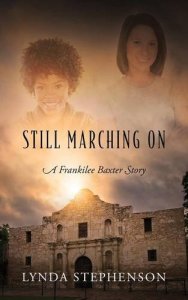
Still Marching On by Lynda Stephenson

Still Marching On

by Lynda Stephenson

Publisher: Outskirts Press

ISBN: 978-1478771982

Synopsis*:

Frankilee Baxter is back! And she is as sassy and resolute as ever. In Still Marching On, Miss Baxter aspires to participate in the Civil Rights Movement, become editor of the Athena College newspaper, and marry Calvin Morris–and odds are, she’ll make her dreams come true with sheer force of personality. A witty young woman with nerve and verve, Frankilee is in no way the traditional Southern sorority girl, which brings disappointment and alarm to her family, as well as shock and dismay to Calvin’s parents. With humor and heart, this highly anticipated third novel by award-winning author Lynda Stephenson depicts the triumphs and the failures of a plucky girl determined not only to stand against the Southern customs she loathes but also to marry the man she loves.

“Here is the story of the irrepressible Frankilee Baxter, who, while she may be a disappointment to the 1960s down-south establishment, will fight to the end for life and liberty, and all that she believes in. I loved it.”

-Carolyn Wall, author of Sweeping Up Glass and Playing with Matches

Critique:

Still Marching On by Lynda Stephenson is the story of a young college girl at the height of the Civil Rights Movement. She must fight against the injustice of the Jim Crow laws and as well as social practices which could keep her from following her dreams.

Frankilee Baxter is a young white college student at Athena College where her roommate, Eleanor, is African American. Together, they join the Civil Rights Movement when racial tensions are very explosive. Frankilee is the type of girl who likes to shock people and study their reactions. She begins to conduct social experiments and writing about her experiences. She is able to sell a few of her stories to the New York Times. She joins sit-ins at a local department store who refused to serve African Americans. She joins Freedom Rides which leads to time in jail. While she fights for social change, she must deal with the everyday issues at home. Her mom is sick. Her dad is having trouble with the bank. Her aunt is trying to bully everyone to follow her plan for the grandfather’s ranch land. And she falls in love with Calvin Morris, a law student who seeks the social change she does. Will Frankilee succeed in her dreams of journalism? Will she be able to forge the social change she seeks to see in the world? Will her dream of marrying Calvin come true?

I enjoyed Still Marching On. It is an interesting book with a passionate retelling of the Civil Rights Movement from a participant who seems so unlikely. The details the author put into the events are graphic but very real. You shiver as you know that person suffered injustices and cruelties as they fought for civil rights. Frankilee is passionate, rash, impulsive and ready to take on the social injustices. The debates between Frankilee and those on the other side and the opinions expressed are dealt with realistically. I highly recommend Still Marching On.

[ reviewed by Jennifer Lara at Observations From a Simple Life ]

Here’s what other reviewers are saying:

Another outstanding book by Lynda Stephenson. Great character development, and very authentic to the period. If you were a college student during the 1960’s you can really identify with the subjects dealt with in this book. The civil rights movement, the freedom riders, the limited professional opportunities for women college graduates, and the predetermined expectations of parents for their children, especially girls. Frankilee, the main character, takes on all these issues with wit, humor, passion, and, yes, her rebellious ways. Ms. Stephenson’s previous book in the Frankilee Baxter series focuses on Frankilee’s freshman and sophomore year; in this book the focus is her junior and senior year. She is more mature, more thoughtful, and more concerned about social inequality. She truly grows into adulthood. Obviously, this is a great book for anyone that was a young adult in the 1960’s, but if you have parents or grandparents that lived through that period and you want to know what they experienced and what life was like, then this book is for you. FINALLY, THE BOOK HAS A GREAT ENDING!

– Amazon Reviewer AdaBill

In Marching On, Frankilee Baxter is fundamentally the same wonderful, perplexing, and often perplexed character that we came to know and love in Dancing With Elvis and The Southern Chapter of the Big Girl Panties Club. In this third novel of the series, author Lynda Stephenson expands upon the theme of integration as it developed in the 50’s and early 60’s. The struggle for civil rights in the South becomes the central factor in Frankilee’s personal struggle to establish her worth and purpose in life. More than ever, she is an idealist who pays dearly for pursuing social and moral goals that clash with purveyors of deeply entrenched bigotry. Though tempered by her comical girlhood blunders, Frankilee at the same time leads the patient reader down (or up) a primrose path seriously darkened by physical and emotional pain.

Looking for structure, Frankilee attempts to summarize her life in literary terms: as classical comedy, which ends with a wedding, rather than as tragedy, which ends in death. Yet more specifically one might say that her willful suffering bespeaks a more complicated persona than one finds in Jane Austin or Emily Dickinson, two of Frankilee’s heroines.

Nor is Frankilee’s journey deeply tragic in the Shakespearian sense of an uber-complicated Hamlet. Her sacrificial cause is rooted in the powerful utopian dream of idealists such as John Lewis and Martin Luther King, Jr. Buttressed by the somewhat enlightened progressives among her friends and family, her optimistic belief in a more just world seems realistically achievable.

Marching On is the story of a small town girl in the throes of becoming a world class woman. She entertains us with an overlay of buffoonery, but she is defined by her capacity for love, including love for her friends, for her family (no matter how obtuse or obnoxious); for her man, and, most importantly, for the unvarnished Truth, however awkward or undignified that makes her feel. In her own personable way, Frankilee Baxter embodies the correct side of our unfolding history.

– Amazon Reviewer James A. Moore

Book Trailer:

* = courtesy of the book’s Amazon book page.


saturday self-published book review

Thanks for reading!  Keep up with the latest in the world of indie and self-published books by watching this space every Saturday!

Self Publishing Advisor

selfpubicon1

In Your Corner: Taking it to the Big Screen

It probably isn’t news to you that video is an important tool in your toolbox as a self-publishing author, so I’ll skip the part of this blog post where I laud the benefits of using video in addition to written means of promotion in order to sell your book, as well as the part where I defend the book trailer as an indefensible part of your self-marketing strategy.  What you’re interested in–and what we’re all interested in, really–is how to use that video to stand out.  How to actually put it to work.  And since we’re sliding into a new month right now, I thought I’d take August as an opportunity to do some serious work when it comes to this whole self-promotion thing.

video trailer promotion

A Miniature Soapbox

Because let’s face it, those “X for Dummies” books have a point, even if they simultaneously belabor the point (thus falling into the whole “defense of X” rut I’ve said I’ll skip, above) and insult readers’ intelligence while at it.  Sidebar: My father gave me the “Photography for Dummies” book almost a decade ago, but I still haven’t really touched it, even though he insisted he didn’t actually think I was dumb.  The real problem with the “X for Dummies” books is that they assume their readers are insecure in their sense of self-worth when it comes to whatever task or object they’re seeking to learn more about.  But let’s be clear: You’re not a “dummy” just because you want to get down to the nitty-gritty of how to make something work.  A lack of information is not a lack of intelligence.

How (& Where) to Use a Book Trailer

  1. Upload your video to your website & on your YouTube channel

Creating a YouTube channel is free, and it happens to come along with a bundle of customizations.  Take a look at the YouTube channel of your favorite musician if you’re looking for inspiration–and then take a look at a variety of different artists’ and musicians’ channels for comparison–and note what customizations work: banner images, layout alterations, etc.  It’s easy to Google templates and tutorials.  Sometimes the simplest changes are actually the most impactful, so don’t overthink it.  Making your YouTube channel beautiful is secondary to making people aware that you have one, so make sure you not only upload your video, but that you promote it too.

  1. Tweet about your book trailer

Fans accessing links to online videos via Twitter watch, on average, an extra minute of video compared to those who stumble across your book trailer via a search engine.  After uploading your book trailer to YouTube and your personal website, tweet about it!  And don’t just tweet about it once, either.  Spread the word across all of your social media platforms–Twitter, Facebook, Tumblr, and everywhere else you have a digital presence.  This will serve as part of your promotional strategy for raising awareness about your book video trailer, but it also will serve as a boost to your overall digital footprint.

  1. Use Search Engine Optimization (SEO)

Before you distribute your book trailer on YouTube and elsewhere, you should understand the basics of search engine optimization (SEO). There’s simply no point in creating a website or book trailer or any other content online if that content can’t be easily found. Which means, when push comes to shove, that you’ve got to start thinking like a search engine.  Each website page or blog post should be optimized so that search engines can find it.  And in the same way you optimize your blog, you need to optimize your book trailer so people can find it.  We’ve written about SEO before, in detail–and it really is worth it to take the time to do this right.

You are not alone. ♣︎

ElizabethABOUT ELIZABETH JAVOR: With over 18 years of experience in sales and management, Elizabeth Javor works as the Manager of Author Services for Outskirts Press. The Author Services Department is composed of knowledgeable publishing consultants, pre-production specialists, customer service reps and book marketing specialists; together, they all focus on educating authors on the self-publishing process to help them publish the book of their dreams. Whether you are a professional looking to take your career to the next level with platform-driven non-fiction or a novelist seeking fame, fortune, and/or personal fulfillment, Elizabeth Javor can put you on the right path.

The Book Beautiful

You’ve heard it all before: people aren’t morally opposed to reading self-published works, but they are aesthetically opposed to reading books of substandard appearance and physical quality–which they often equate with the same thing.

But here’s a fact: to self-publish doesn’t mean you’re accepting a lesser standard of quality, and to read self-published books isn’t to lower some standard out of pity or poor taste.  Many self-published books are already beautiful.  Did anyone see Andy Weir’s original cover for The Martian?  Anyone?  Anyone?  Or how about Christopher Paolini’s covers for Eragon and its sequels?  Those are sometimes said to have helped reshape Young Adult fantasy book covers for the last decade.  And what’s true for the outside of a book is true for the inside, too.  A self-published book can’t automatically be said to have substandard interior design, with faulty formatting and messy editing.  And to be perfectly honest, I don’t think we can even pass this off as a “well, we’ve just gotten better at it with so much practice!” sort of situation.

The truth of the matter is, there is and always has been a powerful stigma to self-publishing, a stigma so ubiquitous and so powerful that it has warped our perception of reality to the extent that even actual self-publishing authors sometimes believe they’re choosing something second-rate, that going indie is a fallback after failure to reach actual success (often equated with traditional publishing).  And while many people do come to self-publishing after doing other things first, that’s beside the point.  The self-publishing world is an inclusive one, where maybe we can begin to heal some of the systemic hurts enforced and policed by traditional publishing.

There have ALWAYS been many beautiful self-published books, just as there have always been some that are less beautiful.  But the same goes for traditionally published books; just because one of the Big Five publishers takes you on doesn’t mean they actually care about the quality of your book’s design, production, and manufacture.  They can more than make up for letting a few books fall through the cracks by pushing sales for next year’s blockbuster success story.  In the world of self-publishing, however, every book matters–no matter its genre, its author’s point of origin, or how much money has been poured into its creation.  If it’s an interesting concept, with an eye-catching cover, readers will show up for it.

A book’s appearance matters.  Its author matters.  Its content matters.

Its publisher, ultimately, doesn’t.

So, over the coming weeks, we’re going to spend some time looking at what makes a book beautiful–and how a book’s appeal can be turned into a currency of its own, something useful to the author’s bank account.  And of course we will dedicate page space each week to talking about how to coax out just a little bit more of that beauty with each facet of a book’s design.

book art


Thank you for reading!  If you have any questions, comments, suggestions, or contributions, please use the comment field below or drop us a line atselfpublishingadvice@gmail.com.  And remember to check back each Wednesday for your weekly dose of marketing musings from one indie, hybrid, and self-published author to another. ♠

KellyABOUT KELLY SCHUKNECHT: Kelly Schuknecht is the Executive Vice President of Outskirts Press. In addition to her contributions to the Outskirts Press blog at blog.outskirtspress.com, Kelly and a group of talented marketing experts offer book marketing services, support, and products to not only published Outskirts Press authors, but to all authors and professionals who are interested in marketing their books and/or careers. Learn more about Kelly on her blog, kellyschuknecht.com. 10:00 AM