Growing Pains: Part III

Last week, we explored the ways in which you can specialize in certain key products and services you offer so as to streamline your business and “grow” your sales. This week, I’d like to speak to the ways in which you can expand upon your product line, if you’ve found that you’re comfortable with the level of work-sales ratio you’re receiving with your current products.

    If you plan to expand your product line, it is crucial that the products and services you add complement those you already provide. By this, I mean that you can see a connection between these things and that your marketing efforts can be used seamlessly between one and the other.

   Let’s say you’ve become a prolific self-published author. You’ve gone through the trial and error processes of editing, formatting, illustrating, marketing, etc etc. You’ve seen what works, and more importantly, what doesn’t work. A complementary service you could offer–with this knowledge you’ve acquired–could be assisting other aspiring self-publishing authors.

  By offering copy-editing, formatting or marketing assistance, you would only further those skills for yourself as an author–so long as you didn’t let it replace the time you spend working on your own books.

     Or, let’s say you’ve found great marketing success is hosting events–book readings, poetry slams, etc. Maybe you’ve even found you have a certain knack for planning these kinds of events. Plenty of authors dread orchestrating such things, and you could use that skill to assist them, while simultaneously building your networking platform. A well-planned event is great marketing for you as an event planner, and it may even turn into great marketing for you as an author.

    Another option: you write children’s books and they’ve become rather popular. Consider branching out and creating book themed toys that model characters in your stories, children not only love interacting with illustrations in your stories, but they especially love being able to have tangible versions of your characters to play with in real life! How exciting would it be to have it be an option to add that toy during a check out of a purchase of your book?? This would be especially great during the holiday season.

  With any of these options for “growing your business,” always keep in mind what your priorities are, or what they should be. Don’t let your side projects take over or take you away from what you love. Put yourself and your work first always. Helping someone else market will only help you if you’ve made enough time to market for yourself first and foremost. Editing someone else’s work will only help you if your work is thoroughly edited and given the attention it deserves. Planning events for other authors should never take precedent over planning events of your own.

In summation, if you don’t have the time or energy to offer these other services, don’t. If you find yourself with extra time and motivation, by all means go for it! The sky is the limit!


Thank you for reading!  If you have any questions, comments, suggestions, or contributions, please use the comment field below or drop us a line at selfpublishingadvice@gmail.com.  And remember to check back each Wednesday for your weekly dose of marketing musings from one indie, hybrid, and self-published author to another. ♠


Kelly

ABOUT KELLY SCHUKNECHT: Kelly Schuknecht is the Executive Vice President of Outskirts Press. In addition to her contributions to the Outskirts Press blog at blog.outskirtspress.com, Kelly and a group of talented marketing experts offer book marketing services, support, and products to not only published Outskirts Press authors, but to all authors and professionals who are interested in marketing their books and/or careers. Learn more about Kelly on her blog, kellyschuknecht.com

Self-Publishing News: 5.8.2017

And now for the news!

Some highlights from this week in the world of self-publishing:

Dr. Alison Baverstock of Kingston University in London was already a writer, publisher, consultant and teacher when she decided to explore the world of non-traditional publishing. Allison ended up with comprehensive enought research on the self-publishing industry that she was able to write How to Market Books, a title that has been called the “bible of book marketing” and which has been translated into 15 different languages.

More than half a million self-published books entered the market last year alone, and that number is sure to keep growing, as it continues to be a more popular option for authors of all types–from the first timer to the seasoned vet.

Baverstock noticed that though self-publishing was originally met with hostility and was highly stigmatized at its onset, it has a growing popularity and acceptance as more and more authors seem to be taking this route for a myriad of different reasons.

Allison is not the only one to have noticed this. Neil White, creative director and publisher at Nautilus Publishing Company in Oxford, said self-publishing was a “huge waste of money 10-plus years ago. In order to make each book affordable, a press needed to publish 1,000-5,000 copies of the book. Most of those are still in someone’s garage.” However, White and Baverstock have both admitted that self-published has transformed a huge amount in just a decade.

The ease of digitization has made self-publishing very popular. You can download programs to edit and format your book from your own computer. You can upload your book directly to Amazon and other ebook platforms, making publishing literally a click away.

Rather than delegitimizing self-publishing, its rising prevalence has made it more respected, with serious authors who have already been through the traditional publishing houses choosing this route because it simply pays better for them in the long run.

Baverstock says, “If you look at the “New York Best Seller” list, there are usually two or three titles in the top ten that started off as self-published books.” Two or three out of ten isn’t too shabby for an industry previously dominated and controlled by the traditional publishing market.

These facts have shown that traditional publishing companies aren’t always as in tune with reader’s tastes and preferences as they thought they were. “There have been several areas of self-publishing that the industry was quite confident that nobody wanted books on, and actually they’ve been proven wrong,” says Baverstock.

This is not to say that all self-published books will do well. White cautions that there are a lot of self-publishing books that will sell less than 1,000, or less than 100 copies of their books. He also cautioned against simply one-click publishing something on Amazon that you haven’t seriously edited or put time and care into formatting. He has four pieces of advice for authors considering the self-publishing route, and they are as follows: “Hire a great story editor. Hire a great copy editor. Hire a talented book designer. Hire a great book publicist.”


spa-news

As a self-publishing author, you may find it helpful to stay up-to-date on the trends and news related to the self-publishing industry.This will help you make informed decisions before, during and after the self-publishing process, which will lead to a greater self-publishing experience. To help you stay current on self-publishing topics, simply visit our blog every Monday to find out the hottest news. If you have other big news to share, please comment below.

KellyABOUT KELLY SCHUKNECHT: Kelly Schuknecht is the Executive Vice President of Outskirts Press. In addition to her contributions to the Outskirts Press blog at blog.outskirtspress.com, Kelly and a group of talented marketing experts offer book marketing services, support, and products to not only published Outskirts Press authors, but to all authors and professionals who are interested in marketing their books and/or careers. Learn more about Kelly on her blog, kellyschuknecht.com.

Saturday Book Review: ” Surviving in a Ever-Changing Healthcare Industry”

Book reviews are a great way for self-publishing authors to gain exposure. After all, how can someone buy your book if he or she doesn’t know it exists? Paired with other elements of your book promotion strategy, requesting reviews is a great way to get people talking about what you’ve written.

When we read good reviews, we definitely like to share them. It gives the author a few (permanent) moments of fame and allows us to let the community know about a great book. Here’s this week’s book review, courtesy of Midwest Book Review:

Surviving in a Ever-Changing Healthcare Industry Donna Gault

Surviving in a Ever-Changing Healthcare Industry

by Donna Gault

Publisher: Outskirts Press

ISBN: 9781478780717

Synopsis*:

Surviving in an Ever-Changing Healthcare Industry is a short book that packs a powerful punch. Donna Gault, a registered nurse with nearly 50 years of experience, explains the many changes in the healthcare industry today and the challenges facing doctors, nurses, hospitals, and especially you-the patient. She then provides guidelines to help everyone obtain safer healthcare. The book includes sections written by two physicians who offer their own viewpoints on the changes facing physicians today, and how to help doctors provide the best care for you.

 * courtesy of Amazon.com

Critique:

Practical, informative, insightful, and thoroughly ‘reader friendly’ in organization and presentation, “Surviving in a Ever-Changing Healthcare Industry” is very highly recommended for clinic, community, and academic library Health/Medicine collections. For personal reading lists it should be noted that “Surviving in a Ever-Changing Healthcare Industry” is also available in a Kindle format ($5.95).

reviewed on The Health Shelf of Midwest Book Review ]

Here’s what some other reviewers are saying:

This book is a must read for anyone who is concerned about the changes taking place in our Healthcare system.

Donna does a great job of articulating the changes with good sound advice .
We all need to be prepared to ask the tough questions and get the answers we need to be better informed. Donna gives us well thought out and researched tools to take charge of our health.

I appreciated the two Doctors who contributed to this book . Each Doctor sharing their viewpoint their perspective on how the changes are affecting them and their practice.

This little easy to read 88 page book is a powerhouse. One that you will keep and refer to over and over in your life.

Bravo Donna and Thank you.

– Amazon Reviewer Brenda

This book is a must have to understand what you need to know to advocate for yourself and loved ones in an ever changing health system. Strengths are emphasized as well as weaknesses in the system. Times have changed since the days of the family physician and this book is based on reality and gives information and advise that every patient needs to know. I would highly recommend this book and encourage everyone to read it. The book is short and easy reading, but packed with vital information that will help you to better advocate for yourself and your loved ones.

– Amazon Reviewer Diane Gray

Book Trailer


saturday self-published book review

Thanks for reading!  Keep up with the latest in the world of indie and self-published books by watching this space every Saturday!

Self Publishing Advisor

selfpubicon1

Conversations: 5/5/2017

LET’S PLAY!

WRITE YOUR CHILDREN’S BOOKS!

Have you ever considered writing books for children? I took a swing at it when my daughter was just starting kindergarten. The plan was to use her experiences to develop a story that would be great fun for lots of children as well as give her a book filled with many of her very own memories. As the pages fell from my typewriter—no personal PC at my house in those days—my embellishments carried her story into an imaginary realm. Although I read it to her at the time, and she laughed and became surprised at all the right spots, the manuscript never left our house. Today, I’m thinking of revising it a bit and try it out with our great-grandchildren. I’ve learned a lot over these years. What better time to share these children’s writing techniques with you than springtime when the world comes alive with blossoms and playgrounds full of children.

children's picture book

Possibly the best advice—and instruction—I received when seeking “the way” to write for children of various ages was this:

Keep it simple. Keep it focused. Keep it moving. Those were the key points given by a well-known children’s author I met at the first writer’s conference I attended. Although she was speaking specifically about writing for young children, I’ve sown those guidelines into all my writing efforts.

Keep it simple. We’ve all heard that educating our children “starts in the womb” when Mom reads aloud. And that infants and toddlers are “sponge learners” absorbing sights, sounds and language very quickly. However, if we over-write a children’s book, it will be of no use to the child/audience we’re want to reach.

  • Hold the story to a 1,200-1,500 word length.
  • Each sentence should reveal one single specific idea.
  • Use words that describe the idea—words that translate into beautiful illustrations.
  • Paragraphs: no longer than three sentences.
  • KEEP YOUR WORDS VISUAL. I’ve added this piece to my Start Here list because once an infant’s eyes begin to “track” the sounds and voices they hear their world expands dramatically.

Keep it focused. It’s all about the available “attention span” of the age group we’re writing for.

  • Picture books/Board books: full color pages with large, easily identifiable characters and illustrations, and one-to-five words per page. These stories need to be tightly written.
  • Short Story books where each page of eight to fifteen words is considered a “chapter.”
  • Longer Chapter books connect to the specific likes of kindergarten and first grade age children. Remember, the parents are still selecting these books, and if the illustrations appear too “different” to them, they will buy a different book.

Keep it moving. All great stories are built on the same essential elements: character(s), interesting setting and plot—ups and downs of some level of conflict—and the resolution. When author Margaret Wise Brown wrote a rhyming poem (1947) describing the bedtime ritual of a bunny rabbit she could not have guessed the millions of children who have enjoyed it. GOOD NIGHT MOON gave very young children the rhythm of the words which flowed with the actions of the main character resulting a peaceful night’s sleep.

Takeaway for today: whether you aim to make a career in the children’s books world, or write in ANY other genre, take the opportunity to exercise your skills and follow the above steps to create one Picture Book. Think of this as PLAY TIME and allow images to float in your thoughts as the words pour onto the page. You may just find yourself writing the next book that sells 48 billion copies. ⚓︎


Royalene

ABOUT ROYALENE DOYLE: Royalene has been writing something since before kindergarten days and continues to love the process. Through her small business—DOYLE WRITING SERVICES—she brings more than 40 years of writing experience to authors who need “just a little assistance” with completing their projects. This is a nice fit as she develops these blogs for Outskirts Press (OP) a leading self-publisher, and occasionally accepts a ghostwriting project from one of their clients. Her recent book release (with OP) titled FIREPROOF PROVERBS, A Writer’s Study of Words, is already receiving excellent reviews including several professional writer’s endorsements given on the book’s back cover.  

Royalene’s writing experience grew through a wide variety of positions from Office Manager and Administrative Assistant to Teacher of Literature and Advanced Writing courses and editor/writer for an International Christian ministry. Her willingness to listen to struggling authors, learn their goals and expectations and discern their writing voice has brought many manuscripts into the published books arena.

In Your Corner: Royalties. What do they mean?

fountain pen money coins royalties

Royalties. There is no better word to convey a connotation of status, power, and entitlement for the published author … but it’s a word which can be dangerously misleading, or seductive. For one thing, getting your royalties isn’t the same thing as getting royalty.

royals tv show

Just sayin’.

You might be confused by the word. In fact, it took years of working in the self-publishing industry with legitimate experts on this subject for me to really get a handle on the finer points. I can’t go into all of them in a single blog post, of course, but I’m here today to talk about some of the common misconceptions about royalties as well as what royalties really are, and what they can do for you.

Definition A:
Royalties or a royalty paid to an author is a percentage of revenue earned on book sales.

Definition B:
Whatever the vanity presses can eke out of you without you knowing.

Traditional publishing houses pay royalties to their author clients based on a percentage of the listed retail prices of their books. This percentage depends on format, and can be tied to net receipts and/or net profits, which are essentially two more loopholes the industry invented to keep a little more of the money out of authors’ hands. And many times, these same institutions will offer authors advances against their expected royalties, which only occasionally works in the authors’ favor.

We never said they weren’t smart. But they’re definitely not out for their authors’ best interests.

So, what about self-publishing? Aren’t there royalties to be had there, too?


Yes and no. As a self-publishing author, you’re both author and publisher. So in the strictest sense, you don’t receive royalties because you don’t extend a deal to yourself and give yourself a percentage of your book’s profit, gross or net or anything else. But in a looser sense, and in most self-publishing literature, this is equivalent to receiving 100% of your book’s royalties–which sounds pretty great, doesn’t it? You’ve already covered the up-front costs of editing, publishing, and marketing, so what’s left is all yours, kids!

In self-publishing, your royalty is the total amount you’re paid. There might conceivably be situations where you split your revenue–say, if you co-authored your book, have a translator or illustrator you did not pay as an independent contractor, or if you accidentally publish through a shady vanity press service which keeps a percentage for themselves.

Read the fine print, always! This is especially true when it comes to paying vanity presses, self-publishing service providers, and DIY self-publishing platforms like Amazon’s Kindle Direct.

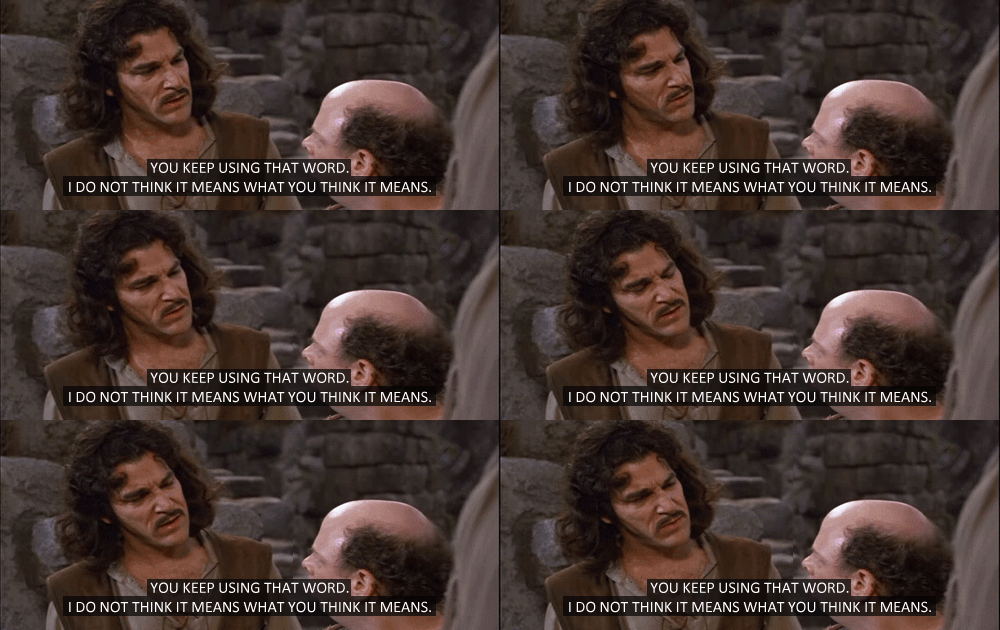
princess bridge inconceivable gif

Incidentally, the Princess Bride contains plenty of useful material for the conscious self-publishing author. Case in point:

princess bridge inconceivable gif

Royalty as a word has its roots in an ancient, mostly outdated traditional model of business. You want to steer clear of any of the aforementioned companies which offer “X percentage of your royalties!” unless they’re offering a flat 100%. Simply put, you’re already paying them for the same services which traditional publishing houses withhold from your royalties to pay for–marketing and such–so there’s absolutely zero reason to let these vanity presses take money out of your royalties on top of everything else you paid a flat starting fee for! They are counting on you not understanding what royalties were invented for, and fleecing you out of the difference.

It’s oh-so-easy to fall into a trap if you don’t do the math. And the only math here worth having is the full, 100% royalties delivered straight to you. Every book sale is your revenue or earnings, and always be sure to do your due diligence before selecting a publishing company. Your down payment and up-front publishing costs are an investment, and your royalties are the payoff! With a little care and a keen eye for the fine print, you can make back those initial expenditures.

You are not alone. ♣︎


Elizabeth

ABOUT ELIZABETH JAVOR: With over 18 years of experience in sales and management, Elizabeth Javor works as the Manager of Author Services for Outskirts Press. The Author Services Department is composed of knowledgeable publishing consultants, pre-production specialists, customer service reps and book marketing specialists; together, they all focus on educating authors on the self-publishing process to help them publish the book of their dreams. Whether you are a professional looking to take your career to the next level with platform-driven non-fiction or a novelist seeking fame, fortune, and/or personal fulfillment, Elizabeth Javor can put you on the right path.