In Your Corner: Royalties. What do they mean?

fountain pen money coins royalties

Royalties. There is no better word to convey a connotation of status, power, and entitlement for the published author … but it’s a word which can be dangerously misleading, or seductive. For one thing, getting your royalties isn’t the same thing as getting royalty.
royals tv show

Just sayin’.

You might be confused by the word. In fact, it took years of working in the self-publishing industry with legitimate experts on this subject for me to really get a handle on the finer points. I can’t go into all of them in a single blog post, of course, but I’m here today to talk about some of the common misconceptions about royalties as well as what royalties really are, and what they can do for you.

Definition A:
Royalties or a royalty paid to an author is a percentage of revenue earned on book sales.

Definition B:
Whatever the vanity presses can eke out of you without you knowing.

Traditional publishing houses pay royalties to their author clients based on a percentage of the listed retail prices of their books. This percentage depends on format, and can be tied to net receipts and/or net profits, which are essentially two more loopholes the industry invented to keep a little more of the money out of authors’ hands. And many times, these same institutions will offer authors advances against their expected royalties, which only occasionally works in the authors’ favor.

We never said they weren’t smart. But they’re definitely not out for their authors’ best interests.

So, what about self-publishing? Aren’t there royalties to be had there, too?


Yes and no. As a self-publishing author, you’re both author and publisher. So in the strictest sense, you don’t receive royalties because you don’t extend a deal to yourself and give yourself a percentage of your book’s profit, gross or net or anything else. But in a looser sense, and in most self-publishing literature, this is equivalent to receiving 100% of your book’s royalties–which sounds pretty great, doesn’t it? You’ve already covered the up-front costs of editing, publishing, and marketing, so what’s left is all yours, kids!

In self-publishing, your royalty is the total amount you’re paid. There might conceivably be situations where you split your revenue–say, if you co-authored your book, have a translator or illustrator you did not pay as an independent contractor, or if you accidentally publish through a shady vanity press service which keeps a percentage for themselves.

Read the fine print, always! This is especially true when it comes to paying vanity presses, self-publishing service providers, and DIY self-publishing platforms like Amazon’s Kindle Direct.
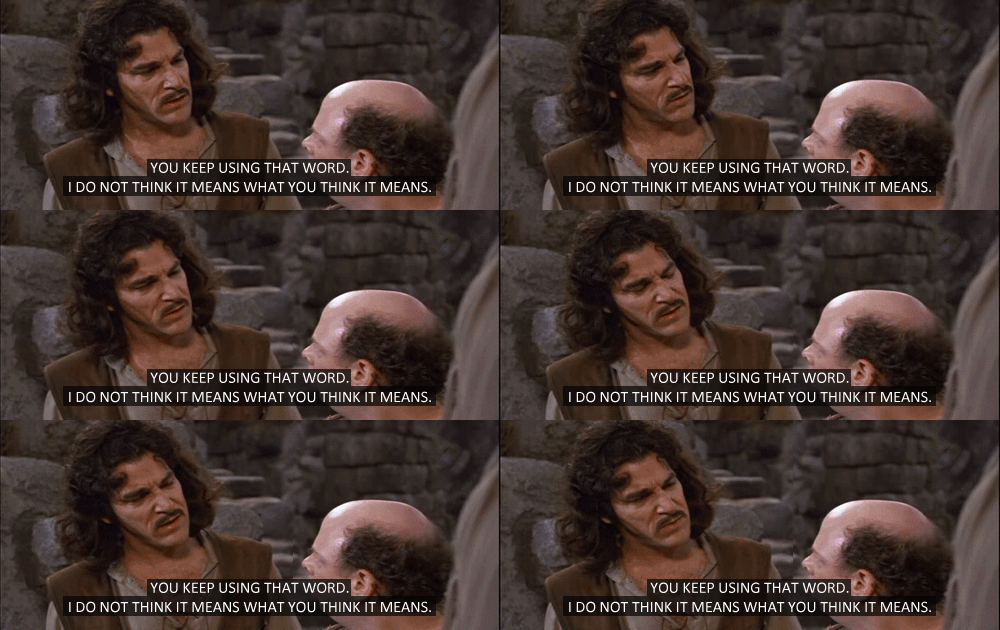
princess bridge inconceivable gif

Incidentally, the Princess Bride contains plenty of useful material for the conscious self-publishing author. Case in point:

princess bridge inconceivable gif

Royalty as a word has its roots in an ancient, mostly outdated traditional model of business. You want to steer clear of any of the aforementioned companies which offer “X percentage of your royalties!” unless they’re offering a flat 100%. Simply put, you’re already paying them for the same services which traditional publishing houses withhold from your royalties to pay for–marketing and such–so there’s absolutely zero reason to let these vanity presses take money out of your royalties on top of everything else you paid a flat starting fee for! They are counting on you not understanding what royalties were invented for, and fleecing you out of the difference.

It’s oh-so-easy to fall into a trap if you don’t do the math. And the only math here worth having is the full, 100% royalties delivered straight to you. Every book sale is your revenue or earnings, and always be sure to do your due diligence before selecting a publishing company. Your down payment and up-front publishing costs are an investment, and your royalties are the payoff! With a little care and a keen eye for the fine print, you can make back those initial expenditures.

You are not alone. ♣︎


Elizabeth

ABOUT ELIZABETH JAVOR: With over 18 years of experience in sales and management, Elizabeth Javor works as the Manager of Author Services for Outskirts Press. The Author Services Department is composed of knowledgeable publishing consultants, pre-production specialists, customer service reps and book marketing specialists; together, they all focus on educating authors on the self-publishing process to help them publish the book of their dreams. Whether you are a professional looking to take your career to the next level with platform-driven non-fiction or a novelist seeking fame, fortune, and/or personal fulfillment, Elizabeth Javor can put you on the right path.

Growing Pains: Part II

Continuing in the vein of growing your business or brand as an author, I want to talk about how you can hone in on what product or service it is you provide. As an author, your product is probably books, right? You might also offer other services though, such as freelance writing, editing, illustrating etc. Make a list of the products or services you supply and pick the most important item from each. It’s important to focus on the most important “thing” you want your business to be known for. Having too many options or services to market and sell will be overwhelming not only for you, but also for your customers.

growing pains marketing

The first step to ensuring you can expose your product or service to the marketplace is to, of course, market them. Marketing is definitely the dead horse we beat on this blog, but it is a crucial piece of being a self-published author. Here are some easy ways to market your book or writing services:

  • Social media! Use relevant hashtags (if you’re stumped, google relevant hashtags for ideas). Add and follow people and actively comment on their posts to get your name out there and encourage them to look on your page. Be active on forums, blogs, your website, etc.
  • Local events. Host local readings, poetry slams, etc. to network with other local authors.
  • Engage with those who already consume your products to ensure a good business/customer relation that will continue on in the future.

The next step is selling your product. Do you have a website where people can easily purchase your books or contact you for your services? Do your social media pages have links to your website? Do you have business cards to hand out at events?

You want there to be a certain ease of purchasing products for your customers. There’s nothing more annoying than a broken “purchase” link, or a giant “out of stock” next to your item. Make sure you have product to sell and make sure you have a means for people to buy it. If you go on tour, think about investing in a “square reader” for your iPhone so that if someone wants to buy your book and they don’t have cash you don’t lose that sale. Often someone will want to buy something on the spot, but if the opportunity passes, they will talk themselves out of it later or forget about it entirely, losing you a sale. Always be prepared to sell. This could be as simple as keeping books in your car or bag so that if you strike up a conversation with someone on the subway you have the opportunity to show them your work, or maybe even sell it.

Ultimately, once you’ve identified what you’re in the “business” of selling, it should be relatively easy to figure out how it is you can grow your business. Once you’ve nailed down who your customer base is and figured out how best to market to them, it’s time to streamline a way to sell your products and services to them.


Thank you for reading!  If you have any questions, comments, suggestions, or contributions, please use the comment field below or drop us a line at selfpublishingadvice@gmail.com.  And remember to check back each Wednesday for your weekly dose of marketing musings from one indie, hybrid, and self-published author to another. ♠


Kelly

ABOUT KELLY SCHUKNECHT: Kelly Schuknecht is the Executive Vice President of Outskirts Press. In addition to her contributions to the Outskirts Press blog at blog.outskirtspress.com, Kelly and a group of talented marketing experts offer book marketing services, support, and products to not only published Outskirts Press authors, but to all authors and professionals who are interested in marketing their books and/or careers. Learn more about Kelly on her blog, kellyschuknecht.com

From the Archives: “By virtue of the term: Self-publishing”

Welcome back to our Tuesday segment, where we’ll be revisiting some of our most popular posts from the last few years.  What’s stayed the same?  And what’s changed?  We’ll be updating you on the facts, and taking a new (and hopefully refreshing) angle on a few timeless classics of Self Publishing Advisor.

∗∗∗∗∗

[ Originally posted: October 14th, 2010 ]

Digital democracy. iTunes changed the record business forever. Blogs have reshaped the landscape of traditional print news. YouTube challenged the way television and advertising CEO’s communicated with the viewing public. Who would have thought even ten years ago that a majority of users would value a user-generated encyclopedia over Britannica?

Technology has quickly and powerfully changed the way we think, enjoy, communicate, and create. Across each industry one thing holds – a democratization effect – where artists make the rules.

On-demand and digital self-publishing is equally shaking things up. As the WSJ notes, “once derided as ‘vanity’ titles by the publishing establishment, self-published books suddenly are able to thrive by circumventing the establishment.”

“Playing God” in his book Mickey Mantle is Going to Heaven, former Yankee pitcher opted to self-publish in order to maintain his content control. A wise move that is rumored to have been opted into a movie project reuniting Matt Damon and Ben Affleck.

democracy definition

The democratization of self-publishing is a big deal, even seven years after we originally mentioned it. With our current grab-bag of print on demand services, self-publishing companies and vanity presses alike, we have an enormous quantity of titles available to readers for affordable consumption–and while few of them get printed in any quantity, is that really an undesirable thing? I mean on a large scale, not an individual one. Clearly it’s better for the individual to have more money in the wallet than otherwise. But a democratic system is a diversified one, with products and services to meet every preference. And that’s where we are, more or less!

So how does this democratization help authors? As someone who has dabbled in both nonfiction and memoir, here’s one way:

Traditionally, nonfiction authors were required to draft outlines and preliminary chapters, submit these to agents and publishing houses for review, and hope that someone would like that material enough to give them an advance–money to help them do the research required to write the rest of the book. Research, generally speaking, is expensive–especially because for nonfiction it usually requires travel, lodging, meals, and subscription or access fees to information repositories like museums and so forth to complete. Many wonderful nonfiction books have not been written simply because authors weren’t able to give publishers a real sense of what their book was about because the money had to come first in order to really do so….

Self-publishing, however, has co-evolved with a whole host of crowdsourcing options. I have at least one friend who financed her book over Kickstarter with some success, and others who have been even more creative. (But that’s for another post. Soon, I promise.) These alternate revenue streams mean that self-publishing authors don’t have to wait on anyone’s say-so, and they don’t have to sacrifice any creative control over the research, writing, and publishing experience to an institution which will always value its own success over its authors’. So nonfiction authors, in this situation specifically, benefit a great deal from not being dependent on an advance. The same holds true for fiction authors in all of the most important ways, and you only have to follow the career of poet Rupi Kaur to see how self-publishing can indeed be more than congenial to that third great genre.

Of course, the idea and status “commercial author” may be on the way out, or at least these authors who’ve chosen to struggle through the traditional publishing model may have diminished opportunities. Fewer authors each year see the virtue in being one of these so-called “starving artists,” who make their way in the world based on an antiquated publishing model which never treated them well in the first place. This is okay. It’s also okay to be a starving artist, by the way. I just wouldn’t want to be one, and it’s no longer the only model of a successful artist anymore.

Self-publishing still has its flaws. But anything that makes publishing possible for more authors, more affordably, and guarantees them more rights and freedoms, is a democratizing influence. And I love democracy! The fact that self-publishing also makes reading more affordable and a more diverse experience can only lead to good things.


Fun Note: A quick foray on Google reveals that as of 2015, at least, Peterson’s book is still under development by Affleck and Damon, so that’s another ray of good news.

Thanks for reading.  If you have any other ideas, I’d love to hear them.  Drop me a line in the comments section below and I’ll respond as quickly as I can.  ♠


Kelly

ABOUT KELLY SCHUKNECHT: Kelly Schuknecht is the Executive Vice President of Outskirts Press. In addition to her contributions to the Outskirts Press blog at blog.outskirtspress.com, Kelly and a group of talented marketing experts offer book marketing services, support, and products to not only published Outskirts Press authors, but to all authors and professionals who are interested in marketing their books and/or careers. Learn more about Kelly on her blog, kellyschuknecht.com.

Self-Publishing News: 5.1.2017

And now for the news!

Some highlights from this week in the world of self-publishing:

Yesterday, in his article for the UK’s Express, author John Marrs dishes on what it took for him to survive all of those rejection letters–and still rise to the top, albeit through different means. Self-published means! Writes Marrs, “I assumed that with more than 20 years as a journalist behind me, writing for national magazines and newspapers, I might have had a slight advantage over other new writers on the hunt for an agent. How naive I was.” And how common an experience this is, for authors today. Becoming published, it seems, has less to do with skill and experience than with some nebulous formula for blockbuster success which the traditional Big Five publishing houses then fail to make good on in most cases. (We’ve talked about midlist authors here on the blog before, and how difficult it is to succeed in publishing even with a publishing house at your back.)

Luckily for Marrs (and everyone else), he found another way. He self-published through Amazon, and his book began to sell. The secret? Family. “I was fortunate that enough family and friends of friends bought The Wronged Sons for it to make an impact on Amazon’s charts,” writes Marrs. “Then, once visible, people I didn’t know began downloading it, too. Recommendations also came from members of online book clubs.” And he didn’t stop there–he released two more books, both of which became big sellers. He has since signed on with a traditional publishing house, but that, he says, is not the greatest reward he’s experienced as a result of self-publishing. Instead, it’s the fans: “One of my favourite things to have come from this ride is being able to interact with readers. They often tweet me to chat about characters or storylines they enjoyed and send me pictures on Instagram of my books in countries as far and wide as Canada, the Maldives and New Zealand,” he writes. If you’re a reader of self-published books, we hope you take a moment to tweet or comment on your favorite authors’ social media accounts today. It makes a big difference!

In this April 26th piece for the Entrepreneur, Samita Sarkar explains why running a kickstarter to launch your book is hard–and maybe not advisable. And in an age when launching a book is already hard, this may seem like a harsh judgement but in fact Sarkar’s thoughts are tempered by compassion and a great deal of wisdom. “Self-published authors know that you can spend months — or years — honing your writing craft,” she writes, “but as soon as your book goes to print, you’re no longer just a writer; you’re also an entrepreneur. Your publishing imprint is your company, and your book is your product.” This is not a bad thing, but it can lead to some interesting consequences when Kickstarter is involved.

“Statistics from Kickstarter show that most of that platform’s campaigns fail,” writes Sarkar, “And that’s not good, because your Kickstarter page is never deleted. So, for years to come, anyone who Googles your name may stumble upon that failed campaign. Out of 349,504 total campaigns,Kickstarter reports, just 123,447 succeeded –a 35 percent success rate. Some 14 percent of projects finished without receiving a single pledge.” You will want to weigh this possible (or statistically probable) result against your need for money. But Sarkar also has some points on how to make Kickstarter work, and these points are worth paying attention to. Read the rest of her article to find out more!


spa-news

As a self-publishing author, you may find it helpful to stay up-to-date on the trends and news related to the self-publishing industry.This will help you make informed decisions before, during and after the self-publishing process, which will lead to a greater self-publishing experience. To help you stay current on self-publishing topics, simply visit our blog every Monday to find out the hottest news. If you have other big news to share, please comment below.

KellyABOUT KELLY SCHUKNECHT: Kelly Schuknecht is the Executive Vice President of Outskirts Press. In addition to her contributions to the Outskirts Press blog at blog.outskirtspress.com, Kelly and a group of talented marketing experts offer book marketing services, support, and products to not only published Outskirts Press authors, but to all authors and professionals who are interested in marketing their books and/or careers. Learn more about Kelly on her blog, kellyschuknecht.com.

Saturday Book Review: “Toxic Food Nation”

Book reviews are a great way for self-publishing authors to gain exposure. After all, how can someone buy your book if he or she doesn’t know it exists? Paired with other elements of your book promotion strategy, requesting reviews is a great way to get people talking about what you’ve written.

When we read good reviews, we definitely like to share them. It gives the author a few (permanent) moments of fame and allows us to let the community know about a great book. Here’s this week’s book review, courtesy of Midwest Book Review:

51qzWwWLmpL

Toxic Food Nation: Why the American Diet is Killing Us … and What We Can Do About It

by George M. Burnell, M.D.

Publisher: Outskirts Press

ISBN: 9781478775355

Synopsis*:

Toxic Food Nation; Why the American Diet Is Killing Us and What We Can Do About It is a wake-up call to all Americans about the typical American diet, rich in processed foods, fat, sugar, salt, omega-6s, pesticides, hormones, antibiotics and hundreds of untested chemicals. This diet triggers chronic inflammation in the body and brain, which leads to heart disease, diabetes, obesity, Parkinson’s disease, Alzheimer’s disease, Crohn’s disease, arthritis, anxiety, mood and behavior disorders, and cancer. We are now faced with several questions about the safety and toxicity of the American diet. How harmful are these chemicals? Can we rely on the government and food industry to protect us from potential threats to our health? What can we do to protect ourselves?

Toxic Food Nation answers all these questions and tells you what the food and chemical industries don’t want you to know and why governmental agencies and elected officials remain silent on the subject. Our food supply is laced with dangerous toxic chemicals that will harm you and your loved ones for years to come unless you take action now. Toxic food is now the new tobacco. It took over two decades before the public accepted the fact that tobacco caused cancer. Meanwhile, plastics and pesticides in our food continue to stockpile in our issues for decades, eventually erupting into a full array of chronic diseases in midlife. In Toxic Food Nation Dr. Burnell shows you how to benefit from cutting-edge science, explaining how to protect and enhance your immune system, which is the key to overcome the devastating effects of chronic inflammation. Drawing from clinical and laboratory studies as well as the latest research around the world, Toxic Food Nation gives you a highly practical program of simple dietary recommendations to prevent disease and heal the symptoms that threaten you and your loved ones. In a clear and nontechnical language Dr. Burnell discusses the issues, choices and barriers to overcoming

 * courtesy of Amazon.com

Critique:

Maintaining a healthy diet is crucial to day-to-day well-being, as well as potentially saving a fortune in health care costs. Yet selecting healthy food is a challenge in the modern era of supermarkets filled with foods that are processed, high-calorie, high-fat, or low-nutrition! Toxic Food Nation discusses the chemicals commonly added to food, what to look for (or avoid!) in nutrition labels, the circumstances under which vitamin/mineral/dietary supplements can be toxic, and much more. Thoroughly accessible from first page to last, Toxic Food Nation is a “must-read”, highly recommended!

“…there are no studies supporting the use of colonics to enhance general health or provide cures for various ailments. In fact, potential side effects can be serious; they include nausea, diarrhea, life-threatening blood poisoning caused by contaminated equipment, […] inability to have bowel movements without colonic irrigation or enemas….”

reviewed on The Health Shelf of Midwest Book Review ]

Here’s what some other reviewers are saying:

Dr. Burnell’s book, ‘Toxic Food Nation’, is an invaluable source of information about the toxic and medicinal properties of the food we consume.
Despite the book having an extensive amount of information, Dr. Burnell is able to explain complex subjects, backed up by the latest peer-reviewed research that a lay person can understand.
In today’s busy world where we may not have time to read ‘Toxic Food Nation’ cover-to-cover, in one sitting, the layout of the book allows me to open it to any area of interest, go to the grocery store, and change at least one food choice. By dinner time I am eating a meal that will be the first of many healthier dietary choices.
A heartfelt thanks to Dr. Burnell.

– Amazon Reviewer Craig H.

‘Toxic Food Nation’ is a comprehensive book on what’s bad and risky in the typical American diet today. Dr. Burnell has made this book very easy to read, and understand. He starts with a questionnaire that assesses whether your current diet puts your health at risk for future chronic diseases (heart disease, diabetes, arthritis, stroke and cancer) and compares it with a retake version of the same questionnaire after you finish the book.
At the end of each chapter you can follow a set of guidelines that will lead you to more healthy eating at your own pace. There is lots of invaluable information, well researched and backed by evidence peer reviewed studies up to 2016. You can always refer back to a given chapter or page you wish to tab for a revisit. Many of my pages are tabbed already. Our foods are becoming the good, the bad, and the ugly, due to so many toxins in processed and packaged foods, our water, and soil.
Organic is the way to go forward. Invest in good food now and save yourself the big extra bucks for medical care later on. Remember: It is never too late to start.

– Amazon Reviewer Elizabeth Ann Gomez


saturday self-published book review

Thanks for reading!  Keep up with the latest in the world of indie and self-published books by watching this space every Saturday!

Self Publishing Advisor

selfpubicon1