In Your Corner : Why Pampering Yourself (& Your Book) Isn’t Such a Bad Thing

When I say “pamper,” I’m guessing one or two images immediately pops into your mind. Luxury in today’s world means manicures and pedicures, gourmet meals, superyachts, and never having to wait in line at the DMV.  Most importantly, perhaps, it is seen as something unattainable by all save a select few who hit the genetic lottery or who are otherwise incredibly lucky.  But most people don’t get to live this life.  Most people aren’t millionaires.  To most people, self-publishing authors included, life is a constant series of negotiations between risk and reward, where “success” equates to keeping one’s head above water a little while longer, and “failure” means losing the house.  Luxury and pampering is saved for special life events, like honeymoons and year-end vacations, only to illustrate even more clearly how impossible it is to attain these things easily and sustainably.

All this is true. But it shouldn’t stop you, a self-publishing author, from receiving the best services available in the design, formatting, and publication of your book.
manicure pedicuregourmet meal

I’m talking about premium options.  And while it’s easy to see why some of these options, like cover enhancement on your book’s Amazon listing, are desirable.  But it’s harder to see, I’d guess, why it’s worth pampering yourself with these options when they’re a kind of luxury.  You can publish your book without them.  So why pay for something you don’t strictly need?  It’s the same old risk vs reward balancing act I mention, above, isn’t it?

I happen to think that certain luxuries are not just attainable for the common author but are revolutionary to that author’s marketing and sales experience.  The problem with premium options on Amazon is that they truly are a kind of pampering–in that they’re not something the common author can do by him or herself.  They take special access to the Amazon publication system, special design skills, and a killer instinct for the constraints of the form.  Basically, the financial obstacles may be easily overcome and the social ones too, but there remains an expertise gap to cross.

Which is why I strongly recommend paying, just this once, for that little luxury–a payment that recoups enormous dividends in the self-publishing author’s sales figures.  If you’re wondering about the specifics, premium options on Amazon allow readers to see your book featured in a larger and more eye-catching setup in their keyword search results, to see inside your book and read some front-page material in a preview … and to see your book cover right away, rather than waiting the four weeks or so that it ordinarily takes the images to be processed.  These are not small advantages–they are the make-or-break features that often determine whether a new reader clicks their way into learning more about your book and, of course, buying it!

The tweaks may be small, but the effects are huge.  They’re at least worth researching, and given my background at Outskirts Press I of course recommend starting with reading up on the enhancement options they offer there.  But no matter who you choose, keep your eyes and ears open to new ideas and new opportunities to “pamper” yourself.  You’re worth it.  Your book is worth it.  You deserve the best!

You are not alone. ♣︎

ElizabethABOUT ELIZABETH JAVOR: With over 18 years of experience in sales and management, Elizabeth Javor works as the Manager of Author Services for Outskirts Press. The Author Services Department is composed of knowledgeable publishing consultants, pre-production specialists, customer service reps and book marketing specialists; together, they all focus on educating authors on the self-publishing process to help them publish the book of their dreams. Whether you are a professional looking to take your career to the next level with platform-driven non-fiction or a novelist seeking fame, fortune, and/or personal fulfillment, Elizabeth Javor can put you on the right path.

Self-Publishing News: 5.16.2016

This week in the world of self-publishing:

This piece–written by Tonya Riley for “The Kernel” on The Daily Dot for the week of May 15–explores the rise and fall of one of self-publishing’s most recent features: the community-ranked and community-driven sort-of self-publishing competition website.  If you haven’t heard of InkPop, you  might have heard of Figment or Swoon Reads, both of which operate on a similar principle: would-be authors upload their manuscripts for other authors and readers to vote on and rank, and the top-ranked manuscript goes on to sign a contract with a publishing house.  In the case of InkPop, that was HarperCollins, a “Big Five” publishing house which went on to shutter InkPop in 2012 after publishing only two manuscripts through the platform.  Riley takes an up close and personal look at why InkPop ultimately failed, despite all of the things it did right.  She interviews author Wendy Higgins, one of InkPop’s two success stories, as well as other members of the InkPop forums.  To read her entire article, follow the link!

[CONTENT WARNING: LANGUAGE]

“Sometime last decade,” writes Katie Rife for The A.V. Club in this May 12 news piece, “Amazon introduced Kindle Direct Publishing, which allows aspiring authors to upload their work to Amazon directly, spending less time dealing with the dinosaurs in the publishing industry and more time writing stories about dinosaurs f***ing people.”  Rife, who eschews more politically correct language to make a point, is referencing an earlier article published by The A.V. Club about the careers of two authors of dino-erotica, one of the many subgenres (many of which are, one hopes, more innocently self-aware) that the self-publishing industry and Amazon in particular has made possible.  (No, I won’t provide that other link here.  Hop on Google if you must!)  But Rife has actual news to share, news which has rocked the self-publishing and video communities: “Amazon, being the pervert that it is, isn’t satisfied. It wants video.”  What she means is, Amazon has deliberately placed itself as a competitor to YouTube and therefore YouTube’s parent company, Google.  Amazon’s new platform probably sounds very familiar: users upload videos to Amazon’s “Video Direct” service that they have made or at least own the right to, decide if they want the video to be free, rentable or purchasable, or free on Amazon Prime (which earns income dependent on performance).  As Rife points out, the content of these videos will probably be determined by equal parts self-interest and the whim of the watching public, which could lead to some … er, interesting material.

“As a former gatekeeper, I’m fascinated by the gatekeeper divide in book publishing, where the role gets falsely propped up by supporters of traditional publishing and completely dismissed by those who favor the indie space,” states Brooke Warner of She Writes Press fame in this May 12 HuffPost Books piece.  She pits former Random House editor Daniel Menaker against self-publishing success story Hugh Howey, each of which paints their chosen platform with the language of perfection–particularly as regards “gatekeeping,” or the tendency of people in positions of authority and power to filter the tastes and interests of those under their influence.  “I take issue with both extremes,” writes Warner, whose own website falls somewhere in the middle between traditional and self-publishing models.  She rejects the sexism and predestinate careers of both parties and instead opts to argue that “there’s another gatekeeper arising in our midst that no one is talking about—and that’s the distributor.  And while she goes on to make the contestable argument that self-publishing churns out inferior books, she follows this up by positing it may in fact be a problem of recognition: there is no system in place to ensure that high-quality self-published materials rise to the top and received the acclaim they deserve, raising the tenor of self-publishing overall.  For more of Warner’s fascinating argument, check out the original article at HuffPost Books.


spa-news

As a self-publishing author, you may find it helpful to stay up-to-date on the trends and news related to the self-publishing industry.This will help you make informed decisions before, during and after the self-publishing process, which will lead to a greater self-publishing experience. To help you stay current on self-publishing topics, simply visit our blog every Monday to find out the hottest news. If you have other big news to share, please comment below.

KellyABOUT KELLY SCHUKNECHT: Kelly Schuknecht is the Executive Vice President of Outskirts Press. In addition to her contributions to the Outskirts Press blog at blog.outskirtspress.com, Kelly and a group of talented marketing experts offer book marketing services, support, and products to not only published Outskirts Press authors, but to all authors and professionals who are interested in marketing their books and/or careers. Learn more about Kelly on her blog, kellyschuknecht.com.

From the Archives: “Self-Publishing Authors Can Get Their Books on the Shelves of ‘Traditional’ Bookstores”

Welcome back to our Tuesday segment, where we’ll be revisiting some of our most popular posts from the last few years.  What’s stayed the same?  And what’s changed?  We’ll be updating you on the facts, and taking a new (and hopefully refreshing) angle on a few timeless classics of Self Publishing Advisor.

∗∗∗∗∗

[ Originally posted: April 27th, 2011 ]

Even with the recent changes in the book publishing industry, a “traditional” bookstore presence should still be a goal for authors who want this. Why? Well, with this presence, authors are able to target an audience that is passionate about books. Think about it — people have to leave behind the comforts of their own home to go into a bookstore. Most likely they are there to purchase a book. If your book is on the shelf, yours may just have a chance at being the book they buy.

How can you work toward getting your book into that bookstore, though? Is it a matter of luck? Can self-publishing authors make the cut? The good news is that even if you’re not necessarily on a “lucky streak”, it’s still possible to successfully target placement in “traditional” bookstores. However, you must have a solid plan in place for doing so. Here are a few action items to put on your list as you get started:

  • Make sure your book is fully returnable. If your book cannot be returned, there is great risk involved for the bookstore. For example, if they stock 10 copies of your book and only 4 sell over the course of a year, they are losing money. If the book is returnable, though, the store can simply send the book back that doesn’t sell. Think of this return-ability as a type of “insurance” for your book.
  • Offer a sufficient trade discount. What’s sufficient? Typically that will be around 50-55% (or higher). Of course this does cut into your profits, but a higher retail margin gives the bookstore more incentive to stock your book on their shelves. No incentive? No cigar.
  • Build proof that your book is desirable. This is probably the most difficult (though not insurmountable) part of it all because authors often have a bias view of their book. However, the best indicator of a desirable book is exponential sales figures. If the amount of books you sale doubles, triples, quadruples, etc. month-after-month, that is something that can work in your favor. If you aren’t a professional marketer, you may want to seek the services of a book marketing consultant. Make sure they are able to help you draft a marketing plan and go forth on planning your publicity.

After you’ve done all of the above, you must put together a proposal to submit to bookstore contacts. You can find others specifically on their websites, but Barnes & Noble can be reached here:

The Small Press Department
Barnes & Noble
122 Fifth Avenue
New York, NY 10011

Other bookstores can be found through Google. Another popular site for locating independent bookstores is Indie Bound.

Do you know of any other bookstores that are small press/self-published friendly?

by Wendy Stetina

When Wendy first posted this article back in 2011, the publishing industry looked rather different––and in many ways, it looked to be stumbling down the path to utter self-annihilation.  Borders, once a behemoth of the bookselling industry, went out of business in 2011, leaving many readers and authors questioning what––if any––place the brick and mortar bookstore held in the future of their industry.  In the heated discussion that followed in the post’s comments section, various Self Publishing Advisor subscribers pointed out the rise of online retailers as the cheapest and most effective sales platform for indie authors.  In response, SPA moderator Elise L. Connors wrote that “[T]his post wasn’t written with the intention of persuading authors to go after bookstores. It was actually written to let authors who are going after that avenue know that they shouldn’t give up on that ‘dream’ because of the current landscape of the industry.”  (The italics are mine.)

It’s true that Amazon has continued its meteoric rise to the top of the bookselling industry since 2011, and it’s also true that Amazon’s expanded offerings to self-publishing authors have captured much of the market and spurred much public dialogue about the world of indie publishing.  It’s true that Barnes & Noble’s online presence, the Apple iBooks Store, and a whole host of social media platforms and numerous self-publishing companies have sprung up in recent years to diversify and stabilize the market.  And while there have never been so many ways to buy and sell a book as there are in the year 2016, it is true too that ebooks and e-readers have done nothing to lessen customers’ appreciation for the pure tactile pleasure of a brick and mortar store.

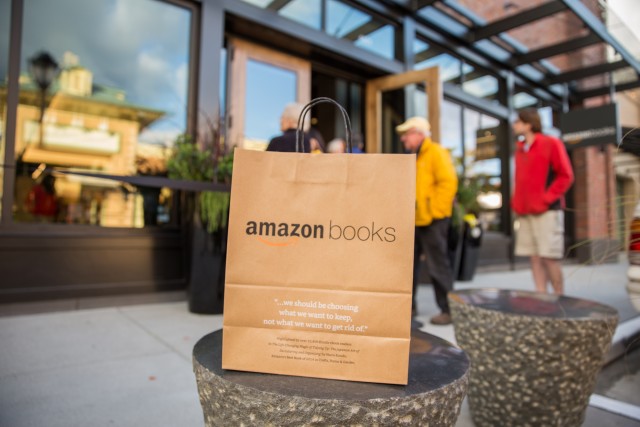
Even Amazon has come around to seeing a street presence as importance, as evidenced by the launch of the first Amazon Books shop (in Seattle) last year.  Yes, it seems mostly a kind of marketing gimmick, but it’s one that works.  As one skeptical self-publishing expert learned, even the store’s critics often walk away with an Amazon Prime Membership or a physical book or two.  (These are true stories, people!)  There is, apparently, nothing that quite beats the “instant gratification” of beholding actual physical books on an actual physical shelf.  And while the jury’s still out on whether Amazon Books stores will do anything specifically geared to boost sales of self-published works––like installing Espresso Book Machines, for example, or offering curated collections of Print on Demand (POD) editions of Kindle favorites––one can’t help but notice the wide swathes of shelf space dedicated to Kindles in pictures of the interior.
amazon bookstore

And Amazon’s not the only company with a brick-and-mortar presence that can make a difference for indie and self-publishing authors.  In fact, many independent bookstores and even larger chains like Denver’s Tattered Cover go to great lengths to boost sales of local indie authors.  On my last visit to one of Tattered Cover’s several stores, I stepped inside the doors and made my way toward the coffee bar––only to find my progress impeded by a series of low bookshelves that blocked out the cafe’s seating area.  These shelves were the first thing every customer sees when walking in that store, and they were positively packed with self-published books, placed there on consignment.  (If you live in or near Denver and are interested in knowing more, visit their website.)


But ultimately, I’m not here today to defend the bookstore as a vital place to sell your books.  I’m here to help those of you who already know you want to get your book into a bookstore somewhere … to do so with the least amount of fuss.

To return to Wendy’s original post, most bookstores now either mandate her first point (“Make sure your book is fully returnable“) or take any guesswork out of the equation by relying on a consignment model (as with Tattered Cover, above).  And Wendy’s second point holds true: when an author is given the option, it’s a wise idea to “Offer a sufficient trade discount.

In many ways, however, Wendy’s third point is the most important.  Aside from keeping your name and work in the public eye, simply by virtue of placing your book in a bookstore, there are several ways you as an author can help “Build proof that your book is desirable.”  Most bookstores have stringent standards for the self-published books they stock: the title in question must dots its is and cross its ts in that it must have an ISBN, a cover that exudes professionalism and sound design sense, and so on.  Striving to meet these standards in order to appear on Barnes & Noble’s or Tattered Cover’s shelves can only do good things for the “desirability” of your book on a larger scale.  I guarantee you that an attractive, professional-looking book will sell better online as well as off the shelf.

Last but not least, a fantastic way to sell readers on the value of your book is by building relationships with them––and one of the best ways to make contact with your readers is to host events … at your local bookstore.  If you pursue hosting such an event, many bookstores will offer additional opportunities to feature your works within your stores, especially since good attendance at your event will likely translate into a solid spike in general sales for them.  (More foot traffic always equates to more sales when it comes to a brick-and-mortar bookstore.)  And the flipside of the coin is also worth examining: if you have already managed to clear a bookstore’s consignment standards, they are more likely to agree to partnering with you on hosting such an event.  Readings, Q&A sessions, and book signings are fertile ground for the indie author!  ♠

KellyABOUT KELLY SCHUKNECHT: Kelly Schuknecht is the Executive Vice President of Outskirts Press. In addition to her contributions to the Outskirts Press blog at blog.outskirtspress.com, Kelly and a group of talented marketing experts offer book marketing services, support, and products to not only published Outskirts Press authors, but to all authors and professionals who are interested in marketing their books and/or careers. Learn more about Kelly on her blog, kellyschuknecht.com.

Self-Publishing News: 1.11.2016

This week in the world of self-publishing:

Corine la Font, in this January 10th article for the Jamaican Gleaner, writes that “it is wise and cost-effective to just obtain the free assigned ISBNs from the platform you are using”–since most platforms provide ISBNs automatically–instead of buying them directly.  Since ISBNs are sold in batches of 10, you may end up with a whole lot more than you need, unless you use a third party service or hybrid publishing company.  ISBNs, for those who aspire to self-publish but have yet to do so, are numeric codes of either 10 or 13 digits that publishing companies, booksellers, readers, and others will use to identify your book as well as the format in which your book is published.  “Ideally,” says la Font, “each format should have its own ISBN, that is print, audio and Kindle/ebook, but what tends to happen is that Amazon, when publishing the ebook of the same title, assigns an ASIN (a topic for another article) to that specific format.”  ISBNs are a key element of the publication process; for more information, visit la Font’s original article here!

Under the “Booklife Report” heading in this week’s Publisher’s Weekly roundup–published on January 10th–-you’ll find a link to an earlier 2016 article by Leylha Ahuile on the explosion of opportunities for self-publishing authors in the Spanish language market.  While the article itself is only available to Publisher’s Weekly subscribers (leaving us with the tantalizing introductory sentence: “Self-publishing is a well-established part of the English-language book trade, but Spanish-language self-publishing is just starting to take off”), it reminds me of this 2013 article by Tina Folsom of the Indie Voice blog, titled “Exploring the Foreign Markets for Self-Publishing.”  Ahuile’s article may claim that opportunities in Spanish language markets have some element of newness to them, but Folsom’s piece and many other articles besides have long been touting the possible benefits of looking beyond the tangible boundaries of geographical divides and the abstract boundaries of language.  Whether you’re looking to self-publish in English and translate your book to Spanish, or publish directly in Spanish, don’t neglect to consider the fact there are more native Spanish speakers and Spanish-language readers in the world than there are native English speakers.  And this doesn’t even touch the percentage of global citizens who speak and read other languages, like Mandarin Chinese!  There has never been a better time to sell your book abroad.

“Penguin Random House, the largest book publisher in the world, is chopping off its self-publishing arm,” writes Amy Wang of the Quartz blog in this January 7th article: “The company said Tuesday (Jan. 5) that it has sold Author Solutions—the self-publishing author-tools platform that it bought in 2012.”  Author Solutions has long been a mainstay of the self-publishing toolbox, but has struggled to emerge from its ownership transfer and other internal problems and to overcome significant obstacles to satisfying end-user demands.  While a sale does not necessarily spell the utter end for Author Solutions, it does seem to indicate a continued slide towards irrelevance as other, better, and easier-to-use options reach a mainstream audience.  Writes Wang, the sale is also an admission of defeat in the battle to stave off market dominance by Amazon, “which already churns out an estimated 85% of self-published titles via its various platforms.”  That’s a tough number to beat.  For more of Wang’s article, follow the link.

“There’s too much grumbling among authors,” says Carol Buchman in this January 7th contribution to The Bookseller.  But Buchman, a self-publishing author of Western fiction based out of Montana’s Flathead Valley, sees a lot of cause for hope: “some people seem to overlook the wonderful benefits of various publishing modes these days,” she says, citing the “freedom to publish and to read in the manner that suits [one] best,” the choice “among e-readers, audio devices, and paper—hardbound or paperback,” and the opportunity for authors to “publish their works in all three formats” as reasons not to despair for the world of words.  “As a storyteller,” she writes, “I’m enthralled by the possibilities in technological development for storytelling.”  She goes on to address “the innovative energy inherent in technology” as an empowering force, and to rally readers and authors alike to a more hopeful, optimistic outlook.  Her full “five-minute manifesto” is available, courtesy of The Bookseller, here!


spa-news

As a self-publishing author, you may find it helpful to stay up-to-date on the trends and news related to the self-publishing industry.This will help you make informed decisions before, during and after the self-publishing process, which will lead to a greater self-publishing experience. To help you stay current on self-publishing topics, simply visit our blog every Monday to find out the hottest news. If you have other big news to share, please comment below.

KellyABOUT KELLY SCHUKNECHT: Kelly Schuknecht is the Executive Vice President of Outskirts Press. In addition to her contributions to the Outskirts Press blog at blog.outskirtspress.com, Kelly and a group of talented marketing experts offer book marketing services, support, and products to not only published Outskirts Press authors, but to all authors and professionals who are interested in marketing their books and/or careers. Learn more about Kelly on her blog, kellyschuknecht.com.