reading succesAs a self-publishing author, you may find it helpful to stay up-to-date on the trends and news related to the self-publishing industry. This will help you make informed decisions before, during and after the self-publishing process, which will lead to a greater self-publishing experience. To help you stay current on self-publishing topics, simply visit our blog every Tuesday to find out the hottest news.
The success of EL James and her Fifty Shades of Grey trilogy did much to overturn the stereotype of a self-published author. Now academic research further challenges the image of eccentric hobbyists scribbling away in their sheds by revealing that it is middle-aged and well-educated women who dominate the growing e-publishing market. This article is an interesting read for all female writers.
This list of top self-published books is an excellent resource for authors wanting to learn more about the industry and craft by studying other writers. I recommend reading successful books by self-published authors as a way to see what works, what doesn’t work, and to improve your own writing and marketing approach.
If you have other big news to share, please comment below.
ABOUT KELLY SCHUKNECHT: Kelly Schuknecht is the Executive Vice President of Outskirts Press. In addition to her contributions to the Outskirts Press blog at blog.outskirtspress.com, Kelly and a group of talented marketing experts offer book marketing services, support, and products to not only published Outskirts Press authors, but to all authors and professionals who are interested in marketing their books and/or careers. Learn more about Kelly on her blog at http://kellyschuknecht.com.
I spent 13-years as a contractor with the Department of Defense working in a variety of locations: Germany, England, Hungary, Bosnia, Turkey, Spain, Italy, Hawaii and New Mexico. This work put me in day-to-day contact with military personnel and gave me personally a HUGE appreciation for veterans – for what they do and what they sacrifice, so today, I’d like to take the time to say thank you to all of the veterans who have served our country. I truly appreciate the sacrifices you have made and admire your courage, strength, and dedication.
In the past, I’ve encouraged writers to honor soldiers by self-publishing stories about them, but today I want to encourage all soldiers, whether they consider themselves writers or not, to share their stories. Each of you has a story to share. Whether it is a love story, a war story, or just general reflections on the time you served, people want to read it.
I think it is important that people get the opportunity to learn many versions of events, especially first-hand tales from those who were there. I also think writing and story telling is a great way to heal, remember, and honor. The American people don’t want to just hear stories from the media. They want to hear stories from the soldiers who were there!
Now, you may be thinking, but I don’t write, and that is okay. You can self-publish a book even if you don’t consider yourself a writer. There are professional ghostwriters out there who would love to help you turn your story into a great book. There are also amazing editors, illustrators, and marketing professionals who can help you be successful.
In honor of Veterans Day, I leave you with this message: share your story. People want to know it, and only you can tell it.
ABOUT JODEE THAYER: With over 20 years of experience in sales and management, Jodee Thayer works as the Manager of Author Services for Outskirts Press. The Author Services Department is composed of knowledgeable customer service reps and publishing consultants; together, they all focus on educating authors on the self-publishing process in order to help them publish the book of their dreams. Whether you are a professional looking to take your career to the next level with platform-driven non-fiction or a novelist seeking fame, fortune, and/or personal fulfillment, Jodee Thayer can put you on the right path.
“Knowledge is the advancing retrieval of clarity from uncertainty and confusion.” I may not have quoted that exactly (nor do I remember where I heard or read it), however, I love the concept of “advancing retrieval.” Tis’ a bit of a paradox, which intrigues me and requires me to tap into my objectivity abilities to separate what is from what I imagine or believe.
One of my best childhood and young-adult friends (who is not a writer) was a master at stating his opinion in absolute terms. That was a trap I fell into way too many times, especially when restating his “fact” in term papers. I could have gone the way of several of our other friends who discounted everything he ever said. However, in some rather miraculous way, I came to appreciate his often unfathomable views and utilize them as a point of comparison with what I was discovering to be reality. So it is that I offer you my final (for now anyway) points to consider on the topic of Critical Thinking. Together with the previous three blogs, I hope these concepts will help you produce superb writings and reader-recognition.
Withhold Judgment. If a piece of information “tweaks” your ear and you immediately want to deny it—or accept and promote it—DIG DEEPER. Do the research. Go the extra investigative mile and put the puzzle pieces together. When the “fit” is natural, you’ll have your answer.
De-pressurize the Pressure. If editors are pushing you to complete a book or article and the words “just get it done” fall into your ear, STOP! The immediate temptation to follow that direction could produce a written work you will not be happy with and—as we know well—it remains “in print” forever—everywhere. It’s okay to remind the editor that their reputation is in play, too. If they don’t care, you may not want to work with/for them again.
Check and Re-Check the Facts. The journalistic rule of “two-or-more” sources is a good place to start. However, depending on your topic and the motive behind writing about it, building a chain of “evidence” that is good, better and best leads to a well-built and believable piece of writing.
Don’t Fear Questions. If uncertainty remains in your mind, it’s okay to include those in your writing. Readers appreciate being included in the discovery process and will buy your next book on that topic to “see” what you’ve learned that they missed.
Avoid Rationalization. I’ve listened to some “creative writing” instructors who insist that decisive writing is a technique that must be mastered and used in all written work. In the marketing arena everything is stated as “fact” and rationalization is a trap door used against the reader. Writers who employ this technique often fall into the consequences of poor decision-making themselves.
Appreciate Your Own Intuition. Hunches are those intriguing and sometimes logically-illogic threads that lead to great discoveries. Never hesitate to listen to them and follow their paths until you’re satisfied with what you find.
All of these elements of Critical Thinking serve the writer in “advancing the retrieval” of pieces to the puzzle of their writing projects—big or small. Join the adventure! Retrieve that remnant of an idea and start advancing it! Soon you’ll have it published and be writing the next one!
ABOUT ROYALENE DOYLE: Royalene Doyle is a Ghostwriter with Outskirts Press, bringing more than 35 years of writing experience to authors who need “just a little assistance” with completing their writing projects. She has worked with both experienced and fledgling writers helping complete projects in multiple genres. When a writer brings the passion they have for their work and combines it with Royalene’s passion to see the finished project in print, books are published and the writer’s legacy is passed forward.
Book reviews are a great way for self-publishing authors to gain exposure. After all, how can someone buy your book if he or she doesn’t know it exists? Paired with other elements of your book promotion strategy, requesting reviews is a great way to get people talking about what you’ve written.
When we read good reviews, we definitely like to share them. It gives the author a few (permanent) moments of fame and allows us to let the community know about a great book. Here’s this week’s book review by Midwest Book Review:
Drinking can destroy lives, and Randi quickly learns how. “Love & Tequila” follows Randi Blanchard as her alcoholism spirals out of control and leaves her life broken and in shambles, with her husband trying to take her children away, spurned by drinking and infidelity. Trying to recover her life is a road that’s a rough one to walk, but she realizes it must be done, and what is truly important. “Love & Tequila” is a poignant read from an author who has faced the destructive power that alcohol has on families.
As promised, I’m back this week to unpack some of the specifics when it comes to using titles and tags to boost your dividends during the Search Engine Optimization (SEO) process.Two weeks ago, you’ll remember, I launched this series with a brief history of search engines and an inquiry into the necessity of SEO.First, I investigated a few ways in which we can better employ keywords.A week ago, I dedicated an entire blog post to talking about matters of content.This is because keywords are often an important doorway, or entry point for many new readers––that is, the way in which they first stumble across or access your work––and content is the house you build behind that doorway, the material that absorbs new readers and gives them a place to settle into conversation with you.
It might be tempting to view titles and tags as merely decorative––a nice piece of wall art to hang above your mantel, or a set of attractivebut generic photographs to tuck into the guest bathroom––but this is far from the truth, and far from doing justice to the potential benefit that a knowledgable and strategic use of these tools can provide.Titles and tags are highly functional components of your digital content.Think of them as the windows, screen doors, and patio of this metaphor; they increase the visibility of your material.Today, I’m going to lead you through two additional steps that may be of use to you as you get started with your own SEO.
Step 3: Optimize Your Title
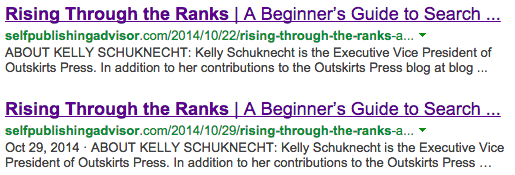
Coming up with a title for your digital material can be every bit as difficult as creating the content that follows.As other websites can tell you, search engines like Google and Bing have character limits on title tags.This means that above and beyond considerations of readability on your website or YouTube channel or blog page, you have to consider an additional layer of presentation: will enough of your title show up on a search engine listing to pull new readers in?To show you what I mean, I plugged “Rising in the Ranks” and “Self Publishing Advisor” into Google (top) and Bing (bottom), just to see how much of my own title tags are showing up after my blog posts are indexed and cached:
Google search listingBing search listing
As you can see, Google displays the titles of my individual blog posts twice––first, in a larger typeface and a more eye-catching color, and then again in a smaller font.The larger typeface only leaves room for 55 or so characters, and the rest is covered by an ellipsis (the “…” at the end of the line).The smaller font below allows for my full titles to be displayed, along with the dates of posting, my screen name, and however many of my tags (more on that later) as can fit.The shorter your titles, the more room there is for tags.
Bing, on the other hand, doesn’t repeat the titles and omits the tags altogether.Instead, it provides an excerpt from my biographical information.The moral of this particular story is: while most search engine listings will include the title of your individual posts, the rest of what they may show is up for grabs (that is, determined by different algorithms).The only common denominator between search engine results is your title.
So, what makes for the best of all possible titles, when it comes to SEO? A balance of simplicity with accuracy and description.This may prove to be a bit of a tug-of-war, especially if you’re posting complicated and thematically rich material––but three quick rules of thumb are:
… keep your title concise, catchy, and grammatically correct,
… include one or more of your most relevant keywords, and
… try to stay below the 50-60 character limits imposed on the listings.
Step 4: Optimize Your Tags
I’ve already mentioned that tags boost the visibility of your digital content.Google and other search engines will sometimes display your tags, or meta descriptions, on search results as a kind of preview to help readers to determine what your blog post or YouTube video or other digital content is actually about.As with keywords, you want to prioritize what you include in your tags.Tumblr, for example, only indexes the first 20 tags you attach to a post.This sort of cutoff is fairly typical for both normal and micro-blogging platforms.
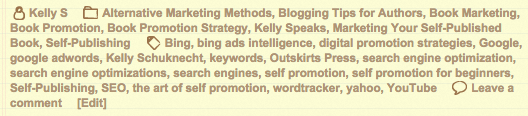
So, what do tags look like?Here are just a few examples, posted with permission:
SelfPublishingAdvisor.com (WordPress) tagsOne of Tumblr’s may tag display optionsAnother of Tumblr’s many tag display options.One of Blogger’s tag display options
As you can see, each platform has its own ways of displaying tags, and sometimes a single platform will allow you to customize the appearance of said tags.Even if you set up your blog to not display tags, make sure you do generate metadata for every post or page, since tags play a vital role in how search engine algorithms determine the relevance of your material to searches your target audience will be running.
I should note that there’s a difference between the tags that are displayed alongside blog posts like this one and meta tags, which are the actual chunks of mostly-invisible HTML code that make up the architecture of your digital content.It used to be true that if you wanted to build a website, you had to develop a working knowledge of HTML in order to take advantage of SEO.Today, most of the big blogging platforms (like WordPress, Blogger, Tumblr, and so on) allow you to input information in the tag field and they convert some or all of that information into HTML meta tags for you.It’s not a perfect translation––but if I’m getting too technical here, remember that the point of SEO is to take advantage of as many simple tricks as you find feasible and translate those tricks into increased website traffic. Not every trick is going to be one that fits your needs. As with all other self-marketing methods, you must weigh the benefits against the costs yourself––and the main cost here is time: the time it takes to learn HTML may offset the actual net benefit, especially if you can take advantage of built-in features like tag fields.
Well, I’ve run out of room this week—check back here next Wednesday to learn more about search engine optimization.I’ll be addressing the matter of analytics!
If you have a question about any of these tools for self promotion, would like to hear from me about something specific, or have other big news to share, please comment below!
ABOUT KELLY SCHUKNECHT: Kelly Schuknecht is the Executive Vice President of Outskirts Press. In addition to her contributions to the Outskirts Press blog at blog.outskirtspress.com, Kelly and a group of talented marketing experts offer book marketing services, support, and products to not only published Outskirts Press authors, but to all authors and professionals who are interested in marketing their books and/or careers. Learn more about Kelly on her blog, kellyschuknecht.com.