Conversations: 2/24/2017

FOUR DOZEN ROSES—FOR WRITERS—IV

Once upon a time—at a writers conference—one of the speakers opened with this question: “Why did the ancient cave dwellers draw on the walls? To tell their story, of course.” This was her introduction to the Memoir writing workshop.  However, what I took special note of that day was the story-fact that roses were part of Cleopatra’s scheme to capture the attention of Rome’s Mark Anthony—having thousands of rose petals scattered in her quarters before his arrival in Egypt. The rose we know today as “the Cleopatra Rose” is basically a wild bush with flowers that go to full blossom almost immediately after blooming. “Going wild” is not a useful quality for serious writers who not only want to write with excellence, but also have something of value to impart to their Readers.

Here is my fourth dozen of tips for you—as you build your writing career.

  1. IF you “hit a wall” and just cannot move past a certain point in the story—GO BACK to the last one or two chapters and read them. Like restarting an engine from the top of a hill, this usually kicks the plot back in gear.
  2. The very old cliché that “there is nothing new under the sun” is basically true when it comes to plot/storyline development. SO select one of your favorite authors in the genre you’re writing and outline the plot they used. No, this isn’t plagiarizing. It is learning from the best. You and only you are writing your Your characters are unique, as are the various settings, etc. However, being able to see a successful plot outline may be just what you need to complete your project.
  3. As you approach the conclusion of your first draft take another look at the main theme and any thread themes you’ve created. There need to be enough clues (information) in the final third of the book for your reader to discover and understand the solutions.
  4. Also, by the time the last third of the story is written, Readers should be pretty clear about who the main protagonist is so they can be participating in the adventure. UNLESS, of course, you’re developing a new Sherlock Holmes-type character who reveals all at the very end.
  5. Even though you’ve written (and probably rewritten) the first sentence/paragraph of your novel multiple times, consider rewriting it one more time AFTER you’ve written THE END.
  6. Consider placing your manuscript with a professional editor who will critique with grace. Ask other writers for recommendations. If you’ve decided to self-publish, ask to “interview” they editing/critique staff. FRESH eyes can hone a well done manuscript into a masterpiece.
  7. When the manuscript comes back to you, FIX IT YOURSELF. You are the author. You know the people/characters. The critique will help you see what needs to be adjusted.
  8. Remember: the words on those book pages will be creating your reputation as an author, and a person living on this planet. Be honest and ethical in your writing and storytelling.
  9. Write from the heart. Write what you need to write.
  10. CONTINUE to watch people—everywhere. Make note of the fine points of life as you observe them in daily living. These will feed your creative spirit and help you develop more stories.
  11. Also make notes about your own personal life experiences. No event—happy, sad, accidental or planned—is wasted material of the writer.
  12. DON’T GIVE UP! Don’t quit! Keep writing—no matter what may try to stop you.

Bottom line…these four dozen TIPS have been offered as experience-taught concepts to be consider—NOT as “rules” of writing—but as guidelines. May you and your creative works prosper! ⚓︎


Royalene

ABOUT ROYALENE DOYLE: Royalene has been writing something since before kindergarten days and continues to love the process. Through her small business—DOYLE WRITING SERVICES—she brings more than 40 years of writing experience to authors who need “just a little assistance” with completing their projects. This is a nice fit as she develops these blogs for Outskirts Press (OP) a leading self-publisher, and occasionally accepts a ghostwriting project from one of their clients. Her recent book release (with OP) titled FIREPROOF PROVERBS, A Writer’s Study of Words, is already receiving excellent reviews including several professional writer’s endorsements given on the book’s back cover.  

Royalene’s writing experience grew through a wide variety of positions from Office Manager and Administrative Assistant to Teacher of Literature and Advanced Writing courses and editor/writer for an International Christian ministry. Her willingness to listen to struggling authors, learn their goals and expectations and discern their writing voice has brought many manuscripts into the published books arena.

In Your Corner: Understanding Copyright

I won’t lie:

Copyright is Hard

So: never let the world beat you down into thinking poorly of yourself for not fully understanding every detail of copyright law. We’ll summarize some of the “greatest hits” of copyright for self-publishing authors here, including when it is important to register your copyright, and what it might look life if you do not pursue acquiring a copyright on your next book … but there’s a lot more out there than we can cover in one blog post, so we’ll provide some of our favorite resources at the end of the post as well.

copyright

The Starter Pack: Basics You Should Know

Copyright was introduced in order to protect intellectual property, and draws directly from the US Constitution, which grants this protection for original works in any tangible medium of self-expression (including books, of course, and art, music, film, et cetera). Copyright covers both unpublished and published works.

Copyright is not something you apply for. It is not something the government issues like tickets at the DMV. Copyright law protects your work from being claimed by others as their own, or from being exploited by others who seek to profit from your work without your explicit permission. Instead, your work is protected under copyright laws from the moment of its creation.

Copyright does not protect everything. It doesn’t cover facts, ideas, systems, or methods of operation, although it will protect a textbook or operating manual explaining those things. Make sense? And copyright does not protect the title of your book. You might attempt to trademark a title if it qualifies for that fully separate protection, but that is a lengthy, uncertain, and pricey process. It’s better to know going into publication that your title does not belong to just you. (But then, that can be a freeing thought. You won’t be served papers for accidentally replicating someone else’s title. With so many millions of books in print, that is a good bet.)

Copyright is good in most international cases. As in, there are some countries with whom the United States has not yet worked out mutually beneficial copyright recognition agreements. But the majority of US-allied countries respect US copyright laws.

So What’s This About Registration?

While there’s no requirement to register your copyright—it’s not strictly mandatory, that is, to register—there is a registration service provided by the Library of Congress in order to record claims to copyright. This establishes precedence, and legal standing if someone should ever violate your copyright—it will help you prove that the book in question was first registered by you and you alone. This is one of those “not required but STRONGLY recommended OR ELSE you might lose in a court case” situations. The world is not always a fair place, so we have to protect ourselves whenever we can.

After registration, you will receive a certificate proving your copyright information and placing your copyright record into the public record. In the off chance you face litigation, you will become eligible for statutory damages and attorney fees, among other things. You don’t have to do this right away, although the sooner the better; if you register with the LoC within five years after your initial publication, you are considered covered under prima facie evidence in a court of law.

Don’t rely on the old trick of mailing yourself a copy of your manuscript in order to acquire proof of copyright; this is considered the “poor man’s registration” but it doesn’t always hold up in court.

If You Do Not Register for Copyright …

Your book might be stolen, knowingly or unknowingly.

How unknowingly??

These days, there are hundreds of automated scripts scanning the web and indexing (or storing old copies of) websites and digital content for archival purposes. Many of these scripts are designed with honorable purposes in mind (wanting to preserve uncorrupted copies of websites in case material is taken offline or corrupted somehow) … but some are not. And some operate in a very grey area. You might remember the trouble Google landed in several years ago for making digital copies of recently published books available through the Google Books platform—the intent was to make all published content searchable, but it ended up making all published content purchasable … and through a website which hadn’t purchased the rights to begin with. It was messy. And it remains messy: the US court system ruled in favor of Google and against the Authors Guild.

Many scripts replicate what Google Books has done, but with even fewer safeguards and protections. This means that you have zero standing if you do not register your book with the Library of Congress and find that a website is running a digital copy of your book pulled from the ether by an algorithm without your permission, and literally anyone can now read your book without consent.

And of course there are much nastier cases, where people intentionally steal copyrighted material or otherwise exploit published material for profit. The point is … give yourself a leg to stand on, even if there’s no judge on your doorstep compelling you to do so this afternoon. There might be one in the future, and you want to be well positioned for that.

Resources

Some of our favorite copyright resources include:

And as always ….


You are not alone. ♣︎


Elizabeth

ABOUT ELIZABETH JAVOR: With over 18 years of experience in sales and management, Elizabeth Javor works as the Manager of Author Services for Outskirts Press. The Author Services Department is composed of knowledgeable publishing consultants, pre-production specialists, customer service reps and book marketing specialists; together, they all focus on educating authors on the self-publishing process to help them publish the book of their dreams. Whether you are a professional looking to take your career to the next level with platform-driven non-fiction or a novelist seeking fame, fortune, and/or personal fulfillment, Elizabeth Javor can put you on the right path.

Decluttering … Clearing the Mental Clutter

Continuing the series Inspired by The Life-Changing Magic of Cleaning Up: The Japanese art of decluttering and organizing by Marie Kondo, let’s spend some time this week talking about the ways in which we can declutter our minds as writers.

mindful mindfulness

You know how it goes; you sit down to write and you start thinking about that item you need to add to the grocery list, you recall that really annoying thing a coworker said to you and you start analyzing why he or she said it in the first place, you remember that your child has a soccer practice tomorrow and you start mentally trying to figure out if you have time to pick her up afterward or if you should arrange a ride for her with another player’s parents…the list goes on. Now if you’re capable of simply “emptying your mind” of all of this useless information by a simple exercise of willpower…kudos. If you’re like me, and need some reminders for how to declutter your headspace, here are some things to consider:

  • Write down all of these bizarre and/or unproductive thoughts you’re having. Putting these things down on paper empties your mind of them, allows you to look at them, analyze them and then put them aside for a time when they become more relevant. Also, any writing gets the writing juices flowing. Who knows, maybe stream of conscious ranting about an interaction at work could create a meaningful dialogue in an upcoming chapter of yours!
  • Focus or meditate on nothing. ‘Now empty your mind of all of your worries and attachments,’ she says, calm as a cow in the downward dog position, her yoga pants screaming enlightenment as she hums a long ‘Ommmmmmmmmm,’ followed by Namaste–or something ridiculously cliché to that same effect. As silly as it sounds, trying to think of ‘nothing,’ or meditating is serious business, and something I would never call myself talented at. Trying to actually let go of the idea that you and all of your little problems and anxieties are at the center of the universe is like trying not to blink. Practicing this focus on nothing will help temporarily remove our focus on that giant ego we all have (and would never, if only begrudgingly admit to having), and help you become present in the task at hand: namely, writing.
  • Put on some music, and go out for a walk or run or a spin on the bike. Exercise (with or without music) is a fantastic way to help you process all of those nagging thoughts cluttering up your mind space. Exercising with music supposedly activates your frontal lobe (the area in your brain associating with higher mental function), and not only that, it gives you something else to meditate on–lyrics perhaps. Focus on the words in the song, seek inspiration in the creativity of music. Meditate on putting one foot in front of the other if the whole Namaste thing is too much for you. Moving meditation is my favorite form, and it always helps boost my creativity.
  • Take a nap. If you have way too much going on in your head to write, take a snooze. Let those things drift away into Never Never Land and wake up feeling refreshed. A nap is like a reset button later in the day. We only get more and more stressed out starting the minute we shut off the alarms anyway, so go back into that bliss-like state of nothingness that is slumber. Maybe you’ll even dream up an interesting scenario for your main character to overcome in the midst.
  • Listen to a podcast or call a friend. A one-sided conversation with a podcast is my favorite means for readjusting my focus. If I want to write about anxiety or loneliness and I’m unable to focus, I’ll search YouTube to see what some of my literary or philosophical love interests have said on the matter. Listening to someone I truly respect and whose opinion I long to have on any matter in my life always get my brain gears turning. Especially since I can’t talk back to them, but can only entertain the conversation in my mind. This makes me want to write to no avail; it makes me want to express my thoughts triggered by someone else’s ideas. This same effect can be achieved by calling a friend who you love discoursing with as well–just make sure to not get too carried away and forget to get back to work at all. 


Thank you for reading!  If you have any questions, comments, suggestions, or contributions, please use the comment field below or drop us a line at selfpublishingadvice@gmail.com.  And remember to check back each Wednesday for your weekly dose of marketing musings from one indie, hybrid, and self-published author to another. ♠


Kelly

ABOUT KELLY SCHUKNECHT: Kelly Schuknecht is the Executive Vice President of Outskirts Press. In addition to her contributions to the Outskirts Press blog at blog.outskirtspress.com, Kelly and a group of talented marketing experts offer book marketing services, support, and products to not only published Outskirts Press authors, but to all authors and professionals who are interested in marketing their books and/or careers. Learn more about Kelly on her blog, kellyschuknecht.com

From the Archives: “Back to Writing on the Road to Self-Publishing”

Welcome back to our Tuesday segment, where we’ll be revisiting some of our most popular posts from the last few years.  What’s stayed the same?  And what’s changed?  We’ll be updating you on the facts, and taking a new (and hopefully refreshing) angle on a few timeless classics of Self Publishing Advisor.

∗∗∗∗∗

[ Originally posted: May 18th, 2010 ]

Ezines – they are a fast and free opportunity to self publish. Moreover, publishing in ezines can help you get motivated to write your book, and even promote your book after publication.

We’ve discussed the idea of publishing excerpts of your book as individual articles or stories. You can simply locate a website and query that site’s webmaster about publishing your article. Make sure you include your biographical byline, which mentions your book as well.

This is more of the same, but concentrating on ezine publication.

There really are countless ezines in existence now, each with a specific niche or category. And all of them are voraciously hungry for content.

Rather than seeking them out individually, you can place your articles into databases that ezine editors frequent for content. They use your article free of charge, and in exchange, include your biographical byline, which, again, includes information about you and your book.

Here are some to check out:

http://www.ezinearticles.com

http://www.ebooksnbytes.com

http://www.connectionteam.com

http://www.netterweb.com

http://www.ideamarketers.com

http://www.goarticles.com

http://www.knowledge-finder.com

http://www.articlecity.com

Don’t send an article you’ve already published last week. Instead, write another chapter of your book first (since finishing your book the main goal, after all.)

Have fun. Keep writing.

zines e-zines ezines

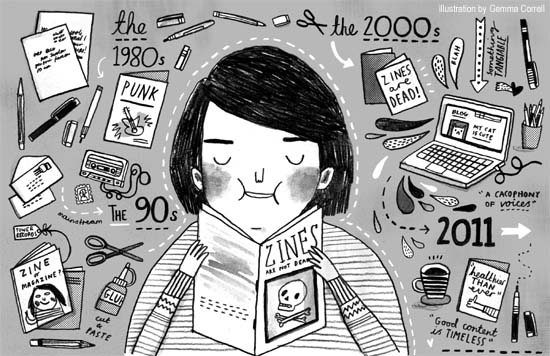
Well, it’s not 2010 anymore … and what is the state of the zine, much less the state of the e-zine? I haven’t heard as much about these lovely creatures of late as I used to, but that doesn’t mean there isn’t a thriving communiting of ziners floating around the interwebs where I can’t see them.

A quick foray around the news feeds I follow turns up, well, actually, quite a lot! This week alone, zines have been featured in local newspapers from coast to coast, as well as a handful of higher-profile national news magazines and online compendiums. The Hudson Valley One hosted an article just last week titled “Revolution in your hands: New Paltz hosts weekend of zine making & reading,” in which I learned a fabulous nugget of information: there is an actual job description called “Zine Librarian” at the Sojourner Truth Library. How cool is that?? (Very cool.) And two weeks ago, eCollege Times hosted an article titled “Print Isn’t Dead: Take a page from local zine queen Charissa Lucille,” and includes an interview with an ASU alum and zine shop owner from Phoenix, Arizona, who dishes on everything from putting together a team of writers to what the future of zines will look like. And late last month, the OC Weekly hosted an article titled “LibroMobile’s Zine Mission,” about a mobile truck (think of a food truck, just stocked with zines and zine-making materials!) powered by the dreams of one enterprising young woman determined to put the materials for creative self-expression into the hands of area teens. And an article from LA Weekly titled “A New Exhibit Traces the Influence of Zines and Books on L.A.’s Art Scene” hints at the long and ongoing legacy of zines on the West Coast as part of the culture-shaping punk aesthetic.

So zines haven’t gone anywhere. What about e-zines?

Well, there are fewer articles than there used to be. I don’t know if that’s a good thing or not, really. But if you spend much time on the E-Zine Directory (www.ezine-dir.com) you might just find yourself overwhelmed by how many e-zines there are these days. There are e-zines on wine-making and e-zines which are the official newsletters for towns and counties in Alabama. There are e-zines about alternative music and e-zines about spirituality and enlightenment. There are e-zines about feng shui and the paranormal, e-zines about parents of “difficult” children, e-zines about small businesses, and e-zines about voice talent and voice coaching.

In short, there seems to be an e-zine about everything. The content of most e-zines has shifted, however, away from what you might think of as typical “punk” content and the arts/music/literature scene which still dominates the physical zines. E-zines have broadened to become the territory of everyone with something to say ….

And that, as a self-publishing blog dedicated to the freedom of expression, we can get behind.


Thanks for reading.  If you have any other ideas, I’d love to hear them.  Drop me a line in the comments section below and I’ll respond as quickly as I can.  ♠


Kelly

ABOUT KELLY SCHUKNECHT: Kelly Schuknecht is the Executive Vice President of Outskirts Press. In addition to her contributions to the Outskirts Press blog at blog.outskirtspress.com, Kelly and a group of talented marketing experts offer book marketing services, support, and products to not only published Outskirts Press authors, but to all authors and professionals who are interested in marketing their books and/or careers. Learn more about Kelly on her blog, kellyschuknecht.com.

Self-Publishing News: 2.20.2017

And now for the news!

This week in the world of self-publishing:

In a fast-paced world, articles with bullet points (especially numbered ones) seem to rule as far as attention grabbers go. Consumers look and see a title like “8 tips for how to self-publish your novel” and think, ‘I’ll read the all of the emboldened points and skim the ones that interest me most, and then I can get back to my really interesting Facebook news feed.’

Ricardo Fayet, provides one such streamlined list for those thinking about taking the plunge into the self-publishing world. Fayet’s list is one worth going over because, while it is concise, it has some insightful tips that one might not consider off-hand.

  1. Know your audience
  2. Create a writing routine and be consistent with it
  3. Give your manuscript to readers and gather reactions before publishing
  4. “Know your budget and do your research”
  5. “Always hire a developmental editor”
  6. DO NOT design your own book cover
  7. “Don’t think of distribution as digital vs. print” — there’s a market for both!
  8. “Build your mailing list before you publish your book”

Within each of these tips, Fayet has pretty sound advice that is fleshed out succinctly, but with enough information to persuade you that he’s done his research. Click the link above and pluck what piece of writer wisdom you can from it!

For a more heart-warming piece, we’ll turn to the story of Dawn Reed, a woman who had the (quite achievable) dream of publishing a children’s book. Reed’s story had been rejected several times over, which would turn some dreamers into cynics or quitters. However, Reed had a more realistic (and optimistic) understanding of these rejections.

I think of Theodore Geisel (Dr. Seuss) who was rejected by over 20 publishers and Norman Bridwell, writer of the Clifford the Big Red Dog books, who was turned away by 15 publishing companies…and I keep going,” says Reed.

Rather than let the rejections stop her in her tracks, Reed simply chose another route–that of self-publishing. While working with a self-publishing company, a bizarre thing happened. Dawn received an email saying, “Hi. Your dream is over. Your book will never be published…” Reed was obviously crushed, but turned to things such as prayer as a way of coping with what seemed to be both terrible and impossible news.

Luckily, after probing and inquiring about the strange email, she received word “from the Vice President and Director of Production,” she said, “His email account had been hacked, and that’s why I received the harsh notice. I was so relieved!”

If you consider yourself a fellow dreamer, lover of writing and self-publishing, read this article to see how Dawn dealt with the possibility of her dreams being shattered time and time again, and how she turned out to still become a self–published author nonetheless. It’s an inspiring article that I’m sure many of us can empathize with.


spa-news

As a self-publishing author, you may find it helpful to stay up-to-date on the trends and news related to the self-publishing industry. This will help you make informed decisions before, during and after the self-publishing process, which will lead to a greater self-publishing experience. To help you stay current on self-publishing topics, simply visit our blog every Monday to find out the hottest news. If you have other big news to share, please comment below.


Kelly

ABOUT KELLY SCHUKNECHT: Kelly Schuknecht is the Executive Vice President of Outskirts Press. In addition to her contributions to the Outskirts Press blog at blog.outskirtspress.com, Kelly and a group of talented marketing experts offer book marketing services, support, and products to not only published Outskirts Press authors, but to all authors and professionals who are interested in marketing their books and/or careers. Learn more about Kelly on her blog, kellyschuknecht.com.