In Your Corner : Do I need a ghostwriter?

How do you know if it’s time to seek out a ghostwriter to help you complete your book?  And what all is involved in the process of ghostwriting, anyway?  Is it really any different from detailed copyediting?

If you’re asking these questions, I hope what I write here will help to answer at least a few of them.

As with any writing venture, ghostwriting is a unique experience that presents unique challenges in addition to unique benefits.  You won’t ever find me pretending otherwise, just as you won’t find me beating around the bush when it comes to recommending a thorough and professional edit of your manuscript once it’s been written––and just as I held no punches when I worked to draw a dividing line between copyediting and proofreading in my blog post two weeks ago.

So, what is ghostwriting?  It is, according to the “Publishing” page on About.com, “the practice of writing for and in the name of someone else. It is most commonly associated with book publishing, but today it is also widely used in public relations, corporate communications, social media, and many other industries and fields that are producing greater and greater amounts of written content.”  Many of our most prolific “superstar” genre specialists, like John Grisham and Tom Clancy and Nora Roberts (and so on and so on to infinity) employ a combination of understudies, assistants or secondary writers, and ghostwriters.  They are called upon to generate, quite simply, too much material for a single human being to keep pace.  But many if not most niche storytellers––whether famous or indie, traditionally published or self-publishing––lead hectic and busy lives that keep them from writing the books that they want to.  We just can’t ignore the fact that self-publishing authors deserve to know that there is another option out there for them!

ghostwriting

The process is relatively simple: most ghostwriters work on a contract or freelance basis for companies like Outskirts Press, so the fastest way to get yourself set up with an accomplished and expert ghostwriter is to go through one of these established websites.  Perhaps the best reason of all to go with someone who has been vetted and proven trustworthy is this: ghostwriting is, at its core, a collaborative venture between you (the author) and your ghostwriter.  How you choose to work depends more on you and what your vision for a piece demands than it does on time constraints, or one hopes for such a truth in a perfect universe.  (Being too rushed for time to go it alone is a wholly valid reason to hire a ghostwriter!)

Ghostwriting has been around awhile.  Long enough, in fact, that industry supergiants like Forbes have taken a look at it––and, circling back to my comment about collaboration:  In this article for Forbes, contributor Sydney LeBlanc writes that “you can turn [your] entire book project over to the writer (research and writing) or you can provide research, notes, periodicals, etc that will help the writer.”  That’s one option, but “You can also have regular ‘interviews’ with the writer who will take notes or record conversations with you about the topic. The writer will write draft chapters for you to review, edit, or make suggestions.”  LeBlanc says that, ultimately, “There are many ways to work with a ghostwriter; it all depends on what is convenient or best for you and what is in your budget.”  (Emphasis mine.)

Hopefully this is enough to convince you that seeking out a ghostwriter is a simple and easy thing to do, and that therefore we can move past one of several possible obstacles to taking that course of action!

(PERSONAL ASIDE & RANT: Enough with the stigma, already!  Everyone’s writing method looks different, anyway, so why do we feel guilty over choosing to bring someone else in on the process?  Let’s celebrate diversification through collaboration rather than taking ghostwriting as a marker of a lack of creativity!)

So, how do you know it’s time to start researching ghostwriting as a viable option for your book?  Well, here’s a simple rule of thumb: if you can answer all or even most of the following questions with “yes,” then it might be time:

  1. Are you overworked, overstressed, or overcommitted?
  2. Do you have a story to share?
  3. Do you need a little help developing your ideas beyond the outline or draft stage?
  4. Do you believe in artistic collaboration?
  5. Can you trust the ghostwriter you pick to do justice to your vision?

Here’s where ghostwriting diverges from that other industry-specific term, “copyediting” : a copyeditor’s job is to take a finished draft and polish it up for final publication.  A thorough copyedit involves more than just shuffling commas around, but it won’t substantially change the core content of a piece.  Ghostwriting, on the other hand, involves the conceptualization and generation of a great deal of new material.  Your ghostwriter becomes your collaborator and your partner in crime, your sounding board and scribe.  Ghostwriters become folded into your stories, and it is in their best interest as paid professionals to deliver the best service they can––but if you’re both lucky, your ghostwriter might even become your ally and friend.  And what could be better than that?  Writing can be such an isolating experience, but I’d like to assure you as I do each and every week:


You’re not alone. ♣︎

ElizabethABOUT ELIZABETH JAVOR: With over 18 years of experience in sales and management, Elizabeth Javor works as the Manager of Author Services for Outskirts Press. The Author Services Department is composed of knowledgeable publishing consultants, pre-production specialists, customer service reps and book marketing specialists; together, they all focus on educating authors on the self-publishing process to help them publish the book of their dreams. Whether you are a professional looking to take your career to the next level with platform-driven non-fiction or a novelist seeking fame, fortune, and/or personal fulfillment, Elizabeth Javor can put you on the right path.

Demystifying the Digital Census : Digital Sales Growing, But Slowing

Last week, I began a series in which I’m applying a microscope to the results of FutureBook‘s Digital Census of 2015 and breaking down to its component parts just what the fallout will be for you and me as indie and self-published authors.  FutureBook, an annual project of industry titan The Bookseller, has been hitting the books for five years now and has become the standard-bearer for those elements of the publishing (and specifically, digital publishing) revolution that range from mainstream (like Amazon) to cutting-edge, innovative, or brand new (like Goop and Medium!).

ebooks

The fifth annual FutureBook conference was held, in part, to evaluate and respond to the Digital Census of 2015, in which record numbers of readers and writers and bloggers and publishers (of traditional or indie ilk alike) and other industry experts reflected upon the ways that has changed or the ways in which they foresee the industry changing, all while indexing their hopes and concerns for where the Book as an object and industry and personal revelation is headed.  The data was condensed down to five talking points which in turn guided and shaped the course of the rest of the conference, and which indicate our ever-evolving relationship to publishing.  These points are:

  1. Mobile overtakes tablets and dedicated e-readers as the device of choice […]
  2. Digital sales are still growing, but they are also slowing […]
  3. Self-love levels recede as many indie authors report lower satisfaction levels […]
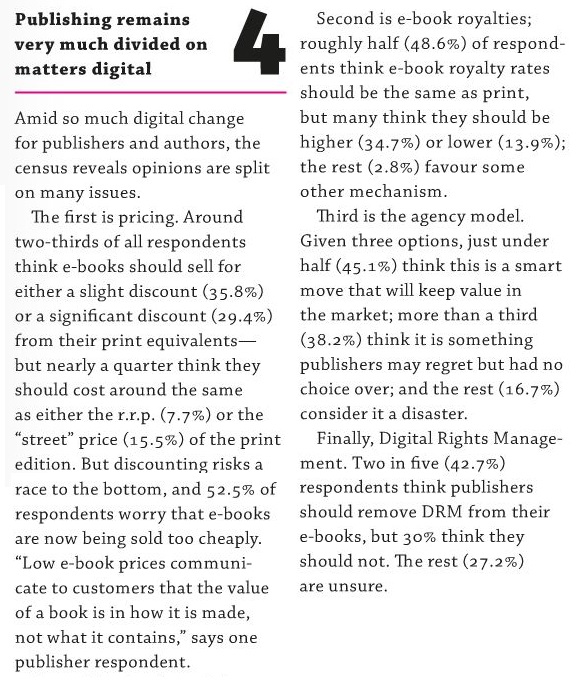
  4. Publishing remains very much divided on matters digital […]
  5. … And the majority believe publishers remain unprepared for what is coming [….]

Today I’m going to examine the second of these points, having addressed #1 (the rise of mobile) in last week’s post.  Here’s what the final FutureBook publication says about digital sales, which continue to demonstrate significant growth––although perhaps also showing signs of plateauing :

digital sales

The data meshes nicely with a series I just finished two weeks ago (“The Current State of E-Readers | An Author’s Guide“), in which I lay out the reasons why slowed growth in both ebook and e-reader sales is both a cause for concern (less overhead profit coming in) and for optimism (a diversified, stabilizing market with more competition and more options for authors).  Much of the research I gathered there applies here, so I don’t want to sound like a broken record and repeat myself––but I do want to emphasize the last line in the FutureBook article:

“Publishers have found that digital technology makes producing and delivering audio much more straightforward, but many are concluding that apps are not worth the candle.”

I think this is an important sentence because nowhere else in the article do audiobooks earn a lot of love, and even in the data mentioned above, the statistics for digital audiobooks is combined with that for digital e-books (that is, the text-based variety that doesn’t involve voice actors and snappy narration). And if there’s one segment of the digital publishing industry that’s neglected here and deserves a second look, it’s the digital audiobook!  Readers love them, and so therefore authors are beginning to pay attention.

We all have probably heard about Amazon’s merger with Audible and their ACX offerings for digital audiobooks by now, but what we don’t know (necessarily) is that there’s a whole niche market out there for authors looking to self-published audio books outside of the ACX/Audible/Amazon umbrella.  This Publisher’s Weekly article, for example, takes a look not just at ACX but at smaller companies without big corporate backing, like Open Book Audio and Spoken Word––and other media are starting to take note, including MediaShift and Author Marketing Institute.

As with all aspects of self-publishing, producing an audiobook (either with or without ACX/Audible/Amazon involvement) is a time- and energy-intensive process that deserves both careful and cautious consideration before you decide to commit … or not to commit.  But if there’s anything I’ve learned from my years in the publishing industry, it’s that readers are inherently voracious and will devour good words wherever they find them and in as many formats as they can discover them … and that there’s no such thing as “standing still” when it comes to the evolution of book distribution technology.  We have, as authors, a responsibility to remain at the forefront of the digital evolution––not hanging back and attempting to deny the inevitable progress from one mode of consumption to another, but leading the way and cutting new paths for those who follow.  Only if we innovate can we stay relevant and useful to our readers.  And I fully believe it when I say your book deserves to be heard.*


* and yes, I know that’s a terrible pun!


Thank you for reading!  If you have any questions, comments, suggestions, or contributions, please use the comment field below or drop us a line at selfpublishingadvice@gmail.com.  And remember to check back each Wednesday for your weekly dose of marketing musings from one indie, hybrid, and self-published author to another. ♠

KellyABOUT KELLY SCHUKNECHT: Kelly Schuknecht is the Executive Vice President of Outskirts Press. In addition to her contributions to the Outskirts Press blog at blog.outskirtspress.com, Kelly and a group of talented marketing experts offer book marketing services, support, and products to not only published Outskirts Press authors, but to all authors and professionals who are interested in marketing their books and/or careers. Learn more about Kelly on her blog, kellyschuknecht.com.

From the Archives: “Self-publishing, Literature and Pop Culture”

Welcome back to our new Tuesday segment, where we’ll be revisiting some of our most popular posts from the last few years.  What’s stayed the same?  And what’s changed?  We’ll be updating you on the facts, and taking a new (and hopefully refreshing) angle on a few timeless classics of Self Publishing Advisor.

∗∗∗∗∗

[ Originally posted: August 19th, 2009 ]

I opened the Books section in yesterday’s New York Times “Urban Eye” to read the headline, “Why Literature Doesn’t Matter.” Really? How sad. It matters to me. It matters to my family, friends, and colleagues. It matters to the self-publishing authors I work with every day. Literature doesn’t matter…. I wish someone would have told me.

According to “Urban Eye,” a recent Sunday Book Review article penned by novelist Kurt Anderson was to fill me in. Anderson writes, “During the 1960s and ’70s…people who hadn’t read a word of a first-rate contemporary novel — no Cheever, no Bellow, no Salinger, Heller, Styron, Doctorow, Updike or Roth — nevertheless knew the novelists’ names… And then everything changed.”

But book sales in the US have remained strong, and are even growing over previous years in Europe. Despite the current recession effects, statistics show that readers are still buying books. Not matter? Anderson goes on to claim, “But irony of ironies, after literature was evicted from mass culture, pop culture itself began to fragment and lose its heretofore defining quality as the ubiquitous stuff that everybody consumed.”

Ah, I’m seeing to whom, or rather to what, Literature doesn’t matter to – pop culture. Wait, then this is a good thing for authors and readers. The fragmentation that Anderson talks about is the segmenting of consumers into smaller, more clearly defined profiles. What that means to self-publishing authors of fiction, non-fiction, etc., is not that your work doesn’t matter, that Literature doesn’t matter, but that it doesn’t matter to everyone. Perfect, now you can coordinate and focus your subject matter and marketing efforts to readers who will benefit from, and buy your books.

Talk to your self-publisher early on about your custom marketing plan.

Karl Schroeder


Interior detail of antique and vintage books and ornaments on a shelf in a Cotswolds country cottage

When Karl Schroeder first wrote this blog for us back in 2009, the market for self-publishing authors had already begun to (in his words) “fragment” into smaller and smaller niche genres and industries.  Authors were on the lookout for that “big hit wonder” element for their books to tap into, the mode that we’re often taught to expect or at least reach for as writers in the modern West.  But despite appearances–despite the rise of J.K. Rowling and Stephanie Meyer and E.L. James and Gillian Flynn and too many others to name–the superstar writer has mostly receded into the background.  What we have today is a (more) stable, (more) diverse, and (more) opportunity-rich industry, and this holds true even for the oft-neglected self-publishing author.

So, yes, what Karl said remains true: literature does still matter, though not to everyone.  What may have, perhaps, changed is that it no longer matters just to connoisseurs of hyper-specialized niche genres and so on … literature does in fact have a profound impact upon and presence within pop culture.  And I’m not just talking about Young Adult Literature or the ever-popular megagenre of crime fiction … I’m talking about the supposedly “forgotten” or “neglected” classic literature.

Ever heard of the #IReadEverywhere hashtag?  Well, it’s a thing.  A very, very big thing … because it demonstrates that our favorite pop culture icons–whether Mindy Kaling or or–read.  A lot.  And they read a pretty fantastic cross-section of all genres, including, yes, classic literature.  For example, we have:

ireadeverywhere1

Mindy Kaling reading Jane Austen (it doesn’t get more classic than that).  And …

ireadeverywhere2

Judy Blume reading Wally Lamb. And …

ireadeverywhere3

The Big Bang Theory’s Mayim Bialik and Melissa Rauch reading Jonathan Safran Foer and Julia Child, while their co-star …

ireadeverywhere4

Jim Parsons reads Buster Keaton.

And they’re not the only ones!  The #IReadEverywhere campaign has generated hundreds of pictures of celebrities catching a few classic words between subway stops, while sipping mochas at coffee shops, or playing on the floor with their cats.  The age of the book may vary (Foer and Childs never overlapped with Jane Austen in the historical record, let’s just say), but the tenor of the trend remains the same: everyone reads, and a lot of people read everywhere and perhaps even often.  You can’t despair for the state of classic literature or any literature at all when it’s literally a marker of “cool” to snap a selfie of you toting Hemingway along to a hip bar in NYC of a Saturday night.

And yet, Karl’s ultimate point remains as valid as ever: you still need to “[t]alk to your self-publisher early on about your custom marketing plan” if you want to create and maintain a steady stream of book sales.  And you can do that most effectively by narrowing your gaze to a specific, manageable target audience.  It’s better to start with a handful of very interested, very invested readers than to spread your fairy dust thinly among people who are only marginally interested.  Invested fans will (sometimes quite literally) sell your book for you, and that has historically been how self-published works have come to receive broad acclaim.  Think of Andy Weir and his blog readers.  Think of E.L. James and her fanatically excited followers on FanFiction.net.  Think of John and Jennifer Churchman and The SheepOver.  You can do everything right as an author and still not sell books if you haven’t gotten your fans on board.  On the flip side, you can invest just a little time and energy in wooing your readers and seizing opportunities when they arise, and sell books like hotcakes by doing so.  Talk to a marketing expert at your self-publishing company, and see what magic you can make happen, together! 

KellyABOUT KELLY SCHUKNECHT: Kelly Schuknecht is the Executive Vice President of Outskirts Press. In addition to her contributions to the Outskirts Press blog at blog.outskirtspress.com, Kelly and a group of talented marketing experts offer book marketing services, support, and products to not only published Outskirts Press authors, but to all authors and professionals who are interested in marketing their books and/or careers. Learn more about Kelly on her blog, kellyschuknecht.com.

Weekly Self-Published Book Review:Breaking the Devil’s Heart

Book reviews are a great way for self-publishing authors to gain exposure. After all, how can someone buy your book if he or she doesn’t know it exists? Paired with other elements of your book promotion strategy, requesting reviews is a great way to get people talking about what you’ve written.

When we read good reviews, we definitely like to share them. It gives the author a few (permanent) moments of fame and allows us to let the community know about a great book. Here’s this week’s book review by Midwest Book Review:

breaking the devils heart

Breaking the Devil’s Heart

H. A. Goodman

Publisher: Outskirts Press

ISBN:9781432790790

Heaven and Hell aren’t as simple as Black and White. “Breaking the Devil’s Heart” starts off with the murder of Stewart Willoughby as he faces the afterlife, and finds it more complicated than angels and devils. Stewart finds his new purpose in his afterlife is a complex one to go against the bureaucracy of hell and end evil. A thoughtful spin of faith and the nature of good and evil, “Breaking the Devil’s Heart” is a strongly recommended pick for fantasy fiction collections.

Here’s what some other reviewers are saying:
Recommended for: those who question and seek, those with ideas rather than belief
Disclosure: I received a free copy from the author in exchange for an honest review.

Synopsis: When Stewart and Layla recruit a demon to spy on the Devil, their decision takes them on a whirlwind ride through the afterlife. Journey alongside this young couple in H. A. Goodman’s new novel, Breaking the Devil’s Heart, and join forces with a teenage Angel outcast to bankrupt Satan’s underground Company and save Heaven from civil war. H. A. Goodman’s Breaking the Devil’s Heart is a rollercoaster afterlife experience that tests a young couple’s love, their grasp on reality, and the essence of human nature. What happens when Stewart and Layla tour Hell’s Marketing Department and Stock Exchange? What happens when their relationship is tested by Satan? This book is unlike anything you’ve ever read, or ever thought the afterlife might be like. Breaking the Devil’s Heart is an enlightening look into an alternate world, a new afterlife, and a profound journey inside the human conscience

My Thoughts: This is actually the second book in the Logic of Demons series, after Logic of Demons, but the author recommends reading it first.

I have to admit that the idea of Hell being a bureaucracy appeals to me at a deep level. The low-level drudgery not only appeals to the absurdist in me, but actually makes more sense than hellfire and brimstone. I’m sure more office drones would agree that some hellfire and brimstone would be a relief compared to some of the long days at work. I also liked the idea of the Observers, or (as Stewart sometimes calls himself) naughty Angels.

The author really delves deeply into human behavior, often turning a quite unflattering spotlight upon our preconceptions. One demon says something that really sums up The Formula perfectly: “Think about it: it’s easier to shoot up a McDonalds (sic) than it is to feed starving people in some remote part of the globe. With one pull of a trigger or one too many glasses of cognac behind the wheel, unspeakable damage can occur. But tremendous goodness and altruism takes a great deal more work and far more effort. The system is skewed in one direction – ours.” Yet Stewart and Layla just can’t seem to get past their somewhat naïve idealism that humans are essentially good.

There are some great twists toward the end, but I don’t want to spoil those for you. This is a fairly quirky story, but very deep and delving into the darkest corners of the human psyche. With this book it is hard to say who will like it – I think I can pretty safely say that most agnostics will like it, most people who have questions about the afterlife, those people who have ideas instead of beliefs. There are some parts that are quite funny, especially to someone like me who finds the whole idea sort of absurd and amusing, but the overall book is fairly serious. I enjoyed it, and I recommend it.

News From the Self-Publishing World: 8/17/15

This week in the world of self-publishing:

Here’s What I Learned By Self-Publishing My YA Novel

In this MTV.com article, Brenna Ehrlich shares what she learned from self-publishing her YA novel. She discusses why she picked the self-publishing route over traditional publishing and tells other writers that, while it requires hard work, self-publishing is a possibility for them as well. She also gives useful advice such as hiring a professional editor, using beta readers, and more. Learning from successful self-published authors is a great way for you to improve your craft and self-publishing strategy.

BCALA, BiblioBoard Launch Self-Publishing Award

Librarians have long sought more guidance on self-published books as well as books by authors of color. Aiming to answer both needs is a new award offered by the Black Caucus of the American Library Association (BCALA) and BiblioBoard (the company that partners with LJ on SELF-e), called the SELF-e Literary Award. It will honor the top self-published fiction and poetry ebooks by African American authors who were born in the United States, with the winners receiving $500, formal recognition at the Black Caucus of the ALA Literary Awards, and a BCALA Literary Award Seal to use on their books. Not only is the lauding of self-published books a first for the BCALA, the new award will also be the group’s first to recognize digital content. Awards are a great way for authors to gain exposure and credibility. For submission details, be sure to check out the full article.

What I Learned When I Self-Published My Book

Writer, actress, and producer Lisa Marie Wilson shares what she learned when self-publishing her book. Her story includes why ebooks are more cost effective, how to apply for a copyright, the motivation behind her book, her regrets, and her plans for her next book. Her story is inspiring and informative. It is a must read for writers.

The Myth of The Lazy Writer

Successful authors work their butts off whether they self-publish or publish with a traditional publishing company. There is no such thing as a lazy successful author. In this Booklife.com article, self-publishing expert Hugh Howey debunks the myth of the lazy writer. He argues that regardless of the publishing route, writing and publishing is tough work. This is an interesting read for writers deciding which publishing route is best for them and for anyone who needs a reminder that they aren’t a lazy writer.

As a self-publishing author, you may find it helpful to stay up-to-date on the trends and news related to the self-publishing industry.This will help you make informed decisions before, during and after the self-publishing process, which will lead to a greater self-publishing experience. To help you stay current on self-publishing topics, simply visit our blog every Tuesday to find out the hottest news. If you have other big news to share, please comment below.

KellyABOUT KELLY SCHUKNECHT: Kelly Schuknecht is the Executive Vice President of Outskirts Press. In addition to her contributions to the Outskirts Press blog at blog.outskirtspress.com, Kelly and a group of talented marketing experts offer book marketing services, support, and products to not only published Outskirts Press authors, but to all authors and professionals who are interested in marketing their books and/or careers. Learn more about Kelly on her blog, kellyschuknecht.com.