A Book is Like A … CAT?

Run a search on Google for “A book is like a…” and you will find that nearly everyone has a handy simile, thousands of entries dedicated to comparing books to start-ups (I suppose they do often keep us up at night and drive us into bankruptcy), to children (they are demanding and require discipline as well as inspiring great pride in us, I expect), to frigates (‘handle with care; this thing might sink you!’ perhaps?), to the good Doctor’s faithful TARDIS (it is bigger on the inside and leads to Narnia–oh, wait).

But so far as I can tell, nobody has yet compared a book to a cat, although the comparison is so perfectly neat as to defy the rules of Internet, which dictate that you can find someone comparing any one thing to any one other thing somewhere, no matter how hyperspecific we want to get about the details. (SEE: Why having an ulcer is like “having a burglar alarm go off inside you” … IN RUSSIAN.)

And a book is most definitely not like a dog. In no way could it ever be like … a dog. So happy to see you after work, so congenial and eager to please, so pleased with even the smallest investment of time or the teeniest of bones thrown its way.

But a cat:
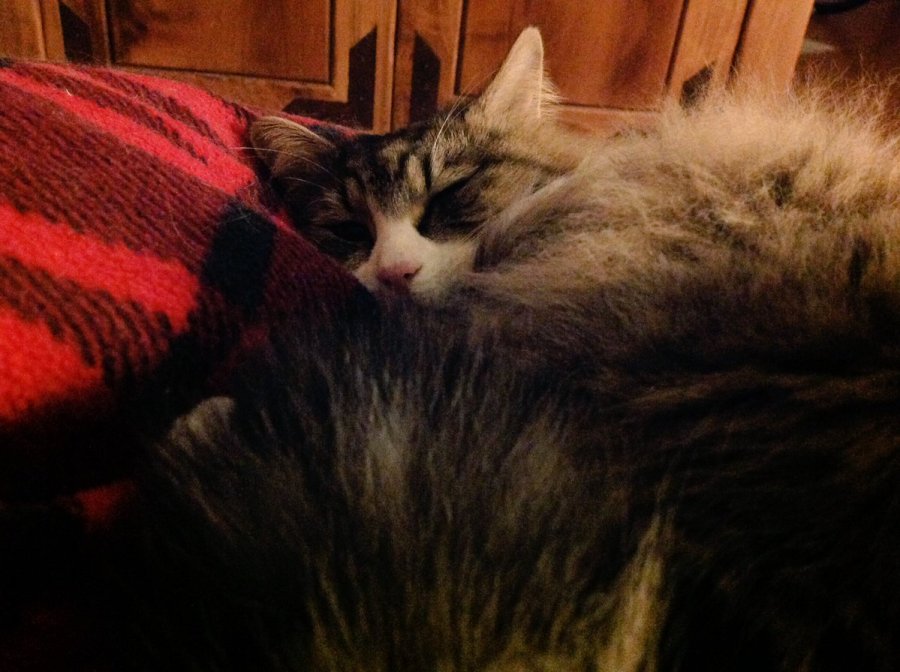
c39purrvcaaoxkk

  • A cat is not dignified and neither is your book. Inspiration won’t come to you easily, or conveniently, but instead unload itself all over your lap whenever you’re least prepared to take advantage of it. It’s difficult to please, but it also can’t clearly articulate what it wants or needs to be what it needs to be, so you end up dancing in circles, trying to keep the blood flowing to your legs.
  • A cat … lurks. And so does your book. It will sit on your desktop, on your laptop, on your cloud storage platform of choice … and wait for attention. Demanding attention is what cats and books do best, only passively, and without wanting to be touched except on their hyperspecific terms so don’t even think about getting cozy.
  • A cat has a mind of its own, and yeah, so does your book. Its characters will run off in completely unexpected directions, your plot will do loop-the-loops instead of following your very thorough outline (or mental sketch, at least), and the ending never feels quite right once you get it in there.

But most importantly, a book is like a cat in one last meaningful way:

  • A cat is worth it. And I guarantee … your book is, too. It’s worth the struggle, the lack of dignity, the lurking, all of it. And yes, it’s a wonderful feeling when you’re done and have the manuscript off to a publisher–but completion, like a cat, is never a fixed point in space or time. Pretty soon you’ll have more ideas cascading in to fill the gap, and the process begins again. The act of being an author is the real work, and the real reward. Just as a cat is its own (self-important, sometimes) reward.

And that, my friends, is how a book is like … a CAT!


Thank you for reading!  If you have any questions, comments, suggestions, or contributions, please use the comment field below or drop us a line at selfpublishingadvice@gmail.com.  And remember to check back each Wednesday for your weekly dose of marketing musings from one indie, hybrid, and self-published author to another. ♠


Kelly

ABOUT KELLY SCHUKNECHT: Kelly Schuknecht is the Executive Vice President of Outskirts Press. In addition to her contributions to the Outskirts Press blog at blog.outskirtspress.com, Kelly and a group of talented marketing experts offer book marketing services, support, and products to not only published Outskirts Press authors, but to all authors and professionals who are interested in marketing their books and/or careers. Learn more about Kelly on her blog, kellyschuknecht.com

Spending Money to Save Money!

Ever find yourself lured into buying something simply because it’s cheaper, only to find that it doesn’t work and then you have to spend more than twice as much money trying to replace it with what you actually need? We’ve all been there. We’ve chosen the cheap mechanic or car salesmen only to have our car break down just a few miles up the road.

As self-publishing authors, the temptation to choose the cheapest route is a dangerous one. A cheaper illustrator for your cover may save you a few bucks in production, but it could cost you exponentially more in sales. Spending money to make money always hurts initially. It’s a risk-based investment that you can’t guarantee will pay off. However, you can almost always guarantee that going a cheap route to save money will  never pay off.

Here are some things that cost money and are worth every penny:

  • Proofreading!!!!!
  • Developmental Editing and Copyediting
  • Interior Designer
  • Cover Designer/Illustrator
  • An up-to-date, visually appealing website
  • A book trailer or other social media marketing tools
  • Education — attend conferences, classes, writing retreats, etc. These things make you a better writer and will improve your sales, your networking and reputation as a writer.

Look at these investments as what they are: things that will pay off in the future. You invested so much time into creating a manuscript that you felt proud of, so don’t sell it short. Invest the money in it that you would like to get back and you will be amazed at the returns. If you just want a book to give to friends and families, feel free to skimp, but if you’re trying to market yourself, spend your money on quality investments.

money dollar bill


Thank you for reading!  If you have any questions, comments, suggestions, or contributions, please use the comment field below or drop us a line at selfpublishingadvice@gmail.com.  And remember to check back each Wednesday for your weekly dose of marketing musings from one indie, hybrid, and self-published author to another. ♠


Kelly

ABOUT KELLY SCHUKNECHT: Kelly Schuknecht is the Executive Vice President of Outskirts Press. In addition to her contributions to the Outskirts Press blog at blog.outskirtspress.com, Kelly and a group of talented marketing experts offer book marketing services, support, and products to not only published Outskirts Press authors, but to all authors and professionals who are interested in marketing their books and/or careers. Learn more about Kelly on her blog, kellyschuknecht.com

From the Archives: “There is No Such Thing as Free Lunch”

Welcome back to our Tuesday segment, where we’ll be revisiting some of our most popular posts from the last few years.  What’s stayed the same?  And what’s changed?  We’ll be updating you on the facts, and taking a new (and hopefully refreshing) angle on a few timeless classics of Self Publishing Advisor.

∗∗∗∗∗

[ Originally posted: May 28th, 2012 ]

Have you heard the cliché “There is no such thing as a free lunch”? Everything has a cost, even if it appears to be free. This true for self publishing as well as all other areas of life.

While there are companies who say they publish your book for free, there are still costs to you. For instance, you may have to buy large amounts of merchandise after the book is printed, or you will have to spend vast amounts of time marketing your own book. In addition, a “free” publishing company could harm your reputation has an author if your book is not of professional quality.

Authors who want their books to be taken seriously need to invest in their projects. This means you’ll at least need a good copy editor and possibly an experienced graphic designer. Depending on your skills and goals, you may also require marketing services. Not all self publishing companies offer these extra services.

Authors should invest in their books by choosing a full-service self publishing company that offers a variety of production and marketing services as well as excellent customer service. This will ensure that you have access to skilled professionals who will help make your book a masterpiece.

I’d love to know, what additional services do you plan to use when self publishing your book?

– by Wendy Stetina

free lunch

While a good (almost) five years have ticked by since Wendy first wrote this post, much of what she has said remains true. Yes, you still need to watch for hidden fees tucked into your self-publishing contract. Yes, you still need to guard against paying for any package that leaves big gaps for you to cover, especially if these gaps coincide with a lack of experience or expertise on your part that you can’t hope to redress in time to sell your book effectively. And yes, many of these issues naturally resolve themselves if you take care and exercise sound judgment in choosing the finest self-publishing company you can.

And since you’ve opted to pursue self-publishing, clearly your judgement is a finely-tuned instrument to begin with!

But I think Wendy had another, greater point buried within her original post, all the way back in 2012. The point of reputation. Your reputation is, for all intents and purposes, inseparable from your personal brand. And your personal brand is what, in the end, sells books. In an age where boycotts have been proven an effective means of communities exercising influence over what works of art get funded and produced, an author’s reputation means a lot. A lot. So much, in fact, that it might as well mean everything, because once it’s even faintly tarnished, it’s rather a complete loss.

The natural end of this formula (a + b = c) is that, yes, the self-publishing company you choose is fundamental to either losing or building a stellar reputation. While self-publishing authors and companies don’t have exclusive ownership of this formula (consider the rage boiling over a certain Twitter troll’s contract with Simon & Schuster, for example, which will affect both of their reputations in the long run), the self-publisher lives and operates an awful lot closer to the line of no return.

And several self-publishing companies have mistreated their customers. This is a sad fact, and not at all indicative of the general trend (which we hope we espouse) towards respectful and honest, unilaterally positive treatment … but even one rotten apple in a bushel is enough to inspire caution, isn’t it? (Or maybe a carton instead of a bushel. I cracked open a rotten egg a week ago, and let me tell you, I have struggled to walk through the kitchen ever since. The memory sticks.)

My point is this: listen to reviews from authors who have self-published already. Spend some time sussing out the dark corners of the internet to verify the company of your choice is, in fact, generating the kind of reviews it should be. Don’t pay any attention to general naysayers who give all self-publisher’s the middle finger, but do listen to articles and posts that are company-specific, and rooted in individual experience.

There’s no margin of error when it comes to your reputation and its relationship to your decision of where to take your next self-published book. Take it somewhere where it–and you, and yes, your lunch–will be in safe hands!

Thanks for reading.  If you have any other ideas, I’d love to hear them.  Drop me a line in the comments section below and I’ll respond as quickly as I can.  ♠


Kelly

ABOUT KELLY SCHUKNECHT: Kelly Schuknecht is the Executive Vice President of Outskirts Press. In addition to her contributions to the Outskirts Press blog at blog.outskirtspress.com, Kelly and a group of talented marketing experts offer book marketing services, support, and products to not only published Outskirts Press authors, but to all authors and professionals who are interested in marketing their books and/or careers. Learn more about Kelly on her blog, kellyschuknecht.com.

From the Archives: “Self Publish a Book in 2013”

Welcome back to our Tuesday segment, where we’ll be revisiting some of our most popular posts from the last few years.  What’s stayed the same?  And what’s changed?  We’ll be updating you on the facts, and taking a new (and hopefully refreshing) angle on a few timeless classics of Self Publishing Advisor.

∗∗∗∗∗

[ Originally posted: December 31st, 2012 ]

It is hard to believe another year is already behind us. As 2013 approaches, many of you will set New Year’s resolutions for yourself. One of the most popular resolutions is writing and publishing a book. Whether you write fiction, non-fiction, adult or children’s books, the Self Publishing Advisor blog is here to help. Every week we share tips, advice and news about self-publishing to help you achieve your goals, and I’m dedicating my January posts to authors whose 2013 resolution is to write and self-publish a book before the year ends.

Whatever your writing obstacles have been in the past (a busy schedule or a fear of failure), I am here to help! Enjoy the last night of 2012 and get ready for the best year of your life — the year you become a self-published author.

Happy New Year’s!

– by Jodee Thayer

Okay, so one last “resolutions-related” blog post for 2017 and I’ll be done. Probably. I suppose it has been on my mind a great deal in the last few months–what with my participation in NaNoWriMo this year and an encroaching sense that if I don’t finish my book now, I will never ever finish it–and I’ve been simply unable to let go of the hope that 2017 can somehow be different … that it has to be different, for my sanity’s sake and the sake of peace and equilibrium at home. And my back. My back would really appreciate it if I could stop internalizing all of my existentialist anxiety and self-recriminations over my lack of progress.

So, how to kick things into gear? Plan. Plan, and then turn plans into the kinds of good habits which lead to a finished book, and ultimately, a published book.

But enough about my story. What about yours? Is 2017 the year–or a year, for those of you who have already self-published–when you publish your next book? Oh, yes. Yes it is. I firmly believe it can be done–even if you haven’t started writing it yet. A dash of fierce dedication and a plethora of hot coffees and maybe a couple of kale smoothies every week, and you can get there. I firmly believe this, not just because I need to for my own reasons, but because 2017 is shaping up to be a fantastic year for self-publishing.

There are countless book expos and fairs making space for self-publishing authors and companies; there are dozens of new technologies and applications in the pipeline to smooth all of the ancillary experiences circling around publication, like marketing and scheduling and getting books into libraries; there are new products and services available pretty much everywhere you look when it comes to choosing your self-publishing company itself (you all already know which one I recommend!); and last but not least, readers are hungry, oh-so-hungry, just positively ravenous for new self-published material to read.

Let 2017 be the year you publish your book. It’s time. Conditions have never been better. And you’re ready. I know you are, because you were born for this.

antique old typewriter dandelion puff

Thanks for reading.  If you have any other ideas, I’d love to hear them.  Drop me a line in the comments section below and I’ll respond as quickly as I can.  ♠


Kelly

ABOUT KELLY SCHUKNECHT: Kelly Schuknecht is the Executive Vice President of Outskirts Press. In addition to her contributions to the Outskirts Press blog at blog.outskirtspress.com, Kelly and a group of talented marketing experts offer book marketing services, support, and products to not only published Outskirts Press authors, but to all authors and professionals who are interested in marketing their books and/or careers. Learn more about Kelly on her blog, kellyschuknecht.com.

In Your Corner: Choosing a Self-Publishing Company

Two roads diverged in a yellow wood,
And sorry I could not travel both
And be one traveler, long I stood
And looked down one as far as I could
To where it bent in the undergrowth;
//
Then took the other, as just as fair,
And having perhaps the better claim,
Because it was grassy and wanted wear;
Though as for that the passing there
Had worn them really about the same,
//
And both that morning equally lay
In leaves no step had trodden black.
Oh, I kept the first for another day!
Yet knowing how way leads on to way,
I doubted if I should ever come back.
//
I shall be telling this with a sigh
Somewhere ages and ages hence:
Two roads diverged in a wood, and I—
I took the one less traveled by,
And that has made all the difference.
X
– Robert Frost, “The Road Not Taken” (1916)
***

You may very well be asking what Robert Frost has to do with self-publishing.  After all, he’s rather more a titanic figure in the world of literature (read: traditionally-published literature) than an icon of the D.I.Y. generation.  But here’s the thing: Robert Frost wrote about choices.  A lot.  And while the poem means as lot things to a lot of different people–a lot of things and a lot of people–Frost himself was taken aback to discover how seriously his readers took it.  He’d written it, quite literally, about his friend and walking buddy Edward Thomas, who had rather a lot of trouble making up his mind where to go while they were walking together.*

choices

If Frost had a point, it was that indecision can lead to rather long walks–and maybe damp hair, if there’s a fog or a rain cloud about.  And as you can no doubt verify, the same principle is at work when it comes to choosing a self-publishing company: indecision leads to long waits, and long waits have more consequences for books than just damp hair.  Timeliness is an important part of a book’s appeal, and when we delay publication for whatever reason, that timeliness is undercut.  But making a rash decision can be equally if not more problematic, can’t it?  Finding yourself trapped into a contract which privileges the company and not the author is always a bad thing.  And so we come to it; if I have any advice in choosing a self-publishing company from my years working with self-publishing authors, I could boil it down to these three pointers.

How to Choose a Self-Publishing Company:

1. Choose the people, not the platform.

A lot of self-publishing companies keep costs down by sacrificing customer support and real humans on the other end of certain processes.  But believe me when I say these companies have lost something vital and important; publishing, even or perhaps even especially self-publishing, is about connection.  Connecting the dots between manuscript and book, between author and readers, and yes!  Between the author and the process of publication itself.  If there’s no one on the other end of the line, the final result will suffer.

A good self-publishing company, on the other hand, hires professionals who really and actually care about producing beautiful books that their authors are proud of.  A good self-publishing company hooks you up with partners, with people who care as much about bringing your vision to life as you are.  Choose the company who makes you feel like a priority, who makes you feel like you actually matter.

2. Post-publication assistance matters.  A lot.

Publishing your book is just the start; there’s a lot that comes after.  Don’t just look for a company that offers pre-publication assistance (like copyediting and custom book cover designs) but one that also offers post-publication assistance.  A good self-publishing company will offer marketing assistance, maybe some merchandising options, social media insight, and distribution not just to online retailers like the Apple iStore or Barnes ?& Noble’s Nook Store, but also to physical retailers like Ingram and to reviewers, award committees, and book fairs.  It doesn’t matter if one or two of the offerings don’t strike you as must-haves … but it does matter that you choose a company with diverse options available (which proves they have a lot of muscle, and a lot of influence) and that you choose a company which can still be useful to you after your book hits Amazon.  A company you can turn to if, for some reason, your book sales stall six months on.

3. Don’t give up what made you decide to self-publish in the first place.

Look, I get it: most of us choose to self-publish because of money.  Or because of intellectual freedom.  There’s usually a bank balance or an ideology at work, and I would caution you against thinking of this as a bad thing.  Something pulled us towards self-publishing, even if it’s just plain old simple curiosity, and that something is both valid and worth hanging on to.  Stick with your guns.  Don’t give up on your instincts–because ultimately, your instincts are the most trustworthy and valuable thing you have when it comes to choosing a self-publishing company.

choices

You are not alone. ♣︎

*  And when Thomas himself took the poem seriously and made some rather intense life choices–for example, going off to WWI–Frost was devastated.  He was even more devastated when Thomas died in Arras.  The moral of this story being, it would seem, to make major life decisions upon thorough research and consideration, not the (misread) interpretation of a poem.

Elizabeth

ABOUT ELIZABETH JAVOR: With over 18 years of experience in sales and management, Elizabeth Javor works as the Manager of Author Services for Outskirts Press. The Author Services Department is composed of knowledgeable publishing consultants, pre-production specialists, customer service reps and book marketing specialists; together, they all focus on educating authors on the self-publishing process to help them publish the book of their dreams. Whether you are a professional looking to take your career to the next level with platform-driven non-fiction or a novelist seeking fame, fortune, and/or personal fulfillment, Elizabeth Javor can put you on the right path.