From the Archives: “Self-Publishing Authors Can Get Their Books on the Shelves of ‘Traditional’ Bookstores”

Welcome back to our Tuesday segment, where we’ll be revisiting some of our most popular posts from the last few years.  What’s stayed the same?  And what’s changed?  We’ll be updating you on the facts, and taking a new (and hopefully refreshing) angle on a few timeless classics of Self Publishing Advisor.

∗∗∗∗∗

[ Originally posted: April 27th, 2011 ]

Even with the recent changes in the book publishing industry, a “traditional” bookstore presence should still be a goal for authors who want this. Why? Well, with this presence, authors are able to target an audience that is passionate about books. Think about it — people have to leave behind the comforts of their own home to go into a bookstore. Most likely they are there to purchase a book. If your book is on the shelf, yours may just have a chance at being the book they buy.

How can you work toward getting your book into that bookstore, though? Is it a matter of luck? Can self-publishing authors make the cut? The good news is that even if you’re not necessarily on a “lucky streak”, it’s still possible to successfully target placement in “traditional” bookstores. However, you must have a solid plan in place for doing so. Here are a few action items to put on your list as you get started:

  • Make sure your book is fully returnable. If your book cannot be returned, there is great risk involved for the bookstore. For example, if they stock 10 copies of your book and only 4 sell over the course of a year, they are losing money. If the book is returnable, though, the store can simply send the book back that doesn’t sell. Think of this return-ability as a type of “insurance” for your book.
  • Offer a sufficient trade discount. What’s sufficient? Typically that will be around 50-55% (or higher). Of course this does cut into your profits, but a higher retail margin gives the bookstore more incentive to stock your book on their shelves. No incentive? No cigar.
  • Build proof that your book is desirable. This is probably the most difficult (though not insurmountable) part of it all because authors often have a bias view of their book. However, the best indicator of a desirable book is exponential sales figures. If the amount of books you sale doubles, triples, quadruples, etc. month-after-month, that is something that can work in your favor. If you aren’t a professional marketer, you may want to seek the services of a book marketing consultant. Make sure they are able to help you draft a marketing plan and go forth on planning your publicity.

After you’ve done all of the above, you must put together a proposal to submit to bookstore contacts. You can find others specifically on their websites, but Barnes & Noble can be reached here:

The Small Press Department
Barnes & Noble
122 Fifth Avenue
New York, NY 10011

Other bookstores can be found through Google. Another popular site for locating independent bookstores is Indie Bound.

Do you know of any other bookstores that are small press/self-published friendly?

by Wendy Stetina

When Wendy first posted this article back in 2011, the publishing industry looked rather different––and in many ways, it looked to be stumbling down the path to utter self-annihilation.  Borders, once a behemoth of the bookselling industry, went out of business in 2011, leaving many readers and authors questioning what––if any––place the brick and mortar bookstore held in the future of their industry.  In the heated discussion that followed in the post’s comments section, various Self Publishing Advisor subscribers pointed out the rise of online retailers as the cheapest and most effective sales platform for indie authors.  In response, SPA moderator Elise L. Connors wrote that “[T]his post wasn’t written with the intention of persuading authors to go after bookstores. It was actually written to let authors who are going after that avenue know that they shouldn’t give up on that ‘dream’ because of the current landscape of the industry.”  (The italics are mine.)

It’s true that Amazon has continued its meteoric rise to the top of the bookselling industry since 2011, and it’s also true that Amazon’s expanded offerings to self-publishing authors have captured much of the market and spurred much public dialogue about the world of indie publishing.  It’s true that Barnes & Noble’s online presence, the Apple iBooks Store, and a whole host of social media platforms and numerous self-publishing companies have sprung up in recent years to diversify and stabilize the market.  And while there have never been so many ways to buy and sell a book as there are in the year 2016, it is true too that ebooks and e-readers have done nothing to lessen customers’ appreciation for the pure tactile pleasure of a brick and mortar store.

Even Amazon has come around to seeing a street presence as importance, as evidenced by the launch of the first Amazon Books shop (in Seattle) last year.  Yes, it seems mostly a kind of marketing gimmick, but it’s one that works.  As one skeptical self-publishing expert learned, even the store’s critics often walk away with an Amazon Prime Membership or a physical book or two.  (These are true stories, people!)  There is, apparently, nothing that quite beats the “instant gratification” of beholding actual physical books on an actual physical shelf.  And while the jury’s still out on whether Amazon Books stores will do anything specifically geared to boost sales of self-published works––like installing Espresso Book Machines, for example, or offering curated collections of Print on Demand (POD) editions of Kindle favorites––one can’t help but notice the wide swathes of shelf space dedicated to Kindles in pictures of the interior.
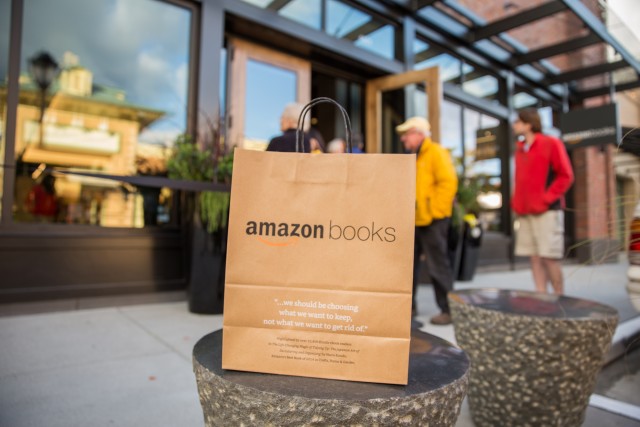
amazon bookstore

And Amazon’s not the only company with a brick-and-mortar presence that can make a difference for indie and self-publishing authors.  In fact, many independent bookstores and even larger chains like Denver’s Tattered Cover go to great lengths to boost sales of local indie authors.  On my last visit to one of Tattered Cover’s several stores, I stepped inside the doors and made my way toward the coffee bar––only to find my progress impeded by a series of low bookshelves that blocked out the cafe’s seating area.  These shelves were the first thing every customer sees when walking in that store, and they were positively packed with self-published books, placed there on consignment.  (If you live in or near Denver and are interested in knowing more, visit their website.)


But ultimately, I’m not here today to defend the bookstore as a vital place to sell your books.  I’m here to help those of you who already know you want to get your book into a bookstore somewhere … to do so with the least amount of fuss.

To return to Wendy’s original post, most bookstores now either mandate her first point (“Make sure your book is fully returnable“) or take any guesswork out of the equation by relying on a consignment model (as with Tattered Cover, above).  And Wendy’s second point holds true: when an author is given the option, it’s a wise idea to “Offer a sufficient trade discount.

In many ways, however, Wendy’s third point is the most important.  Aside from keeping your name and work in the public eye, simply by virtue of placing your book in a bookstore, there are several ways you as an author can help “Build proof that your book is desirable.”  Most bookstores have stringent standards for the self-published books they stock: the title in question must dots its is and cross its ts in that it must have an ISBN, a cover that exudes professionalism and sound design sense, and so on.  Striving to meet these standards in order to appear on Barnes & Noble’s or Tattered Cover’s shelves can only do good things for the “desirability” of your book on a larger scale.  I guarantee you that an attractive, professional-looking book will sell better online as well as off the shelf.

Last but not least, a fantastic way to sell readers on the value of your book is by building relationships with them––and one of the best ways to make contact with your readers is to host events … at your local bookstore.  If you pursue hosting such an event, many bookstores will offer additional opportunities to feature your works within your stores, especially since good attendance at your event will likely translate into a solid spike in general sales for them.  (More foot traffic always equates to more sales when it comes to a brick-and-mortar bookstore.)  And the flipside of the coin is also worth examining: if you have already managed to clear a bookstore’s consignment standards, they are more likely to agree to partnering with you on hosting such an event.  Readings, Q&A sessions, and book signings are fertile ground for the indie author!  ♠

KellyABOUT KELLY SCHUKNECHT: Kelly Schuknecht is the Executive Vice President of Outskirts Press. In addition to her contributions to the Outskirts Press blog at blog.outskirtspress.com, Kelly and a group of talented marketing experts offer book marketing services, support, and products to not only published Outskirts Press authors, but to all authors and professionals who are interested in marketing their books and/or careers. Learn more about Kelly on her blog, kellyschuknecht.com.

From the Archives: “Self-Publishing – A Growing Industry”

Welcome back to our new Tuesday segment, where we’ll be revisiting some of our most popular posts from the last few years.  What’s stayed the same?  And what’s changed?  We’ll be updating you on the facts, and taking a new (and hopefully refreshing) angle on a few timeless classics of Self Publishing Advisor.

∗∗∗∗∗

[ Originally posted: January 11th, 2010 ]

Did you know that over 40% of all book sales in the United States last year took place online, through e-retailers like Amazon.com and BarnesAndNoble.com? More and more people are becoming comfortable with (and even accustomed to) shopping online. What’s more, consumers are more likely to purchase lesser-known and self-published books, according to Inc. Magazine.

What does this mean for the self-published author? With the convenience of on demand-printing and full-service self-publishing options: Good things. Selling books online is more cost-effective than selling through a typical bookstore, and that means more money in your pocket. Again, make sure your publisher lets you set your own retail price, royalty, and discount to take maximum advantage of shifting consumer trends.

Just something to keep in mind as you write and investigate the publishing options best in-line with your goals.

Have fun and keep writing!

by Karl Schroeder

sales growth

Almost six years on from Karl’s original post, we now have the benefit of hindsight to apply to many of his predictions–and fortunately for all of us who happen to be involved in the self-publishing industry, most of them came true!  According to Statista.com, “some 41 percent of global internet users having purchased products online in 2013”–and the numbers have continued to climb steadily from there.  And in respect to total e-commerce sales, a separate Statista article shows that Chinese retail giant Alibaba had a massive 23.7% market reach (outright) in 2015, but that Amazon and its affiliated sites together had an aggregate market penetration of 39.6% (the affiliates earned 22%, and Amazon proper 17.6%).

Many companies might struggle to find their niche in a market so overrun by big business, but smaller, more nimble organizations (including hybrid and self-publishing firm Outskirts Press) have shown they’re more than capable of keeping their footing.  Outskirts, which ranked in Inc. Magazine‘s top 500 or 5000 for four years in a row starting in 2009, continues to ensure that its authors make waves in the Amazon bestseller listings–and get their books onto actual physical bookshelves, as well.

And Outskirts Press is just one company among many who are succeeding at delivering on the promises of self-publishing as laid forth by Karl in his article: convenience in on demand-printing and full-service self-publishing options, cost-effective marketing, and more money in authors’ pockets, not to mention control over retail price, royalties, and discounts.  Inc. Magazine and others have come forward to bolster our knowledge and understanding of the inner workings of the publishing and self-publishing business, with articles like “How to Self-Publish Your Book” (2011), “How to Self-Publish a Business Bestseller” (2012), and “Publisher’s Note: Celebrating the Power of Partnership” (2015) underscoring new ways to adapt in an ever-shifting landscape of opportunities and challenges.

Some things have changed since 2010: Barnes & Noble seems to be stuck in a slow and gradual decline, print books seem to be on the rebound after Hachette and the other Big Five traditional publishing houses won their battle in the Amazon price-fixing war, and so on.  But other things haven’t changed: self-publishing is succeeding where traditional publishing continues to fail–in providing vital and necessary services and support to authors whose books are too daring, too interesting, and too precious to fall through the cracks.

What does this all mean, though?  It means, as Karl’s article so eloquently stated, that self-publishing remains a “Growing Industry.”


KellyABOUT KELLY SCHUKNECHT: Kelly Schuknecht is the Executive Vice President of Outskirts Press. In addition to her contributions to the Outskirts Press blog at blog.outskirtspress.com, Kelly and a group of talented marketing experts offer book marketing services, support, and products to not only published Outskirts Press authors, but to all authors and professionals who are interested in marketing their books and/or careers. Learn more about Kelly on her blog, kellyschuknecht.com.

In Your Corner : The Gift of Self-Publishing

Today, if you’ll let me, I’d like to speak a little bit about the gift of self-publishing–about how it’s a gift not to have to wait for an agent to accept your book, how you no longer need to give away your rights, and how with self-publishing, you’re in control of your book, your creation.  I want to speak about how self-publishing is a gift that keeps on giving to–quite literally–everyone who is touched by the process, from authors to readers to–yes, I mean it when I add–those who publish through or work within the boundaries of traditional publishing.

christmas gift self publishing

A Gift to Authors

I’ve already mentioned the fact that, with self-publishing, you maintain full creative control over your masterpiece from start to finish.  You also retain your rights, your royalties, and total control over your book.  The profit goes where it should go (into your pocket), the look and feel is exactly what you dictate, and you get the satisfaction of knowing you have brought your original vision into the world exactly how you wanted to, full-fledged and ready to meet its ideal readers.

A Gift to Readers

And let’s not neglect to give those readers their moment in the sun!  With self-publishing exploding onto the market in recent years, there’s an ever-more-broad and ever-more-diverse range of books for readers to choose from, new discovery tools to use to find new books, and ever-evolving ways to read those books.  I’m talking about e-readers and ebooks, smartphones and tablets, social media platforms and websites like Wattpad and Fanfiction.net.  Many of these websites lack the “respectability” of a professional product only in the eyes of purists; by and large, people are coming around to the idea that what makes for good reading and good writing boils down to personal taste–and there’s absolutely no reason to denigrate another person’s preferred reading material.  I’m even talking about websites like LinkedIn and Etsy, which smart authors and smart readers are repurposing to serve as new conduits for self-published works.  More options doesn’t always equate to more reading, but many of the tech-savvy silicon generation are connecting the dots and teaching each other how to leap that gap.

A Gift to Traditional Publishing

By broadening the field to make room for more authors and more works, self-publishing has raised the bar for the entire publishing industry.  Traditional publishing houses have been forced to adapt, evolve, and rise to the challenge presented by a diversified, richly textured market.  They can no longer sit back and take it easy when it comes to dominating sales; instead, the traditional industry is turning away from relying on mass-marketed and mass-printed books and towards so-called “niche” offerings.  This is good news for everyone, because niches are petri dishes for innovation and further change.  Authors can experiment more, readers can expect to find more cutting-edge work on bookstore shelves, and so on.  Which leads beautifully to my next point:

A Gift to the Marginalized

When reinvention is the name of the game, even the stodgiest of stodgy institutions tends to open its doors–or at the very least, crack a window––to let in texts or conversations that might previously have been deemed unacceptable or controversial.  As Zetta Elliot writes for the School Library Journal, “Like racism in police forces across this nation, racism in publishing is cultural and systemic.”  And why is racism a problem, specifically, in the publishing industry?  Miral Sattar of Mediashift puts it another way:

Ever since the birth of my daughter last fall I’ve become more acute to the fact that we live in a whitewashed world, and I don’t want her to go through the same experiences that I did as a child. I became more conscious about buying books that tell stories with characters from varying backgrounds. It’s hard to come by these books from traditional publishers since less than 6 percent of books published in 2012 had diverse characters. You have to look really really really hard or resort to buying books that have talking animals.

Sattar, who grew up in a Pakistani-American household, writes of attending publishing conferences and often finding herself the only woman much less the only woman of color in a room.  Like Elliot, she has felt the sting of underrepresentation, and understands what it means to grow up almost entirely locked out of the day-dreams and fantasies that others so take for granted.  (Astronauts, anyone?  President of the United States?  Mage in a fantasy universe?)   And skin pigmentation is just one reason that traditional publishers have historically used as an excuse to not publish certain books (and it’s a terrible reason, let’s face it).  With a new film adaptation of Annie and the advent of the new Hamilton musical, it might seem like we are making progress on this front–but authors like Elliot and Sattar warn of the dangers of complacency, especially since there are so many other factors that publishers still use and abuse in the same fashion.

Here’s the good news, though: self-publishing has become a safe-haven for authors of color, neurodivergent authors, and authors keen to address civil rights issues.  And readers are hungry for these books, hungry enough to prompt traditional publishers to get in on the movement.  Change to any institution so dead-set in its habits will be hard-won and slow, but it is happening.  If you have felt that there was no room for your work in the market, cast your eyes upon self-publishing!

You’re not alone. ♣︎

ElizabethABOUT ELIZABETH JAVOR: With over 18 years of experience in sales and management, Elizabeth Javor works as the Manager of Author Services for Outskirts Press. The Author Services Department is composed of knowledgeable publishing consultants, pre-production specialists, customer service reps and book marketing specialists; together, they all focus on educating authors on the self-publishing process to help them publish the book of their dreams. Whether you are a professional looking to take your career to the next level with platform-driven non-fiction or a novelist seeking fame, fortune, and/or personal fulfillment, Elizabeth Javor can put you on the right path.

Why the Digital Census Matters : A Retrospective

Here on Self Publishing Advisor, we strive not just to keep up with the current trends, but to try and keep a little ahead of the curve–which is why I spent the last five weeks unpacking the results of The Bookseller’s 2015 Digital Census (as described in the FutureBook).  For those of you who are perhaps checking in for the first time, The FutureBook collates information from those involved in the digital publishing industry (whether through traditional or “indie” means) and summarizes the top five current market trends.

[ I’ve broke down each trend, and you can find posts dedicated to each point linked at the far bottom of today’s article. ]

Reviewing the 2015 FutureBook and Digital Census findings has been a wonderful and enlightening experience for me–and hopefully it wasn’t entirely useless to you, as well!–but it’s not the whole picture.  It reflects our attitudes, hopes, and concerns at a specific, limited moment in time.  And ultimately, the FutureBook’s timeliness lends the material contained therein both its value and its constraints:

We need the Digital Census because without it, we wouldn’t know where our experiences as indie and self-publishing authors fit within a larger story–and we need the Digital Census to keep happening because there’s nothing static about the book industry.  As the FutureBook’s editors have said, the survey from which the Census information is collated was designed to “reflect how the sector is continuing to change [….] It asks [authors] what about what their perspective on the book business is, and how we can help them take their innovations to the next stage.”  Change is change, and digital publishing as well as self-publishing must continually reinvent itself to remain a force to be reckoned with.

Those constraints I mentioned? The Digital Census only touches upon those publishing matters which pertain to works that make an appearance in pixels.  It’s not a complete picture of the publishing experience, whether we’re talking about traditionally-published or independently published authors.  So while the Digital Census is an important piece of the puzzle, it’s not the be-all and end-all of information gathering for us here at Self Publishing Advisor.  Like clockwork, industry titans like Publisher’s Weekly and HuffPost Books release predictions for the upcoming year.  Bowker just released a report in November on the top concerns in the self-publishing market, while Author Earnings publishes its reports every few months.  It is my goal in 2016 to keep you “in the know” on all of these reports–because we all know one thing to be true:

knowledge

You don’t have to be evil to recognize the power knowledge can bring–because power isn’t necessarily about the subjugation of others.  Power, in the world of self-publishing, is the ability to take hold of your own narrative and shape it however you please.  Just as empathy and cooperation will trump behavior in line with a “survival of the fittest” mentality (every time, according to behavioral scientists and psychologists), indie authors know that power is something we all benefit from cooperatively and collectively.  This is why, think, the self-publishing industry is such a rich and complex network of community forums, relationships, and partnerships.

All of this is a little beside the point, perhaps, but it’s worth noting that what we do with the information we collect is equally as important as the fact that we collect it.  Many of the reports and information sources, like Author Earnings and the FutureBook itself, are born from a desire to help the indie community!  And that’s the kind of generous impulse I can thoroughly stand behind, especially as we navigate the holiday season.


Thank you for reading!  If you have any questions, comments, suggestions, or contributions, please use the comment field below or drop us a line at selfpublishingadvice@gmail.com.  And remember to check back each Wednesday for your weekly dose of marketing musings from one indie, hybrid, and self-published author to another. ♠

KellyABOUT KELLY SCHUKNECHT: Kelly Schuknecht is the Executive Vice President of Outskirts Press. In addition to her contributions to the Outskirts Press blog at blog.outskirtspress.com, Kelly and a group of talented marketing experts offer book marketing services, support, and products to not only published Outskirts Press authors, but to all authors and professionals who are interested in marketing their books and/or careers. Learn more about Kelly on her blog, kellyschuknecht.com.

Demystifying the Digital Census, Point by Point:

One: Mobile overtakes tablets and dedicated e-readers as the device of choice

Two: Digital sales are still growing, but they are also slowing

Three: Self-love levels recede as many indie authors report lower satisfaction levels

Four: Publishing remains very much divided on matters digital

Five: … And the majority believe publishers remain unprepared for what’s coming.

From the Archives: “‘Tis the SEASON to …”

Welcome back to our new Tuesday segment, where we’ll be revisiting some of our most popular posts from the last few years.  What’s stayed the same?  And what’s changed?  We’ll be updating you on the facts, and taking a new (and hopefully refreshing) angle on a few timeless classics of Self Publishing Advisor.

∗∗∗∗∗

[ Originally posted: December 6th, 2013 ]

‘Tis the SEASON to …

Last year I pretty much gave up shopping—well shopping in the marketing-media frenzy sense, anyway.  My passion for books—and the authors I’ve worked with—inspired me to buy their books and send them to family and friends.  I enjoyed the “holiday bargains,” of course, but much more than that, I felt as if I was passing forward the legacy of writing (and good story telling) that my self-publishing clients represent.

It was also last year that I seemed to hit a wall of mounting disappointment as I listened to the younger generations of my family and friends talking about their “exasperating,” even “frightening”, holiday shopping experiences.  A long-hidden rebellion within me grew and my fingers flew over the keyboard writing op-ed pieces to send to every daily or weekly print publisher.  I wanted to make a statement!  I wanted THE SEASON to be different!  I wanted it to be PEACEFUL!  Full of GOOD CHEER!  LOVE and LAUGHTER abounding on every block, in every city, town and nation!  However, to my own discredit, not one of my pieces was sent.  Too many last minute details derailed my fervor.  However, this season, I’m thinking of pulling out those pieces—developing them into a book—and self-publishing it in plenty of time for next year’s marketing-media-frenzy.

In the meantime, I hope you’ll join me in a taste of rebellion and allow your thoughts to stroll back to your favorite Holiday Season(s)—and WRITE about them.  Besides finding “just what you wanted” under the tree, what other memories do you see?  A favorite aunt bringing her deee-licious walnut fudge to Christmas dinner?  Your grandmother telling her version of “naughty” stories about your dad?  The next door neighbor stopping by with a handmade toy carved from oak wood just for you!

Over the years our family has enjoyed many traditions such as the youngest child placing the ceramic Baby Jesus in the manger on Christmas Eve and attending Christmas Eve church services.  One fairly new tradition in our house is watching a made-for-TV movie titled Silent Night.  This true-story, produced in 2002, stars Linda Hamilton as the German mother of a young son (age 12) who will soon be conscripted into Hitler’s army.  She takes him out of the city to a cabin in the woods—not far from “enemy” lines.  It is Christmas Eve, 1944, and unexpected guests arrive: first three American soldiers, then three German soldiers.  She demands a truce between them—for this one night.

You may be wondering why this movie?  Simple answer.  It inspired me.  This movie was created from an oral history interview with a high school student!  Her subject was Fritz Vincken, the boy in the “story,” and the one thing he remembered most about his childhood was war.  Many of us—many of our neighbors—and too many the world over hold such memories or actually live in war zones today.  I don’t want to forget that.  I don’t want to get so caught up in shopping or party-planning that I misplace my compassion for those who are hurting.  And, for me, seeing/experiencing a well-written, well-directed, well-acted movie such as Silent Night helps me hold my center; helps me appreciate the gifts I’ve been given that cannot be wrapped.

Plus, realizing that this story was developed (written/scripted) from a collection of oral histories done by high school students is exceptionally inspiring to me.  Important, vital, must-be-told stories are out there waiting for the right person to write them!  Is that YOU?

– ROYALENE DOYLE

snight1

It may only have been two years since our friend Royalene first posted this piece for us on Self Publishing Advisor, but I personally think it’s worth bringing back every Christmas.  Why?  Because storytelling is what we do, and there’s simply no more fertile ground for storytelling than the holiday season.

“Holidays bring holiday memories, and, often a sense of nostalgia for good times long gone, perhaps even loved ones long gone,” writes Wynne Parry over at LiveScience.  “This bittersweet nostalgia helps us feel connected, both around the holidays and at other times. And, it can be a salve to those suffering through hard times,” says Parry, quoting psychology professor and “nostalgia expert” Krystine Batcho, of Le Moyne College in New York.

According to Batcho, “whenever there is a major change it can be very helpful to kind of keep grounded in the sense of who you are. That sense of nostalgia helps to link you to your own personal past; it helps you remember who you have been.”  By that definition, nostalgia is both an important element to our scientific understanding of the human brain and consciousness, and an important element of the way we tell stories about ourselves and to each other.

My thoughts, as we progress into yet another holiday season, following a year of both fantastic “highs” and incredible “lows”–personally, as self-publishing authors, and simply as human beings on this planet–are as follows: We ought not to be afraid of nostalgia.  We should use the nostalgic impulse as we use all others: that is, we should allow it to spur us on in our writing, to compel us to create new things that make the most of old things.  Do the holidays–does Christmas, specifically–make you feel something?  Use that as fodder for prose.  Do the holidays leave you hungering after something more substantial or just something different in your own life?  Use that as impetus for transformation, as a writer as in all other things.

And yes, be a rebel.  If the popularity of dystopic young adult literature has taught us anything, it’s that people–our readers–are thirsty for change, to see the world move away from the sorrows and griefs and injustices that sometimes rule it.  Readers are rebels, too, and they love it when they stumble across that voice which perfectly captures the carpe diem spirit of a spirit in search of positive change.  Just as that German mother portrayed in Silent Night brought a small slice of peace and change to that cabin in the woods, you can do great things in this world.  We’re excited to see where the holiday nostalgia leads you! ♠

Silent Night (2002) with Linda Hamilton


KellyABOUT KELLY SCHUKNECHT: Kelly Schuknecht is the Executive Vice President of Outskirts Press. In addition to her contributions to the Outskirts Press blog at blog.outskirtspress.com, Kelly and a group of talented marketing experts offer book marketing services, support, and products to not only published Outskirts Press authors, but to all authors and professionals who are interested in marketing their books and/or careers. Learn more about Kelly on her blog, kellyschuknecht.com.