Conversations With A Self-Publishing Writer: 12/04/2015

LET ALL THE WORLD KNOW


“There was a MOMENT—just a flash of an idea—that would not let me go.” My friend Lorry Lutz (author of ten books, soon to be eleven) was explaining that she simply had to write her most recent book. “I don’t remember exactly how I came across this woman’s life story, but when I did I felt like I knew her. Her Faith was a passion and her compassion for women who were being forced into bondage led her into many dangerous situations. I simply had to bring her story into today’s world, so people will realize that each one of us can make a difference.”

And, there we have it—the Personal KEYS to writing—the moment (idea flash), the message (expressed through actions/events), the memory (personal connection) and the miracle (making a difference).

For many writers I know, the moment the writing idea formulates is when we’re half-asleep—or half-awake—whichever side of the moment we’re experiencing. Other times of awareness hit us when we’re driving, stopped at a red light and happen to glance across a beautifully landscaped park, or up into the brilliance of an evening sunset. And, of course, there is the shower moment or the kitchen-sink-full-of-dirty-dishes moment or the changing diapers moment. I’m certain that you can add many such idea flashes of your own to this list. The point being—these inspired moments DO come and we need to grab hold of them as quickly as possible.

Grasping the idea is crucial and so exciting! From that momentary idea flash comes the whole.

  • The Headline that will be highlighted on the back cover of your book.
  • The Summary and/or synopsis that will draw readers and publishers.
  • The Heart—or Thread—concept that will carry your main points throughout.
  • The Passion that you will exude when presenting your book to agents, publishers, and most importantly, to readers.
  • The Significance or Take-Away Value that readers will grasp and carry into their own lives.

Author Lorry Lutz will see her book Boundless (her working title) released in December, 2016. The heroine of this historical fiction novel is Katharine Bushnell (February 5, 1855 – January 26, 1946) who became a medical doctor and social activist at a time when very few ladies were willing to take the risks she did. Her desire to reform conditions of human degradation took her to back-country mining and lumber camps in America, villages in China and palaces in India. I hope you will bring Lutz’s excellent story into your homes when it appears online—an exceptional example of grasping an idea and developing it to its fullest.


JGmnGvpL
Lorry Lutz  (courtesy of her Twitter account)


Of course, timing is always a factor: the moment in time when the idea hits us, the months and quite possibly years in the research and writing, and the investigation and decision-making season when publishing options are weighed. Authors today have a quiver full of possibilities when reaching the moment to publish. You already know that mainstream publishers will not come knocking on your door to hand you a contract. However, if you know someone (who knows someone) in the big houses, there is at least the possibility that your manuscript will be read and considered. For those of us who are not in that position, the self-publishing presses have multiple packages that will not only get your book in print, but ONLINE for all the world to see. So talk to your author friends, query writing conference directors, read the Writers Market and Writer’s Digest, and discover where you and your book fit. Then … get it published!  ⚓︎


RoyaleneABOUT ROYALENE DOYLE: Royalene has been writing something since before kindergarten days and continues to love the process. Through her small business—DOYLE WRITING SERVICES—she brings more than 40 years of writing experience to authors who need “just a little assistance” with completing their projects. This is a nice fit as she develops these blogs for Outskirts Press (OP) a leading self-publisher, and occasionally accepts a ghostwriting project from one of their clients. Her recent book release (with OP) titled FIREPROOF PROVERBS, A Writer’s Study of Words, is already receiving excellent reviews including several professional writer’s endorsements given on the book’s back cover.  

Royalene’s writing experience grew through a wide variety of positions from Office Manager and Administrative Assistant to Teacher of Literature and Advanced Writing courses and editor/writer for an International Christian ministry. Her willingness to listen to struggling authors, learn their goals and expectations and discern their writing voice has brought many manuscripts into the published books arena.

Demystifying the Digital Census : A House Divided

We’re in the future-making business.  As indie, hybrid, and self-publishing authors, we have to look ahead, and we have to take an active hand in surfing that cutting edge in an industry that sometimes seems bent on keeping its authors penned up in the early decades of the Twentieth Century.  That publishers have reasons for this goes without saying, but those reasons don’t always equate to satisfactory treatment when we really examine how things play out for authors–traditionally published authors included.  (Ever heard of “publishing hell” and the dreaded “midlist“?  I rest my point.)

For the last couple of weeks I’ve been taking a look at the FutureBook‘s compendium of results from its Digital Census of 2015.  The FutureBook, an offshoot of its famous cousin The Bookseller, examines current publishing trends with a particular eye for how these trends intersect with an international readership and the rise of digital technology.  We’ve already looked at the first three points:

One: Mobile overtakes tablets and dedicated e-readers as the device of choice

Two: Digital sales are still growing, but they are also slowing

Three: Self-love levels recede as many indie authors report lower satisfaction levels

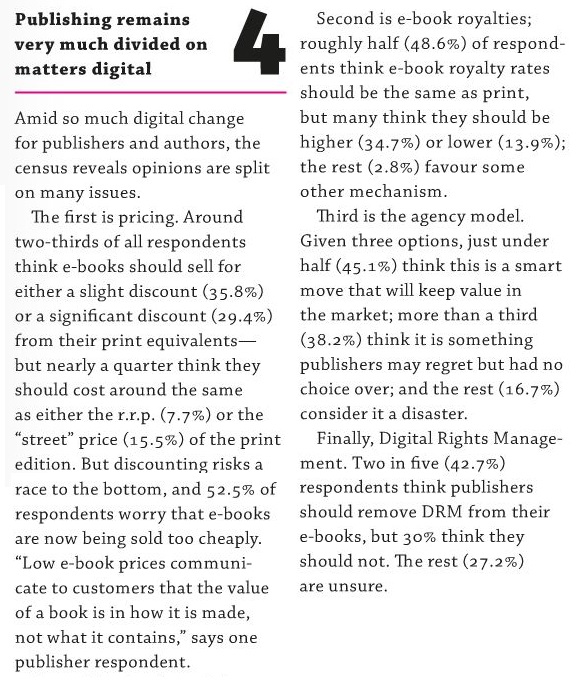
This week, we’re here to examine the fourth conclusion reached by the FutureBook editors: “Publishing,” it argues based on extensive survey data, “remains very much divided on matters digital.”  The full FutureBook publication, which is put together by The Bookseller’s Porter Anderson and Philip Jones, spells things out a bit more for us self-publishing authors:

futurebook


Division is rarely a good thing, when it comes to an emerging (but still fringe) market niche–tension between supporters of indie publishing tends to undercut our collective ability to make big gains in reaching new readers, and winning a broadened cultural acceptability.  There are some times, however, when division may be less of a “bad thing” than it is an indicator of something very, very positive: growth and market dominance.  The fact that we’re suffering from (seemingly petty) infighting over discounts shows that we’re now a force to be reckoned with–we’ve moved past being able to use words like “new” and maybe even “emerging” in reference to self-publishing.  (We’re here; we’ve emerged.  Hear us roar!)

And make no mistake, traditional publishing platforms as well as corporate giants (like Amazon) with a stake in the self-publishing game want us to keep fighting among ourselves over these things … because ultimately, if we’re fighting among ourselves we’re not fighting them.

tension

Yes, that’s right: All of these little squabbles benefit the Big Five and the Corporate Heavyweights.  Which is not to say that the concerns being fought over aren’t valid–we just can’t let them do what fights are always at risk of doing: keeping us stagnant.  If we are to remain the future-makers that The Bookseller and the FutureBook celebrate, we need to reach consensus and then act on that consensus.

And here’s some good news: We already are making progress!  In early October, 2015, a judge ruled against Apple for conspiring with the Big Five traditional publishing houses to artificially inflate e-book prices (the dividends of which were not trickling down to authors).  Prices for e-books have been climbing at least since April (although the jury’s still out on how effective these price hikes have been at increasing net profits for self-publishing authors).  More than ever before, indie authors are aligning to bring the full weight of our collective interest to bear on decisions and trends like these.


Thank you for reading!  If you have any questions, comments, suggestions, or contributions, please use the comment field below or drop us a line at selfpublishingadvice@gmail.com.  And remember to check back each Wednesday for your weekly dose of marketing musings from one indie, hybrid, and self-published author to another. ♠


KellyABOUT KELLY SCHUKNECHT: Kelly Schuknecht is the Executive Vice President of Outskirts Press. In addition to her contributions to the Outskirts Press blog at blog.outskirtspress.com, Kelly and a group of talented marketing experts offer book marketing services, support, and products to not only published Outskirts Press authors, but to all authors and professionals who are interested in marketing their books and/or careers. Learn more about Kelly on her blog, kellyschuknecht.com.

From the Archives: “‘Tis the SEASON to …”

Welcome back to our new Tuesday segment, where we’ll be revisiting some of our most popular posts from the last few years.  What’s stayed the same?  And what’s changed?  We’ll be updating you on the facts, and taking a new (and hopefully refreshing) angle on a few timeless classics of Self Publishing Advisor.

∗∗∗∗∗

[ Originally posted: December 6th, 2013 ]

‘Tis the SEASON to …

Last year I pretty much gave up shopping—well shopping in the marketing-media frenzy sense, anyway.  My passion for books—and the authors I’ve worked with—inspired me to buy their books and send them to family and friends.  I enjoyed the “holiday bargains,” of course, but much more than that, I felt as if I was passing forward the legacy of writing (and good story telling) that my self-publishing clients represent.

It was also last year that I seemed to hit a wall of mounting disappointment as I listened to the younger generations of my family and friends talking about their “exasperating,” even “frightening”, holiday shopping experiences.  A long-hidden rebellion within me grew and my fingers flew over the keyboard writing op-ed pieces to send to every daily or weekly print publisher.  I wanted to make a statement!  I wanted THE SEASON to be different!  I wanted it to be PEACEFUL!  Full of GOOD CHEER!  LOVE and LAUGHTER abounding on every block, in every city, town and nation!  However, to my own discredit, not one of my pieces was sent.  Too many last minute details derailed my fervor.  However, this season, I’m thinking of pulling out those pieces—developing them into a book—and self-publishing it in plenty of time for next year’s marketing-media-frenzy.

In the meantime, I hope you’ll join me in a taste of rebellion and allow your thoughts to stroll back to your favorite Holiday Season(s)—and WRITE about them.  Besides finding “just what you wanted” under the tree, what other memories do you see?  A favorite aunt bringing her deee-licious walnut fudge to Christmas dinner?  Your grandmother telling her version of “naughty” stories about your dad?  The next door neighbor stopping by with a handmade toy carved from oak wood just for you!

Over the years our family has enjoyed many traditions such as the youngest child placing the ceramic Baby Jesus in the manger on Christmas Eve and attending Christmas Eve church services.  One fairly new tradition in our house is watching a made-for-TV movie titled Silent Night.  This true-story, produced in 2002, stars Linda Hamilton as the German mother of a young son (age 12) who will soon be conscripted into Hitler’s army.  She takes him out of the city to a cabin in the woods—not far from “enemy” lines.  It is Christmas Eve, 1944, and unexpected guests arrive: first three American soldiers, then three German soldiers.  She demands a truce between them—for this one night.

You may be wondering why this movie?  Simple answer.  It inspired me.  This movie was created from an oral history interview with a high school student!  Her subject was Fritz Vincken, the boy in the “story,” and the one thing he remembered most about his childhood was war.  Many of us—many of our neighbors—and too many the world over hold such memories or actually live in war zones today.  I don’t want to forget that.  I don’t want to get so caught up in shopping or party-planning that I misplace my compassion for those who are hurting.  And, for me, seeing/experiencing a well-written, well-directed, well-acted movie such as Silent Night helps me hold my center; helps me appreciate the gifts I’ve been given that cannot be wrapped.

Plus, realizing that this story was developed (written/scripted) from a collection of oral histories done by high school students is exceptionally inspiring to me.  Important, vital, must-be-told stories are out there waiting for the right person to write them!  Is that YOU?

– ROYALENE DOYLE

snight1

It may only have been two years since our friend Royalene first posted this piece for us on Self Publishing Advisor, but I personally think it’s worth bringing back every Christmas.  Why?  Because storytelling is what we do, and there’s simply no more fertile ground for storytelling than the holiday season.

“Holidays bring holiday memories, and, often a sense of nostalgia for good times long gone, perhaps even loved ones long gone,” writes Wynne Parry over at LiveScience.  “This bittersweet nostalgia helps us feel connected, both around the holidays and at other times. And, it can be a salve to those suffering through hard times,” says Parry, quoting psychology professor and “nostalgia expert” Krystine Batcho, of Le Moyne College in New York.

According to Batcho, “whenever there is a major change it can be very helpful to kind of keep grounded in the sense of who you are. That sense of nostalgia helps to link you to your own personal past; it helps you remember who you have been.”  By that definition, nostalgia is both an important element to our scientific understanding of the human brain and consciousness, and an important element of the way we tell stories about ourselves and to each other.

My thoughts, as we progress into yet another holiday season, following a year of both fantastic “highs” and incredible “lows”–personally, as self-publishing authors, and simply as human beings on this planet–are as follows: We ought not to be afraid of nostalgia.  We should use the nostalgic impulse as we use all others: that is, we should allow it to spur us on in our writing, to compel us to create new things that make the most of old things.  Do the holidays–does Christmas, specifically–make you feel something?  Use that as fodder for prose.  Do the holidays leave you hungering after something more substantial or just something different in your own life?  Use that as impetus for transformation, as a writer as in all other things.

And yes, be a rebel.  If the popularity of dystopic young adult literature has taught us anything, it’s that people–our readers–are thirsty for change, to see the world move away from the sorrows and griefs and injustices that sometimes rule it.  Readers are rebels, too, and they love it when they stumble across that voice which perfectly captures the carpe diem spirit of a spirit in search of positive change.  Just as that German mother portrayed in Silent Night brought a small slice of peace and change to that cabin in the woods, you can do great things in this world.  We’re excited to see where the holiday nostalgia leads you! ♠

Silent Night (2002) with Linda Hamilton


KellyABOUT KELLY SCHUKNECHT: Kelly Schuknecht is the Executive Vice President of Outskirts Press. In addition to her contributions to the Outskirts Press blog at blog.outskirtspress.com, Kelly and a group of talented marketing experts offer book marketing services, support, and products to not only published Outskirts Press authors, but to all authors and professionals who are interested in marketing their books and/or careers. Learn more about Kelly on her blog, kellyschuknecht.com.

Demystifying the Digital Census : Self Love Levels Drop

Two weeks ago, I launched this series by laying the groundwork for understanding what the FutureBook (and its parent organization, The Bookseller) is all about and, as a result, what the annual Digital Census seeks to measure and comment upon.  (In summary: it tracks emerging and outgoing matters of interest for authors and publishers and other trade experts invested in digital publishing, whether through traditional or indie, hybrid, and self-publishing platforms.)  I also took a quick peek at the FutureBook‘s first confirmed trend of 2015: the fact that mobile has overtaken both tablets and dedicated e-readers as the primary means for reading ebooks.  And last week, I applied a microscope to the FutureBook’s second confirmed trend of 2015: the fact that digital sales are still growing, but that growth is slowing.  

self-love

This week, I’m going to examine the FutureBook’s third confirmed trend for the year.  Straight from the horse’s mouth, so to speak: “Self-love levels recede as many indie authors report lower satisfaction levels.” The FutureBook publication, which you can read here, says:

futurebook

Screen Shot 2015-11-24 at 11.44.01 PM

You can imagine how deeply sad I feel when I see a well-respected and industry-enriching publication commenting on authors tanking in the self-love department.  As it turns out, the data indexed by the Digital Census isn’t necessarily asking authors to psychoanalyze their performance and self-satisfaction, so “self-love” may be a bit strong of a term––but then again, maybe not.  Many authors do equate self-satisfaction (and their identity, really) with their performance in respect to sales figures.  And that’s a deeply problematic way to measure self-worth, as everyone is well aware … but sometimes we can’t help but believe it to be an accurate yardstick, especially when we’re spoon-fed a certain narrative by the mainstream media: the narrative in which success means J.K. Rowling, means Veronica Roth, means Tom Clancy and P.D. James and Agatha Christie, means George R.R. Martin, means blockbuster film adaptations and interviews with Ellen or Oprah or Jimmy Kimmel.

Maybe other self-publishing authors and bloggers might be content to state that this is wrong and it shouldn’t be the case, but I can’t just let it lie.  Where does the narrative of success originate?  And how can we alter the conversation to reflect a more holistic, life-affirming reality––the selfsame reality that indie, hybrid, and self-publishing authors of great quality and phenomenal worth experience on a day-to-day basis?

I think a lot of it comes down to the whole do as I say, not as I do syndrome that applies to many other grand social narratives in our modern world.  For example, we affirm again and again to our children that whatever path life takes them on, they have value––as plumbers as well as princesses, as garbage collectors and astronauts––but we flood their lives with films, television shows, and books that highlight the “exceptional” nature of the same “grand narratives” that the world will later try and tell them are impossible to actually attain, in adulthood.  (When was the last time we turned to a college student and said, “You can totally be a princess!” … and actually mean it?)

It’s the same with publishing, including self-publishing: we tell warn aspiring authors again and again that success doesn’t look like any one thing, and it certainly isn’t equatable with sales figures.  But at the same time, the narratives of “successful” authors that we learn about and spread through news articles and social media are almost always about authors who rake in the big bucks and attention from the Big Five publishing houses (after a successful “grassroots campaign,” of course), and about rags-to-riches stories like Andy Weir’s and Christopher Paolini’s.  And I’m here to say: it’s too little, and too late.  It’s simply not good enough to affirm our indie authors as individual successes with trite sayings and cold comfort.  By the time we need comforting, it’s too late.  We have to break the stereotypes and unravel the threadbare story before authors publish.

Otherwise, we’re always going to be playing catch-up and damage control.  I will always, always be on hand to affirm that you’re a success simply because you did the hard thing and you (self-) published your book, but I think we can do more to set you up for a healthy sense of your own value and worth and general excellence, and do it earlier and better.  Let’s start by teaching the next wave of future authors that numbers do not an identity make!


Thank you for reading!  If you have any questions, comments, suggestions, or contributions, please use the comment field below or drop us a line at selfpublishingadvice@gmail.com.  And remember to check back each Wednesday for your weekly dose of marketing musings from one indie, hybrid, and self-published author to another. ♠

From the Archives: “Avoid the 3 ‘Tell-Tale’ Signs of Self-Published Books”

Welcome back to our new Tuesday segment, where we’ll be revisiting some of our most popular posts from the last few years.  What’s stayed the same?  And what’s changed?  We’ll be updating you on the facts, and taking a new (and hopefully refreshing) angle on a few timeless classics of Self Publishing Advisor.

∗∗∗∗∗

[ Originally posted: May 2nd, 2011 ]

You’ve self-published a book, and it’s amazing that you’ve dedicated so much time and energy into writing and creating you own masterpiece. While there’s nothing wrong with self publishing, and it’s actually a great opportunity for many authors, you don’t necessarily want your book to “look self published”. That could mean inability of your audience to take your book seriously, receiving horrible reviews, suffering from poor sales performance, or worse.

Here are a few of the 3 “deadly sins” not to commit when publishing your book:

  • Use of cover templates – Templates are often rather dull, at best. Invest your money into really making your cover stand out.
  • Unedited manuscript – Run on sentences, sentence fragments, etc. are all things that can leave a bad taste in the mouth of a reader. We always recommend that you hire a professional editor for your manuscript. No, your sister-in-law doesn’t count as a professional editor. You need more than a fresh set of eyes when it comes to choosing an editor. You need someone who is professionally trained in editing.
  • Non-traditional interior
    • Double-Spaced – A book should NEVER be double spaced. Just because something works great for reports and other forms of communication doesn’t mean it will work the same for a printed book.
    • Strange and/or difficult to read typestyles – You like typing in Script MT Bold. It looks beautiful on screen, but will not look as good in a printed book.
    • Missing headers/footers – Have you ever read a book (other than a children’s book) without a header or footer? Why leave them out on your book?
    • Non-standard page numbering – Make sure your page numbers are in the same position on each opposite page. Also make sure font is consistent across all numbering.
When you hire a self-publishing company, all of these things can be taken care of under one umbrella. However, if you are “going it alone”, it’s important to remember the tips above to make sure you avoid showcasing an unprofessional appearance.
-WENDY STETINA


Four and a half years after Wendy’s original post, not much has changed when it comes to the aspects of self-publishing which set the final products at a disadvantage compared to their traditionally published kin.

And look, we’ve all seen a lousy book cover or two in our time.  And with online compendiums like the Huffington Post––what with their readerships of thousands upon thousands––going out of their way to pick on a select few, I see no reason to get in on the finger-wagging here.  But suffice it to say, many self-published book covers don’t look quite as polished and beautiful as those put out by the Big Five publishing houses.  There are all sorts of reasons for this: self-publishing authors are shorter (much shorter) on funds than the average industry juggernaut, or perhaps simply prefer to allocate their funds elsewhere, or perhaps have a poor eye for what appeals to a mass market audience.  Templates are rather dull, but they exist for a reason.  Or a series of unfortunate reasons.

We don’t need to blame our fellow indie authors for the trend’s existence to recognize that we can, collectively, do better.  How?  Well, we’ve written about the virtues of a well-crafted book cover before and elsewhere at length, but suffice it to say that there are quite a few options which will result in a lovelier cover than the one you or I can churn out in a basic word processing program.  More importantly, the time and money and energy you spend on an attractive cover reaps dividends that more than compensate for the expense.

When it comes to leaving a manuscript unedited, however, I must admit that I struggle to see a reason that justifies this decision.  Not because I don’t recognize the limitations of a tight budget or the profound importance of exercising total creative control over one’s own work––I understand that  completely––but because an unedited manuscript poses so many opportunities to lose and alienate our readers, no matter how excellent the content and construct of our work.  An attractive book cover will draw readers in, while a polished and professionally-edited manuscript will keep them invested.  It’s as simple as that.  (And for more of our rationale on this one, check out Jodee’s thoughts here, Rob Mangelson’s thoughts here, and Elizabeth’s thoughts here.)  As self-publishing authors, we can’t afford to lose our readers.

Sometimes, we miss things.  The more people who have eyes on a given work, the less likely it is that any single mistake will be overlooked, which is one reason why paying a professional to edit or at least evaluate your work is such an important idea.  But there’s another reason: Professional copyeditors know the rules.  I don’t just mean the official rules of publication and grammar, but the unspoken rules too.  They know which details are going to distract a reader, consciously or subconsciously, from your book.  They know how to create consistency in the midst of chaos.  All of those little details that Wendy mentioned in her original post?  They are exactly the kind of thing that can hurt your sales, even though they may seem small or insignificant.  Copyeditors are your partners and co-laborers in bringing your book to the world, and it’s in their best interest as well as yours to catch every single little misstep before it becomes a profit-buster.

copyediting

Whether it’s presenting your book with an exterior as beautiful as its interior, or editing your book’s content, self-publishing today offers all sorts of options to the aspiring author that wouldn’t have been possible just four years ago.  That is good news indeed! 

KellyABOUT KELLY SCHUKNECHT: Kelly Schuknecht is the Executive Vice President of Outskirts Press. In addition to her contributions to the Outskirts Press blog at blog.outskirtspress.com, Kelly and a group of talented marketing experts offer book marketing services, support, and products to not only published Outskirts Press authors, but to all authors and professionals who are interested in marketing their books and/or careers. Learn more about Kelly on her blog, kellyschuknecht.com.