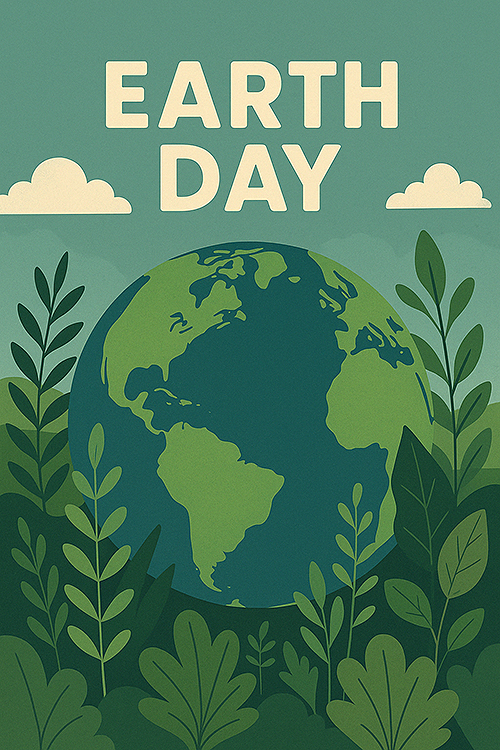
Why is EARTH DAY tomorrow more important than ever?


Since its inception in 1970, Earth Day, occurring each April 22, has stood as a global symbol of environmental awareness and action. What began as a response to a devastating oil spill in Santa Barbara has evolved into a worldwide movement, observed by over a billion people every year. It’s a day to reflect on the state of our planet, and more importantly, what we can each do to protect it.

While environmental advocacy has traditionally focused on large-scale industries and policies, publishing—and particularly self-publishing—has an increasingly important role to play. The tools and technologies that enable authors to bring their books to life are not just empowering from a creative standpoint—they can also be more sustainable.

Enter print-on-demand (POD) self-publishing.

Unlike traditional offset printing, which often relies on large print runs, warehousing, and mass distribution (with the inevitable waste of unsold copies), POD publishing prints books only when they’re ordered. This seemingly simple shift has a significant environmental impact. It dramatically reduces paper waste, minimizes the energy used in storage and transportation, and cuts down on the overproduction that has long defined the publishing industry.

In a world where sustainability is more than just a buzzword, POD offers a practical, effective alternative for authors and publishers who want to reduce their ecological footprint without compromising on quality or access. Fewer warehouses, fewer trucks, fewer trees lost to overstocked shelves and pulped inventory. More intention. More efficiency. More responsibility.

This year’s Earth Day arrives in a moment of both innovation and uncertainty. As climate policies evolve, government support shrinks, and industries reevaluate their impact, self-publishers have a unique opportunity to lead by example. Every decision an author makes—from the platform they choose to the way their book is produced—ripples outward. Choosing POD is one small but meaningful way to align personal storytelling with global sustainability.

So as we celebrate Earth Day, let’s also acknowledge the power of publishing—specifically, self-publishing done thoughtfully. When your story finds its audience without leaving a wake of unnecessary waste behind, that’s more than just a creative victory. It’s a conscious one.

This content was enhanced through collaboration with AI-powered creativity applications.

In Your Corner : Save the Earth (and maybe even the Whales) with POD!

Do you ever wonder what you can do as an author to save the world?  Are you the sort to take recycling and environmentally-conscious living seriously?  As we get closer to Earth Day 2016 (April 22nd), these conversations rise to the surface and spark all kinds of innovative thinking.  And this year, I’d like to toss one more idea into the ring–one more way you, an author, can do your bit to better protect this beautiful planet of ours:

Convert to Print on Demand (POD) publishing

Remember 50 Shades of Grey?  (Of course you do.  Who could forget?)  In the most interesting anecdote I’ve read all week, the Swansea Oxfam used bookstore received so many donated copies of 50 Shades that they–quite literally!–built a FORT out of them.  Think I’m kidding?  They posted a picture to their Twitter feed:

50shades

The tweet has gone viral, generating a series of articles on the rise and fall of E.L. James’ once-rabidly-popular and now-slightly-less-popular steamy Twilight fanfiction-inspired novel.  More importantly, in my mind, is the fact that this media frenzy has prompted people to take a second glance at how publishing is done–in particular, how the traditional publishing model blankets the world in a flood of books that nobody buys, or that people buy and then dispose of almost immediately.

The second issue–the disposability of a book–is more or less a consequence of its content.  But the first issue–the excessive number of printed books that never find homes–is one that you can avoid simply by choosing the self-publishing model, and choosing to print your books on demand.  What is Print on Demand (POD)?  The clue is in the title: POD is any service that allows authors to print however many copies of their book that they want, as they gauge interest and on the go.  This saves everyone from repeating the dreaded Swansea book fort scenario, and helps mitigate a sad reality in the West: unsold books headed straight to landfill.  I was speaking to a local librarian the other day, and it turns out that despite their best efforts to redistribute all donated books to area Little Free Libraries, book nooks in local businesses, and sales through Amazon … they still sometimes have to send new books straight to the dump, because nobody wants them.  These are usually titles of which so many copies were printed, everyone has already read them, and all the people who want to own copies already have one at home.

So we return to the simple fact: POD is far more earth-friendly than a massive print run.

Instead of being locked into a massive initial print run that they then must recoup the cost of through sales, indie and self-publishing authors can print a smaller number of copies, recoup the cost faster, and go back for more whenever they like or need to.  POD services are included in the cost of many publishing packages, including several of those offered by my own employer, Outskirts Press.  At Outskirts and other hybrid publishing firms, the diversity of packages offered creates additional flexibility–authors only pay for what they need, and not for excesses that underscore a traditional publishing company’s bottom line.  And at least with Outskirts, books are printed mainly on recycled paper (another earth-friendly boon!) and we offer ebook options that require no paper or ink at all!  It’s well worth your time to explore all of the options available to you, and to tailor your publishing experience to suit your resources.


I didn’t use the word “convert” earlier lightly.  It has somewhat religious undertones (or overtones, depending on who you ask), and I find it fitting because nature at its best often inspires a kind of spiritual or religious experience.  I remember standing on the South Rim of the Grand Canyon overlooking the Colorado River hundreds of feet below–that was pretty miraculous!  And I remember how I felt walking among the ancient Redwoods in Northern California–a different kind of grandeur.  Greener, more peaceful.  These moments are among the many gifts that the world gives us, an earth that quite literally keeps us alive and breathing.  I think limiting our excesses, whether in respect to printing books or supporting sustainable water usage and so forth, is an important step to take–and in this case, it’s also a way to protect your pocketbook from a different kind of excess.  It’s rare that what’s good for making a profit and what’s good for the environment line up, but Print on Demand (POD) publishing is one of those rare cases!

You are not alone. ♣︎

ElizabethABOUT ELIZABETH JAVOR: With over 18 years of experience in sales and management, Elizabeth Javor works as the Manager of Author Services for Outskirts Press. The Author Services Department is composed of knowledgeable publishing consultants, pre-production specialists, customer service reps and book marketing specialists; together, they all focus on educating authors on the self-publishing process to help them publish the book of their dreams. Whether you are a professional looking to take your career to the next level with platform-driven non-fiction or a novelist seeking fame, fortune, and/or personal fulfillment, Elizabeth Javor can put you on the right path.

How Self-Publishing Can Help the Environment

In honor of Earth Day yesterday (April 22, 2014), you may be looking for ways you can help protect our planet and preserve our precious resources. Self-publishing is a great option for eco-conscious authors. Many self-published companies offer “green” services and technology. Here is why self-publishing is the most environmentally friendly publishing choice.

  •  Self-published ebooks save trees because they are paperless. Saving trees is important for not only maintaining the beauty of our land, but also the health.
  • Paperback or hardcover copies can be printed on recycled paper or paper made from sustainable resources. Contact your self-publishing company to learn more.
  • The print-on-demand model is the most resource-efficient way to publish.  It eliminates warehousing, returns and pulping.
  • Self-publishing allows you to publish books on topics related to the environment. You could share green living tips, inform readers about problems in the environment, or just use green topics as the basis for a novel.
  • Some self-publishing companies use alternative energy sources and support eco-friendly organizations.

To learn more about the eco-conscious options available from your self-publishing company, talk to self-publishing support team.

I’d love to know, how do you plan to use self-publishing to protect the environment?

ABOUT KELLY SCHUKNECHT: Kelly Schuknecht is the Vice President of Outskirts Press. In addition to her contributions to the Outskirts Press blog at blog.outskirtspress.com, Kelly and a group of talented marketing experts offer book marketing services, support, and products to not only published Outskirts Press authors, but to all authors and professionals who are interested in marketing their books and/or careers. Learn more about Kelly on her blog at http://kellyschuknecht.com.

How Self-Publishing Authors Can Celebrate Earth Day

In honor of Earth Day next week, many of you may be looking for ways to reduce your carbon footprint. Self-publishing authors can help keep our planet clean, beautiful, and healthy by offering their readers an ebook version of their book. Here are a few reasons why self-publishing an ebook is a great idea.

  • Obviously, ebooks equal paperless, and less paper equals more trees. More trees equal a healthier, more beautiful environment.
  • E-readers, such as the Kindle and Nook, are becoming increasingly popular, so more and more readers are looking for ebooks.
  • Offering an ebook increases the chance that your book will appear in search results, which increases the chance that readers will purchase your book.
  • Ebooks offer your readers a quick and convenient way to purchase your book. Today’s market wants to be able to make purchases by simply clicking a button, and unlike ordering a paperback book, readers don’t have to wait for the book to arrive in the mail.

While there are many benefits to ebooks, I also recommend offering readers a paperback version. Despite the growing ebook trend, some readers still prefer paper books. You don’t want to limit your audience by only offering one format. Paperback books are also ideal for gifts and selling at conferences or other public speaking events.

ABOUT JODEE THAYER: With over 20 years of experience in sales and management, Jodee Thayer works as the Manager of Author Services for Outskirts Press. The Author Services Department is composed of knowledgeable customer service reps and publishing consultants; together, they all focus on educating authors on the self-publishing process in order to help them publish the book of their dreams. Whether you are a professional looking to take your career to the next level with platform-driven non-fiction or a novelist seeking fame, fortune, and/or personal fulfillment, Jodee Thayer can put you on the right path.

Celebrate Earth Day by Self Publishing an Ebook

In honor of Earth Day last week, many of you may be looking for ways to reduce your carbon footprint. We all know that resources are scarce, pollution is a growing problem, and we must change how we live if we want to keep our planet clean, beautiful, and healthy. But many people aren’t sure what they can do to help. Well, if you are a self publishing author, one of the things you can do is offer your readers an ebook. Here are a few reasons why self publishing an ebook is a great idea.

  • Obviously, ebooks equal paperless, and less paper equals more trees. More trees equal a healthier, more beautiful environment.
  • E-readers, such as the Kindle and Nook, are becoming increasingly popular, so more and more readers are looking for ebooks.
  • Offering an ebook increases the chance that your book will appear in search results, which increases the chance that readers will purchase your book.
  • Ebooks offer your readers a quick and convenient way to purchase your book. Today’s market wants to be able to make purchases by simply clicking a button, and unlike ordering a paperback book, readers don’t have to wait for the book to arrive in the mail.

If you are also going to offer a paperback or hardcover copy of your book, consider using recycled paper. Some self publishing companies, such as Outskirts Press, offer this option.

I’d love to know, how often do you read ebooks, and what format do you plan to self publish your book?

ABOUT JODEE THAYER: With over 20 years of experience in sales and management, Jodee Thayer works as the Manager of Author Services for Outskirts Press. The Author Services Department is composed of knowledgeable customer service reps and publishing consultants; together, they all focus on educating authors on the self-publishing process in order to help them publish the book of their dreams. Whether you are a professional looking to take your career to the next level with platform-driven non-fiction or a novelist seeking fame, fortune, and/or personal fulfillment, Jodee Thayer can put you on the right path.