The Book Beautiful: Front & Back Matter (It Matters!)

So you’ve written a manuscript, thus the ‘meat’ of your book is complete. However, you want to happily sandwich that meat between what we call ‘front matter’ and ‘back matter.’ Front matter includes things like the half-title, the title page, the copyright page, a dedication, acknowledgements, a table of contents, and perhaps other things such as an epigraph, a preface, an introduction, or a prologue. The back matter can include an index, an appendix, and other material that doesn’t belong in the meat of the book, but that you’d like to include to feel you have a complete book.
First, let’s break down what front and back matter should include and how to make them look professional and appropriate. We’ll begin by tackling the different types of front matter you can choose to include.


  • Half Title –  As writers, you’re probably (and hopefully!) avid readers yourself, so you know that typically the first page of a book tends to just contain the title of the book. No author name, no other clutter, just a straightforward, bold texted title.
  • Title Page – The title page will also include the title of the book, but it will also include a subtitle (if you have one), the author’s name, as well as the name of the publishing company of the book. Other details that are often found on this page would be the location of the publishing house, the year the book was published, and perhaps even an illustration.
  • Copyright Page – You’ll usually find the copyright page by simply flipping the title page, and it will have a copyright notice, edition information, cataloging data, publication information, legal notices, and your book’s ISBN.
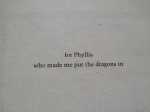
  • Dedication Page – This page will typically follow your copyright page and can be as simple as…


For my dearest mother Mary: R.I.P.

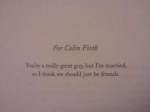
Or they can be witty…

“I dedicate this book to George W. Bush, my Commander-in-Chief, whose impressive career advancement despite remedial language skills inspired me to believe that I was capable of authoring a book.”

Pedram Amini, ‘Fuzzing: Brute Force Vulnerability Discovery’

Or they can be touching…

“Dear Pat,

You came upon me carving some kind of little figure out of wood and you said, “Why don’t you make something for me?”

I asked you what you wanted, and you said, “A box.”

“What for?”

“To put things in.”

“What kind of things?”

“Whatever you have,” you said.

Well, here’s your box. Nearly everything I have is in it, and it is not full. Pain and excitement are in it, and feeling good or bad and evil thoughts and good thoughts- the pleasure of design and some despair and the indescribable joy of creation.

And on top of these are all the gratitude and love I have for you.

And still the box is not full.”

–John Steinbeck, ‘East of Eden


  • Acknowledgements Page – This is where you can express your appreciation for all of those who helped you create the book.
  • Table of Contents – The table of contents is where you list all the major divisions within your book, more often than not in the form of chapters. The length of your book will determine how detailed your table of contents will need to be–a longer book will typically require a more detailed table of contents to assist your reader in navigating the piece.
  • Epigraph – An epigraph is a quotation that you can choose to devote an entire page to (usually facing the table of contents), or that you can choose to put at the start of the first chapter.
  • Preface – A preface is place for the author to explain how the book came into being and is often signed and dated by the author.
  • Introduction – Here the author can explain the goals of the work, place the work in context, or explain the organization and scope of the work.
  • Prologue – A prologue is told from the voice of a character in the book, and not the author’s own. It is typically used in a piece of fiction to set the scene for the story that is about to unfold.

As for the back matter of your book,

  • Index – An index will act as a guide to the book itself; it provides an alphabetized list of terms in the text and will indicate where in the text these terms were used.
  • Appendix – An appendix will provide supplementary details about your book such as corrections, updates, and details.


Now these are merely suggestions for what you can choose to include in the front and back matter of your book. What is most important is that what you do include looks professional and is well formatted. Pick up multiple books from your shelf and take a look at the front and back matter for a point of reference. While you’ve probably skipped over it on most books you’ve read, think how much more legitimate books with these sections look than books without them. These parts of publishing may seem tedious, but as I’ve said before, they are what will transform your manuscript into a book.


Thank you for reading!  If you have any questions, comments, suggestions, or contributions, please use the comment field below or drop us a line at selfpublishingadvice@gmail.com.  And remember to check back each Wednesday for your weekly dose of marketing musings from one indie, hybrid, and self-published author to another. ♠


Kelly

ABOUT KELLY SCHUKNECHT: Kelly Schuknecht is the Executive Vice President of Outskirts Press. In addition to her contributions to the Outskirts Press blog at blog.outskirtspress.com, Kelly and a group of talented marketing experts offer book marketing services, support, and products to not only published Outskirts Press authors, but to all authors and professionals who are interested in marketing their books and/or careers. Learn more about Kelly on her blog, kellyschuknecht.com

From the Archives: “Self-Publishing Ripple Effect Marketing”

Welcome back to our Tuesday segment, where we’ll be revisiting some of our most popular posts from the last few years.  What’s stayed the same?  And what’s changed?  We’ll be updating you on the facts, and taking a new (and hopefully refreshing) angle on a few timeless classics of Self Publishing Advisor.

∗∗∗∗∗

[ Originally posted: May 27th, 2010 ]

Later this week, on May 18th, the Colorado Independent Publishers Association (CIPA) EVVY Awards will be hosting the 2013 award banquet. The event will take place at Marriott Denver South at Park Meadows and all proceeds will benefit the literacy projects of the CIPA Education and Literacy Foundation (CIPA ELF).

CIPA is a nonprofit association of independent book publishers, authors, future authors and related publishing service providers that has been providing leadership since 1992. Members come from many states as well as from Colorado and three foreign countries to take advantage of the resources made available through CIPA membership. Organization membership, along with active participation in CIPA programs, can open doors to many opportunities and can save thousands of dollars in costly mistakes.

Best of luck to all the finalists! To learn more about the event, visit http://www.cipacatalog.com/pages/CIPA-EVVY-Awards.

by Kelly Schuknecht

.

Thanks for reading.  If you have any other ideas, I’d love to hear them.  Drop me a line in the comments section below and I’ll respond as quickly as I can.  ♠


Kelly

ABOUT KELLY SCHUKNECHT: Kelly Schuknecht is the Executive Vice President of Outskirts Press. In addition to her contributions to the Outskirts Press blog at blog.outskirtspress.com, Kelly and a group of talented marketing experts offer book marketing services, support, and products to not only published Outskirts Press authors, but to all authors and professionals who are interested in marketing their books and/or careers. Learn more about Kelly on her blog, kellyschuknecht.com

Self-Publishing News: 9.5.2016

happy labor day


And now for the news!

This week in the world of self-publishing:

“Professional photographer Alice Mabin is a woman not afraid to have a go in life,” writes Jennette Lees in her September 2nd article for the Cootamundra Herald, a paper which covers the Cootamundra District in New South Wales, Australia.  Says Lees, New Zealand born Mabin, 29, “always knew she wanted a career on the land,” and indeed spent “her early working life traipsing around high country stations in New Zealand mustering sheep, cattle, and deer, before packing up her life, including her dogs, in 2007 and moving to the vast, flat, drought-stricken planes of Hay, to experience farming the Australian way.”  She even took part in the 2013 Brinkworth cattle drive, the longest cattle drive in over 100 years of Australian history, walking roughly eighteen thousand head of cattle “from central Queensland to Hay,” a journey of 2000 kilometers (1240+ miles).

brinkworth cattle drive
[ a map of the Brinkworth drive ]
2000 kilometers, for comparison, is roughly the distance from Dusseldorf to Skopje, and from New York to Miami. You can imagine that walking that far might lend itself to some interesting photography, and Mabin made good on that opportunity. Writes Lees, Mabin “went along for a day to take photographs and ended up joining the crew for the entire five-month trip. She finished with beautiful, scenic images capturing a side of Australian life few have the opportunity to experience.”  After putting her images together as a book, and struggling to find a publisher, Mabin self-published The Drover and printed just a thousand copies.  To date, reports Lees, “21,000 copies of the book have been sold with another reprint on the horizon.”  To learn more about Mabin’s fascinating work and the story of her self-publishing experience, follow the link!


Some weeks ago–back in May, in fact–we reported on Rana Ayyub’s rough journey to self-publication, and this week we are happy to offer a wonderful follow up.  As Priya Ramani writes for Live Mint in this September 2nd article, “All the angst fades when you’re the country’s latest self-publishing sensation who has, pretty much single-handedly, managed to sell 32,000 copies of a book nobody would touch. It also feels nice to be on the verge of paying back the Rs.5 lakh bank loan you took to do this.”  Says Ramani, “It’s great when the country’s biggest English language book distributor takes you on board because they know it makes commercial sense, political affiliations be damned.” Ayyub, who published the highly controversial Gujarat Files: Anatomy Of A Cover Up earlier this year, has faced everything from being ignored to accusations of being a jihadi Muslim radical. It doesn’t hurt that Ramani herself is clearly impressed with Ayyub’s work; as Ramani puts it, “the then 26-year-old reporter who went undercover as film-maker Maithili Tyagi for eight months in 2011 to investigate the riots, custody killings and 2003 murder of Gujarat home minister Haren Pandya. The investigation, originally commissioned by news magazine Tehelka, was never published. Several years later, Ayyub has self-published it as The Gujarat Files. It takes a single-minded madness to do what she did.”  Single-minded madness aside, Ayyub has become something of a self-publishing sensation in addition to a political force for transparency, advocacy, and the ethical treatment of others.  For the full report, click here.

Emma Bryson has some strong words for the publishing community.  In her latest (September 1st) article for New Zealand’s premier Booksellers magazine, Bryson bemoans the fact that romance authors and publishers “inspire a bare minimum of mainstream media attention, aside from the odd condescending ‘human interest’ story. But the slight of romance rides further than this still, with traditionally little to no coverage in national or even local bookish circles.”  Says Bryson,  “I’m beginning to think that the somewhat toxic relationship between the wider publishing world and romance needs to be re-negotiated. Not for our sake, but for yours.”  How ‘yours’?  The genre “transcends most of those traditional mainstream publishing concerns,” she writes, and this is good for everyone: “Multinational vs indie? No problem, you can make a career out of either, or both. Traditional vs self-publishing? Both can be lucrative options for romance writers. Print vs digital? Hey, same there.”  The complicated relationship between Romance and Feminism bears further study, too, according to Bryson.  But when push comes to shove, it’s Romance’s very transgressiveness–its ability to cross lines because no one is looking–that makes it home for innovation and success. Its authors are “freed to explore those cutting-edge avenues that traditional publishers still scoff at,” write Bryson–and this is ultimately good news for everyone.  For the rest of Bryson’s article, follow the link..


spa-news

As a self-publishing author, you may find it helpful to stay up-to-date on the trends and news related to the self-publishing industry. This will help you make informed decisions before, during and after the self-publishing process, which will lead to a greater self-publishing experience. To help you stay current on self-publishing topics, simply visit our blog every Monday to find out the hottest news. If you have other big news to share, please comment below.


Kelly

ABOUT KELLY SCHUKNECHT: Kelly Schuknecht is the Executive Vice President of Outskirts Press. In addition to her contributions to the Outskirts Press blog at blog.outskirtspress.com, Kelly and a group of talented marketing experts offer book marketing services, support, and products to not only published Outskirts Press authors, but to all authors and professionals who are interested in marketing their books and/or careers. Learn more about Kelly on her blog, kellyschuknecht.com

“Skinny Little Tree” : A Saturday Self-Published Book Review

Book reviews are a great way for self-publishing authors to gain exposure. After all, how can someone buy your book if he or she doesn’t know it exists? Paired with other elements of your book promotion strategy, requesting reviews is a great way to get people talking about what you’ve written.

When we read good reviews, we definitely like to share them. It gives the author a few (permanent) moments of fame and allows us to let the community know about a great book. Here’s this week’s book review, courtesy of Between the Pages:

skinny little tree by jayme martin

Skinny Little Tree

by Jayme Martin

Publisher: Outskirts Press

ISBN: 978-1478708131

Synopsis*:

Author Jayme Martin has created a pretty picture book describing the seasons through the eyes of a skinny little tree. Through questions asked by a curious little boy, skinny little tree shares answers that highlight the passing of the seasons. There is the happiness of summer, the fading of fall, the loss during winter, and finally renewal as spring returns.

Colorful drawings correspond with the text to illustrate the tree’s answers. Martin adds a unique touch by including occasional blank pages offering the reader a chance to try his/her own hand drawing things referenced in the story such as a blue bird, little leaves, and the moon.

The simple story and friendly image of the skinny little tree make reading and sharing Martin’s book a pleasure. Young children can look back at their own additions created in response to the drawing prompts and perhaps imagine further images as the seasons change.

Critique:

I really enjoyed this interactive children’s book. First I want to comment on how special it is that this book allows children to draw on some of the pages, this helps to keep them intrigued. The story was short and simple which is perfect when reading it with young children. I enjoy sharing this book with my daughters because the author takes something familiar to children and creates a simple story which is essential in keeping their interest. My favorite part was the illustrations. I felt as though the artist did a great job conveying the emotions the tree was feeling in the story. This is a great addition to any young child’s library.

reviewed by Lynda Coker at Between the Pages ]

Here’s what other reviewers are saying:

At twenty-eight unnumbered pages, this letter-sized paperback is targeted toward preschool aged children and beginner readers, especially those who enjoy interacting with books by drawing as they follow along with the story line. With no profanity or scary scenes except perhaps a few dark-looking trees at night, it is an ideal book to read and use right before nap time or bed time. Artist Clark Andrews Jr. uses full page, colorful illustrations with enough engaging details to keep readers interested.

After fill-the-blank ownership and acknowledgement pages, this imaginative tome is about a little boy who speaks to a tall, green tree that looks happy and contented on the front cover. The boy asks the tree lots of questions such as why it is smiling at him, why is it weeping or worried, why does it dance with glee at night, and why is it smiling again. Promoted as a book discussing all the seasons of life, it is more about emotions like being happy, sad, worried, or cheerful.

With each question the boy asks, the tree responds with reasons such as being tickled by wiggly worms, having a friendly blue bird fly away, shedding little leaves who would rather play with the ground, listening to the moon sing, or having all its friends back, surrounding it.

Also with each answer there is a blank page to have the reader create and draw his or her own wiggle worm, blue bird, leaves, moon, smile, and even a skinny little tree. By engaging readers through artistic interaction, they learn not only how to imagine and draw their own designs, they are educated about a few emotions, what insects and animals are near trees, and that trees shed their leaves.

Although the book is very short in length and there are only six drawing applications for readers, the concept of interacting with the story is helpful and fun. Due to the word repetition, beginner readers can focus on specific word groups and learn new, more complicated words and their meanings.

– Amazon Reviewer Conny

Learning that all seasons of life are worth living is the focus of author Jayme Martin’s delightful tale, SKINNY LITTLE TREE.

A youngster finds a skinny little tree smiling and ask why. It says Wiggly Worms are tickling its toes. Then the tree cries because its friend the Blue Bird leaves.

Next the tree becomes worried when its leaves begin to fall. But then the tree dances with glee under the moon. Finally the tree is happy again when all things return.

With each new find, Martin has left a page for readers to draw what the tree is discussing. This enables the reader to participate in the story in their own way. This enchanting story follows the seasons of the tree with great detail and insight. Martin has a delightful way of showing how life changes giving parents and children a fun way to talk about it.

The beautiful illustrations by Clark Andrews Jr. enhance the fun story. The vivid drawings will capture readers attention as they follow the tree’s story.

Youngsters will learn as they enjoy this entertaining story. It’s a fun read for all ages.

– Amazon Reviewer Mason Canyon

Book Trailer:

* = courtesy of Goodreads reviewer Sally Kruger.


saturday self-published book review

Thanks for reading!  Keep up with the latest in the world of indie and self-published books by watching this space every Saturday!

Self Publishing Advisor

selfpubicon1

Conversations: 9/2/2016

WRONG WORD vs RIGHT WORD

= Editor Assistant

Are you the Writer whose story is rattling around in your thoughts and never gives you a moments rest? Does it wreak havoc with your daily life? Do conversations with family and friends become punctuated with descriptions of the perfect scene to open chapter eight? Is everyone asking you the question: WHEN will you be finished with that novel? This may be the time to consider working with an editor/assistant—but how do you find the right one? When I posed this question to one of my author/editor friends, she said: “It’s much like picking the right puppy out of a big litter. Go to a writers conference; sit in the middle of the room; and voila. The right one will come to you—eventually.” Well…maybe that has worked for her. Because she’s not just an author, but also an editor who easily connects with people and really does a great job of editing for them, lots of people enjoy talking with her. However, allow me to offer a few other suggestions that might help folks who aren’t quick as outgoing.

frustration

  • Because my editing friend is also a published author (with several book on Amazon and in bookstores), I look for that information in any Editor’s Bio. If someone has never gone through the whole writing process themselves, how are they going to understand what I’m going through—and HELP ME!
  • Whether in-person or by phone, I want to TALK with several Editors about my book ideas and then LISTEN to their responses. I’m hoping to hear a connected-ness to the central concepts of the book and feel a person-to-person (writer-to-writer) connected-ness, too. If they don’t “get” the story I’m trying to write, they are not the Editor for me.
  • Also important is finding an Editor who will compliment a writer’s personality type. Most of the authors I know have utilized personality-type-testing to enhance their understanding of Introvert/Extrovert, Empathic/Detached, etc. “characters” as they are developed in their stories. Knowing the basic personality type of the Editors being interviewed will help select the best person to BALANCE the creative flow.
  • Both Author and Editor must also be adaptable—sensitive—to the STORY being written. We’ve all heard (and eventually understand) that stories and characters take on a life of their own as the book gets closer to completion. Editor and Author must be willing to LISTEN to each other’s ideas about improving plot without making decisions that alter the character(s) and the life they’re living in the story.
  • Finally, ask for references from the Editor’s authors list and be willing to call them. One of my favorite things to do is provide the list of the published books my author/client/friends completed.

Mark Twain is quoted saying, “The difference between the almost right word and the right word is like the difference between the lightning bug and lightning.” The same can be said about connecting with the right Editor. There is one more way to find an excellent Editor who will match your needs. Talk with the publishing consultant from the publisher you plan to use. Their experience in connecting Writers with Editors is there for the asking. ⚓︎


Royalene

ABOUT ROYALENE DOYLE: Royalene has been writing something since before kindergarten days and continues to love the process. Through her small business—DOYLE WRITING SERVICES—she brings more than 40 years of writing experience to authors who need “just a little assistance” with completing their projects. This is a nice fit as she develops these blogs for Outskirts Press (OP) a leading self-publisher, and occasionally accepts a ghostwriting project from one of their clients. Her recent book release (with OP) titled FIREPROOF PROVERBS, A Writer’s Study of Words, is already receiving excellent reviews including several professional writer’s endorsements given on the book’s back cover.  

Royalene’s writing experience grew through a wide variety of positions from Office Manager and Administrative Assistant to Teacher of Literature and Advanced Writing courses and editor/writer for an International Christian ministry. Her willingness to listen to struggling authors, learn their goals and expectations and discern their writing voice has brought many manuscripts into the published books arena.