From the Archives: “A New Year’s Manifesto”

Welcome back to our Tuesday segment, where we’ll be revisiting some of our most popular posts from the last few years.  What’s stayed the same?  And what’s changed?  We’ll be updating you on the facts, and taking a new (and hopefully refreshing) angle on a few timeless classics of Self Publishing Advisor.

∗∗∗∗∗

[ Originally posted: December 30th, 2015 ]

Around this time last year, I was busy making resolutions for the new year–2015, the year we’ve just finished–and in some cases I have actually managed to make good on those resolutions (see the list here and here).  This year, however, I’m pushing back a little against the instinctual attraction to “list-fever,” that special kind of holiday mania that leaves us mellow and warm and happy once the list is complete (it always feels good to write up a list, doesn’t it?) but panicked and anxious as the year reaches its end and we haven’t yet accomplished all that we set out to do.  And so it is that this year, instead of compiling all of the things I want to do, I thought I’d sketch out a quick drawing of who I think we are, as self-publishing authors.

This is my self-publishing manifesto:

I hereby claim the mountain of content and the island of method for us, the (few, the mighty) self-publishing authors of the world.  I assert our right to write what we please in whatever manner we please and within whatever time frame we deem fit.  I declare nothing off-limits, nothing too “edgy” or “tame” or “niche” or “unique.”  We are the fearless in life, and we have the right, too, to write and publish as adventurously as we live.

I hereby claim the lake of responsibility and the waterfall of ethical treatment for us.  In the little skirmishes and give-and-take between the traditional and self-publishing worlds, we occupy the high moral ground, ground from which we foresee a future in which authors are treated with the respect that they have earned, simply by virtue of being authors, and in which no one–neither the authors nor the publishers, the editors, the graphic designers, nor any other professional involved in the industry–uses their influence to abuse or undervalue others and the services they offer.  I assert our support for a future in which no-one can claim a monopoly on distribution or quality of product.  I claim the right to creative freedom and creative control–as well as an ethical flow of profits to and from the right people–for us, the self-publishers.  And I also claim the collective right to not tolerate unethical behavior from the corporate publishing sector which routinely reneges on its commitments to writers, readers, and its own employees.

I hereby claim the plains of ambition and the foothills of inspiration for us.  We will write, to the best of our ability, the best books we are capable of writing.  We will create, to the best of our ability, the finest covers and illustrations and altogether visually pleasing objects of which we are capable of creating.  We will learn from our mistakes without damage to our sense of self or our ego; we will seek out expert feedback and emerge with a refreshed sense of purpose and vision for where to go next.

I also claim the right to act out of self-interest, collectively and individually, for us–the authors who have been told we don’t belong or aren’t good enough but most definitely do and are–while also upholding our commitment to generosity, compassion, and social responsibility.  I claim the right to take full advantage of the digital revolution, to look forward to and think with a futurist’s imagination about, a publishing world and a market that looks radically different from the one we work with now.

I hereby claim ownership of my own decisions.  I do not ask for permission from others to write what I write or publish what I publish; I write and publish what brings joy to me and to my readers.  I do not ask for compliments or pats on the back or for any recognition which undervalues my skills and the intelligence of my readers.  I declare my obligation to respect, value, and represent the interests of others, and to balance this obligation with my own needs as an author and human being.  I recognize the privileges of my position as a person of influence, a person with the vocabulary to reflect and shape the world around me, and seek to put that privilege to good use for good ends.

I am not shy about recognizing my strengths, and I am not afraid of my weaknesses.  I hereby claim the valley of well-earned pride and the city of well-learned failures as my province.  I am proud to be a self-published author, and proud to be a part of a wider community of self-publishing authors as well as the readers who open their hearts and minds to the books we place in their hands.

– by Kelly Schuknecht


manifesto writing cheerfully

I think this one stands on its own—don’t you? What else can we claim in 2017 that we weren’t able to claim in 2015 or even 2016? The self-publishing industry hasn’t necessarily broken new ground, but it has built steadily upon its previous successes, and reports keep coming in that the market share division between digital and print books has leveled out and begun to run steady. But there’s a lot of tension in the air, politically, socially, and yes, metaphorically—tensions that have the power to shape our decisions. If I were to add any one “claim” to my original list, it would be this:

I hereby claim the fearlessness, both frantic and calm, of the entrepreneur, of the start-up, of the crowdfunded, cloud-built-and-stored, groundbreakers. I opt to place myself in the way of beauty, and in the way of success, by giving it all that I’ve got and taking no prisoners, taking no breaks from being myself and from pursuing my dreams, and yet taking a jackhammer to my bad habits with a sensitivity to my good ones, and to my body, mind, and soul’s needs. I claim the ambition of the space race, the empty-all-pocketbooks audacity of a world utterly bankrupt of fear, and the joy of knowing that whatever mistakes I make, whatever failures I slide into, I rush headlong into them knowing that I gave my absolute best and without fear that it’s the end. I will live with a future-mind, knowing that today’s fears and hardships will not hold me in place forever. I claim the right to unleash myself on this world, as an author and a purveyor of stories.

How’s that for an addition? I think I might just keep up this tradition. I might even codify our existing claims—along with any additions you, dear readers, might throw our way—into a document for year-round use. What do you think?

Thanks for reading.  If you have any other ideas, I’d love to hear them.  Drop me a line in the comments section below and I’ll respond as quickly as I can.  ♠


Kelly

ABOUT KELLY SCHUKNECHT: Kelly Schuknecht is the Executive Vice President of Outskirts Press. In addition to her contributions to the Outskirts Press blog at blog.outskirtspress.com, Kelly and a group of talented marketing experts offer book marketing services, support, and products to not only published Outskirts Press authors, but to all authors and professionals who are interested in marketing their books and/or careers. Learn more about Kelly on her blog, kellyschuknecht.com.

Self-Publishing News: 1.9.2017

And now for the news!

This week in the world of self-publishing:

Let’s Kickstart the new year with a piece on funding books with, well…Kickstarter. Funding is always the number one concern when thinking about publishing a book in general, but especially when self-publishing. Dylan Goldby used crowdfunding to help publish a book of his photography and says, “For me, crowdfunding made the most sense because I wanted to leverage my existing contacts, spread the word organically, and use the final product to raise more money without having to pay back any loans, etc.” Further, he says he enjoyed the rewards program built into crowdfunding which allowed him to send copies of his book to those who supported him, which also acted as a networking and marketing tool.

As far as using Kickstarter goes, Goldby has realistic and insightful advice for authors thinking about utilizing this crowdfunding platform. First off, he is explicit in stating that this is a time consuming process, so if you have a more efficient way to raise the money, by all means take advantage of it. The next piece of advice he offers: be prepared. Have your idea fully flushed out, study campaigns that have failed and succeeded and find out why. Part of Goldby’s preparation was creating a folder of Facebook and Instagram posts, emails asking for support, blog posts, videos, etc. Picking core hashtags relevant to your project is another great way to amplify your online presence.

Since you’re already in the self-publishing world, I’ll just keep beating a dead horse and say that marketing is a crucial piece to using Kickstarter–you need to self-promote like it was your job! Keeping up on your social media and networking presence is a fundamental piece to a successful Kickstarter campaign. To find out more about how Goldby experienced such success via this route, read the article above!

If you keep up on Huffington Post, you may have seen the article last week titled: Self-Publishing: An Insult To The Written Word, in which author Laurie Gough makes claims such as, “I’d rather share a cabin on a Disney cruise with Donald Trump than self-publish,” and “From what I’ve seen of it, self-publishing is an insult to the written word, the craft of writing, and the tradition of literature.”

Of course statements like these make me cringe, however something that makes me cringe even more is the sensationalism and mob culture of the online world which reacted to Laurie’s article with personal death threats, trashed ratings and the like. We unfortunately live in a world where technology allows us to fire vitriol at perfect strangers without ever seeing the repercussions or painful reactions of those we spew it at. Can you imagine threatening someone’s life you disagreed with if you were sitting next to them on public transportation? Of course not, because it is not only socially unacceptable, it is an absolutely insane and outrageous thing to do.

Gough has since apologized for the article (which has not stopped the hate-mail of course), where she recants her naive claims and admits on her Facebook page, “I’ve only read a handful of self-published books so was basing my article on that. I guess I was in a bad mood when I wrote it and I SO wish I’d never written it.”

Admittedly, Laurie’s article was offensive, brusque and clearly out of touch with the self-publishing world. Comparing self-publishing to screaming into a microphone and calling yourself a musician or saying that “the only similarity between published and self-published books is they each have words on pages inside a cover. The similarities end there,” are highly unfair assessments of the industry and have been proven wrong by numerous successful self-published authors.

So my question is why, when we know people are obviously wrong and expressing intolerant views, do we act so wrongly and intolerant right back at them? Intolerance shouldn’t breed more intolerance; if you fundamentally disagree with the tenants of someone’s argument, either ignore it and go on with your day, or add something productive to the conversation that will help persuade them via rational argumentation, rather than by fear of their safety or well-being. Screaming your opinion the loudest won’t make people listen to you, it will only make them want to plug their ears.

People will disagree with you, they will shoot you down, and they will tell you that you have no talent. Traditional publishing companies have done that to us for years, but we don’t go burn down their headquarters or troll their CEOs–we move on and we take the high road. I sincerely hope self-published authors let up on Gough, and I am sincerely happy to see her public and quite genuine-seeming apology.


spa-news

As a self-publishing author, you may find it helpful to stay up-to-date on the trends and news related to the self-publishing industry. This will help you make informed decisions before, during and after the self-publishing process, which will lead to a greater self-publishing experience. To help you stay current on self-publishing topics, simply visit our blog every Monday to find out the hottest news. If you have other big news to share, please comment below.


Kelly

ABOUT KELLY SCHUKNECHT: Kelly Schuknecht is the Executive Vice President of Outskirts Press. In addition to her contributions to the Outskirts Press blog at blog.outskirtspress.com, Kelly and a group of talented marketing experts offer book marketing services, support, and products to not only published Outskirts Press authors, but to all authors and professionals who are interested in marketing their books and/or careers. Learn more about Kelly on her blog, kellyschuknecht.com.

Saturday Book Review: “50 Things Your Kids Don’t Want To Tell You”

Book reviews are a great way for self-publishing authors to gain exposure. After all, how can someone buy your book if he or she doesn’t know it exists? Paired with other elements of your book promotion strategy, requesting reviews is a great way to get people talking about what you’ve written.

When we read good reviews, we definitely like to share them. It gives the author a few (permanent) moments of fame and allows us to let the community know about a great book. Here’s this week’s book review, courtesy of Midwest Book Review:

50 Things Your Kids Don't Want to Tell You by Shelly Campbell-Harley

50 Things Your Kids Don’t Want to Tell You

by Shelly Campbell-Harley

Publisher: Outskirts Press

ISBN: 9781478773627

Synopsis:

Shelly Campbell-Harley has a Master’s in Education and has had dozens of articles published online and offline, including The Old Schoolhouse Magazine, where one of her articles was included in TOS magazine’s Best of the Best 2013 special publication. Shelly has been involved with young people in many different facets over the past two decades, including that of teaching, educational consultant, youth group leader/director, and working with youth in a rehabilitation environment. She is currently teaching at-risk youth in an innovative charter school program in southern California. 50 Things Your Kids DON’T Want To Tell You is a compilation of valuable insights gleaned from young people aged 10-19 whom Shelly has encountered and wanted to share with parents and other adults who work with young people. It is an eye-opening experience for many who are curious as to what is going on in the lives and minds of our youth today. It was written with the purpose of opening the lines of communication between adults and young people, as well as promoting more positive relationships. 50 Things Your Kids DON’T Want To Tell You is a fascinating, scary, and realistic read that will awaken your mind and shake up your impression of how well you think the youth of today are living. With the rise of teenage suicide rates and school shootings, this book may be the beginning of an important connection needed to bridge that gap of communication while helping our young people see that they are being heard and understood. Get your copy today and make a positive change in a child you know!

Critique:

50 Things Your Kids DON’T Want To Tell You is comprised of five chapters:

  1. Family Relationships
    2. Personal Choices
    3. School: The Stage
    4. Legal: Crossing Lines
    5. Sex: No Plan

After each chapter, author Shelly Campbell-Harley has a ‘Reflection Page’. This is where you may list your thoughts about what you’ve read. Here, you may use free thought, mind mapping, or whatever method you deem necessary to lead to possible truths.

There isn’t any commentary on the 50 Things and it’s supposed to be that way. The book was meant to help you to think critically (deeply, not negatively) about whether or not your offspring is struggling with some of the mentioned issues. If 50 Things brings you and young to a point where a nonjudgmental conversation can be broached, then, the book will have well-earned your bucks.

Perhaps, a resource section would have been good though.

Shelly Campbell-Harley is the author of over a dozen educational articles and has written several children’s books, as well as a book on leadership. She has a Master’s in education and has been teaching for over 20 years. When Shelly is not writing, teaching, or spending time with family and friends, she enjoys reading, crafting, and spending time outdoors.


reviewed by Ginae McDonald of Midwest Book Review ]

Here’s what some other reviewers are saying:

Shelly Campbell Harley understands the most important thing about getting your teen to open up and talk to you, the parent, about what’s going on with their lives. And that is listening. Not interrogating, but rather inviting your child to share with you, and responding in a way that allows for them to feel safe in their sharing. The key to get them to take you up on this invitation could be unlocked in this simple book. Forever grateful to Shelly Campbell Harley.

– Amazon Reviewer S. Brown

I loved this book. I back and bought multiple copies after reading it, and gave to family, friends and co-workers. This book really opens your eyes to the different situations that might be or could be going on in your own child’s life or possibly a friends child or a family member’s child. I am very happy with this purchase and recommend this book to everyone.

– Amazon Reviewer Amazon Customer


saturday self-published book review

Thanks for reading!  Keep up with the latest in the world of indie and self-published books by watching this space every Saturday!

Self Publishing Advisor

selfpubicon1

Conversations: 1/6/2017

WRITER SEEKS MENTOR

January and the New Year nudge many of us to look into the future and consider what we might accomplish during the next twelve months. Quite often this season of new loungingpossibilities fills me with memories of the English/writing teachers in my life—the men and women who were passionate about grammar, sentence structure and the specific definitions of words. Many of my friends talk about the professors who became their tour guides into the worlds of American and English Literature, Shakespeare and Renaissance writings and the dramatic works of stage plays and poetry. For me, personally, I continued my education through writers’ conferences and local creative writing workshops. Without exception, each of the instructors fed me the knowledge they’d learned—and experienced—giving me the opportunity to absorb as much as I would or could at the time. I will forever be thankful for these counselors, advisors and mentors in my life.

Have you been a protégé of an English teacher, Journalism professor or local Creative Writing instructor?  Have you advanced your skills and abilities under their tutoring? Are you now ready to be a Mentor? Here are few thoughts to consider in this New Year—as you find yourself in position to encourage the youngest and oldest writers in your neighborhoods.

  • Be prepared with lists of resources. Take an inventory of your own writing resources. Include books and articles you’ve found most helpful and also include several of your favorite books—in several genres—that demonstrate the best of writing expertise.
  • Learn about your own personality type and the corresponding communication skills that allow you to connect with someone who asks for your advice.
  • Create a list of questions that you can select from which will help you understand what the person—and their writing project—need from you.
  • Be willing to decline a request for help. It is quite possible that you are a link to help that person connect with the writer/person who will be their best advisor.

There are several authors I know who are offering creative support to writers. Two of my “go to” mentors are Francine Rivers (Christian Fiction) and Joanne Penn (Thrillers). Their websites and blogs offer excellent advice developed from years of experience and award-winning writing. They are excellent resources for those who are a bit shy about meeting face-to-face. However, should you wish to locate a writer in your location, you can contact the National Writing Organizations in your genre and ask for recommendations. Another source is your local Universities and Community Colleges. Their professors may be a good fit, or they will know of author/mentors in your area.

It is an exciting time when one writer seeks mentoring by another. I never imagined that I would someday be in both positions—simultaneously. Experience has and is teaching me, that every writer—as we grow in our craft—become counselor, advisor and partner/assistant to other writers. What we learn from helping other writers, both through them and their specific projects, enhances our own skills in ways we may not realize for years. These are continuing paths of education that cannot be measured or given a monetary value.

As we begin this year of 2017, I hope we’ll all enjoy the blessings of being mentored and mentoring at least one other person. And may we never be shy about seeking the mentoring we need. It is through these experiences we become lifetime-learners! ⚓︎


Royalene

ABOUT ROYALENE DOYLE: Royalene has been writing something since before kindergarten days and continues to love the process. Through her small business—DOYLE WRITING SERVICES—she brings more than 40 years of writing experience to authors who need “just a little assistance” with completing their projects. This is a nice fit as she develops these blogs for Outskirts Press (OP) a leading self-publisher, and occasionally accepts a ghostwriting project from one of their clients. Her recent book release (with OP) titled FIREPROOF PROVERBS, A Writer’s Study of Words, is already receiving excellent reviews including several professional writer’s endorsements given on the book’s back cover.  

Royalene’s writing experience grew through a wide variety of positions from Office Manager and Administrative Assistant to Teacher of Literature and Advanced Writing courses and editor/writer for an International Christian ministry. Her willingness to listen to struggling authors, learn their goals and expectations and discern their writing voice has brought many manuscripts into the published books arena.

In Your Corner: Resolve!

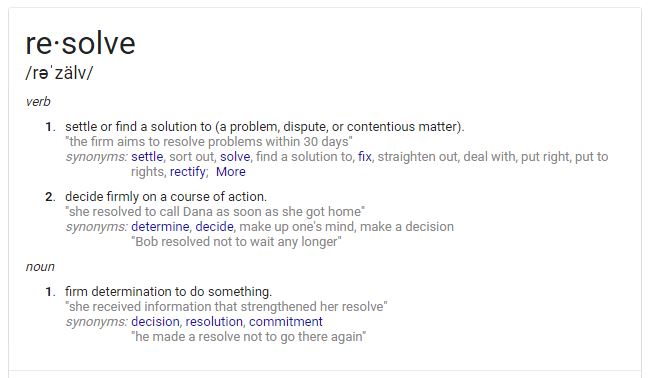
What is resolve? And why do we talk so much about it at this time of year? Simply defined, the word can either be a noun or a verb, a thing or an action we espouse, involving firmness of purpose and determination to reach some sort of goal.

resolve definition

So why do we do this whole “New Year’s Resolutions” thing? Is it because starting a new year somehow frees us up to do things we weren’t able to do before? Unlikely. Or is it because, historically, many cultures have a tradition of ceremonially marking the passing of an old year by letting go of past worries and struggles? Possibly. My personal theory is that New Year’s Resolutions came about as a combination of cultural ceremony and human psychology, wherein people find it useful and perhaps easier to lay the groundwork for big tasks or challenging years if they do it all at once, while they’re in a certain frame of mind. And the winter holidays in North America are the perfect time for reflection; in many parts of the continent, we’re all stuck inside due to forbidding weather, and exhausted by the passing of a full year. Holidays like the one we’ve just had give us some much-needed emotional distance from our experiences, past and future, that can be fuel for making plans for change.

new year's resolutions

As authors, our resolutions automatically look a little … different. We might also resolve to go on diets or quit smoking or any of the other “top tens” out there, but we usually sneak a couple of writing-related objectives into the list, too. And with so many people setting the goal of publishing their next book in 2017, there are some specific resolutions which might be of use to you which I thought I might mention here–ways in which you can achieve your dream of book publication in time.

  1. Keep writing, and keep it structured. At least, you know, to the extent which is useful. I started scheduling an hour before getting ready for work each morning during NaNoWriMo this last November, and that has proven to be a habit I can more or less stick to now. Very useful for me, personally. It may not be useful for you. But one thing is certain–no matter when you schedule yourself to write, make sure that you do make it a habit. Publishing means very little if you give up on the thing you love most: writing more books!
  2. Lock in a deadline for your first draft. If you write for an hour a day, you can reasonably expect to finish a first draft within two to three months of steady writing. It doesn’t need to be a full draft, but it does need to capture the main essence of what you’re trying to get at. You can go back and diagnose problems of plot and characterization later, but if you agonize over the details during the drafting stage, you’ll never get it done. I speak from personal experience.
  3. Lock in a deadline for your second draft, too. A second draft is where you fill in all the big blank spaces you left while drafting the first manuscript, and maybe address some of the larger issues of pacing and structure. I recommend another two months for this process.
  4. Stop writing–and stop editing, too. Once you have a good second draft in hand, it’s time to leave the writing desk for a little while and look for some outside assistance. Layer your personal crew of early readers–family and friends–with the expertise of a professional editor. I can’t emphasize the importance of this professional help enough! Our friends and family are wonderful, but they tend to be bound by affection in some ways, or they  might lead busy lives which prevent them from giving your manuscript their full, expert attention. And I recommend seeking professional advice at this stage because you still have the emotional room to make big edits and changes without feeling as though you’re butchering the text. A copyeditor, later on, can catch your spelling mistakes and so forth, but a true professional edit at this stage will help you fix character flaws, plot holes, and large-scale disorganization. Very important. And editors are available in many places, including through Outskirts Press.
  5. You guessed it–schedule your last round of edits. Give yourself that deadline, maybe a month or two out. This will bring you to six months from today–June of 2017. And that gives you a couple of months before Awards Season rolls around to get your book to a self-publishing company and out into the world, making you eligible for those awards submission deadlines.

And that’s it! I highly recommend keeping your resolutions simple and straightforward, and of course … don’t punish yourself if you perceive yourself somehow “falling short.” Resolutions are guidelines and motivators, and should not ever be a source of shame. Use what’s useful, and lose what’s a distraction, I say! And may 2017 be a year of firm resolve for all of us!

You are not alone. ♣︎


Elizabeth

ABOUT ELIZABETH JAVOR: With over 18 years of experience in sales and management, Elizabeth Javor works as the Manager of Author Services for Outskirts Press. The Author Services Department is composed of knowledgeable publishing consultants, pre-production specialists, customer service reps and book marketing specialists; together, they all focus on educating authors on the self-publishing process to help them publish the book of their dreams. Whether you are a professional looking to take your career to the next level with platform-driven non-fiction or a novelist seeking fame, fortune, and/or personal fulfillment, Elizabeth Javor can put you on the right path.