In Your Corner : Celebrate National Reading Month With These Marketing Tips! (part one)

March is National Reading Awareness Month!  Here at Self-Publishing Advisor, we love the fact that there’s an entire month devoted to celebrating the written word–as well as the ways in which we can spread the joy of literacy–and I would like to invite you to join me in making reading a focus all month long, here in our Thursday blog post slot.  

As writers, we’re not just people who produce stories; we also consume them, share them, and advocate on their behalf.  As writers, March of 2016 is the ideal time for you to not only finish your book and start publishing it, but also to promote yourself and your book while encouraging everyone to read.  

Think this sounds like a challenge?  Maybe it is.  But I have some pointed ideas to get you started.  This is doable.  I promise you!  All you need to do is dedicate some time each day this month to pursuing the marketing and promotion tips I’ll be posting here for the next four weeks.

GETTING STARTED : Become the local expert.  

If you haven’t heard of National Reading Awareness Month or know the details of its longstanding connection to Dr. Seuss’ birthday, the history of the National Education Association, and how you can participate … well, it’s time to you pay a visit to the NEA’s website and browse through the plentiful promotional materials, media tips, press release tips and fact sheets the NEA has posted there in order to introduce you and other acolytes to the Read Across America celebration.  

Another tip?  It’s well worth offering to speak at local schools and NEA events, or to local organizations on the importance of childhood reading skills.  Many schools, libraries, bookstores, and other organizations welcome the outside help in putting on events of this kind, and yes–there’s something in it for you, too.  The more you make yourself indispensable to your local literary and literacy-building community, the more likely you are to be called on again in the future, and to get word of your own work before fresh eyes.  Best of all, there’s a great deal of satisfaction in knowing you’re helping to foster the next generation of readers–some of whom may go on to read your book!  Which leads me to ….

First Lady Michelle Obama takes part in Read Across America 2012

TIP TWO: GET ‘EM WHILE THEY’RE YOUNG 

Yesterday was Read Across America Day!  Writers are some of the biggest supporters of this day and event.  While you may have missed the boat for 2016, there’s no better time to prepare for the next year than now, when the opportunities (even the missed ones) are fresh on parents’ and teachers’ minds.  Contact local schools, libraries, and nonprofits to find out how you can help promote reading, writing, and kindergarten readiness in general–not just today, but throughout the entire month of March.  Ask if you might partner with some of them in throwing an event next year, in 2017, and start lining up the logistics.  When it comes to scheduling things in March, which is testing season for many American schools, the earlier you get started the better an outcome you can expect.
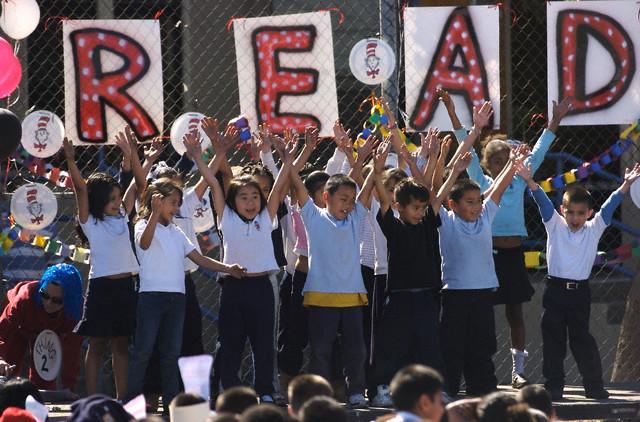
Read Across America 2007

TIP THREE: CONSIDER ONLINE ADVERTISING  

The last two tips built upon a foundation of interpersonal networking–that is, meeting people face to face and using this method to benefit everyone.  But what about those readers beyond your immediate sphere of influence?  How can you get them reading–and reading your book in particular?  Here’s a thought: Once your book is published, consider whether it might benefit from any online advertising.  You can set up ads on sites like Facebook, Google and Goodreads easily, or with some assistance from your self-publishing company and the marketing consultants they likely keep on staff.  If you’ve published through a company like Outskirts Press (my own stomping grounds), you can count on their staff to help you make your book more discoverable on Google with something like the Google Books Preview Program.

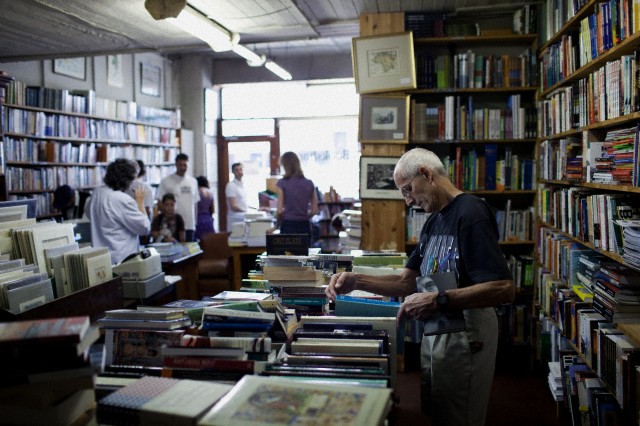
Reading in Madrid

TIP FOUR: INTRODUCE NEW FORMATS OF YOUR BOOK 

You know how it goes: The more easy a thing is to buy, and the more accessible it is to a large number of people, the more sales of that thing will jump.  It’s a well-demonstrated fact that self-publishing authors can reach a larger audience of readers by offering additional formats such as Kindle, Apple iPad or NOOK editions of your book.  And if you’ve only ever published your book digitally, perhaps it’s time you branched out into Print on Demand (POD) copies of your masterpiece!  Consider which formats you want to offer and add them before or after your hardcover format hits the virtual shelves.  If you feel inexpert in how to make the most of a multiplatform, multiedition publication, don’t hesitate to turn to those with the most wisdom to share: your fellow self-publishing authors!  We’re here for you.

Always remember: you are not alone. ♣︎

ElizabethABOUT ELIZABETH JAVOR: With over 18 years of experience in sales and management, Elizabeth Javor works as the Manager of Author Services for Outskirts Press. The Author Services Department is composed of knowledgeable publishing consultants, pre-production specialists, customer service reps and book marketing specialists; together, they all focus on educating authors on the self-publishing process to help them publish the book of their dreams. Whether you are a professional looking to take your career to the next level with platform-driven non-fiction or a novelist seeking fame, fortune, and/or personal fulfillment, Elizabeth Javor can put you on the right path.

Defining The Hybrid Publishing Experience

If you’ve spent much time on this blog or researching your publishing options, you probably have a fairly substantial definition in mind for the terms “self-publishing” and “traditional publishing,” but can you say the same for “hybrid publishing“?  We use the term rather often here on Self Publishing Advisor as a catch-all for every company and business model that doesn’t fit neatly into the aforementioned binary––but what does it mean, really?  It’s not enough to define a thing by what it is not … we need some basis for a positive, holistic understanding of what hybrid publishing has to offer the indie author.

What qualifies as “hybrid”?

Biologically speaking, a hybrid is “the offspring of two plants or animals of different species or varieties, such as a mule (a hybrid of a donkey and a horse).” Most of us are familiar with a different kind of hybrid, which is to say the mythological kind, where different species find themselves mashed up into one single creature on a physical but not cellular level.  A centaur is a mythological hybrid between man and horse, the Sphinx between a woman, lion, and raptor.  Is a hybrid publishing company, then, the offspring of two warring traditions (self- and traditional publishing)––or is it some oddball thing that adopts the best or most distinctive features of other publishing traditions to serve an entirely different narrative?

Says Jane Friedman of Publisher’s Weekly, it has become “nearly impossible to categorize certain publishers and services; some wish to avoid being labeled altogether. They consider themselves innovators, providing an important alternative for authors.”  These companies self-advertise as providing a third way altogether, not just cutting the difference between the two established publishing modes.  This reality would seem to indicate that hybrid publishing shares more with a centaur than it does with a mule, but perhaps we’re splitting hairs.

Perhaps, when it all shakes out, we can safely define hybrid publishing on its own terms.  Brook Warner of Huff Post Books suggests  four categories that fit the catchall term:

Traditional publishers who’ve been brokering hybrid deals for years. […]

Partnership publishing models. […]

Agent-assisted publishing models. [… and]

Other assisted publishing models.

All four of these categories acknowledge “assistance” as a defining feature, but here’s the problem: assuming that self-publishing and traditional publishing don’t  offer assistance as a part of their mechanism creates a false dichotomy that does nobody justice, and many companies that Warner might call “hybrid” do in fact distance themselves intentionally from the term because it implies too heavy a reliance on paid assistance––or authors “taking the easy way out,” so to speak.  This just in: elitism may be the bread and butter of gatekeeping traditional publishing, but it doesn’t have to be the same for self-publishing!

This still leaves us with a problem, however: How to define hybrid publishing?  Let me suggest a new definition:

Hybrid publishing is any publishing model that allows authors to enter into direct, flexible, contractual collaborations with industry professionals that in traditional publishing would be indirect (they would be paid by the publishing house, not the author) and are not traditionally available to self-publishing authors.  This includes companies like Outskirts Press, which offers a range of collaborative services, and excludes the so-called “hybrid author,” or someone who has moved from traditional publishing into self-publishing or vice versa.

Playing the field:

As Friedman goes on to point out, each of the companies that might fit into the hybrid category operates on a different business model, making it difficult to compare them against each other.  She advocates asking a series of questions, such as “How will your books be distributed?” and “What marketing and promotion support do their titles receive?” before committing to a certain choice.  But this doesn’t exactly help new authors decide whether hybrid publishing and a “third way” is for them––and with so many options now available, narrowing the field is an important part of the decision-making process. Ultimately, the choice of whom to choose may rest on individual features such as those Friedman suggests evaluating … or it may rest instead on the complicated matrix of human need.  Hybrid publishing companies, despite their extreme differences, do seem to collectively meet authors’ desires for a human-driven, relational publishing experience.

In conclusion … for now:

The world of hybrid publishing is perhaps a bit too complicated to break down in its entirety within the constraints of an initial foray such as this one, but it is a world we will be returning to again and again here on Self-Publishing Advisor.  As the world of publishing evolves and diversifies, so too must the companies who serve to send our stories out into that world.


Thank you for reading!  If you have any questions, comments, suggestions, or contributions, please use the comment field below or drop us a line at selfpublishingadvice@gmail.com.  And remember to check back each Wednesday for your weekly dose of marketing musings from one indie, hybrid, and self-published author to another. ♠

KellyABOUT KELLY SCHUKNECHT: Kelly Schuknecht is the Executive Vice President of Outskirts Press. In addition to her contributions to the Outskirts Press blog at blog.outskirtspress.com, Kelly and a group of talented marketing experts offer book marketing services, support, and products to not only published Outskirts Press authors, but to all authors and professionals who are interested in marketing their books and/or careers. Learn more about Kelly on her blog, kellyschuknecht.com.

6 Tips to Combat the Marketing Blues

Chances are, you’ve probably already experienced the very real struggle that is the Marketing Blues––that nebulous cluster of miseries and disappointments that are unique to the self-publishing experience.  Going through the publishing process alone––much less the marketing one that follows––is bound to feel isolating or solitary at times.  After all, you’re doing a Big Thing indeed in self-publishing your book, and you’re investing a lot of elbow grease.

So how best to beat the blues?  Here are six tips to get you started:

  • FOCUS ON THE POSITIVE: Sounds straightforward, doesn’t it?  But it’s much, much harder than a simple phrase suggests: altering your perspective and slimming down your method to focus on the things you’re doing well–this is hard, hard stuff.  When I use the word “focus,” I mean it in both an emotional and a practical sense; you can’t afford to waste time on marketing strategies that you have already tried repeatedly in several different ways.  (This is, after all, the definition of “insanity.”)
  • KEEP WRITING: We’ve said it before here on Self-Publishing Advisor, but we should say it again: your best advertisement and your best marketing strategy is to write the next book.  Don’t lose what you love most in the midst of the marketing frenzy, and don’t allow the publication process and everything that goes along with it to lead you away from the person you want to be: an author.  Keep doing what you love; readers are drawn to that authenticity … not to mention the probability that they’ll have more to read from you in the future!
  • THINK LIKE A READER: Your readers aren’t agonizing over the gaps in your marketing strategy that they can’t see; and they’re definitely not looking for an author who isn’t listening to them and what they want.  They’re simply eager to discover new and wonderful things, to fall in love with the brave new worlds they find between the covers of a book.  And so, if you think like a reader, you’ll find new ways to put your book in front of fresh eyes day after day without fail.  Engage with your readers and demonstrate you’re not just another author looking to push your own sales!  How to do this?  Reach out to them where they live––on social media, or elsewhere.
  • TREAT YOURSELF: What’s fun for you?  Do that thing.  You can find ways to make your own passions intersect with your marketing strategy, sure, but if it’s not fun for you … it probably isn’t going to be fun for your readers, either–especially when we’re talking about what you put out through social media.  Ultimately, anecdotal evidence overwhelmingly indicates that the most sustainable marketing strategies are the ones that authors enjoyed implementing.  And sometimes, the only way to rescue a deadly dull one is to break the mold a little bit.
  • DON’T FIXATE: I’m talking about reviews, folks.  And other things, too.  But this principle applies to authors who have mostly positive OR mostly negative OR even very mixed reviews (on Amazon, Goodreads, blogs, and elsewhere).  Here’s a fact you should hear repeated often: accumulating positive reviews isn’t worth sacrificing your own emotional health over.  I’m not saying that reviews aren’t an important––an incredibly important––part of any decent marketing strategy.  I’m saying that fixating on any single aspect of the process can be toxic, if it tarnishes your enjoyment of the self-publishing experience.
  • FIND YOUR PEOPLE: Communities of like-minded individuals are our safe-havens, our ports in the storm.  There are countless self-publishing-centered communities out there on the web and in the offline world, and most of them are so easy to join and so welcoming that it seems almost a crime not to join one right away!  (It’s not a crime, I promise.  Especially if you’re not yet ready for others to read your work.)  If you’re feeling blue and struggling your way through the process of marketing your self-published book, having the emotional support of your fellow writers and drawing upon their infinite wisdom born from personal experience may be exactly what you need to kick your own experience back into gear!

marketing blues

Of course, I rather hope that you don’t ever experience the Marketing Blues.  I know that escaping unscathed is rather unlikely, but having been there, I know what it’s like.  It’s rough.  It is also, however, temporary.  It will pass … and we will still be here, you and I, doing what we love.


Thank you for reading!  If you have any questions, comments, suggestions, or contributions, please use the comment field below or drop us a line at selfpublishingadvice@gmail.com.  And remember to check back each Wednesday for your weekly dose of marketing musings from one indie, hybrid, and self-published author to another. ♠

KellyABOUT KELLY SCHUKNECHT: Kelly Schuknecht is the Executive Vice President of Outskirts Press. In addition to her contributions to the Outskirts Press blog at blog.outskirtspress.com, Kelly and a group of talented marketing experts offer book marketing services, support, and products to not only published Outskirts Press authors, but to all authors and professionals who are interested in marketing their books and/or careers. Learn more about Kelly on her blog, kellyschuknecht.com.

Marketing BASICS : Call Your Own Shots

Last week, I tackled a fairly unpleasant reality when I itemized a few reasons why paying for a little advice isn’t such a bad idea––why it is, in fact, a fantastic idea––but I wanted to follow that lengthy tidbit up with an equally lengthy reminder that the whole reason self-publishing is worth exploring is the fact that it allows us––the authors––to call the shots when it comes to our own work.  And there’s no getting around the fact that free things are wonderful, just as there’s also no denying the reality that sometimes it’s best to do a few things really well and bring others alongside who can do the rest instead of doing everything decently and nothing exceptionally well (or worse, doing everything poorly).

Paying a little out of pocket doesn’t negate the value of an author’s hard work, and it certainly doesn’t erode our creative control, but rather reinforces it; when we foot the bill, graphic designers, copyeditors, and other paid publishing consultants become our employees, and our vision becomes their mission.


Welcome back to my series on marketing B.A.S.I.C.S.!  This is the fifth in a series of blog posts where I tackle the fundamentals of marketing in hopes of making things a little more manageable for you, the self-publishing author.  Four weeks ago I launched the series with this introductory post, followed by:

This week, as you might have guessed, we’re taking a look at:

  • C. Calling Your Own Shots

applause applause applause we live for the applause plause

There is, of course, an upside and a downside to being your own boss.  The upside is, as previously mentioned, you’re in control at every step of the process (that you want to be).  The product of your labors will turn out exactly the way you want and pay for it to do.  Your masterpiece, made your way by the people of your choosing.  Perfection.

The downside is: Bosses abide by deadlines, just like everyone else.  Better still, they set their own deadlines.  This is quite a leap to make, if you’ve never been self-employed or self-directed before––but it’s not the end of the world!  As Tom Wood of Killer Nashville Magazine writes, “self-imposed deadlines might be the hardest of all—precisely because only three people will push you to complete the book: Me, myself and I.”  Says Wood, “It’s not easy to find the time to write in a day full of work, chores, raising a family or whatever.”

Maybe deadlines aren’t actually a downside.  Some people thrive at the challenge of creating their own internal structure and abiding by it!  I don’t hate deadlines, even after the requisite years of working under the thumb of many such requirements, but I do hate falling behind and I have a tendency to fall into cycles of unproductive self-loathing when I do so.  It’s not hard for me to finish projects if nothing else (Wood’s “whatever”) interrupts me … but it’s really hard to re-hone and focus my attention if (or when) it does.  My main problem is I forget to write things down, and if it’s not on paper … well, it doesn’t happen.  Period.

The best investment I ever made was in a large––I mean, large––calendar planner, broken out into days on top of the usual weeks and months.  It doesn’t exactly solve all of my problems for me, and it doesn’t magically give me the motivation to do things I didn’t want to do in the first place, but it reminds me of the bare minimum.  And some days, we can all take pride in doing the bare minimum since even that is an insurmountable difficulty in a busy life and a busy world.  On days when I do more than what I write in my calendar … well, let’s just say that I’m not above keeping a chocolate stash in my desk drawer to celebrate.

Whether it’s buying a planner or tracking down an accountability partner, take some time to figure out your best fit when it comes to setting––and keeping––deadlines.  We may or may not like ’em, but we definitely can’t avoid living among them.  In the wild moors of self-publishing, singing with the echoes of a dream-laden wind, we call the shots.  Every.  Single. One.


Thank you for reading!  If you have any questions, comments, suggestions, or contributions, please use the comment field below or drop us a line at selfpublishingadvice@gmail.com.  And remember to check back each Wednesday for your weekly dose of marketing musings from one indie, hybrid, and self-published author to another. ♠

KellyABOUT KELLY SCHUKNECHT: Kelly Schuknecht is the Executive Vice President of Outskirts Press. In addition to her contributions to the Outskirts Press blog at blog.outskirtspress.com, Kelly and a group of talented marketing experts offer book marketing services, support, and products to not only published Outskirts Press authors, but to all authors and professionals who are interested in marketing their books and/or careers. Learn more about Kelly on her blog, kellyschuknecht.com.

Marketing BASICS : Selling Readers ON Your Book, Not Just Selling Your Book to Readers

Welcome back to my series on marketing B.A.S.I.C.S. here at Self Publishing Advisor, of which this is the fourth installation.  Three weeks ago I got the series underway with this introductory post, followed by an exposition on the “B” in B.A.S.I.C.S. (“Building an Online Presence“).  Last week, I answered the burning question of “What does the letter “A” stand for, then?” with a not-so-simple answer tackling various ways and means of “Ascertaining Your Ideal Reader.”  This week, as you might have guessed, we’re taking a look at the next letter in B.A.S.I.C.S. as we examine just how to go about Selling readers ON your book––and not just selling your book TO readers.  If the distinction seems a touch unclear, consider it this way: there are a lot of reasons why people do or do not buy specific books, and it only rarely can be defined as ONLY a financial transaction.  Ultimately, a book’s larger success can be credited to the author’s creation (and after, cultivation) a fan following made up of readers who really love and connect to the book.

As I mentioned last week, this series emphasizes marketing for new or first-time authors, but this point––this letter “S”––carries a lot of meaning for even the most experienced of authors.  There’s no point in an author’s professional career––even a blockbuster success of a career––where free passes are handed out.  No matter what stage of the self-publishing process you are at, you must continually strive to connect to your readers, and to create a product that is more than just attractive to them––you must strive to create a product, a book, that blows them away.  Each and every time.  This, too, is one of the most important and foundational of steps to crafting a successful marketing strategy.

selling a book

So, how DO I sell readers on my book?

  • Even before you publish your book, build community.  Spread the word!  Launch countdowns and promotions (like giveaways of Advance Reader Copies, or ARCs) on social media early.  And don’t forget to reach out!  Many first-time self-publishing authors find their most passionate advocates to be other members of the indie community.  Why?  Not only do they understand the rigors and narrative of self-publishing, but they’re by and large a welcoming bunch with extensive and generous networks––networks made up, in part, of avid readers looking for their next great book.  You shouldn’t approach the indie publishing community, online or off, as a chance to steal eggs from someone else’s basket, though: humility is a quality that belongs in the self-publishing community every bit as much as it does in fairy tales.  And, seeing a little of themselves in you, many established indie authors will be willing to put in a kind word for you with their readers.  One day, you’ll be able to pay it forward in the same way.


  • Share.  You’re not just selling a book––you’re selling the larger narrative surrounding your book, and that narrative intersects with your own life in ways that you won’t always be able to predict.  A key ingredient to selling readers on your book is to follow in Steve Job’s footsteps and be your own product’s biggest fan; your book is a beautiful and wonderful thing, and your enthusiasm for can be positively infectious.  Never be ashamed to share with your readers your passion for what you’ve created, and to do so in as many creative ways as you can think of: radio and blog interviews, posts to Twitter and Instagram and Tumblr and Vine that reveal the “behind the scenes” elements that give a book its own life and render you, the author, into an interesting character in your own right.  (And trust me, you ARE interesting!  You’ve written a book, after all.  You’ve put a piece of yourself out in the world for other people to engage with and respond to.  Whoa.)


  • And last but not least: Publish the book that you would want to buy.  If you’re only halfway sold on the concept, execution, or presentation of your book … well, let’s just say that readers are usually looking for the same things in the books they buy as authors really want to see in the books they publish.  Give every detail of the process––from conception through creation to final publication––the same level of care and attention that you might give to a priceless work of art.  The comparison is only fair, as your book is art.  And I, for one, can’t wait to read it.

Thank you for reading!  If you have any questions, comments, suggestions, or contributions, please use the comment field below or drop us a line at selfpublishingadvice@gmail.com.  And remember to check back each Wednesday for your weekly dose of marketing musings from one indie, hybrid, and self-published author to another. ♠

KellyABOUT KELLY SCHUKNECHT: Kelly Schuknecht is the Executive Vice President of Outskirts Press. In addition to her contributions to the Outskirts Press blog at blog.outskirtspress.com, Kelly and a group of talented marketing experts offer book marketing services, support, and products to not only published Outskirts Press authors, but to all authors and professionals who are interested in marketing their books and/or careers. Learn more about Kelly on her blog, kellyschuknecht.com.