The Book Beautiful: Front & Back Matter (It Matters!)

So you’ve written a manuscript, thus the ‘meat’ of your book is complete. However, you want to happily sandwich that meat between what we call ‘front matter’ and ‘back matter.’ Front matter includes things like the half-title, the title page, the copyright page, a dedication, acknowledgements, a table of contents, and perhaps other things such as an epigraph, a preface, an introduction, or a prologue. The back matter can include an index, an appendix, and other material that doesn’t belong in the meat of the book, but that you’d like to include to feel you have a complete book.
First, let’s break down what front and back matter should include and how to make them look professional and appropriate. We’ll begin by tackling the different types of front matter you can choose to include.


  • Half Title –  As writers, you’re probably (and hopefully!) avid readers yourself, so you know that typically the first page of a book tends to just contain the title of the book. No author name, no other clutter, just a straightforward, bold texted title.
  • Title Page – The title page will also include the title of the book, but it will also include a subtitle (if you have one), the author’s name, as well as the name of the publishing company of the book. Other details that are often found on this page would be the location of the publishing house, the year the book was published, and perhaps even an illustration.
  • Copyright Page – You’ll usually find the copyright page by simply flipping the title page, and it will have a copyright notice, edition information, cataloging data, publication information, legal notices, and your book’s ISBN.
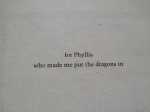
  • Dedication Page – This page will typically follow your copyright page and can be as simple as…


For my dearest mother Mary: R.I.P.

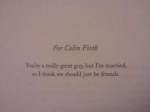
Or they can be witty…

“I dedicate this book to George W. Bush, my Commander-in-Chief, whose impressive career advancement despite remedial language skills inspired me to believe that I was capable of authoring a book.”

Pedram Amini, ‘Fuzzing: Brute Force Vulnerability Discovery’

Or they can be touching…

“Dear Pat,

You came upon me carving some kind of little figure out of wood and you said, “Why don’t you make something for me?”

I asked you what you wanted, and you said, “A box.”

“What for?”

“To put things in.”

“What kind of things?”

“Whatever you have,” you said.

Well, here’s your box. Nearly everything I have is in it, and it is not full. Pain and excitement are in it, and feeling good or bad and evil thoughts and good thoughts- the pleasure of design and some despair and the indescribable joy of creation.

And on top of these are all the gratitude and love I have for you.

And still the box is not full.”

–John Steinbeck, ‘East of Eden


  • Acknowledgements Page – This is where you can express your appreciation for all of those who helped you create the book.
  • Table of Contents – The table of contents is where you list all the major divisions within your book, more often than not in the form of chapters. The length of your book will determine how detailed your table of contents will need to be–a longer book will typically require a more detailed table of contents to assist your reader in navigating the piece.
  • Epigraph – An epigraph is a quotation that you can choose to devote an entire page to (usually facing the table of contents), or that you can choose to put at the start of the first chapter.
  • Preface – A preface is place for the author to explain how the book came into being and is often signed and dated by the author.
  • Introduction – Here the author can explain the goals of the work, place the work in context, or explain the organization and scope of the work.
  • Prologue – A prologue is told from the voice of a character in the book, and not the author’s own. It is typically used in a piece of fiction to set the scene for the story that is about to unfold.

As for the back matter of your book,

  • Index – An index will act as a guide to the book itself; it provides an alphabetized list of terms in the text and will indicate where in the text these terms were used.
  • Appendix – An appendix will provide supplementary details about your book such as corrections, updates, and details.


Now these are merely suggestions for what you can choose to include in the front and back matter of your book. What is most important is that what you do include looks professional and is well formatted. Pick up multiple books from your shelf and take a look at the front and back matter for a point of reference. While you’ve probably skipped over it on most books you’ve read, think how much more legitimate books with these sections look than books without them. These parts of publishing may seem tedious, but as I’ve said before, they are what will transform your manuscript into a book.


Thank you for reading!  If you have any questions, comments, suggestions, or contributions, please use the comment field below or drop us a line at selfpublishingadvice@gmail.com.  And remember to check back each Wednesday for your weekly dose of marketing musings from one indie, hybrid, and self-published author to another. ♠


Kelly

ABOUT KELLY SCHUKNECHT: Kelly Schuknecht is the Executive Vice President of Outskirts Press. In addition to her contributions to the Outskirts Press blog at blog.outskirtspress.com, Kelly and a group of talented marketing experts offer book marketing services, support, and products to not only published Outskirts Press authors, but to all authors and professionals who are interested in marketing their books and/or careers. Learn more about Kelly on her blog, kellyschuknecht.com

Self-Publishing News: 9.5.2016

happy labor day


And now for the news!

This week in the world of self-publishing:

“Professional photographer Alice Mabin is a woman not afraid to have a go in life,” writes Jennette Lees in her September 2nd article for the Cootamundra Herald, a paper which covers the Cootamundra District in New South Wales, Australia.  Says Lees, New Zealand born Mabin, 29, “always knew she wanted a career on the land,” and indeed spent “her early working life traipsing around high country stations in New Zealand mustering sheep, cattle, and deer, before packing up her life, including her dogs, in 2007 and moving to the vast, flat, drought-stricken planes of Hay, to experience farming the Australian way.”  She even took part in the 2013 Brinkworth cattle drive, the longest cattle drive in over 100 years of Australian history, walking roughly eighteen thousand head of cattle “from central Queensland to Hay,” a journey of 2000 kilometers (1240+ miles).

brinkworth cattle drive
[ a map of the Brinkworth drive ]
2000 kilometers, for comparison, is roughly the distance from Dusseldorf to Skopje, and from New York to Miami. You can imagine that walking that far might lend itself to some interesting photography, and Mabin made good on that opportunity. Writes Lees, Mabin “went along for a day to take photographs and ended up joining the crew for the entire five-month trip. She finished with beautiful, scenic images capturing a side of Australian life few have the opportunity to experience.”  After putting her images together as a book, and struggling to find a publisher, Mabin self-published The Drover and printed just a thousand copies.  To date, reports Lees, “21,000 copies of the book have been sold with another reprint on the horizon.”  To learn more about Mabin’s fascinating work and the story of her self-publishing experience, follow the link!


Some weeks ago–back in May, in fact–we reported on Rana Ayyub’s rough journey to self-publication, and this week we are happy to offer a wonderful follow up.  As Priya Ramani writes for Live Mint in this September 2nd article, “All the angst fades when you’re the country’s latest self-publishing sensation who has, pretty much single-handedly, managed to sell 32,000 copies of a book nobody would touch. It also feels nice to be on the verge of paying back the Rs.5 lakh bank loan you took to do this.”  Says Ramani, “It’s great when the country’s biggest English language book distributor takes you on board because they know it makes commercial sense, political affiliations be damned.” Ayyub, who published the highly controversial Gujarat Files: Anatomy Of A Cover Up earlier this year, has faced everything from being ignored to accusations of being a jihadi Muslim radical. It doesn’t hurt that Ramani herself is clearly impressed with Ayyub’s work; as Ramani puts it, “the then 26-year-old reporter who went undercover as film-maker Maithili Tyagi for eight months in 2011 to investigate the riots, custody killings and 2003 murder of Gujarat home minister Haren Pandya. The investigation, originally commissioned by news magazine Tehelka, was never published. Several years later, Ayyub has self-published it as The Gujarat Files. It takes a single-minded madness to do what she did.”  Single-minded madness aside, Ayyub has become something of a self-publishing sensation in addition to a political force for transparency, advocacy, and the ethical treatment of others.  For the full report, click here.

Emma Bryson has some strong words for the publishing community.  In her latest (September 1st) article for New Zealand’s premier Booksellers magazine, Bryson bemoans the fact that romance authors and publishers “inspire a bare minimum of mainstream media attention, aside from the odd condescending ‘human interest’ story. But the slight of romance rides further than this still, with traditionally little to no coverage in national or even local bookish circles.”  Says Bryson,  “I’m beginning to think that the somewhat toxic relationship between the wider publishing world and romance needs to be re-negotiated. Not for our sake, but for yours.”  How ‘yours’?  The genre “transcends most of those traditional mainstream publishing concerns,” she writes, and this is good for everyone: “Multinational vs indie? No problem, you can make a career out of either, or both. Traditional vs self-publishing? Both can be lucrative options for romance writers. Print vs digital? Hey, same there.”  The complicated relationship between Romance and Feminism bears further study, too, according to Bryson.  But when push comes to shove, it’s Romance’s very transgressiveness–its ability to cross lines because no one is looking–that makes it home for innovation and success. Its authors are “freed to explore those cutting-edge avenues that traditional publishers still scoff at,” write Bryson–and this is ultimately good news for everyone.  For the rest of Bryson’s article, follow the link..


spa-news

As a self-publishing author, you may find it helpful to stay up-to-date on the trends and news related to the self-publishing industry. This will help you make informed decisions before, during and after the self-publishing process, which will lead to a greater self-publishing experience. To help you stay current on self-publishing topics, simply visit our blog every Monday to find out the hottest news. If you have other big news to share, please comment below.


Kelly

ABOUT KELLY SCHUKNECHT: Kelly Schuknecht is the Executive Vice President of Outskirts Press. In addition to her contributions to the Outskirts Press blog at blog.outskirtspress.com, Kelly and a group of talented marketing experts offer book marketing services, support, and products to not only published Outskirts Press authors, but to all authors and professionals who are interested in marketing their books and/or careers. Learn more about Kelly on her blog, kellyschuknecht.com

The Book Beautiful: Illustrations

We all started out reading illustrated children’s books; perhaps your parents would read the words as your eyes were captivated by the images of a hungry caterpillar, the Berenstain bears, a Curious little George, etc. As we grow older, however, it’s probably not too often that the books we fill our time with have accompanying illustrations. Nevertheless, it has not always been the case that book for adults went unillustrated. Charles Dickens, for example, was known to have very close relationships with his illustrators, to whom he would give plot outlines before he’d even written the text itself. So while it’s easy to pull up references to colorful children’s books illustrations, that is not to say that they don’t have a valid and important place in other genres of books geared toward young adults and adults as well.

curious george illustration

So you want to write an illustrated book? First of all, don’t look at the illustrations to an illustrated book as supplemental, but as a crucial aspect to the themes you are trying to convey. Images help augment the reader’s imaginative experience, they make a book fun and easier to read, and they definitely help hold on to the reader’s attention.

There are certain genres that illustrations or photographs seem to be an obvious and necessary accompaniment–cookbooks, DIY-books, textbooks, autobiographies and biographies, and as we’ve previously mentioned, children’s books. The illustrations for a cookbook could simply be photographs of the final result of your recipe, and for a DIY-book they could be drawings or photographs of the different steps of the project your book conveys. If you’re writing an autobiography or a biography, photographs of the subject throughout their life or at pivotal moments in their life will help the reader further identify with the subject as a person rather than as a character in a story whom they have to fabricate an image of in their mind. As far as children’s books goes, the adage ‘don’t judge a book by its cover’ doesn’t really apply–kids will always judge a book by its cover and they will be inevitably more drawn to eye-catching, colorful illustrations.

Quantity is another important consideration to make as far as illustrations go. For a young-adult book, one illustration per chapter will usually suffice, while a children’s book should probably have one illustration per page. With a children’s book then, layout becomes another consideration–will your images be a full-page spread, or will they be next to, above, or below the text? If you’re writing a biography or an autobiography, you may want to have your photographs placed at the relevant points in your text–for example, your subject won the Olympic gold medal and here is a picture of her doing just that. OR, you could have a center panel with multiple pages of photographs and use footnotes in the text that will direct the reader to the relevant images that they can flip to easily.

Now, assuming that you yourself are not going to illustrate your own book (not to at all doubt your artistic abilities), the question of how to get your book illustrated become important. Outskirts Press offers custom, full-color illustrations for authors, even if they haven’t published through our company. By using this service, you can be sure that you’ll never have to split royalties with an artist, a cost that is always nice to avoid. Remember, no matter who you choose to illustrate your book, that quality illustrations are going to be a very important factor in the marketing value of your book.


Thank you for reading!  If you have any questions, comments, suggestions, or contributions, please use the comment field below or drop us a line at selfpublishingadvice@gmail.com.  And remember to check back each Wednesday for your weekly dose of marketing musings from one indie, hybrid, and self-published author to another. ♠


Kelly

ABOUT KELLY SCHUKNECHT: Kelly Schuknecht is the Executive Vice President of Outskirts Press. In addition to her contributions to the Outskirts Press blog at blog.outskirtspress.com, Kelly and a group of talented marketing experts offer book marketing services, support, and products to not only published Outskirts Press authors, but to all authors and professionals who are interested in marketing their books and/or careers. Learn more about Kelly on her blog, kellyschuknecht.com

Self-Publishing News: 8.29.2016

And now for the news!

This week in the world of self-publishing:

“When former Farrar, Straus and Giroux editor Jesse Coleman was looking to get back into publishing after spending years building a freelance editorial business,” writes Rachel Deahl in this August 26th article for Publishers Weekly, “he found himself weighing opportunities at Big Five houses against a job at a software company.” Ultimately, it seems, he was able to create his own third way between the two and launched a publishing branch to the Los Angeles-based software company, NationBuilder.  “That a software company would be interested in a book division seems, as Coleman acknowledged, a bit odd,” writes Deahl. But neither Coleman nor NationBuilder were new to the notion of publishing–or self-publishing.  NationBuilder’s cofounder and CEO, Jim Gilliam, gave a viral speech to the Personal Democracy Forum in 2011, a speech he and his fellow cofounder Lea Endres later transformed into a manuscript that Coleman edited and they together self-published. The book’s success, according to Deahl, whetted their appetite and they noticed a distinct synergy between nontraditional publishing models and their own company’s mission. It seemed natural, then, to develop a publishing arm to their own company with the goal of creating “the kind of nonfiction books that have consumer appeal, and extend the company’s brand.” NationBuilder Books, says Deahl, launch this fall when The Internet Is My Religion is officially rereleased on September 13. Says Deahl, “NationBuilder’s titles will be available in both print and online, and Gilliam said he’s currently in negotiations with a major distributor. Veering from the traditional royalty model, Coleman is instead commissioning books as works for hire. In lieu of royalties, authors will be offered flat advances of $20,000 each.” This places NationBuilder somewhere in the grey zone just off center of the traditional publishing houses–albeit a grey zone that has its roots deep in the self-publishing movement. For the full story, follow the link!

A quick update on a story we first brought you news on back at the beginning of the month: FlipHTML5 is officially live and seeing its first users according to this press release published to Digital Journal on August 26th. The Hong-Kong based developer, FlipHTML5 Software Co. Ltd, promotes this software as “significantly useful for self publishers as it allows them to distribute their magazines everywhere in order to reach more people,” but the proof will remain in the pudding until more users have reported back their experiences with the software over time. The demos provided on the FlipHTML5 website, including one for “Dumb Starbucks,” demonstrate the interactivity and potential for the medium–albeit, for very corporate ends. (There are also demos for H&M, WeddingWire, Miss Dior, Apple, Hard Graft, Outside Magazine, Top Gear, GoToMeeting, and a number of others under the website’s “Case Studies” tab.) One could foresee this becoming a new and beautiful way to publish zines, for one. To read the rest of the press release, click here.

Here’s some good news to start your week off on a happy note: the Independent Publishing Resource Center, given notice of its upcoming ousting earlier this summer, is close to finding its next home according to Portland Business Journal staff reporter Ron Bell in this August 24th article. “The nonprofit, which has offered publishing tools, workshops and other resources to writers and self-publishers for nearly 20 years, got word of the increase in July and needs to find a new home to replace its Southeast Division Street location by April 2017,” says Bell, making it one of “handful of recent real estate transactions that have triggered the ousting of Portland artists — including the Towne Storage Building, the Troy Laundry Building and the impending sale of Imago Theatre’s home.” The rent hike of 300 percent may not be feasible for the Independent Publishing Resource Center, but its recent successes in providing support to the self-publishing industry … is. Writes Bell, the organization turned to its friends to help out with the costs associated with leaving its 20-year home and “launched a Kickstarter campaign with a goal of $20,000. As of this past Friday, the nonprofit had cleared that and then some. This morning, the total had hit $20,754, and the campaign still had another 10 days to go.” This is good news for everyone that the IPRC has helped over the years and will help in the years to come! For the rest of Bell’s coverage of the situation, read the original article here.


spa-news

As a self-publishing author, you may find it helpful to stay up-to-date on the trends and news related to the self-publishing industry. This will help you make informed decisions before, during and after the self-publishing process, which will lead to a greater self-publishing experience. To help you stay current on self-publishing topics, simply visit our blog every Monday to find out the hottest news. If you have other big news to share, please comment below.


Kelly

ABOUT KELLY SCHUKNECHT: Kelly Schuknecht is the Executive Vice President of Outskirts Press. In addition to her contributions to the Outskirts Press blog at blog.outskirtspress.com, Kelly and a group of talented marketing experts offer book marketing services, support, and products to not only published Outskirts Press authors, but to all authors and professionals who are interested in marketing their books and/or careers. Learn more about Kelly on her blog, kellyschuknecht.com

Conversations: Royalene Returns!

It has been a long month without Royalene here to anchor the blog on Fridays–she’ll be back next week!–and it turns out her absence has given me a lot to think about in terms of the importance of personal witness and testimony within the modern self-publishing tradition.

It’s vital.

I think it’s more vital than, say, something similar within the traditional publishing industry.  Authors who pursue a traditional publication route face many challenges, there’s no denying it, but their challenges take place within the protective sphere of a guaranteed team of editors, designers, publishers, marketers, and other experts who happen to have a stake in making sure any given author they publish sells a lot of books.  Their challenges also take place within a massive literary tradition that has been defended–and eloquently, at that–by other authors for centuries, and will continue to be defended by other authors for as long as the institution lasts.

conversation illustration

Self-publishers don’t have this tradition at their backs, and they certainly don’t have teams of assistants on hand to make sure they’re striking the right tone at this or that interview or that they’re appearing at the right venues for maximum impact. Self-publishers may opt to pay for some of these services, now that the market has diversified, but their default experience takes place in a vacuum.  If they’re very lucky, they’ll have access to other indie authors who have gone before or are coming up alongside them, but they don’t have centuries and centuries of precedents to follow.  When it comes to modern self-publishing, they may have a couple of decades’ worth of a pattern to analyze, but few enough of those who went before had voices that resonate the same way that, say, traditionally published authors like F. Scott Fitzgerald or John Krakauer (to name two random names in a million) have.

This is why conversations with other self-publishing authors, like Royalene, are so important. Each conversation serves to chip away at the wall between an indie author and the comforts of community and tradition.  Conversations are what set us apart from traditionally published authors–we have the option to speak for ourselves, unfiltered and in perfect honesty, about whatever we please without repercussions or sanctions–and what unite us.

I, for one, can’t wait for September and Royalene’s return.  She and other voices like her make our lives–and our work–better.♠


Kelly

ABOUT KELLY SCHUKNECHT: Kelly Schuknecht is the Executive Vice President of Outskirts Press. In addition to her contributions to the Outskirts Press blog at blog.outskirtspress.com, Kelly and a group of talented marketing experts offer book marketing services, support, and products to not only published Outskirts Press authors, but to all authors and professionals who are interested in marketing their books and/or careers. Learn more about Kelly on her blog, kellyschuknecht.com