In Your Corner: Be the Life of the Party…Literally!

book club book party coffee tea nature

It can be hard, reinventing the wheel. Every holiday season, the same challenges and opportunities roll around–and every author is forced to decide: this one, or that one? Host a reading at the library, or coordinate a potluck and book sale at home? Or, worst of all, there’s the option of letting the holidays slide–of letting them drift away in a haze of busy schedules and truly important family and social demands–without making use of them as an author.

My suggestion? Host a holiday writing party! This isn’t your plain-Jane reading or book sale, although you could definitely incorporate elements of those tried-and-trues into your new plan. No–a writing party is much more inclusive and much more fun for kids of all ages (“from one to ninety-two” as Nat King Cole would put it). And while you are still the facilitator and secret power-broker behind the scenes of a writing party, you’re not the sole event–and at this time of year, that’s a blessing! No really, one can only pull off the holidays if one is expected to carry every burden. And typically, once the idea of a writing party is broached, everyone is eager to pitch in!

If you’re thinking “Hey! That’s not such a bad idea!” then I have a couple of suggestions, based on prior experience (I love these parties!):

  • Have everyone bring a dish, and in a twist have them steer clear of the typical holiday goodies, which everyone will very soon be sick of from sheer quantity–candies and cookies and so forth. Instead, have them bring something inspired by one of their favorite books! Kids might find something in Redwall to inspire, and there is an entire genre dedicated to “geek cookbooks” online, where you can find cookbooks (official and unofficial) with recipes from The Lord of the Rings, Harry Potter, and Little House on the Prairie, among others … so this is not such a difficult challenge to meet. (And adults: there are endless lists of cocktails inspired by literature out there, so don’t be afraid to crack open that bar after the kids go to bed!)
  • Dedicate a part of your session just to snacking. It’s worth it, and it gets the chatting and the fiddling and the greasy fingers out of the way before the serious work begins. There’s usually a quiet lull in the conversation about twenty minutes in which serves as a nice segway–but again, everyone’s party should be tailored to suit your specific vision! Just make sure that food is stored away from the writing table, since messes do tend to happen–and everybody has a favorite “loud chewing sound” story! (Hot beverages are usually handy at the table, though.)
  • Then, get down to business. You’ll know what this ought to look like when it happens, and when it feels right. Every book club, writing club, and party has its own rhythm, but don’t worry–you’ll know. Sometimes it’s helpful to keep a timer nearby, or to set one up on your phone–breaking writing up into a couple of shorter sessions with quick snack and bathroom breaks in between is one way to keep everyone’s blood moving and energy up. And if that doesn’t cut it, consider leading a couple of breathing activities or even–yes!–yoga moves! Studies indicate significant improvements to focus in intellectual activities when the body is kept active and balanced. (It helps with carpal tunnel syndrome, too. Shake out those cramped wrists and fingers!) Oh–and don’t forget to offer up a couple of writing “prompts” for anyone in need of inspiration, and gear them towards your audience. Adults may want to write fiction–or letters to loved ones at Christmas. Kids might want to doodle or draw, or slay a dragon in five paragraphs or fewer!
  • Wrap up with a quick reflection. Try to steer clear of putting any one person on the spot, but offer up a couple of open questions about books, characters, challenges, and more. At this point, or as the last writing session is wrapping up, you can begin bringing the snacks to the writing table. The goal is for everyone to reach a point of total relaxation and contentment, and holiday joy.

Be inspired. There are so many shapes and forms your writing party might take–it may look nothing like the one I’ve described here–it might be outside, with just a couple of friends, or inside, with a pack of small children looking on. It could be held at the library! Or at your kitchen table. There’s no one way to hold a writing party–but a writing party is the best kind of party. After all, like the adult coloring movement–like Knit Night–like quilting and gardening and origami and yoga and meditating on one’s reading, writing is an activity which triggers serotonin release, calm, peace, and rejuvenation in those who take part in it. We can’t think of a better way to kick the holiday stress than by hosting a writing party!

What do you think? Will you have a chance to host an event this Christmas season? We’d love to hear about it. Drop us a line in the comments section below.

book party grandpa grandfather grandchildren children

You are not alone. ♣︎


Elizabeth

ABOUT ELIZABETH JAVOR: With over 18 years of experience in sales and management, Elizabeth Javor works as the Manager of Author Services for Outskirts Press. The Author Services Department is composed of knowledgeable publishing consultants, pre-production specialists, customer service reps and book marketing specialists; together, they all focus on educating authors on the self-publishing process to help them publish the book of their dreams. Whether you are a professional looking to take your career to the next level with platform-driven non-fiction or a novelist seeking fame, fortune, and/or personal fulfillment, Elizabeth Javor can put you on the right path.

In Your Corner: The Spice of Life

Last week, dear readers, I wrote at length about how Thanksgiving isn’t just a holiday for giving and receiving things–if it were, then it would be no different from Halloween and Christmas, save for the stitching and embroidery–but I have to be the first person to own up to the fact that what I wrote wasn’t the whole picture. Yes, Thanksgiving is about doing things and not just about a fantastic dinner spread. Yes, Thanksgiving was borne as a tradition out of a time of real need and desperation–of near starvation, to be specific.

Everything I wrote last week remains true. But it’s not everything that ought to be said about Thanksgiving. And today, the final Thursday of November and Thanksgiving Day itself, I wanted to leave room for reflection. For gratitude. For joy unmixed with lingering doubts or fears over what’s to come, if that’s possible in today’s hectic world. (Oh, let’s face it: It’s always been a hectic world. Maybe once it was safe to eat those candied apples in our Halloween buckets, but by and large life has always delivered challenges in equal measure to its happinesses.)

Ugh–let me start over.

thanksgiving spice

I want to leave the door cracked for thankfulness untouched by everything else that’s happening or going to happen. For you, dear reader. For sticking with us for so many years, for your likes and your comments and your feedback and, occasionally, for calling us out on what we need calling out on. Thank you for being loyal, for being so smart, for recommending us to your friends (or at least, we’re assuming our newer followers are here because they heard about us from someone). For being writers. For bearing the torch and mustering the determination to slog forward through thick and thin. For being ours, and for being yourselves. I know I speak for everyone else here at Self Publishing Advisor when I say thank you, dear reader, for joining us as we all walk down this road together–a road that leads to new challenges, new joys, and a new year.

You are the spice of life.

~ Thank you. ~

You are not alone. ♣︎


Elizabeth

ABOUT ELIZABETH JAVOR: With over 18 years of experience in sales and management, Elizabeth Javor works as the Manager of Author Services for Outskirts Press. The Author Services Department is composed of knowledgeable publishing consultants, pre-production specialists, customer service reps and book marketing specialists; together, they all focus on educating authors on the self-publishing process to help them publish the book of their dreams. Whether you are a professional looking to take your career to the next level with platform-driven non-fiction or a novelist seeking fame, fortune, and/or personal fulfillment, Elizabeth Javor can put you on the right path.

In Your Corner: Making Your Presence Felt

It would be hard to get to 2016 and not feel convicted of the importance of social media in selling books–and, just as importantly, in selling readers on you, the author. The power and influence of social media is uncontested–after all, it has helped feed and foment revolutions in the Middle East, toppling dictators and spinning the mythological webs that create internet celebrities. They have also, demonstrably, created the framework by which self-published authors become self-sufficient and successful. Authors like Lisa Genova (Still Alice) and Hugh Howey (Wool) often credit their devoted social media fanbase for moving their books out of obscurity and into the blockbuster realm.

With that kind of a recommendation on the table, it almost seems a waste to not partake in the wave of social media platforms developing today, right? But wanting to start developing your social media strategy and actually building it from the ground up are two separate propositions. And ultimately, it’s hard to know where to start.

Luckily, there’s not so much one way to get it wrong, but rather so many ways to get it right. This is because there are so many platforms out there, including:

And so many more! Because social media is a moving target–for example, the short-video-hosting platform Vine, owned by Twitter, was shut down recently for its inability to turn a profit for company shareholders–there’s no predicting which platforms will be on the ascent in a given year and which will be on its way out, like the age-old example of Myspace, a platform which more or less lost all of its users once Facebook became peoples’ primary conduit of digital social contact.

This changing landscape isn’t a bad thing, in the end. It’s a strength! It means that yes, you need to be willing to continually adapt to new platforms and to pick up new skills, but it also means that if you’re not all that good at one, you can always capture your readers by making a comprehensive social media presence, rounded out with a variety of different smaller presences that weave together into something greater than the sum of their parts.

I guess what I’m saying is: Try everything. Try everything, and don’t hold on too tightly to any one of those things. Experimentation is the mother of invention, as is necessity, and these two forces will keep your social media presence in a constant state of evolution, well-suited to the M.O. of the Internet itself. Maybe soon we’ll have options to network not just with our friends and our refrigerators, but with our books as active participants themselves. Can you imagine what that might look like? I’d bet you five dollars that someone out there is already figuring out how to make it happen. And that’s the wonderful thing about change: it’s wild and wonderful and asks very little of us except the will to keep up!

You are not alone. ♣︎


Elizabeth

ABOUT ELIZABETH JAVOR: With over 18 years of experience in sales and management, Elizabeth Javor works as the Manager of Author Services for Outskirts Press. The Author Services Department is composed of knowledgeable publishing consultants, pre-production specialists, customer service reps and book marketing specialists; together, they all focus on educating authors on the self-publishing process to help them publish the book of their dreams. Whether you are a professional looking to take your career to the next level with platform-driven non-fiction or a novelist seeking fame, fortune, and/or personal fulfillment, Elizabeth Javor can put you on the right path.

In Your Corner: Marketing for Anything-But-Dummies

Have you ever wondered what “proper” marketing support might look like, and how imperative it is to self-publishing successfully? What about implementation–have you ever wondered what effective implementation of your carefully-planned-out marketing plan might look like, too? I’m going to spend a bit of time this Thursday thinking through some of the answers to these questions.

If there’s one thing I’ve learned from my years of working with self-publishing authors, both as an author myself and as an author advocate and representative for other authors with Outskirts Press, it’s that there’s quite a lot of truth to the statement that “preparation is the key to success”–but as Marie Forleo puts it, sometimes “the key to success is to start before you’re ready.” How do we make these two things compatible? Aren’t they mutually exclusive?

the key to success is to start before you're ready marie forleo

Here’s a thought: what if they’re not?

I don’t think they are, and that’s because I think “preparedness” and “readiness” are two separate modes of being. Preparedness, in my mind, is the process of taking concrete steps to plan ahead for whatever you can, and putting in place measures–good habits, good coping mechanisms, and good thoughts–that will see you through any times when being prepared will do no good. Readiness, on the other hand, has more to do with confidence–and sometimes, your sense of how ready you are for a thing may or may not line up with what you’re prepared for. Sometimes, we won’t feel ready to get started on a thing even if we’ve planned thoroughly and set our good habits in stone. Those are the moments, I think, that Marie Forleo speaks to–the moments when we just need to get started, whether or not our feelings line up with reality.

Proper marketing support, then, should help you both prepare and, hopefully, acquire the confidence to feel that you’re ready as well. And as my fellow writer Kelly Schuknecht pointed out in her “Marketing Master Strokes” series of blogs earlier this year, effective marketing strategies require a willingness to reach your readers where they live, to incentivize, and to play well with others–among others. “Proper” marketing support will assist you in doing all these things–and if that seems a bit beyond the pale for the ordinary self-publishing company, luckily, there are several extraordinary self-publishing companies–and I know I’m a little biased, but I happen to think my coworkers among the Personal Marketing Assistants working for Outskirts Press count as extraordinary. So if you feel like some of these points might be beyond your reach, consider reaching out and making contact with the experts, either through a paid service or through a more casual network, as on social media.

The best part of looking to the experts is that doing so will assist you in execution as well as in planning–so you’ll get the best of both preparation and readiness. Or at least, that’s the goal.

It’s hard to boil down all of the salient points regarding marketing into one coherent blog post, but luckily, and perhaps it’s a little trite to say “oh, I’m not ready to do that” given the context of today’s subject (you can tell how some of my jokes bomb around the dinner table, can’t you?). But the fact of the matter is, Self Publishing Advisor has been a resource for self-publishing authors looking to market their books for most of a decade now, and our archives are rife with posts on the subject–including those by Kelly that I mentioned earlier. If you’re looking for those concrete steps to transform the broad strokes we’ve brushed here into tangible steps, her series is spectacular. I highly recommend taking a look!

Marketing Master Strokes:

  1. What do ears, geysers, and self-publishing have in common?
  2. Be willing to reach your readers where they live
  3. Incentivize!
  4. Play Well With Others
  5. Try Every New Thing

You are not alone. ♣︎


Elizabeth

ABOUT ELIZABETH JAVOR: With over 18 years of experience in sales and management, Elizabeth Javor works as the Manager of Author Services for Outskirts Press. The Author Services Department is composed of knowledgeable publishing consultants, pre-production specialists, customer service reps and book marketing specialists; together, they all focus on educating authors on the self-publishing process to help them publish the book of their dreams. Whether you are a professional looking to take your career to the next level with platform-driven non-fiction or a novelist seeking fame, fortune, and/or personal fulfillment, Elizabeth Javor can put you on the right path.

In Your Corner: The Guts of the Thing

Welcome to the sixth episode in our ongoing series about the myriad difficult decisions a self-publishing author makes in the process of pursuing publication!  In previous weeks, we’ve discussed:

But just as the decisions about the outside of your book are important, so too are the decisions you make about the inside.  That’s right, we’re talking about:

Illustrations & Formatting

OR: the ‘look and feel’ element.

We all know how important it is that your book look good on the outside, so that new readers will pick it up off of the bookstore shelf (or the library shelf) and have that immediate “AHA!” moment.  The problem is, while first impressions like these are one make-or-break moment for your relationship with your reader, so too is the moment when they thumb through the pages and take a look at the actual pages.  Most readers I know will crack a cover open before committing to taking a book to the check-out (or circulation) counter, so–what gives?  What elements of your book’s interior design will give a resounding second cheer to the good impression made by your book’s beautiful front cover?

ILLUSTRATIONS

As good a place to start as any, let’s take a look at illustrations and what role they play in a reader’s impression of your book.  First off, let’s clear the air: we recognize that the appeal of any single illustration is largely a matter of taste, and we’re not here to cast aspersions or shame at any self-publishing author’s style of illustration.  Many self-publishing authors crave the option to illustrate their own books, so there’s a wholeness of purpose sometimes behind illustrations that don’t immediately appeal to us–but again, that’s not what we’re really talking about here.

Take a look at these illustrations, all of which are courtesy of books my employer (Outskirts Press) has published in the past:

You can see that’s there no one common thread connecting them all.  They’re all different styles, all different degrees of visual impact.  They’re as unique as the books that give them a home.

Professional illustrations like these give your book an oomph–a real kick of appeal–that your book wouldn’t have without them.  But are they appropriate for every book?  Probably not.  You might see how one style of illustration–simple, cartoonish, minimal–might fit perfectly in a children’s picture book, and how something a little more stylistically complicated–with detailed, fine pencil work–might fit well in a book for older readers, perhaps young teens.  Novels for adults don’t often have illustrations–which isn’t to say they shouldn’t–but this may also be a question of audience.  And one might imagine contexts–a cookbook with historic recipes, for example, or a book involving complicated geography–might benefit from a couple of beautiful illustrations.  The key is to know thy audience and to make sure any illustrations you include are as polished and professional as they can be.

FORMATTING

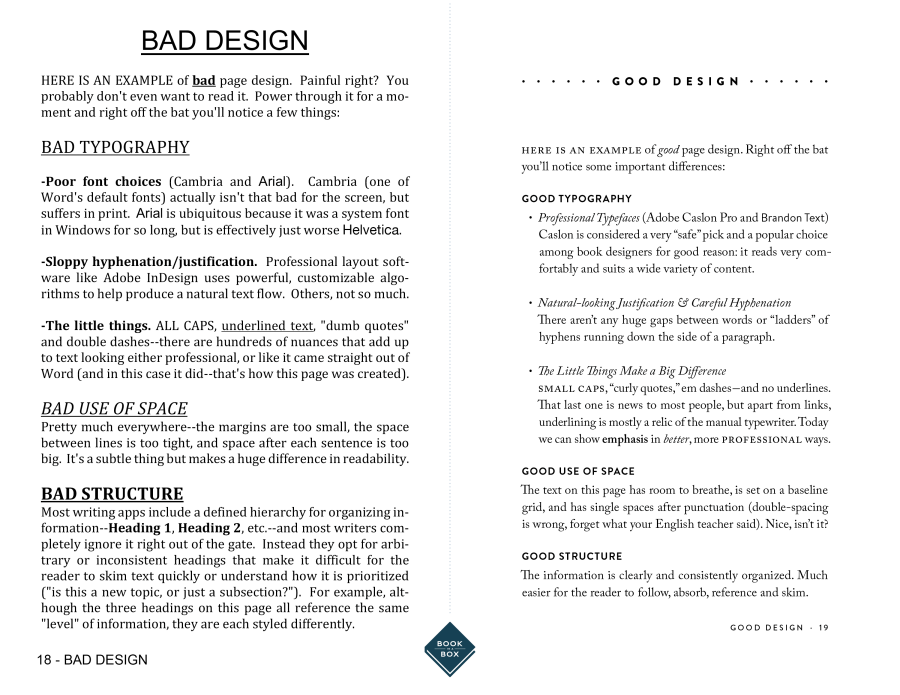
Ugh, now we’re really getting down to the nuts and bolts of your book aren’t we?  But your book’s formatting is a vital component of whether it can hold a new reader’s attention or not.  There’s nothing more frustrating than feeling like you’re being made uncomfortable by a book’s layout–and there are some rather well-research theories out there to explain why dense paragraphs, poor kerning or character spacing, poor font choices, and a poor handle on the virtues of white space can doom a book.  Without getting lost in the details, it’s rather easy to summarize the visual impact of bad vs. good formatting with the following comparison:

book formatting

Sound complicated?  It can be.  But it’s mostly a matter of balance, and consistency.

If you’re feeling … at sea, don’t worry.  As with good cover design and illustrations, there are quite a few resources out there to help you navigate the decisions that await–including whether or not you should outsource some of your design sensibilities to a paid professional.  We’re one resource, and companies like Outskirts are another, and there are plenty–and I mean an almost obscene number–of self-help guides out there.  The problem is, as it is with many things in the Internet age, that it’s almost impossible to know where to start.  And that’s why we’re here!  If you have design or formatting questions, give me a shout-out here on our blog, or track me and my compatriots down where we work.

You are not alone. ♣︎


Elizabeth

ABOUT ELIZABETH JAVOR: With over 18 years of experience in sales and management, Elizabeth Javor works as the Manager of Author Services for Outskirts Press. The Author Services Department is composed of knowledgeable publishing consultants, pre-production specialists, customer service reps and book marketing specialists; together, they all focus on educating authors on the self-publishing process to help them publish the book of their dreams. Whether you are a professional looking to take your career to the next level with platform-driven non-fiction or a novelist seeking fame, fortune, and/or personal fulfillment, Elizabeth Javor can put you on the right path.