Conversations: 3/3/2017

MARCH INTO SPRING

WITH A SPRING IN YOUR WRITING STEP Part I

Are you one of those writers who learns by doing—learns by experience? I am, too. Yet there is so much that I want to learn about and skills I want to develop that I’d need to live ten lifetimes in order to do and/or experience it all. READING has become my university, but not the textbook educational delivery system that we most often think of as the source for higher education. I learn best through story—either personal experiences shared with the passion they were lived, well-researched historical fiction, or inspired writings by people of deep faith who are telling their story through the beauty of  belief.  So it is that this month I’ll mention a few books written by authors who meet my criteria of educational reading—with an added comment (of course) about how these types of books can enhance the education of all writers no matter what genre we write.

Author William Guthrie calls himself “a student of the human condition.” He’s written several books in various genres. However, the book I’m highlighting today is ahhh Biography/Memoir: A Woman of Valor, A Woman of Strength: The Latchmin Bridgelall Story. This story is heralded as a “touching story” written by the son of an “amazing family matriarch whose sacrifice, courage and wisdom shaped a generation of children.” AND…I will add…will continue shaping generations of children yet to be born.
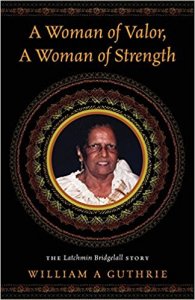
This is the beauty of Memoir.  Guthrie understands this well and explains it saying: “…if something is not written down or recorded it is lost…. Then the family loses its history and its lore and all that has gone before is virtually lost to future generations. In a fundamental and almost visceral sense, it is what humanizes us on this planet and gives us a sense of identity among billions and billions of other earthlike creatures like ourselves.”

Guthrie also states that “whether we like it or not, we all stand on the shoulders of generations of relatives gone by.” This is also so true of the writers who have gone before us! Therefore, for those of us who have a passion for Memoir/Biography writing it is advised to read the work of the respected biographers such as: Leonie Frieda, author of Catherine de Medici: Renaissance Queen of France; John Taliaferro, author of All the Great Prizes: The Life of John Hay, from Lincoln to Roosevelt; and Humphrey Carpenter, author of J.R.R. Tolkien: A Biography.

Here are a few of my basic “tips” that will help you along the road:

  • Photographs are great memory-refreshers
  • Research into specific daily possessions used during various time periods is essential (cars, radios, telephones, etc.)
  • Letters and journals offer insight, but DO NOT over-step the boundaries of their use.
  • Find the voice of the main person the memoir is about and, if possible, the voices of those closest to them.

The main concept I’ve developed over the years about Memoir writing is this: Start from the heart. Don’t be afraid of the guts. Close with inspiration.

AND…don’t hesitate to self-publish! The “ordinary people” we write about have “extraordinary” information for us to share with the world showing us the way to survive the struggles of life with joy, love and laughter.  ⚓︎


Royalene

ABOUT ROYALENE DOYLE: Royalene has been writing something since before kindergarten days and continues to love the process. Through her small business—DOYLE WRITING SERVICES—she brings more than 40 years of writing experience to authors who need “just a little assistance” with completing their projects. This is a nice fit as she develops these blogs for Outskirts Press (OP) a leading self-publisher, and occasionally accepts a ghostwriting project from one of their clients. Her recent book release (with OP) titled FIREPROOF PROVERBS, A Writer’s Study of Words, is already receiving excellent reviews including several professional writer’s endorsements given on the book’s back cover.  

Royalene’s writing experience grew through a wide variety of positions from Office Manager and Administrative Assistant to Teacher of Literature and Advanced Writing courses and editor/writer for an International Christian ministry. Her willingness to listen to struggling authors, learn their goals and expectations and discern their writing voice has brought many manuscripts into the published books arena.

In Your Corner: Nom de Plume (Part I)

What is a nom de plume, and why should you care?

First of all, we’re talking about pen names.

Ever since J.K. Rowling began writing adult fiction under the pseudonym Robert Galbraith, there has been a resurgence of interest in pen names and what they can do for authors. But the practice predates her and has quite a long legacy; many of your favorite authors are probably using pseudonyms. The author who is Nora Roberts writes romance under that name, futuristic science fiction under another (J.D. Robb), and still more under the names Jill Marsh and Sarah Hardesty. Her real name is Eleanor Marie Robertson. And then there’s Elena Ferrante, who remains as-yet “unknown” in that the author’s real name has not yet been revealed, and James S.A. Corey, which is a collaborative pen name for authors Daniel Abraham and Ty Franck.

But there’s a right and a wrong way to go about using a nom de plume.


Back in the 18th Century, a pen name enabled writers, journalists, and artists to publish controversial and even illegal articles, letters to the editor, and other works of protest without being discovered––but these protections don’t necessarily hold true today, when publishing houses and companies can be subpoenaed for your contact information, among other things. A pen name can help you avoid overexposure, yes––as both Dean Koontz and Stephen King can attest––or to conceal your gender in a still-occasionally-sexist industry––as both Rowling and George Eliot were known to do––but it should never be used as cover for illegal activities, or trusted to protect you from political exposure.

Pen names are tied up with identity politics, and that’s a fact. But new authors should be focusing on the work itself, not on being “exposed” in the public eye, right? Well … probably. Maybe. If you’re writing a tell-all about the mafia, you still might want to consider a nom de plume.


PEN NAME PROS:

  • You can put together a name which no one else “owns.” The world is unlikely to need two David Baldaccis, and you can avoid painful confusion by picking a pen name to differentiate yourself.
  • You legitimately need to conceal your identity. Say you’re a physics teacher in a small town and you want to publish steamy romance books. It’s not illegal, but you want to avoid uncomfortable questions at work. Or perhaps you’re part of the LGBTQIA+ community, and you are afraid of reprisals from friends or family as you write your memoirs. There are reasons for concealment that have nothing to do with “lying.”
  • Your branding is “off” for the genre. You know how it goes … you walk into a bookstore and you can immediately tell what section you’re in by the kinds of names on the shelves. Yeah, that’s a thing. And sometimes, having a catchy name which hints at your genre can be an important selling point. This point leaves room for those of us with difficult to pronounce or remember last names. Findability is key; “weird” names are sometimes perfectly memorable, and there’s zero shame in either sticking to yours or changing it up––but ultimately that’s a decision you might be forced to make.
  • Your last book … didn’t go over so well. It happens. And when it does, sometimes you may need to put out your next book under a new name, to break old associations.


Next week, we’re going to take a look at some “cons” of choosing to use a pen name, like how obnoxious it can be to live and correspond with people under two or more names, and the legal side of things, too. Pen names aren’t the easiest thing in the world to pick up and use … but we’re confident that with the right information, you’ll make the right choice for yourself! So check back next week for Part II in this series on noms de plume!

screen-shot-2017-03-02-at-7-12-09-am

You are not alone. ♣︎


Elizabeth

ABOUT ELIZABETH JAVOR: With over 18 years of experience in sales and management, Elizabeth Javor works as the Manager of Author Services for Outskirts Press. The Author Services Department is composed of knowledgeable publishing consultants, pre-production specialists, customer service reps and book marketing specialists; together, they all focus on educating authors on the self-publishing process to help them publish the book of their dreams. Whether you are a professional looking to take your career to the next level with platform-driven non-fiction or a novelist seeking fame, fortune, and/or personal fulfillment, Elizabeth Javor can put you on the right path.

Decluttering … Digitally!

In the age of computers, our desks are not the only things that can get cluttered, but also our desktops, websites, social media platforms and web browsers. If you’re as OCD as I am, this type of clutter will be as, if not moreso, bothersome as the more tangible clutter we find lying around our homes.

So this week I’d like to take a look at the ways in which we can declutter digitally, something that is especially relevant for 21st century authors who utilize the ever pervasive technology of computers.

decluttering digitally


  • Streamline your author website


First off, if your domain name is anything beyond a combination of your first and last name, or some super vague play off of your favorite sports team, consider changing it, and if [yourauthorname].com isn’t available, try .org, .net or some other version of that.

If you use some free website hosting platform such as WordPress, make sure you choose a theme that is aesthetically appealing, and if you’ve had the same one for a while, consider changing it up.

Make sure that you have clearly branded yourself on your homepage with the type of writing you do and be sure to use relevant tags on all of your posts. If you have an outdated bio and/or photo, consider cleaning those up and making them fresh.

Don’t just have a cluttered list of all of your  books for readers to try and sift through. Create a page for each that they can easily purchase from. Be careful to not have too many pages though, as more isn’t always merrier. Also be sure that they’re labeled clearly–don’t try to get too creative and distract your readers from the content of your page.

  • Streamline your social media presence

Speaking of less sometimes being more, let’s talk social media. Now we all know we hate those folks that clog our newsfeed with 1,000 posts a day–from pictures of babies to overly political rants/links to news articles to inspirational quotes plastered over scenic backdrops of places you’ve never been. Those people tend to get “unfollowed” by me, meaning I could miss a lot of things they are posting that actually interest me.

First off, I highly recommend having a separate author page, so if you do post things like I mentioned above, they are not getting sent to your audience who probably does not care to see them. With your separate author page, be sure to only put out content that helps to promote your brand and the image you want your readers to have of you. If your post doesn’t meet that criteria, scrap it or delete it from the Timeline. You want readers to go to your page and scroll down and get a feel for you as an author right away.

  • Organize your documents!

This one may seem straightforward, but I know how easy it is to just save things with random titles in that all-embracing folder of “Documents.” However, when you go to look for that chapter outline you made four months ago before you even started your book and you named it something obscure that you can no longer remember…you’re going to waste precious time trying to hunt it down.

Folders are your friend. Create a folder for your manuscript and subfolders for planning, characters, chapters, etc. Each time you save something, plop it in the according folder and back it all up on Google Drive, or some other free online storage host, lest you fall prey to the almighty computer crash.

***

Hopefully these few tips will help you declutter your digitized reality, which has become almost more real than reality itself.


Thank you for reading!  If you have any questions, comments, suggestions, or contributions, please use the comment field below or drop us a line at selfpublishingadvice@gmail.com.  And remember to check back each Wednesday for your weekly dose of marketing musings from one indie, hybrid, and self-published author to another. ♠


Kelly

ABOUT KELLY SCHUKNECHT: Kelly Schuknecht is the Executive Vice President of Outskirts Press. In addition to her contributions to the Outskirts Press blog at blog.outskirtspress.com, Kelly and a group of talented marketing experts offer book marketing services, support, and products to not only published Outskirts Press authors, but to all authors and professionals who are interested in marketing their books and/or careers. Learn more about Kelly on her blog, kellyschuknecht.com

From the Archives: “Bestselling Author and the BIG Move to Self-Publishing”

Welcome back to our Tuesday segment, where we’ll be revisiting some of our most popular posts from the last few years.  What’s stayed the same?  And what’s changed?  We’ll be updating you on the facts, and taking a new (and hopefully refreshing) angle on a few timeless classics of Self Publishing Advisor.

∗∗∗∗∗

[ Originally posted: November 4th, 2010 ]

Ten years after the success of his debut novel, bestselling author of “Kidnapped,” AJ Davidson, has made the switch to independent self-publishing. With the availability of full-service publishing options on the rise and the high profile moves of established authors to independent publishing, AJ discusses the increasing appeal of this new model for traditionally published authors.

Q: What was the deciding factor for moving to independent publishing?

A: Initially I wasn’t entirely sure if Indie publishing was right for me. The deciding factor was how traditional publishers seem to be narrowing the range of their lists with each passing year. I recently compared 1970s best sellers with the 2010 best sellers and was staggered to realize how many of the chart-topping writers of yesteryear are still there four decades later. Kudos to the authors for consistency, but the dearth of new names is a sad indictment for the publishing world. The smaller presses are more adventurous, but more often than not the marketing will be left to the author, and if that’s the case, then Indie publishing is the way to go.

Q: Now that you manage the marketing independently as well as the publishing, do you find it difficult to switch back and forth between writing and marketing?

A: I have found the change in my writing to be a dramatic one. In the past I was the only one I had to please with a piece of prose. Now I’m much more aware of the readers’ attitudes. As I write I find that I ask myself constantly how the readers would react. This transformation is due largely to the immediacy of Indie publishing. With a traditionally published book there can be years between writing and publication. Your agent might suggest minor changes. It may then take time for the manuscript to be accepted. The publishers will nominate a slot, often a year or more in the future. Libel lawyers may have to cast an eye over it. Copy and proof editors will refine the work. Artwork will be done. By the time the book hit the shops, the writer will have moved on, often immersed in another project. I often felt a sense of detachment from a book by the time it was published.

Q: The list of well-known authors that are moving toward Independent publishing structures continues to grow. Do you think this is opening up possibilities for less established authors or monopolizing what was formerly their only option?

A: I’m optimistic about the future of Indie publishing and would buy shares in Smashwords faster than in Barnes & Noble. The fate of the traditional bookstore will be down to specialization. I doubt if they can continue being all things to all people. We already see some very successful stores concentrating in one or two genres. This genre specialization will develop, and no doubt the giants of the retail industry have a trick or two yet. I expect some form of stratification will enter Indie book publishing.

Perhaps a division between the one book author and the multiple author. Certainly we have seen a rise in the popularity of book series in the last decade and readers do enjoy embarking on journeys with writers they admire. It is anyone’s guess where will this leave the authors of a single text. Bad news for the Harper Lees and Margaret Mitchells.

Q: You give your work away for free. Can you explain your strategy on this?

A: Giving away the occasional free book is an established marketing tool. The first Walter Mosley book I read was a magazine freebie, and I became a huge fan. It’s a great way of increasing consumer awareness. I have had readers read my free e-books, then go buy the paperback. I still have the Mosley book, but I also bought another edition of it.

Q: How relevant is your success with traditional publishing to your reputation as an independent author?

A: Being a traditionally published author who switched to Indie does lend a degree of credibility. But reputations do not sell books. Positive word of mouth is the magic key to high number book sales and the only thing that will generate that is a damned good story. Admittedly the snowball rolling down a hill effect will be faster for a moderately well known author. It would be nice to be still amongst the best sellers in forty years time.

From the Huffington Post, October 29th 2010

So how did that work out, anyway?

Pretty good, actually.

When you visit AJ Davidson’s website now, it’s not a flashy page full of advertisements for his books––it’s a blog, a simple blog hosted by WordPress and packed with useful tidbits of information, including the latest gem from January 17th of 2017:

AJ Davidson has become the second Irish writer to join Radish, the serial fiction platform based on the incredibly successful model used in China and Korea. Paper Ghosts, Davidson’s most downloaded book (1,400,000) will be available in the near future, closely followed by a sequel released on a serial basis.

Can you imagine––almost one and a half million downloads of just one book? Yeah, Davidson may not be making the news the same way (after all, to do so, he’d have to self-advertise and aggressively) but he’s being productive in the way that counts most for an author: sales and distribution.

AJ Davidson
Author Photo

So why revisit this blog post?

It’s because we’re so used to stories of self-publishing authors “gone big,” gone over to traditional publishing after having been scouted by some enterprising soul within that industry. And don’t get us wrong, we love the stories about Andy Weir’s The Martian and Christopher Paolini’s The Inheritance Cycle as much as anybody––but they’re not the only Cinderella stories out there. We have people like AJ Davidson, too, who defected from traditional publishing to move into the world of indie books because he saw the value in shaking off old modes of thinking. (And yes, there are other authors who defect for other reasons, including neglect or downright mistreatment from their publishing houses and marketing teams.)

The story of self-publishing and who chooses to do it is more rich and varied than we ever could have imagined, in 2010. Some indie authors have risen up who never knew any other way of life and publishing, and some have crossed over in each direction from traditional to indie and vice versa, and some still perceive it as the last haven of the desperate. But the stigma is fading, both as the tools for self-publishing improve each year, and as people begin to realize what many of us have always known: Everyone has something to say worth hearing, and self-publishing is the most effective, affordable, and natural way of saying it.

The news may seem a bit bleak overall just now, with political upheaval across the globe and many people still mired in despair, but there is a ray of hope. It may not be able to touch everything––but maybe it can, at that. The future of self-publishing is secure in people like AJ Davidson and in you, and your stories have a home.

Thanks for reading.  If you have any other ideas, I’d love to hear them.  Drop me a line in the comments section below and I’ll respond as quickly as I can.  ♠


Kelly

ABOUT KELLY SCHUKNECHT: Kelly Schuknecht is the Executive Vice President of Outskirts Press. In addition to her contributions to the Outskirts Press blog at blog.outskirtspress.com, Kelly and a group of talented marketing experts offer book marketing services, support, and products to not only published Outskirts Press authors, but to all authors and professionals who are interested in marketing their books and/or careers. Learn more about Kelly on her blog, kellyschuknecht.com.

Self-Publishing News: 2.27.2017

And now for the news!

This week in the world of self-publishing:

Milo Yiannopoulos, who just resigned from Breitbart News on Tuesday after some highly condemned comments about pedophilia, is currently in an interesting position as far as being an author goes. When a lucrative book deal falls through due to this level of bad press, celebrity figures of Yiannopoulos’ status find themselves in the same position of aspiring authors of lesser status; no publishing company will touch their book.

In this article, James Hibbard points to other celebrity figures who’ve been in a similar situation to Yiannopoulos, such as O.J. with his title If I Did it with a hypothetical confession of the double murder and Bret Easton Ellis’ American Psycho with its graphic and violent  content that angered too many people. Seeing as how the O.J. book was picked up and sold over 100,000 copies through a small publishing house, there is speculation that something similar could happen for Yiannopoulos. Jason Pinter, a publisher with Polis Books says, “I think it’s going to be a situation like with the O.J. book, where even if somebody publishes it, a lot of bookstores will refuse to carry it.” The logic follows, if bookstores won’t carry it, publishers probably won’t want to touch it, no matter how many copies he pre-sold, especially if those pre-sold copies were to his previous supporters who have since abandoned him do to his lewd comments.

So I guess the moral of this story is…even if you’re a celebrity with a huge social media and right wing media platform, you could still very easily end up in the shoes of those of us who can’t get a publishing company to touch our work. Silver linings: at least ours isn’t ignored or pushed aside because of infamy.

If you’re looking for a fantastic, in-depth and honest article about self-publishing children’s books, look no further than this piece by Ashley Eneriz. Eneriz begins with the priciest part of children’s books: the illustrations.

Eneriz gives a rough estimate for what a quality illustrator might cost, so you can know if you’re being high or low balled right off the bat, which I found useful because a lot of people don’t know what a reasonable price is for a book with a color cover and 20-40 color illustrations inside.

As far a time as something that was “spent” by Eneriz, she says that she spent about an hour a week for 15 weeks, which when you break it down like that, doesn’t sound too shabby for writing an entire book (albeit one for children)! Another time commitment she had to invest was in-person marketing at craft fairs and other special events, as she said that almost none of the 2,000 copies she sold the first year were online sales.

So, her final questions was, “is it worth it?”. While admitting that she barely broke even and that she makes more money in a month at work than she did in a year of selling her books, it was a dream come true for her, which was ultimately priceless. Sometimes, profit is not the goal, but following our passion is. If you think writing is a get-rich-quick scheme, sure, you may be disappointed, but hopefully you write for the love of it and not the love of money.


spa-news

As a self-publishing author, you may find it helpful to stay up-to-date on the trends and news related to the self-publishing industry. This will help you make informed decisions before, during and after the self-publishing process, which will lead to a greater self-publishing experience. To help you stay current on self-publishing topics, simply visit our blog every Monday to find out the hottest news. If you have other big news to share, please comment below.


Kelly

ABOUT KELLY SCHUKNECHT: Kelly Schuknecht is the Executive Vice President of Outskirts Press. In addition to her contributions to the Outskirts Press blog at blog.outskirtspress.com, Kelly and a group of talented marketing experts offer book marketing services, support, and products to not only published Outskirts Press authors, but to all authors and professionals who are interested in marketing their books and/or careers. Learn more about Kelly on her blog, kellyschuknecht.com.