How to Write an Author’s Bio that Stands Out and Attracts Readers

It’s easy to overlook the author’s bio. Often, they’re tucked into the back of a book or at the bottom of an article. Yet, a bio is necessary if you’re publishing a book and want to make writing a career.

If you have no bio, readers may be puzzled by its absence. If your bio is bad, then your readers may put down your book. If you put in the work to craft a solid author bio that stands out, it will pique the interest of potential readers, and it may even help you sell more copies.

Thankfully, an author bio is way easier than writing a book. However, even with that in mind, there are some guidelines to follow if you want your bio to stand out in a good way rather than being forgettable or bewildering. In this post, I go into the essentials of a good author’s bio that hooks readers and sells books.

The most important rule is to keep your bio brief. You will use your bio in several places (more on that later) and want your readers to read the entire paragraph without trailing off. Bio may be short for “biography,” but you should save the long-form essay for other places. The word count varies, but 100–150 words are a good ballpark for most places.

Another important convention is to write your bio in the 3rd person point-of-view, not in the 1st person “I” voice. While you want your writer’s voice to shine through, the 3rd person grants your bio an air of professionalism.

Bio openings vary, but a safe go-to is to put in the first sentence a) your name, b) your profession, and c) the name of the book you’re writing the bio for.

Just for fun, imagine if I’m writing a book based on this blog. By using the above template, my opener may be, “Elizabeth Javor is the sales and marketing director of Outskirts Press and the author of the book Elizabeth Speaks.” (That’s a working title.)

Within your bio, you should hint at the subject matter or themes in your writing. Ideally, you should be hinting at the unifying principle of your work. If you’re a novelist, mention the subgenre and the important themes you aim for in your stories. If you’re a nonfiction writer, focus on your niche.

Especially in nonfiction, you want your bio to show off your expertise. When your readers want to be informed or persuaded or at least believe in what you’re writing, showing them your credentials and accomplishments does the job. If you’re publishing an academic book, your educational history is a must-have. Even outside of academia, it’s nifty to show off any higher degree you have, such as an MFA. If you’re writing about how to run a business, your audience will want to know your companies and if they’re successful.

Even in fiction, mentioning your experience in your bio is useful. For example, if you’re writing a novel about running, readers will buy into your story more if you’re a runner yourself.

A common way to add a personal touch to the bio is to share your geography and your family. For this, avoid charting out your entire life story. Instead, stick to where you’re currently living unless a previous residence pertains to your book’s subject. With your family, only mention what you’re comfortable with. For example, some authors are happy to say they have a husband, a bunch of kids, and a cat. Other authors will omit that personal information altogether.

If you want to stand out, you can opt for something unusual about your life. For example, some readers may be interested if you’re a fire dancer or an exotic animal trainer, even if these identities don’t relate to your book. In these cases, do keep it to one sentence.

When ending your bio, a reliable closer states what else you’ve written. If you’ve already written books and you’re reading this article as a refresher, this is the opportunity to plug your previous titles. If this is your first book, you can state that you’re a debut author. Even if it’s your debut, you should bring up relevant publications you’ve contributed pieces to, such as journals and blogs.

Once you have your author bio, the fun starts! Your bio doesn’t just exist in the back of your book. You can take the same blurb and reuse it, with some tweaks, in your marketing.

Put your bio on the product page for your books and your author page on a storefront like Amazon. Then, you can put it on your website by extending it into a full “about” page. Next, trim it up for your social platforms, such as Instagram, and send it to your hosts for guest blog posts, podcast appearances, and book signings. You can even use it as an outline for a longer blog post or a Twitter thread pitching your book.

With all this advice in mind, start drafting your bio. If you’re stuck on how to write it, open some books in the genre you’re writing in and study how their authors structure their spiels. You can even look at the contributor bios on this very blog.

The author bio is rarely the one factor that sells your book. Nevertheless, it’s integral to pitching your book and getting your next reader.

In Your Corner: Self-publishing Ripple Effect Marketing

Think of self-publishing book marketing as a marathon, not a sprint. Plan the journey, prepare to work, pace yourself, and not become discouraged when you the bear jumps on your back. Your second wind is right around the corner.

Unlike blockbuster books like Harry Potter, which sell 90% of their copies in the first 90 days of release, an independently published book is often the opposite––not surprising since titles like Harry Potter make up a percent of a percent of all books published. It takes time to build awareness. Sales may start slowly, but can climb over time if you persistently market your book.

If you’ve yet to nail down a specific marketing plan, I suggest starting in your own hometown. Build a following. Attract the interest and readers of people in your inner circle before you focus on your neighborhood. Then, focus on your neighborhood before concentrating on your city. Next your state and region, etc. This is known as the ripple effect.

It applies to both online and traditional marketing tactics.

Water background red and silhouette hand

Thinking of marketing as something other than a sprint, or a laundry list of items to get through (“Poetry reading, check! Social media account created, check!”) is the wisest advice I’ve heard all year. Thinking of your marketing as you think of your other relationships–as more than just the sum of its parts, or the sequence of events–is important. Every action affects every other action, and the changes are cumulative or even, sometimes, exponential! Think, instead, of your marketing strategy as a whole, and a whole which is best contemplated as a web of interrelated components which all touch each other and all affect how the other components play out. Some pieces need to come before others in order for them both to work, and sometimes a misstep with one component will lead to a cascade of problems in the others.

Another great image to keep in mind is the ocean. Yes, the ocean operates under the same physical principles and constraints as a ripple in a swimming pool–but would we really compare their behaviors and say they’re the same thing? There’s more at work than simple scale; the ocean works on its environment in a multitude of ways, and one of its most impressive qualities is its ability to wear anything down–given time. The ocean is interminable, it is unstoppable, and it is unwearying in its work upon the seashore. Wave after wave after wave can lead to an entirely new shoreline, right?

So as we head into Fall, think about ripples and oceans. They are the same thing … except they aren’t. Steal from both. Steal the cumulative effects of the ripple (and the interrelationships of the web) and steal the repetitive unstoppability of the ocean. This is your arsenal against the soporific atmosphere of midsummer.

You are not alone. ♣︎

Do you have ideas to share? Please don’t hesitate to drop us a line in the comments section, below.
Elizabeth

ABOUT ELIZABETH JAVOR: With over 20 years of experience in sales and management, Elizabeth Javor works as the Director of Sales and Marketing for Outskirts Press. The Sales and Marketing departments are composed of knowledgeable publishing consultants, customer service reps and book marketing specialists; together, they all focus on educating authors on the self-publishing process to help them publish the book of their dreams. Whether you are a professional looking to take your career to the next level with platform-driven non-fiction or a novelist seeking fame, fortune, and/or personal fulfillment, Elizabeth Javor can put you on the right path.

Self-Publishing News: 5.28.2019

May -wooden carved name of spring month. Calendar on business office table, workplace at yellow background. Spring time

And now for the news!

Some highlights from this month in the world of self-publishing!

This week, Publishers Weekly contributor Matia Burnett profiles indie success story, Gurpreet Kaur Sidhu, who wrote her first book in the seventh grade (heavily inspired by Harry Potter, like many of us!) and who always found in writing a way of both retreating from and reframing her relationship to the off-the-page world. Writes Burnett, “As Sidhu came of age and pursued a career in business management—serving as assistant manager at a Fortune 500 company—she continued to find a haven from life’s stresses and disillusionments through writing creatively.” Burnett allows us a closer look at Sidhu’s latest book, a self-published title simply titled Storm. Her journey was, as with many indie and self-published authors, far from straightforward:

Sidhu set out to publish her novel traditionally. “In the very beginning, I was dead set on getting an agent and having my work published through a big publishing house,” she says. But she was pragmatic in her approach, weighing the pros and cons of traditional publishing and self-publishing. The latter won out.

“After getting rejected over 50 times, I decided that if I wanted the world to read my work, I wasn’t going to wait around or be dead by the time they discovered Storm,” Sidhu says. She also recognized that she’d need some expert advice in order to effectively navigate the world of self-publishing and hired an editor and a publicist—a move that she strongly recommends for first-time authors.

In an age of plentiful gadgets and gizmos, finding useful expertise to navigate all of the options is indeed a move that we here at Self Publishing Advisor could get behind, as well. You can find out more about Sidhu’s book by following the link to the Publishers Weekly article, above.

(Hint: Step 6 is to self-publish.) Tarun Varshney writes a straightforward what-to (a necessary prequel to any how-to) in this week’s Entrepreneur that provides, if only as a final flourish, an endorsement of self-publishing for those authors struggling to find publishing homes for their manuscripts. Writes Varshney, there are definitely some structural and sentence-level work that can be done to render your work more appealing to traditional publishing houses, but there are also some manuscripts that are better suited—whether in content or form—for an indie approach.

Rejection doesn’t mean: your book is bad. There could be other reasons:

a. publisher doesn’t know how to sell your book and fears to invest money
b. publisher’s book publishing target for the year has been completed
c. a literary agent is fully occupied
d. a literary agent is not active at that time

So, do not think about the flaws in your work. Your work is in the best possible shape if you have followed steps properly. Go for print-on-demand model. So you can invest along the way based on the response from readers.

Varshney also reminds readers of Entrepreneur that ultimately, the polish and shine isn’t what brings a book financial success—it’s connecting with readers. And connecting with readers, as Varshney puts it, is “all about awareness about you and your book.” Boosting awareness requires as much time and energy as writing, but there are ways forward through the workload—as we have written about on this very website!


spa-news

As a self-publishing author, you may find it helpful to stay up-to-date on the trends and news related to the self-publishing industry.This will help you make informed decisions before, during and after the self-publishing process, which will lead to a greater self-publishing experience. To help you stay current on self-publishing topics, simply visit our blog each month to find out the hottest news. If you have other big news to share, please comment below.

icon logo self publishing advisor

In Your Corner: The Polar Vortex of Marketing (Continued)

Last week, with our fingers frozen stiff inside of our heaviest winter mittens, we leaned into the life-affirming (and self-publishing-lifestyle-affirming) wisdom of self-publishing authors who have seen success, drawing specifically upon a series of articles put out by Goodreads; the first post was titled “Advice for Aspiring Indie Authors by Successful Indie Authors” and I would continue to recommend that you check it out, as well as its sequel, “Indie Authors Share Their Secrets to Creating Successful Self-Publishing Careers,” which features much more lengthy insights from a number of others.

We were hoping that the polar vortex would have been on its merry way by now, but depending on where you live, you may be in for quite a bit more snow throughout the remainder of February.

warning snow

Since the weather hasn’t changed much, we’ll continue in the same vein as my last article two weeks ago, and if you’ll remember, that article ended with a statement and a question:

This week, take a moment to witness and absorb the wise words of these authors and remember what got you into self-publishing in the first place. Remember the joy that comes with carving out a space for yourself in the world of words, and seeing something you’ve written out there, changing the lives of those lucky enough to find it.

Now we can get started thinking about how to help more people be that lucky, right?

If we rephrase that question as how can we get started thinking about how to help other authors find success in self-publishing, the question becomes even more interesting and complex. One way in which authors differ from other entrepreneurs or small business owners is that we are very rarely in competition with each other in any way that affects the pocketbook. If anything, feuding authors tend to drive up each others’ sales, although that’s certainly not a marketing approach that we would counsel anyone to embrace—not when positive collaborative opportunities are so readily available!

[Several years ago, we hosted a “Marketing Master Strokes” article on the subject of “Playing Well With Others,” and it’s well worth revisiting here.]

Even before you reach out to another author to collaborate, there are plenty of ways to learn and benefit from other authors. You’re probably already drawing on quite a few of your own favorites as inspiration for your own work—and the act of writing itself—but you can also learn from other authors by studying how they shape their own brand and public marketing platform. Spend some time on Google acquainting yourself with author websites, Facebook pages and other social media accounts, blogs, newsletters, and their various efforts throughout. Which websites grab your eye? What features do they share? What can you learn from even an ugly website, in terms of what to steer clear of? What was the author’s latest promotion: a sale, a discount, a giveaway, or something else? And what kind of programs and materials did they use to make that happen? How often do they Tweet and post to Facebook, and what kinds of content seem to gain the most responses?

All of these questions can be answered just by surveying what material is already out there. It’s worthwhile narrowing your focus to look at authors who have  similar resources to you, or writing in the same genre; doing so will make sure you’re comparing apples to apples, and ensuring that these authors’ marketing strategies are manageable.

But then … once you’ve finished your web sleuthing … it’s time to make a personal connection. As you’re conducting your web search, keep a record of the names and contact information for authors whose work and marketing strategies you admire. Once you’ve got a handful, it’s time to reach out! Put together a letter to each one which expresses, simply and straightforwardly, what it is you admire about their work and what you’d like to do with them. Would you like to, as our “Marketing Master Strokes” article put it, pair up with another author or multiple authors to host a book discussion or workshop together? Would you like to gather several other authors together and apply to run a booth at a local book fair, or a panel at a “con” (convention)? Would you like to conduct interviews with other authors and share them on each other’s websites, providing insight into the authorial process? Or would you like to perhaps co-write short stories or novellas together, to be distributed as giveaways or free to the public online?

In my opinion, interviews and blog “round-ups” are the most fun and enlightening, and not only do they help drive traffic to your website or blog, but they also may just provide some important insights that you will make good use of in the future!

The letter doesn’t have to be long. It could, in fact, be a three-to-six sentence email. The main thing to remember, etiquette-wise, is that many self-publishing authors who post their contact details online get lots of spam, so make sure your letter or email doesn’t look and feel like the dreaded “form” or “spam” letter. And you should never push back if someone says “no,” because there are far too many awesome possible collaborations out there to be disappointed by one “no,” and also because you really do want to find those authors whose work and style meshes nicely with yours naturally and without too much scheduling gymnastics. A simple:

“Hi, I’m [insert name here], and I recently self-published a book on [insert half-sentence premise here]. I was really impressed by your recent blog post on [insert subject here], and I was wondering if you might be interested in doing a quick interview exchange which we could both post to our blogs. You can find out more about my book at [insert link] to see if a collaboration feels right to you. I wish you much success in all that you do! Sincerely, [insert name here].” Or at least, that’s the kind of email I’d write!

If you have already collaborated with other authors, good on you! That’s awesome! We’d love to hear from you about how you went about making those connections, and how the process ended up working out. Just drop us a line in the comments section, below!

winter snow reading

You are not alone. ♣︎

Do you have ideas to share? Please don’t hesitate to drop us a line in the comments section, and I’ll make sure to feature your thoughts and respond to them in my next post!

Elizabeth

ABOUT ELIZABETH JAVOR: With over 20 years of experience in sales and management, Elizabeth Javor works as the Director of Sales and Marketing for Outskirts Press. The Sales and Marketing departments are composed of knowledgeable publishing consultants, customer service reps and book marketing specialists; together, they all focus on educating authors on the self-publishing process to help them publish the book of their dreams. Whether you are a professional looking to take your career to the next level with platform-driven non-fiction or a novelist seeking fame, fortune, and/or personal fulfillment, Elizabeth Javor can put you on the right path.


In Your Corner: The Polar Vortex of Marketing


winter storm cat book

Are you managing to survive the current polar vortex sweeping across North America? (If you live in the southern hemisphere and are currently toasting your toes on a beach somewhere … is your suitcase large enough to stuff an adult human into? Asking for a friend.) This is the time of year—after the holiday magic has well and truly worn off, and before the rejuvenating effects of spring have kicked in—when we start feeling truly down and out. And of course, since everything is connected, our self-publishing adventures tend to suffer just as much as our general mood and the cleanliness level of our kitchens. (What? Your kitchen is still tidy? What’s wrong with me?) This is the time when we need a touch of encouragement to make it through the polar vortex, or whatever interminably cold and barren patch of ground we face.

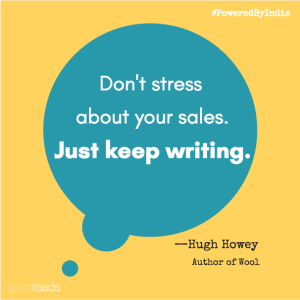
It’s probably no secret at this point that I love Goodreads, the hybrid social media site for dedicated readers and book reviewers; it’s how I track what I’m reading, especially when my to-read pile (it’s actually an entire bookshelf, plus an extra coffee table, now) gets a little bit out of control. (Who am I kidding? It’s always out of control.) Well, back in October of 2016, the Goodreads blog hosted a series of posts that may prove to be exactly what you need to read right now, as a self-publishing author facing the doldrums yourself. The first post to catch my eye included a series of quotes from popular self-publishing authors such as Hugh Howey, such as:

hugh howey quote

colleen hoover quote

and …

andy weir quote


The post was titled “Advice for Aspiring Indie Authors by Successful Indie Authors” and I highly recommend that you check it out, as well as its sequel, “Indie Authors Share Their Secrets to Creating Successful Self-Publishing Careers,” which features much more lengthy insights from a number of others. As authorities on the subject, sometimes writers such as Weir and Hoover and Howey have the power to both inspire us and flip that emotional switch buried deep inside us, the one that gets a bit, ahem, iced over with repeated disappointment or from lack of use. If you’re at all like me, this is the time of year when my creative energy is at its absolute lowest, and I sometimes don’t even realize what all is possible, I’m so swept up in the blues. A wise word or two acts like a shock to the system, reminding me that, yeah, actually, I *can* do this thing I’ve been meaning to do, but have been feeling too anxious and self-sabotaging to get started on.

This week, take a moment to witness and absorb the wise words of these authors and remember what got you into self-publishing in the first place. Remember the joy that comes with carving out a space for yourself in the world of words, and seeing something you’ve written out there, changing the lives of those lucky enough to find it.

Now we can get started thinking about how to help more people be that lucky, right?

More on that next week!

You are not alone. ♣︎

Do you have ideas to share? Please don’t hesitate to drop us a line in the comments section, and I’ll make sure to feature your thoughts and respond to them in my next post!

Elizabeth

ABOUT ELIZABETH JAVOR: With over 20 years of experience in sales and management, Elizabeth Javor works as the Director of Sales and Marketing for Outskirts Press. The Sales and Marketing departments are composed of knowledgeable publishing consultants, customer service reps and book marketing specialists; together, they all focus on educating authors on the self-publishing process to help them publish the book of their dreams. Whether you are a professional looking to take your career to the next level with platform-driven non-fiction or a novelist seeking fame, fortune, and/or personal fulfillment, Elizabeth Javor can put you on the right path.