News From the Self-Publishing World: 12/07/15

This week in the world of self-publishing:

Some writers get an early start, and as Britney Tabor of the Denton Record-Chronicle notes in this December 3rd article on fifteen-year-old self-publishing advocate Brittney Dear, a little help doesn’t hurt.  After moving from a fourth-grade essay on snow leopards to writing full-length novels, then battling her way through the dreaded-but-inevitable Writer’s Block, Dear faced yet another challenge (and one we’re probably all familiar with on this blog): overcoming the know-how barrier to moving her book from manuscript into published book.  She turned to an expert, Tabor records, and “Rocky Callen, a published author and book coach from Maryland, gave Brittney advice on self-publishing her first book. She referred her to editors and illustrators and gave her marketing pointers.”  With this help, Dear (who writes under the nom de plume Brittney Kristina) worked “six-, eight- and 10-hour shifts three to four days a week as a lifeguard in Prosper and teaching swim classes […] to pay editor and illustrator expenses for the book.”  Dear is already enjoying success as her book (Forsaken) finds its target audience, Tabor says, but it isn’t about the money.  Instead, Dear hopes her story “inspires teens to do anything they set their minds to.”  Here’s hoping, Brittney!


(Bear with me a moment on this one:)

Last Saturday, author Simon Abah (who has contributed to news outlets as diverse as the UK’s Guardian and Olaitan Ajiboye) voiced the concerns of many when he wrote in the Nigerian paper Leadership that “Book-shelves today are full of works by self-published, self-approved writers whose standards are dismal.”  And while Abah is specifically seeking to address a problem he perceives to exist in the Nigerian book market, who among us indie authors hasn’t heard this sentiment expressed somewhat closer to home, about what we do?  The reason I think it’s worth including Abah’s article in this week’s news roundup is to highlight exactly why this concern is ill-founded.

Where does Abah, and where do all those other nay-sayers go wrong?  They think the primary reason to self-publish is to avoid rejection.  Says Abah (case in point): “How can you be an effective writer if you do not suffer rejections leading to reworking of first, second and countless drafts? People who avoid this tortuous route do not have the writing spirit, aren’t confident of themselves and do not understand the concept of patience as a virtue.” But a self-published author might clue Abah in to one simple fact: self-publishing is no easier a route than traditional publishing!  Indie authors face equal, if different, barriers to entry into the publishing market: financial barriers, barriers of time and energy, barriers that can only be overcome by intensive research and application to marketing expertise, skill in self-promotion, and the readiness to put everything else on hold to get the book to its ideal readers.  In fact, we say an “Amen!” to Abah’s point that we ought to base our “writing efforts on conviction rather than commercial necessity,” that we should “not let insincerity become the hallmark that carries [us] into the future.”

Here’s some news: self-publishing makes room for more authors to hold true to their original visions for their books––to remain sincere––than any number of rejections might do.


In a December 4th article for HuffPost Books, self-publishing author Kristen Houghton (of HuffPost’s ‘The Savvy Author’ and Cate Harlow Private Investigation series fame) lays the groundwork for a beautiful argument to choose self-publishing this holiday season––and incidentally, provides the perfect rebuttal to our previous news item.  She takes the time to define and describe the distinction between self-publishing, hybrid publishing, digital publishing, and “boutique” publishing––all of which intersect in various ways, but occupy different axes on the indie spectrum.  “Major upheavals and changes in publishing benefit authors who now have choices other than the traditional press,” she writes.  “Publishing houses have staffers to read proposals and manuscripts, teams of editors, cover designers, book layout designers, printers, and distributors; all this is done with no certainty that the book will find its audience. They’re hesitant to take a chance.”  But, as we’ve mentioned before, it’s not all about rejection.  The fact that “you are in charge […] isn’t a bad thing. It’s your business and you are the CEO and CFO of the company.”  To start your week on a high note, check out the rest of Houghton’s article at the link.


As a self-publishing author, you may find it helpful to stay up-to-date on the trends and news related to the self-publishing industry.This will help you make informed decisions before, during and after the self-publishing process, which will lead to a greater self-publishing experience. To help you stay current on self-publishing topics, simply visit our blog every Monday to find out the hottest news. If you have other big news to share, please comment below.

KellyABOUT KELLY SCHUKNECHT: Kelly Schuknecht is the Executive Vice President of Outskirts Press. In addition to her contributions to the Outskirts Press blog at blog.outskirtspress.com, Kelly and a group of talented marketing experts offer book marketing services, support, and products to not only published Outskirts Press authors, but to all authors and professionals who are interested in marketing their books and/or careers. Learn more about Kelly on her blog, kellyschuknecht.com.
Demystifying the Digital Census : A House Divided

We’re in the future-making business.  As indie, hybrid, and self-publishing authors, we have to look ahead, and we have to take an active hand in surfing that cutting edge in an industry that sometimes seems bent on keeping its authors penned up in the early decades of the Twentieth Century.  That publishers have reasons for this goes without saying, but those reasons don’t always equate to satisfactory treatment when we really examine how things play out for authors–traditionally published authors included.  (Ever heard of “publishing hell” and the dreaded “midlist“?  I rest my point.)

For the last couple of weeks I’ve been taking a look at the FutureBook‘s compendium of results from its Digital Census of 2015.  The FutureBook, an offshoot of its famous cousin The Bookseller, examines current publishing trends with a particular eye for how these trends intersect with an international readership and the rise of digital technology.  We’ve already looked at the first three points:

One: Mobile overtakes tablets and dedicated e-readers as the device of choice

Two: Digital sales are still growing, but they are also slowing

Three: Self-love levels recede as many indie authors report lower satisfaction levels

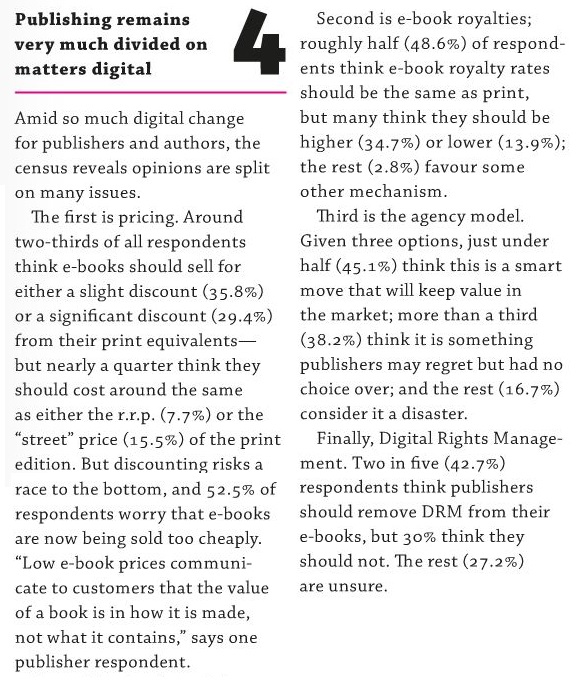
This week, we’re here to examine the fourth conclusion reached by the FutureBook editors: “Publishing,” it argues based on extensive survey data, “remains very much divided on matters digital.”  The full FutureBook publication, which is put together by The Bookseller’s Porter Anderson and Philip Jones, spells things out a bit more for us self-publishing authors:

futurebook


Division is rarely a good thing, when it comes to an emerging (but still fringe) market niche–tension between supporters of indie publishing tends to undercut our collective ability to make big gains in reaching new readers, and winning a broadened cultural acceptability.  There are some times, however, when division may be less of a “bad thing” than it is an indicator of something very, very positive: growth and market dominance.  The fact that we’re suffering from (seemingly petty) infighting over discounts shows that we’re now a force to be reckoned with–we’ve moved past being able to use words like “new” and maybe even “emerging” in reference to self-publishing.  (We’re here; we’ve emerged.  Hear us roar!)

And make no mistake, traditional publishing platforms as well as corporate giants (like Amazon) with a stake in the self-publishing game want us to keep fighting among ourselves over these things … because ultimately, if we’re fighting among ourselves we’re not fighting them.

tension

Yes, that’s right: All of these little squabbles benefit the Big Five and the Corporate Heavyweights.  Which is not to say that the concerns being fought over aren’t valid–we just can’t let them do what fights are always at risk of doing: keeping us stagnant.  If we are to remain the future-makers that The Bookseller and the FutureBook celebrate, we need to reach consensus and then act on that consensus.

And here’s some good news: We already are making progress!  In early October, 2015, a judge ruled against Apple for conspiring with the Big Five traditional publishing houses to artificially inflate e-book prices (the dividends of which were not trickling down to authors).  Prices for e-books have been climbing at least since April (although the jury’s still out on how effective these price hikes have been at increasing net profits for self-publishing authors).  More than ever before, indie authors are aligning to bring the full weight of our collective interest to bear on decisions and trends like these.


Thank you for reading!  If you have any questions, comments, suggestions, or contributions, please use the comment field below or drop us a line at selfpublishingadvice@gmail.com.  And remember to check back each Wednesday for your weekly dose of marketing musings from one indie, hybrid, and self-published author to another. ♠


KellyABOUT KELLY SCHUKNECHT: Kelly Schuknecht is the Executive Vice President of Outskirts Press. In addition to her contributions to the Outskirts Press blog at blog.outskirtspress.com, Kelly and a group of talented marketing experts offer book marketing services, support, and products to not only published Outskirts Press authors, but to all authors and professionals who are interested in marketing their books and/or careers. Learn more about Kelly on her blog, kellyschuknecht.com.

From the Archives: “‘Tis the SEASON to …”

Welcome back to our new Tuesday segment, where we’ll be revisiting some of our most popular posts from the last few years.  What’s stayed the same?  And what’s changed?  We’ll be updating you on the facts, and taking a new (and hopefully refreshing) angle on a few timeless classics of Self Publishing Advisor.

∗∗∗∗∗

[ Originally posted: December 6th, 2013 ]

‘Tis the SEASON to …

Last year I pretty much gave up shopping—well shopping in the marketing-media frenzy sense, anyway.  My passion for books—and the authors I’ve worked with—inspired me to buy their books and send them to family and friends.  I enjoyed the “holiday bargains,” of course, but much more than that, I felt as if I was passing forward the legacy of writing (and good story telling) that my self-publishing clients represent.

It was also last year that I seemed to hit a wall of mounting disappointment as I listened to the younger generations of my family and friends talking about their “exasperating,” even “frightening”, holiday shopping experiences.  A long-hidden rebellion within me grew and my fingers flew over the keyboard writing op-ed pieces to send to every daily or weekly print publisher.  I wanted to make a statement!  I wanted THE SEASON to be different!  I wanted it to be PEACEFUL!  Full of GOOD CHEER!  LOVE and LAUGHTER abounding on every block, in every city, town and nation!  However, to my own discredit, not one of my pieces was sent.  Too many last minute details derailed my fervor.  However, this season, I’m thinking of pulling out those pieces—developing them into a book—and self-publishing it in plenty of time for next year’s marketing-media-frenzy.

In the meantime, I hope you’ll join me in a taste of rebellion and allow your thoughts to stroll back to your favorite Holiday Season(s)—and WRITE about them.  Besides finding “just what you wanted” under the tree, what other memories do you see?  A favorite aunt bringing her deee-licious walnut fudge to Christmas dinner?  Your grandmother telling her version of “naughty” stories about your dad?  The next door neighbor stopping by with a handmade toy carved from oak wood just for you!

Over the years our family has enjoyed many traditions such as the youngest child placing the ceramic Baby Jesus in the manger on Christmas Eve and attending Christmas Eve church services.  One fairly new tradition in our house is watching a made-for-TV movie titled Silent Night.  This true-story, produced in 2002, stars Linda Hamilton as the German mother of a young son (age 12) who will soon be conscripted into Hitler’s army.  She takes him out of the city to a cabin in the woods—not far from “enemy” lines.  It is Christmas Eve, 1944, and unexpected guests arrive: first three American soldiers, then three German soldiers.  She demands a truce between them—for this one night.

You may be wondering why this movie?  Simple answer.  It inspired me.  This movie was created from an oral history interview with a high school student!  Her subject was Fritz Vincken, the boy in the “story,” and the one thing he remembered most about his childhood was war.  Many of us—many of our neighbors—and too many the world over hold such memories or actually live in war zones today.  I don’t want to forget that.  I don’t want to get so caught up in shopping or party-planning that I misplace my compassion for those who are hurting.  And, for me, seeing/experiencing a well-written, well-directed, well-acted movie such as Silent Night helps me hold my center; helps me appreciate the gifts I’ve been given that cannot be wrapped.

Plus, realizing that this story was developed (written/scripted) from a collection of oral histories done by high school students is exceptionally inspiring to me.  Important, vital, must-be-told stories are out there waiting for the right person to write them!  Is that YOU?

– ROYALENE DOYLE

snight1

It may only have been two years since our friend Royalene first posted this piece for us on Self Publishing Advisor, but I personally think it’s worth bringing back every Christmas.  Why?  Because storytelling is what we do, and there’s simply no more fertile ground for storytelling than the holiday season.

“Holidays bring holiday memories, and, often a sense of nostalgia for good times long gone, perhaps even loved ones long gone,” writes Wynne Parry over at LiveScience.  “This bittersweet nostalgia helps us feel connected, both around the holidays and at other times. And, it can be a salve to those suffering through hard times,” says Parry, quoting psychology professor and “nostalgia expert” Krystine Batcho, of Le Moyne College in New York.

According to Batcho, “whenever there is a major change it can be very helpful to kind of keep grounded in the sense of who you are. That sense of nostalgia helps to link you to your own personal past; it helps you remember who you have been.”  By that definition, nostalgia is both an important element to our scientific understanding of the human brain and consciousness, and an important element of the way we tell stories about ourselves and to each other.

My thoughts, as we progress into yet another holiday season, following a year of both fantastic “highs” and incredible “lows”–personally, as self-publishing authors, and simply as human beings on this planet–are as follows: We ought not to be afraid of nostalgia.  We should use the nostalgic impulse as we use all others: that is, we should allow it to spur us on in our writing, to compel us to create new things that make the most of old things.  Do the holidays–does Christmas, specifically–make you feel something?  Use that as fodder for prose.  Do the holidays leave you hungering after something more substantial or just something different in your own life?  Use that as impetus for transformation, as a writer as in all other things.

And yes, be a rebel.  If the popularity of dystopic young adult literature has taught us anything, it’s that people–our readers–are thirsty for change, to see the world move away from the sorrows and griefs and injustices that sometimes rule it.  Readers are rebels, too, and they love it when they stumble across that voice which perfectly captures the carpe diem spirit of a spirit in search of positive change.  Just as that German mother portrayed in Silent Night brought a small slice of peace and change to that cabin in the woods, you can do great things in this world.  We’re excited to see where the holiday nostalgia leads you! ♠

Silent Night (2002) with Linda Hamilton


KellyABOUT KELLY SCHUKNECHT: Kelly Schuknecht is the Executive Vice President of Outskirts Press. In addition to her contributions to the Outskirts Press blog at blog.outskirtspress.com, Kelly and a group of talented marketing experts offer book marketing services, support, and products to not only published Outskirts Press authors, but to all authors and professionals who are interested in marketing their books and/or careers. Learn more about Kelly on her blog, kellyschuknecht.com.

Demystifying the Digital Census : Self Love Levels Drop

Two weeks ago, I launched this series by laying the groundwork for understanding what the FutureBook (and its parent organization, The Bookseller) is all about and, as a result, what the annual Digital Census seeks to measure and comment upon.  (In summary: it tracks emerging and outgoing matters of interest for authors and publishers and other trade experts invested in digital publishing, whether through traditional or indie, hybrid, and self-publishing platforms.)  I also took a quick peek at the FutureBook‘s first confirmed trend of 2015: the fact that mobile has overtaken both tablets and dedicated e-readers as the primary means for reading ebooks.  And last week, I applied a microscope to the FutureBook’s second confirmed trend of 2015: the fact that digital sales are still growing, but that growth is slowing.  

self-love

This week, I’m going to examine the FutureBook’s third confirmed trend for the year.  Straight from the horse’s mouth, so to speak: “Self-love levels recede as many indie authors report lower satisfaction levels.” The FutureBook publication, which you can read here, says:

futurebook

Screen Shot 2015-11-24 at 11.44.01 PM

You can imagine how deeply sad I feel when I see a well-respected and industry-enriching publication commenting on authors tanking in the self-love department.  As it turns out, the data indexed by the Digital Census isn’t necessarily asking authors to psychoanalyze their performance and self-satisfaction, so “self-love” may be a bit strong of a term––but then again, maybe not.  Many authors do equate self-satisfaction (and their identity, really) with their performance in respect to sales figures.  And that’s a deeply problematic way to measure self-worth, as everyone is well aware … but sometimes we can’t help but believe it to be an accurate yardstick, especially when we’re spoon-fed a certain narrative by the mainstream media: the narrative in which success means J.K. Rowling, means Veronica Roth, means Tom Clancy and P.D. James and Agatha Christie, means George R.R. Martin, means blockbuster film adaptations and interviews with Ellen or Oprah or Jimmy Kimmel.

Maybe other self-publishing authors and bloggers might be content to state that this is wrong and it shouldn’t be the case, but I can’t just let it lie.  Where does the narrative of success originate?  And how can we alter the conversation to reflect a more holistic, life-affirming reality––the selfsame reality that indie, hybrid, and self-publishing authors of great quality and phenomenal worth experience on a day-to-day basis?

I think a lot of it comes down to the whole do as I say, not as I do syndrome that applies to many other grand social narratives in our modern world.  For example, we affirm again and again to our children that whatever path life takes them on, they have value––as plumbers as well as princesses, as garbage collectors and astronauts––but we flood their lives with films, television shows, and books that highlight the “exceptional” nature of the same “grand narratives” that the world will later try and tell them are impossible to actually attain, in adulthood.  (When was the last time we turned to a college student and said, “You can totally be a princess!” … and actually mean it?)

It’s the same with publishing, including self-publishing: we tell warn aspiring authors again and again that success doesn’t look like any one thing, and it certainly isn’t equatable with sales figures.  But at the same time, the narratives of “successful” authors that we learn about and spread through news articles and social media are almost always about authors who rake in the big bucks and attention from the Big Five publishing houses (after a successful “grassroots campaign,” of course), and about rags-to-riches stories like Andy Weir’s and Christopher Paolini’s.  And I’m here to say: it’s too little, and too late.  It’s simply not good enough to affirm our indie authors as individual successes with trite sayings and cold comfort.  By the time we need comforting, it’s too late.  We have to break the stereotypes and unravel the threadbare story before authors publish.

Otherwise, we’re always going to be playing catch-up and damage control.  I will always, always be on hand to affirm that you’re a success simply because you did the hard thing and you (self-) published your book, but I think we can do more to set you up for a healthy sense of your own value and worth and general excellence, and do it earlier and better.  Let’s start by teaching the next wave of future authors that numbers do not an identity make!


Thank you for reading!  If you have any questions, comments, suggestions, or contributions, please use the comment field below or drop us a line at selfpublishingadvice@gmail.com.  And remember to check back each Wednesday for your weekly dose of marketing musings from one indie, hybrid, and self-published author to another. ♠

News From the Self-Publishing World: 11/23/15

This week in the world of self-publishing:

We pretty much love i09, the millennial go-to forum for all news fandom-related.  And when an article begins with the line, “At an anti-library closure protest, local magician and comics legend Alan Moore had some surprising words” you can bet we sit up and pay attention––particularly when those “surprising words” end up rallying support to the self-publishing cause.  The article by Kaila Hale-Stern, which posted to i09 on November 19th, records Moore as saying “Publishing today is a complete mess. I know brilliant authors who can’t get their books published [….] Publish yourself. Don’t rely upon other people.”  Says Hale-Stern, “It’s rare and refreshing for an established writer to promote the potential boons of self-publishing and be honest about their perception of what lies behind the industry curtain.”  Moore’s words aren’t exactly  hot off the press (the protest actually took place back in 2011), but Hale-Stern’s decision to resurrect them––and to a high-traffic website like i09––says a lot about what millennials are hungering for.  HINT: It’s not more bureaucratic red tape and rejection by traditional publishers.  For more of Hale-Stern’s article, visit her article here.

In another article published on the 19th, GalleyCat contributor Dianna Dilworth updates readers on the latest development for self-publishing authors looking to break into the audiobook market––and, fittingly enough, this week that involves the launch of a new self-publishing tool by the audiobook industry supergiant, Audiobooks.com.  (When you own the domain name, you must be close to the top of your pyramid.)  The platform is being called Author’s Republic, and according to Dilworth it will allow self-publishing authors to “submit titles to Audiobooks.com, Audible, iTunes, Amazon, Barnes & Noble, Scribd, Downpour, and tunein, as well as library providers such as Findaway and Overdrive.”  The benefits seem (from a cursory glance at least) to be notable: “Most of these platforms will pay authors an average of 35 percent royalty on what their titles are sold for. iTunes and Amazon will pay a 25 percent royalty.”  Only time will tell if this new service measures up to existing competitors, of course.  For more information, follow the link.

Self-publishing made it into the Huffington Post this last week!  In an article for HuffPost Books on November 20th, contributor Brooke Warner writes that “Most writers have traditional publishing aspirations” in that “They want an agent to fall in love with their project and champion their work; they’re looking for the external validation of being accepted by a publishing house; their fantasies about getting published involve a red carpet experience that’s increasingly elusive in this industry.”  But so few aspiring authors receive that validation, despite having genuinely rich material to submit.  The solution?  According to Warner, you can fine-tune your approach to agents and publishers alike, but the one option which will always be open to you is that of the indie, hybrid, and self-publishing market.  Says Warner, “Independent publishing is a blossoming middle ground for authors, and in many cases you can replicate the experience you always dreamed of having–though you pay for it instead of being paid for it.”  Obviously we’re a little biased here at SPA, but we fully advocate for more creative control!  To catch more of Warner’s article, check out the original post.

When it comes to self-publishing, or publishing in general, “art books” don’t get a lot of love or attention.  But they should!  I mean, what’s more eye-catching and giftable than a beautiful oversized book full of illustrations and photographs?  And with the digital revolution has come a parallel evolution in the creation and editorial tools now available to artists and photographers––so really, seeing someone pay attention to them is both refreshing and necessary.  In this November 20th piece for Publisher’s Weekly,  Ryan Joe writes that “despite the amount of work that goes into such an endeavor, numerous creators—some big names in their respective fields, others up-and-comers—are taking matters into their own hands when it comes to getting their art books published.”  He goes on to document the ways and means in which several of these creators have trailblazed the way for other artists to follow, and in so doing Joe creates a summary guide for authors looking to flex a different self-publishing muscle.  Well worth a second look, we’d expect!


As a self-publishing author, you may find it helpful to stay up-to-date on the trends and news related to the self-publishing industry.This will help you make informed decisions before, during and after the self-publishing process, which will lead to a greater self-publishing experience. To help you stay current on self-publishing topics, simply visit our blog every Monday to find out the hottest news. If you have other big news to share, please comment below.

KellyABOUT KELLY SCHUKNECHT: Kelly Schuknecht is the Executive Vice President of Outskirts Press. In addition to her contributions to the Outskirts Press blog at blog.outskirtspress.com, Kelly and a group of talented marketing experts offer book marketing services, support, and products to not only published Outskirts Press authors, but to all authors and professionals who are interested in marketing their books and/or careers. Learn more about Kelly on her blog, kellyschuknecht.com.