Self-Publishing News: 9.12.2016

And now for the news!

This week in the world of self-publishing:

“When I self-published my book, admittedly, it was the last resort,” writes Eva Lesko Natiello in her September 8th article for The Huffington Post‘s Entertainment section. Natiello, who self-published her book The Memory Box after a series of rejections from traditional publishers, goes on to describe the dejection and intense discouragement that followed. “Quickly,” she writes, “the consolation prize felt very much like a booby prize.” This discouragement was only amplified by the positive responses she received.  Says Natiello, “I’m probably the only author on the planet that cringes when a reader says, ‘I read your book in one night! I couldn’t put it down!’ Knowing the myriad all-nighters I pulled writing and editing it. And all the sleepless nights that are ahead of me to finish the next book.”

Natiello’s experience is hardly unique, however. Many authors turn to self-publishing as a last resort after rejection, and there’s a tendency to think that this somehow automatically equates to failure–that self-publishing is the hallmark of failed writers, even as sales soar and readers respond the way that Natiello’s do. But there’s a silver lining to the struggle, she reminds us: “It was unglamorous and worth every minute. I didn’t know it back then, but self-publishing is just a different way to do the thing I always wanted: to entertain readers. You can’t do that unless you produce something for them to read.”  And Natiello has.  To read her full story and catch up on the success of her book, you can access the full HuffPost piece here.

Some self-publishing companies are, shall we say, unique. And Erika Bester’s Fire Quill Publishing, the first fully female-owned publisher, is one of several experienced self-publishing authors who has taken steps towards activating the potential of other authors by launching a startup that defies the world of traditional publishing according to Neo Koza in this September 9th article for Eyewitness News.  Bester saw a need–“Our publishing companies focus more on non-fiction and memoirs, they are not very supportive of fantasy genres and non-adult science fiction”–and decided to set about satisfying that need.  But it’s not easy going, as Koza reports: when small publishers like Fire Quill do occasionally get their books into stores, they are often tucked away out of sight. “It’s always somewhere in the corner where nobody sees it,” says Bester.  But her struggle is an important one, as Koza records, since the field of traditional publishing leaves little room for diverse voices like Simamkele Dial’s, whose book was published through Fire Quill earlier this year. As many self-publishing authors have discovered, self-publishing is more than just a home to discouraged authors seeking shelter after rejection by the institution; the platform provides a wholly new launchpad for diversity in thought and representation. (And content.)  But enough of the summary; check out Koza’s coverage of Bester’s work at the link.

Award opportunities for self-publishing authors can be few and far between, but there are opportunities out there as this September 9th press release for Outskirts Press reveals. The full-service self-publishing company will by the time you read this have both sponsored and sent representatives to the first-ever Colorado Book Festival, held at the Denver Public Library.  “As a Colorado-based company that assists authors worldwide,” says the release, “Outskirts Press is thrilled to provide resources to aspiring authors attending this free event.”  The event is drawing some attention not just because of its novelty but because of the names attached; Colorado’s Governor, John Hickenlooper, attended the event as well as Outskirts Press’s founder and President, Brent Sampson, who took part in a panel discussion while the company’s CEO, Jeanine Sampson, met writers one-on-one in order to field questions about both the company and the process of self-publishing.  The event, which drew more than 75 local authors (!!), ran the gamut from crime to sports, poetry to photography, and fiction to history as authors mingled and shared their experiences with other attendees.  With book signings, giveaways, and children’s story times scheduled throughout the event, this first-ever Colorado Book Festival holds a lot of promise in terms of giving authors an idea of what they might come to expect in the future for their industry: Hope, optimism, and a great deal of public attention.  For the full press release, follow the link!


spa-news

As a self-publishing author, you may find it helpful to stay up-to-date on the trends and news related to the self-publishing industry. This will help you make informed decisions before, during and after the self-publishing process, which will lead to a greater self-publishing experience. To help you stay current on self-publishing topics, simply visit our blog every Monday to find out the hottest news. If you have other big news to share, please comment below.

Kelly

ABOUT KELLY SCHUKNECHT: Kelly Schuknecht is the Executive Vice President of Outskirts Press. In addition to her contributions to the Outskirts Press blog at blog.outskirtspress.com, Kelly and a group of talented marketing experts offer book marketing services, support, and products to not only published Outskirts Press authors, but to all authors and professionals who are interested in marketing their books and/or careers. Learn more about Kelly on her blog, kellyschuknecht.com

The Book Beautiful: Front & Back Matter (It Matters!)

So you’ve written a manuscript, thus the ‘meat’ of your book is complete. However, you want to happily sandwich that meat between what we call ‘front matter’ and ‘back matter.’ Front matter includes things like the half-title, the title page, the copyright page, a dedication, acknowledgements, a table of contents, and perhaps other things such as an epigraph, a preface, an introduction, or a prologue. The back matter can include an index, an appendix, and other material that doesn’t belong in the meat of the book, but that you’d like to include to feel you have a complete book.

First, let’s break down what front and back matter should include and how to make them look professional and appropriate. We’ll begin by tackling the different types of front matter you can choose to include.


  • Half Title –  As writers, you’re probably (and hopefully!) avid readers yourself, so you know that typically the first page of a book tends to just contain the title of the book. No author name, no other clutter, just a straightforward, bold texted title.
  • Title Page – The title page will also include the title of the book, but it will also include a subtitle (if you have one), the author’s name, as well as the name of the publishing company of the book. Other details that are often found on this page would be the location of the publishing house, the year the book was published, and perhaps even an illustration.
  • Copyright Page – You’ll usually find the copyright page by simply flipping the title page, and it will have a copyright notice, edition information, cataloging data, publication information, legal notices, and your book’s ISBN.
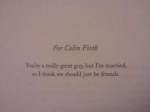
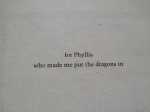
  • Dedication Page – This page will typically follow your copyright page and can be as simple as…


For my dearest mother Mary: R.I.P.

Or they can be witty…

“I dedicate this book to George W. Bush, my Commander-in-Chief, whose impressive career advancement despite remedial language skills inspired me to believe that I was capable of authoring a book.”

Pedram Amini, ‘Fuzzing: Brute Force Vulnerability Discovery’

Or they can be touching…

“Dear Pat,

You came upon me carving some kind of little figure out of wood and you said, “Why don’t you make something for me?”

I asked you what you wanted, and you said, “A box.”

“What for?”

“To put things in.”

“What kind of things?”

“Whatever you have,” you said.

Well, here’s your box. Nearly everything I have is in it, and it is not full. Pain and excitement are in it, and feeling good or bad and evil thoughts and good thoughts- the pleasure of design and some despair and the indescribable joy of creation.

And on top of these are all the gratitude and love I have for you.

And still the box is not full.”

–John Steinbeck, ‘East of Eden


  • Acknowledgements Page – This is where you can express your appreciation for all of those who helped you create the book.
  • Table of Contents – The table of contents is where you list all the major divisions within your book, more often than not in the form of chapters. The length of your book will determine how detailed your table of contents will need to be–a longer book will typically require a more detailed table of contents to assist your reader in navigating the piece.
  • Epigraph – An epigraph is a quotation that you can choose to devote an entire page to (usually facing the table of contents), or that you can choose to put at the start of the first chapter.
  • Preface – A preface is place for the author to explain how the book came into being and is often signed and dated by the author.
  • Introduction – Here the author can explain the goals of the work, place the work in context, or explain the organization and scope of the work.
  • Prologue – A prologue is told from the voice of a character in the book, and not the author’s own. It is typically used in a piece of fiction to set the scene for the story that is about to unfold.

As for the back matter of your book,

  • Index – An index will act as a guide to the book itself; it provides an alphabetized list of terms in the text and will indicate where in the text these terms were used.
  • Appendix – An appendix will provide supplementary details about your book such as corrections, updates, and details.


Now these are merely suggestions for what you can choose to include in the front and back matter of your book. What is most important is that what you do include looks professional and is well formatted. Pick up multiple books from your shelf and take a look at the front and back matter for a point of reference. While you’ve probably skipped over it on most books you’ve read, think how much more legitimate books with these sections look than books without them. These parts of publishing may seem tedious, but as I’ve said before, they are what will transform your manuscript into a book.


Thank you for reading!  If you have any questions, comments, suggestions, or contributions, please use the comment field below or drop us a line at selfpublishingadvice@gmail.com.  And remember to check back each Wednesday for your weekly dose of marketing musings from one indie, hybrid, and self-published author to another. ♠


Kelly

ABOUT KELLY SCHUKNECHT: Kelly Schuknecht is the Executive Vice President of Outskirts Press. In addition to her contributions to the Outskirts Press blog at blog.outskirtspress.com, Kelly and a group of talented marketing experts offer book marketing services, support, and products to not only published Outskirts Press authors, but to all authors and professionals who are interested in marketing their books and/or careers. Learn more about Kelly on her blog, kellyschuknecht.com

From the Archives: “Self-Publishing Ripple Effect Marketing”

Welcome back to our Tuesday segment, where we’ll be revisiting some of our most popular posts from the last few years.  What’s stayed the same?  And what’s changed?  We’ll be updating you on the facts, and taking a new (and hopefully refreshing) angle on a few timeless classics of Self Publishing Advisor.

∗∗∗∗∗

[ Originally posted: May 27th, 2010 ]

Later this week, on May 18th, the Colorado Independent Publishers Association (CIPA) EVVY Awards will be hosting the 2013 award banquet. The event will take place at Marriott Denver South at Park Meadows and all proceeds will benefit the literacy projects of the CIPA Education and Literacy Foundation (CIPA ELF).

CIPA is a nonprofit association of independent book publishers, authors, future authors and related publishing service providers that has been providing leadership since 1992. Members come from many states as well as from Colorado and three foreign countries to take advantage of the resources made available through CIPA membership. Organization membership, along with active participation in CIPA programs, can open doors to many opportunities and can save thousands of dollars in costly mistakes.

Best of luck to all the finalists! To learn more about the event, visit http://www.cipacatalog.com/pages/CIPA-EVVY-Awards.

by Kelly Schuknecht

.

Thanks for reading.  If you have any other ideas, I’d love to hear them.  Drop me a line in the comments section below and I’ll respond as quickly as I can.  ♠


Kelly

ABOUT KELLY SCHUKNECHT: Kelly Schuknecht is the Executive Vice President of Outskirts Press. In addition to her contributions to the Outskirts Press blog at blog.outskirtspress.com, Kelly and a group of talented marketing experts offer book marketing services, support, and products to not only published Outskirts Press authors, but to all authors and professionals who are interested in marketing their books and/or careers. Learn more about Kelly on her blog, kellyschuknecht.com

Self-Publishing News: 9.5.2016

happy labor day


And now for the news!

This week in the world of self-publishing:

“Professional photographer Alice Mabin is a woman not afraid to have a go in life,” writes Jennette Lees in her September 2nd article for the Cootamundra Herald, a paper which covers the Cootamundra District in New South Wales, Australia.  Says Lees, New Zealand born Mabin, 29, “always knew she wanted a career on the land,” and indeed spent “her early working life traipsing around high country stations in New Zealand mustering sheep, cattle, and deer, before packing up her life, including her dogs, in 2007 and moving to the vast, flat, drought-stricken planes of Hay, to experience farming the Australian way.”  She even took part in the 2013 Brinkworth cattle drive, the longest cattle drive in over 100 years of Australian history, walking roughly eighteen thousand head of cattle “from central Queensland to Hay,” a journey of 2000 kilometers (1240+ miles).

brinkworth cattle drive
[ a map of the Brinkworth drive ]
2000 kilometers, for comparison, is roughly the distance from Dusseldorf to Skopje, and from New York to Miami. You can imagine that walking that far might lend itself to some interesting photography, and Mabin made good on that opportunity. Writes Lees, Mabin “went along for a day to take photographs and ended up joining the crew for the entire five-month trip. She finished with beautiful, scenic images capturing a side of Australian life few have the opportunity to experience.”  After putting her images together as a book, and struggling to find a publisher, Mabin self-published The Drover and printed just a thousand copies.  To date, reports Lees, “21,000 copies of the book have been sold with another reprint on the horizon.”  To learn more about Mabin’s fascinating work and the story of her self-publishing experience, follow the link!


Some weeks ago–back in May, in fact–we reported on Rana Ayyub’s rough journey to self-publication, and this week we are happy to offer a wonderful follow up.  As Priya Ramani writes for Live Mint in this September 2nd article, “All the angst fades when you’re the country’s latest self-publishing sensation who has, pretty much single-handedly, managed to sell 32,000 copies of a book nobody would touch. It also feels nice to be on the verge of paying back the Rs.5 lakh bank loan you took to do this.”  Says Ramani, “It’s great when the country’s biggest English language book distributor takes you on board because they know it makes commercial sense, political affiliations be damned.” Ayyub, who published the highly controversial Gujarat Files: Anatomy Of A Cover Up earlier this year, has faced everything from being ignored to accusations of being a jihadi Muslim radical. It doesn’t hurt that Ramani herself is clearly impressed with Ayyub’s work; as Ramani puts it, “the then 26-year-old reporter who went undercover as film-maker Maithili Tyagi for eight months in 2011 to investigate the riots, custody killings and 2003 murder of Gujarat home minister Haren Pandya. The investigation, originally commissioned by news magazine Tehelka, was never published. Several years later, Ayyub has self-published it as The Gujarat Files. It takes a single-minded madness to do what she did.”  Single-minded madness aside, Ayyub has become something of a self-publishing sensation in addition to a political force for transparency, advocacy, and the ethical treatment of others.  For the full report, click here.

Emma Bryson has some strong words for the publishing community.  In her latest (September 1st) article for New Zealand’s premier Booksellers magazine, Bryson bemoans the fact that romance authors and publishers “inspire a bare minimum of mainstream media attention, aside from the odd condescending ‘human interest’ story. But the slight of romance rides further than this still, with traditionally little to no coverage in national or even local bookish circles.”  Says Bryson,  “I’m beginning to think that the somewhat toxic relationship between the wider publishing world and romance needs to be re-negotiated. Not for our sake, but for yours.”  How ‘yours’?  The genre “transcends most of those traditional mainstream publishing concerns,” she writes, and this is good for everyone: “Multinational vs indie? No problem, you can make a career out of either, or both. Traditional vs self-publishing? Both can be lucrative options for romance writers. Print vs digital? Hey, same there.”  The complicated relationship between Romance and Feminism bears further study, too, according to Bryson.  But when push comes to shove, it’s Romance’s very transgressiveness–its ability to cross lines because no one is looking–that makes it home for innovation and success. Its authors are “freed to explore those cutting-edge avenues that traditional publishers still scoff at,” write Bryson–and this is ultimately good news for everyone.  For the rest of Bryson’s article, follow the link..


spa-news

As a self-publishing author, you may find it helpful to stay up-to-date on the trends and news related to the self-publishing industry. This will help you make informed decisions before, during and after the self-publishing process, which will lead to a greater self-publishing experience. To help you stay current on self-publishing topics, simply visit our blog every Monday to find out the hottest news. If you have other big news to share, please comment below.

Kelly

ABOUT KELLY SCHUKNECHT: Kelly Schuknecht is the Executive Vice President of Outskirts Press. In addition to her contributions to the Outskirts Press blog at blog.outskirtspress.com, Kelly and a group of talented marketing experts offer book marketing services, support, and products to not only published Outskirts Press authors, but to all authors and professionals who are interested in marketing their books and/or careers. Learn more about Kelly on her blog, kellyschuknecht.com

The Book Beautiful: Illustrations

We all started out reading illustrated children’s books; perhaps your parents would read the words as your eyes were captivated by the images of a hungry caterpillar, the Berenstain bears, a Curious little George, etc. As we grow older, however, it’s probably not too often that the books we fill our time with have accompanying illustrations. Nevertheless, it has not always been the case that book for adults went unillustrated. Charles Dickens, for example, was known to have very close relationships with his illustrators, to whom he would give plot outlines before he’d even written the text itself. So while it’s easy to pull up references to colorful children’s books illustrations, that is not to say that they don’t have a valid and important place in other genres of books geared toward young adults and adults as well.

curious george illustration

So you want to write an illustrated book? First of all, don’t look at the illustrations to an illustrated book as supplemental, but as a crucial aspect to the themes you are trying to convey. Images help augment the reader’s imaginative experience, they make a book fun and easier to read, and they definitely help hold on to the reader’s attention.

There are certain genres that illustrations or photographs seem to be an obvious and necessary accompaniment–cookbooks, DIY-books, textbooks, autobiographies and biographies, and as we’ve previously mentioned, children’s books. The illustrations for a cookbook could simply be photographs of the final result of your recipe, and for a DIY-book they could be drawings or photographs of the different steps of the project your book conveys. If you’re writing an autobiography or a biography, photographs of the subject throughout their life or at pivotal moments in their life will help the reader further identify with the subject as a person rather than as a character in a story whom they have to fabricate an image of in their mind. As far as children’s books goes, the adage ‘don’t judge a book by its cover’ doesn’t really apply–kids will always judge a book by its cover and they will be inevitably more drawn to eye-catching, colorful illustrations.

Quantity is another important consideration to make as far as illustrations go. For a young-adult book, one illustration per chapter will usually suffice, while a children’s book should probably have one illustration per page. With a children’s book then, layout becomes another consideration–will your images be a full-page spread, or will they be next to, above, or below the text? If you’re writing a biography or an autobiography, you may want to have your photographs placed at the relevant points in your text–for example, your subject won the Olympic gold medal and here is a picture of her doing just that. OR, you could have a center panel with multiple pages of photographs and use footnotes in the text that will direct the reader to the relevant images that they can flip to easily.

Now, assuming that you yourself are not going to illustrate your own book (not to at all doubt your artistic abilities), the question of how to get your book illustrated become important. Outskirts Press offers custom, full-color illustrations for authors, even if they haven’t published through our company. By using this service, you can be sure that you’ll never have to split royalties with an artist, a cost that is always nice to avoid. Remember, no matter who you choose to illustrate your book, that quality illustrations are going to be a very important factor in the marketing value of your book.


Thank you for reading!  If you have any questions, comments, suggestions, or contributions, please use the comment field below or drop us a line at selfpublishingadvice@gmail.com.  And remember to check back each Wednesday for your weekly dose of marketing musings from one indie, hybrid, and self-published author to another. ♠


Kelly

ABOUT KELLY SCHUKNECHT: Kelly Schuknecht is the Executive Vice President of Outskirts Press. In addition to her contributions to the Outskirts Press blog at blog.outskirtspress.com, Kelly and a group of talented marketing experts offer book marketing services, support, and products to not only published Outskirts Press authors, but to all authors and professionals who are interested in marketing their books and/or careers. Learn more about Kelly on her blog, kellyschuknecht.com