In Your Corner: Knowing When to Quit

quit

We’ve all been there, and it’s a tough place to be: we’ve all faced the daunting question of “Should I continue writing this?” and not known the answer. But there are signs on the road that leads to doubt, signs which can tell us more or less reliably when the project needs to make a quick exit from our lives … and when to press on.

My first impulse as someone who works in author services is always to encourage, to say … you can do it! You can finish the thing! All it needs is a little more time and focus! … and sometimes, I’m right. But sometimes, I’m not. And a lot of my job relies on me being able to parse the right time to–yes, encourage–the writers I work with to part ways with their current piece.

It all starts with time, and waiting.

The first sign that it’s time to quit is that you’re waiting for inspiration. A lot. Maybe all of the time. It’s like a divine fire which descends from the skies and burns its way out of you, this inspiration. You can work through the night without even noticing, when it comes … but it doesn’t often come. The difficulty here is that if waiting is your M.O., you’re likely to eventually produce a manuscript … but not a workable book. Writing frenetically and disorganizedly, powered only by brief flashes of inspiration, isn’t enough to hold a book together–the secret to writing a novel isn’t to work through minor problems quickly and leave major ones until after the first draft is complete, but this is where waiters-for-inspiration tend to end up.

The second sign that it’s time to quit is when you wake up and realize you’re writing for someone else, not because you feel personally involved in the story being told. Some authors succeed in writing for the masses passionlessly, but it’s generally not a safe bet, because what draws the masses (in most cases) is a recognition on the author’s part–the author looks into the text and recognizes that there’s something magical going on there, some part of the self which has found its own kind of agency.

Oh, and authors who write for a market and not out of vision tend to neglect their craft. Why does the sentence-level work matter if the grander arc of the story doesn’t? Authors sense this discrepancy and it can kill enthusiasm stone dead.

The third sign that it’s time to quit is when you start finding reasons to not write. Like, if you’re reading this blog post because you Googled “How to know when to quit?” then … that’s what I’m talking about. Or when you find excuses to be too busy during your dedicated writing hour each morning (or evening, you night owls!). Or when “the fire just isn’t there anymore,” as one author lamented to me recently. Often, when we try to push through this particular sign, it’s because we’re more intent on being authors than we are on writing. We wish to belong to a category of people who live lives we think desirable. We want fame. But the burnout inevitably happens a quarter or midway through the manuscript, and it never really comes back.

Usually at this point in a post about quitting, bloggers start quoting authors like David Eddings and Samuel Beckett and Neil Gaiman. And don’t get me wrong, I love Neil Gaiman the same as you do … but isn’t that half of the problem? We lean on the voices of others when we find ourselves at sea to pin down an idea. And leaning is 100% encouragement-worthy behavior, in my opinion, if you’re feeling on the edge of some great Quitting. But: forget all of those authors who faced setback after setback before finding an agent or getting published (Stephanie Meyer and Kathryn Stockett, I’m looking at you!). Forget the inspirational quotes.

Yes, some success is the result of stick-to-my-guns-itude. Some. But for every Kathryn Stockett out there, there are ten authors who persevered with the same degree of determination that she did, and never got past the bottleneck. And for every Stephanie Meyer out there, there are ten authors who realized their work wasn’t going anywhere and figured out somewhere better it could go.

Stick to your guns … until you know the sticking is sheer stubbornness. If you quit, it’s not the end of the world. There’s another book out there for you, waiting to be written. Maybe quitting is actually an important skill to develop–tasteful quitting, graceful quitting, quitting when the object being quitted is holding you back from digging in to a new, better object just waiting for your attention.

Quit, darlings. Quit and start afresh. It’s okay.

You are not alone. ♣︎


Elizabeth

ABOUT ELIZABETH JAVOR: With over 18 years of experience in sales and management, Elizabeth Javor works as the Manager of Author Services for Outskirts Press. The Author Services Department is composed of knowledgeable publishing consultants, pre-production specialists, customer service reps and book marketing specialists; together, they all focus on educating authors on the self-publishing process to help them publish the book of their dreams. Whether you are a professional looking to take your career to the next level with platform-driven non-fiction or a novelist seeking fame, fortune, and/or personal fulfillment, Elizabeth Javor can put you on the right path.

In Your Corner: Common Spelling Mistakes & How To Avoid Them

typo errors spelling mistakes

Have you ever made a spelling mistake?

Well, you’re human (probably), so I’m going to guess that you have. I definitely have. Just the other day, a friend went through a chapter of my latest manuscript and pointed out at least five typos and other errors which had slipped entirely by me.

So, how do we avoid these pesky little guys, spelling mistakes?

The first step is to recognize them for what they are: your brain being highly efficient, not deficient. Research indicates that typos and other errors rarely come from a lack of knowledge or training, but rather from the brain being focused on something else, like narrative, plot, characters, time management, and so on and so forth. These are higher order processes, really quite sophisticated, and as such they take a lot of brain power which otherwise might be spent looking for other things, like typos. Your brain is a beautiful and efficient thing, with certain priorities it doesn’t always share with you, but that’s okay. Just … don’t kick yourself too hard for each typo your friends catch when they read your manuscript. (Yes, I tell myself this, too. Every day.)

The second step is to know which mistakes are the most common. That way, you’ll be–yes–more efficient at catching them. There are struggles that come from words being similar in shape and sound but having different meanings, like foreword and forward. This is called a homophone error. One implies direction (forward) and one is a structural component of a book which serves as a preface or introductory note, usually including the “whys” and “wherefores” of the thing. Complimentary and complementary are also homophones. One means to deliver praise (complimentary) and one means to accessorize well or that one thing works well with another, as in complementary colors. These kinds of errors are what Google was invented for; never be ashamed to look up a word if you’re afraid you might not be catching all of its nuances!

Other common errors include trouble with suffixes and morphemes (substituting “-able” and “-ible” or “-ance” and “-ence”), defying the so-called ‘laws’ of spelling (i before e except after c, u always follows q, et cetera), mixing up how to pluralize tricky words ending in f or y, and composing adverbs. These are common struggles, particularly for people who did not learn English as their first language, and the only way to improve on these is to keep writing. A lot. And to keep a reference guide on hand, like this Business Insider article on these language acquisition-related errors. And again, don’t feel shame about hopping on Google for these.

The third step is to fix the errors yourself, if you can. Don’t rely on spell check for this, since Microsoft Word and other word processors rarely understand nuance, or know how a whole sentence fits together and which words do not fit. (Sometimes it will highlight perfectly acceptable sentences as grammatically broken, and not highlight sentences which need some work.) You should always proofread your work, but you want to make sure you do this after you finish getting all of the ideas out of your head. Some people prefer to set aside five or ten minutes after each daily writing session for this process, but the ideal time is after the whole manuscript is done and you can sit down and do it all at once. That way, you won’t struggle with continuity issues. Also, it’s just … more efficient! Keep a reliable resource to hand–something more comprehensive than that BI article, like the Chicago Manual of Style (there are pocket editions) or the Associated Press Style Book. I really like the MLA Pocket Style Manual, which is what I used in college. They’re updated every couple of years, these resources, so update your collection appropriately.

The fourth and final step is knowing when to let go. As in, when it will be more useful and efficient to place your manuscript into the hands of a professional editor. Trust me, this is no easy decision! The tendency is to feel resentment, or fear that the editor will change the material substance of your work in a way that will make it … less yours. But that’s not what editors are for, much less copyeditors, the professionals who dedicate their lives to examining other peoples’ writing on the sentence level. Know the difference before you go in–we’ve written about editors vs. copyeditors here on SPA before–and choose accordingly. But do choose! Friends and family make for excellent first readers, but you really do need that trained eye on your work if you want to catch the peskiest of all errors, because your readers will find (and mind) them even if your friends and family don’t.

Writing is hard. Finding errors is harder still. But …

You are not alone. ♣︎


Elizabeth

ABOUT ELIZABETH JAVOR: With over 18 years of experience in sales and management, Elizabeth Javor works as the Manager of Author Services for Outskirts Press. The Author Services Department is composed of knowledgeable publishing consultants, pre-production specialists, customer service reps and book marketing specialists; together, they all focus on educating authors on the self-publishing process to help them publish the book of their dreams. Whether you are a professional looking to take your career to the next level with platform-driven non-fiction or a novelist seeking fame, fortune, and/or personal fulfillment, Elizabeth Javor can put you on the right path.

In Your Corner: The Business of Writing

So, you’re an author. Writing is your business, right?

Well … hopefully. The problem with being an author, particularly a self-published author, is that the real work is a solitary activity, taking place at home or in another not-a-standard-office-environment workplace, and is oh-so-easily interrupted by the ordinary vagaries of daily life. Anyone who works from home can attest that it’s difficult to keep home life and work life separate!

So how can an author make writing a business, with all of the peculiar challenges authors face?

Draw up a business plan.

Whoa, whoa, a business plan?! Isn’t that for people who are, like, starting a bakery or a coffee shop or maybe a lumber yard? Yes. But it’s also for you, the indie author. You have to prioritize making a business plan if you want to make a profit off of your writing. There are plenty of small-business handbooks available through your local public library, so I won’t go into great detail for you here, other than to say you don’t need to be afraid of the spreadsheets … you just have to be willing to bow before the truths they present to you. If the spreadsheets and the business plan requires you to sacrifice certain luxuries in order to make a good go at becoming a profitable self-publishing author, that’s what you’ll need to do. In most cases, however, a business plan will simply help you figure out which services you ought to pay for, and which ones you ought to train yourself to manage. Like bookkeeping, or website design. It will help you organize your author-related budget and separate it from your personal, regular budget, articulate your needs and your vision, and filter out distractions. I promise, this is the best possible thing you can do, whether you’re just starting out or midway through your career!

Figure out your brand.

What do you want to be known for, as an author? Are you going to be recognized for some sort of narrative through-line to your works, a passion for author advocacy, for your engagement with your audience, or something else entirely? (Hint: you can be all of things, and more.) Your “brand” is as much a product of your personality and your priorities as it is the actual physical product you publish on the page.

You can probably name a couple of brands off of the top of your head. Starbucks, Wal*Mart, Toyota … and when you think of these brands, what do you think of? Their visual presence, like their logo and their website or smartphone app? Or perhaps the little jingle that plays during their commercials? Now, what about authors? Which ones spring to mind as having distinctive presences out in the world? Terry Tempest Williams? Ann Rice? Stephen King? Figure out what draws you in, and what you can feasibly do as a creator in order to tap into the same strengths.

Find your market.

Have you spent much time thinking about your ideal reader? This isn’t a simple thought exercise, it’s an important part of delivering your business plan into the world without undue complications. Spend a few hours researching and drawing out characteristics and qualities you think of when you contemplate who will or ought to be drawn to your work, and then brainstorm ways to reach them which you can manage in a regulated, sustainable, and protected way.

Protected? Yeah. As with all other new things, it can be hard to build new muscles and tap into new markets, because such things rely on habitual, scheduled curation. Statistically speaking, readers are far more likely to subscribe to your social media accounts, blog, and email newsletters if they know they’ll get updates regularly—even on the same day each week. You absolutely must protect such habits from the encroachment of daily distractions! Otherwise, they’ll go the way of all other resolutions. And if you want to treat your work as an author like a business, that’s just not going to help much.

businesslike business suit coffee child

If you’re feeling frustrated with your attempts to put together a business plan for your writing, get in touch! We’d love to hear your stories and help you face the challenges ahead with the best possible resources at hand. We’re here for you.

You are not alone. ♣︎


Elizabeth

ABOUT ELIZABETH JAVOR: With over 18 years of experience in sales and management, Elizabeth Javor works as the Manager of Author Services for Outskirts Press. The Author Services Department is composed of knowledgeable publishing consultants, pre-production specialists, customer service reps and book marketing specialists; together, they all focus on educating authors on the self-publishing process to help them publish the book of their dreams. Whether you are a professional looking to take your career to the next level with platform-driven non-fiction or a novelist seeking fame, fortune, and/or personal fulfillment, Elizabeth Javor can put you on the right path.

In Your Corner: Distinguished Gentlepen

(I know, my puns are the worst. I just can’t help making them; it must bed some kind of compulsion, or character flaw.)

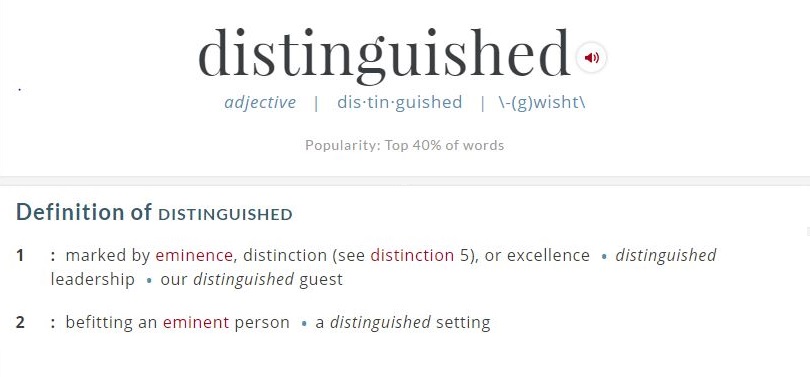
Today I’m going to take a peek at what makes a book–and its author–distinguished. Now, if you haven’t used this word recently in a sentence of your own, you might be thinking of ball gowns and tuxedos and those nifty eyeglasses that attach to one’s watch-pocket by chain. You might even be thinking of particularly thick mustaches, and a well-maintained Model T Ford. The word is straight out of Victorian literature, but I would make the argument that it has continued relevance today. It is defined as:

distinguished definition

And as you can see, it actually lies a touch above the curve in terms of popularity–Merriam Webster places it in the top 40% of words according to usage. At least it’s not … fulvous … with envy of those more popular words.

If being “distinguished” simply means some rough equivalent to “being excellent,” then why not just say so? Why use a slightly dated word, other than to add a little buff and polish and appeal to an idea we cover each and every day here on Self Publishing Advisor in some way, shape, or form?

There are connotations to pursuing a distinguished persona or book that do not apply to something simply “excellent.” These connotations include, for the word in question, a sense of superiority, of fine texture, make, or production quality–and of course, the connotation of public presence. After all, even the Victorians understood that a very fine frock or overcoat wasn’t about keeping warm; it was about putting on a good show for others.

A distinguished self-publishing author is more than just “getting by.” He or she thrives under the heavy thumb of freedom which is pressed upon them by the choice to ditch traditional publishers–heavy because there is a cost to pay, in that so much of the burden of marketing and promotion falls on the author–and stands out from other authors by virtue of his or her attitude. That’s par for the course; so much in life comes down to attitude, doesn’t it? To be distinguished also has, of course, connotations of gentlemanly or gentlewomanly behavior, hence the terrible pun at the beginning of this post. The most gentlepersonly person I’ve ever met was a lumber salesman, a truly distinguished fellow who treated the world and every person in it with kindness, generosity, and respect. This most certainly holds true for self-publishing authors, however, since the average author has to navigate hundreds of relationships and social contracts in order to publish and market a book successfully. May you be distinguished by your curiosity, your kindness, and your intrepid spirit in pursuit of the best possible life as an author,

So, too, may your book be distinguished in all of those little ways which will help it stand out from the herd: quality design and production value, a beautiful feel in the hand and look on the page, perfectly copyedited content and fiercely individualized material, as well as its accessibility to all of those potential readers lurking out there in the ether.

It may not seem like much, recommending that you look into the nature of distinguishment, but in fact it’s everything. As mentioned earlier, it’s an attitude which encompasses everything else you could possibly be or make or do–as an author, and as a human being in general. It’s on my heart and mind today that we live in a world which is often hostile to the point of making us focus on the struggle for survival far more than living well, and while survival is necessary, so too is emerging on the other side proud of who you’ve been and become. We’re here for that, and we’re here for you.

You are not alone. ♣︎


Elizabeth

ABOUT ELIZABETH JAVOR: With over 18 years of experience in sales and management, Elizabeth Javor works as the Manager of Author Services for Outskirts Press. The Author Services Department is composed of knowledgeable publishing consultants, pre-production specialists, customer service reps and book marketing specialists; together, they all focus on educating authors on the self-publishing process to help them publish the book of their dreams. Whether you are a professional looking to take your career to the next level with platform-driven non-fiction or a novelist seeking fame, fortune, and/or personal fulfillment, Elizabeth Javor can put you on the right path.

In Your Corner: Nom de Plume (Part III)

Two weeks ago, I began a quick series on the merits of using a nom de plume–otherwise known as a pen name, otherwise known as a pseudonym–under which to self-publish your next book. The series continued last week, with an examination of the drawbacks of using such a cover, and concluded with the question:

So: You’re ready. What next?

And … here we go.

masked unmasked nom de plume pseudonym pen name

If you’ve decided to adopt a pseudonym, there are a few steps you should take to ensure you do it right. (And by right, I mean correctly!)

  1. Choose wisely. Once you’ve selected a pen name, yup, you’re stuck with it. Or rather, you will want to be stuck with it for a whole host of reasons to do with convenience and consistency, so make sure it’s not a name that ages poorly or that you will grow out of in a year or two. Don’t go overboard in making up a name so memorable that it comes off as goofy to others. Use friends and family that you trust as a sounding board for pseudonym ideas–they’ll let you know if they catch a whiff of something goofy immediately, since your reputation is important to them.
  2. Choose something unique. Don’t settle for your first idea; your pen name should be unique, so it’s well worth your time to do a little searching through Google and so forth in order to check that your pseudonym of choice is not already used by another writer (past or present) since you want to avoid confusion. Also: steer clear of imitating famous names. Stephen King will not be happy when he hears you’ve stolen his name, and you’re favorite dead author wants you to know her estate will be calling to sue, even though she’s long gone. Hunt through the U.S. Trademark Office website to make doubly sure you won’t get into any hot water for duplication, conscious or unconscious.
  3. Put a ring on it. Or, you know, your personal domain. Search for available domain names before committing to a pseudonym, and then buy it. Also make sure to file a Fictitious Business Name Statement if you’re likely to receive payments made out to your nom de plume instead of your real name. This is a real thing, and you should do it.
  4. Put your mouth where your money is. I know, I know, this is a total reversal of the usual statement. But once you put money down on a domain name, you want to make good on that expenditure. Put your pseudonym on your book’s cover and on your copyright notice. It is worth putting the notice in both your real and pen names.
  5. Keep your publisher in the loop. I know this sounds obvious, but it’s crucial that you be in touch with your self-publishing company at every step of this process. They’re the ones who will catch a lot of the flack if something goes wrong, but they also can do a lot to make sure your pseudonym is a success. Talk with them! And if total anonymity is your desire, then you’ll want to make that clear to them, possibly even going so far as to set up a corporation, LLC, or other entity in order to sign your contract under a name other than your real one. But that’s expensive, and complicated. If you are content with being anonymous only to the general public and fully frank with your publisher, there’s little need for that step.
  6. Register that copyright. Look, this might sound like an extra detail, but it’s 100% worth the fiddly work. You really ought to register the copyright of your work under your real name, your pseudonym, or both. There are different ways of going about this, but my personal recommendation is to lean towards “both.” That way, all of your bases are covered and you’ll never be caught out in a tricky legal situation where you can’t prove that your works are, well, products you made yourself.

No matter what, the decision about choosing a pen name rests with you, the self-publishing author, and while there are several potential missteps you might make, good intentions go a long way in the world of words. The one crucial thing you’ll need to do in choosing a pseudonym is to choose it sooner rather than later, especially if secrecy is something you want to weave into your relationship with your publisher. But the sooner you settle on a name, the sooner you can get your cover designs settled, and your copyright paperwork filed, and so on and so forth. “The early bird publishes in a timely fashion” would seem to be the moral of our story this week!

Do you have any questions about pseudonyms that we can answer here on SPA? I’d love to tackle them, or to hear you weigh in on your past experiences with pseudonyms, good or bad. We’re here for you, as a listening ear and a resource.

You are not alone. ♣︎


Elizabeth

ABOUT ELIZABETH JAVOR: With over 18 years of experience in sales and management, Elizabeth Javor works as the Manager of Author Services for Outskirts Press. The Author Services Department is composed of knowledgeable publishing consultants, pre-production specialists, customer service reps and book marketing specialists; together, they all focus on educating authors on the self-publishing process to help them publish the book of their dreams. Whether you are a professional looking to take your career to the next level with platform-driven non-fiction or a novelist seeking fame, fortune, and/or personal fulfillment, Elizabeth Javor can put you on the right path.