From the Archives: “Google misspelled itself: The weight of word choice in self-publishing a book”

Welcome back to our Tuesday segment, where we’ll be revisiting some of our most popular posts from the last few years.  What’s stayed the same?  And what’s changed?  We’ll be updating you on the facts, and taking a new (and hopefully refreshing) angle on a few timeless classics of Self Publishing Advisor.

∗∗∗∗∗

[ Originally posted: December 5th, 2010 ]

Scholars and sources claim that William Shakespeare invented as many 1700 in his published and performed writing career. Language is dynamic and words are invented all of the time. Or, in cases like “Google” reinvented through accidentally misspelling the word for the number, googol. When words, specific combinations of words, are used often they can become powerful. They can also become cliché.

An interesting definition of the word cliché from Wikipedia:

“a saying, expression, idea, or element of an artistic work which has been overused to the point of losing its original meaning or effect rendering it a stereotype, especially when at some earlier time it was considered meaningful or novel. The term is frequently used in modern culture for an action or idea which is expected or predictable, based on a prior event. It is likely to be used pejoratively.”

How many of us where taught to avoid cliché in our writing at all cost? One popular creative writing professor focuses an entire week on the subject.

In print, the French derived word, cliché, came to denote a printing plate used as a cast in moveable type. Commonly used words and phrases were cast into a single mold. The idea was to take a novelty and replicate it easily and inexpensively. The overuse of such came to take on a negative connotation.

But cliché can work for the self-publishing author in marketing your book.

What do words and phrases like these bring to mind?

Change we can believe in
All for one…
Don’t leave home without it…
Google

Even if these are terms you don’t personally buy into, or even agree with, they are indelible. Think of them as the cast plate of the new digital work that come in the form of keywords, tags, Twitter handles, and the list goes on. The can become the brand for your book. And the best part is they are free.

Whether you’re published or just finishing the 1st chapter of your book, start thinking about what makes your work unique, and how cliché may become a key component in your book marketing campaign.

On Clichés

They’re not all bad, are they? After all, there’s nothing quite so appealing as the comfort of familiarity, especially in the midst of unfamiliar territory or while on the hunt for something new to stock the shelves––whether those shelves are in the pantry or the office or the library, this rule will always apply. Even people who self-confess to being “adventurous souls” very rarely try the absolute least familiar item available on the menu; humans are hard-wired to be scientists, and to hone their powers of selection by trial and error.

Try something and hate it, and anything connected to it will automatically become a less likely future choice, even subconsciously. Try something and love it, and anything remotely similar or that shares similar ingredients will strike a congenial subconscious note, making that strange seafood dish you’ve never heard of but that contains coconut and shrimp automatically appealing––or that book you’ve never read, but that uses a similar cover design to Adrian Tchaikovsky or Nnedi Okorafor deeply interesting, even though you’ve never heard of the new author.

This process of learning and developing tastes by trial and error leads to another psychological distillation which at first sounds ominous: confirmation bias. Essentially, confirmation bias comes into play when people want a certain idea to be true, and they end up coaxing themselves into believing it to be true. As Psychology Today puts it, “They are motivated by wishful thinking. This error leads the individual to stop gathering information when the evidence gathered so far confirms the views (prejudices) one would like to be true.” Confirmation bias has been blamed for a lot of negative human behavior, including the recent political conversation about “fake news” and the people who do or do not believe the news in question, but it’s not always such a bad thing. It’s the consequence of how humans learn––by trial and error, and learning from not just our personal errors but the errors of others. Oh, that kind of book cover has let me down in the past. Oh, that genre has been a safe choice before! And so on.

Confirmation bias shares the power of clichés on a grand social level––we only believe them to work because we tell ourselves that they work, collectively. But if there’s anything we can learn from human psychology, it’s that these kinds of collective decisions can have powerful, wide-ranging, far-reaching effects. We will use a cliché if we personally or collectively have tested its premise and found it lines up with the universe well. For example, if we’ve “looked a gift horse in the mouth” or known someone who did, and suffered for it, we’re far more likely to use the cliché ourselves in the future––because it lines up with experience.

So:

Experience is the test of whether you should use a certain cliché in your marketing or not. Don’t use a cliché just because it exists and falls easily off of the tongue (and onto your laptop keyboard) … use a cliché because it lines up with the evidence, personally and generally. Readers have phenomenally sensitive “B.S. detectors” (as my father put it once), and they will not forgive you for lapsing into cliché-speak just to drive sales and without verifying the legitimacy of your language usage. As in all things, you want to be true to yourself, to your voice as an author––in marketing as in everything else––and you want to be the most effective, accurate author possible.

Screen Shot 2017-03-07 at 7.25.05 AM

Thanks for reading.  If you have any other ideas, I’d love to hear them.  Drop me a line in the comments section below and I’ll respond as quickly as I can.  ♠


Kelly

ABOUT KELLY SCHUKNECHT: Kelly Schuknecht is the Executive Vice President of Outskirts Press. In addition to her contributions to the Outskirts Press blog at blog.outskirtspress.com, Kelly and a group of talented marketing experts offer book marketing services, support, and products to not only published Outskirts Press authors, but to all authors and professionals who are interested in marketing their books and/or careers. Learn more about Kelly on her blog, kellyschuknecht.com.

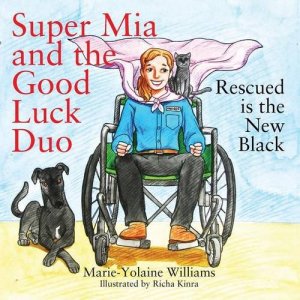
Saturday Book Review: “Super Mia and the Good Luck Duo – Rescued is the New Black”

Book reviews are a great way for self-publishing authors to gain exposure. After all, how can someone buy your book if he or she doesn’t know it exists? Paired with other elements of your book promotion strategy, requesting reviews is a great way to get people talking about what you’ve written.

When we read good reviews, we definitely like to share them. It gives the author a few (permanent) moments of fame and allows us to let the community know about a great book. Here’s this week’s book review, courtesy of Midwest Book Review:

super mia and the good luck duo - rescued is the new black by marie-yolaine williams

Super Mia and the Good Luck Duo – Rescued Is the New Black

by Marie-Yolaine Williams (author)
Richa Kinra (illustrator)

Publisher: Outskirts Press

ISBN: 9781478771579

Synopsis*:

Are black cats really bad luck? Are black dogs scarier than other dogs? When Baggins, a champion racing dog, is injured during a race, his owner callously dumps him in a wooded area. There, Baggins meets Evader, a black cat, and the two become fast friends. When the duo are captured by County Animal Services, Baggins discovers that he and Evader have little chance of being adopted because of their black fur. When the shelter’s manager takes a special interest in them, it looks like their luck may finally change for the better. Will Baggins and Evader find their forever home?

 * courtesy of Amazon.com

Critique:

Another outstanding collaboration by author Marie-Yolaine Williams and illustrator Richa Kinra, “Super Mia and the Good Luck Duo – Rescued Is the New Black” is another in their outstanding ‘Shelter Dog Series’ and very highly recommended for the picture book collections of families, elementary schools, and community libraries. For personal reading lists it should also be noted that “Super Mia and the Good Luck Duo – Rescued Is the New Black” is available in a paperback edition as well (9781478771579, $9.95)

reviewed on the Children’s Bookwatch of Midwest Book Review ]

Here’s what some other reviewers are saying:

Five stars all the way! We love this book! I’d say it’s for a 6-9 year old (if your 6 year old is a strong reader).

It’s so amazing to see that the hero who saves the day in the story is a person in a wheelchair. That is something we have never seen in a children’s book and I have to say it’s a breath of fresh air. What a wonderful message for children about inclusiveness! Heroes come in all different forms and it’s long overdue that we communicate this to children. It’s a great conversation starter about disability and illness too (the hero Mia has MS and explains she has good days and bad days – on bad days she needs her wheelchair). I don’t want to give away the ending but we love how it ends!

We learned about black dog syndrome, superstition (which has a negative impact on black cats and their chances at adoption), and the country of Greece. I also love that the author walked us through what happens when an animal is dumped somewhere from the animal’s point of view. I hope this makes people think twice before they discard a pet like thrash. It’s great that some of the proceeds are going to animal rescue.

The interview at the end (the author interviews her rescue dogs and they answer questions like what is your favorite movie or book etc.) really made us laugh.

I strongly recommend this book. It’s well written and a great story. More books like this please. This is part of a series, we have the first book already (we loved that one too) and can’t wait for the next one!

– Amazon Reviewer Amazon Customer

This is an enchanting story, and Mia is its princess! What an excellent book for all. I dearly love the title: “Super Mia and the Good Luck Duo, Rescued is the New Black”. Baggins was a greyhound who broke his leg racing. After the vet said he could race no longer, the owner dropped him off in some woods and left him (something he does often). A cat offered to help Baggins. When County Animal Services captured Baggins, Evader came out of hiding to be with him. It only gets better and better from here.

Both Baggins and Evader have black fur. Marie-Yolaine Williams did a very good deed for cats and dogs by letting Evader announce,”we have a very slim chance of being adopted.” Ms. Williams correctly informs her readers. When Baggins asked why, he replied “Because we have black fur. People are scared of black dogs and think that black cats are bad luck”. My Grandma had that incorrect superstition.

I worked in a Humane Society who stopped adopting out black cats for several days before Halloween to protect them. I fostered and adopted two beauties, my two black cats that I love more than life itself. I won’t give away the ending of the story. It is excellent!

Thank you Marie-Yolaine Williams and Word Slinger for giving me a book to read in exchange for my honest review.

– Amazon Reviewer C M Anderson


saturday self-published book review

Thanks for reading!  Keep up with the latest in the world of indie and self-published books by watching this space every Saturday!

Self Publishing Advisor

selfpubicon1

Conversations: 3/3/2017

MARCH INTO SPRING

WITH A SPRING IN YOUR WRITING STEP Part I

Are you one of those writers who learns by doing—learns by experience? I am, too. Yet there is so much that I want to learn about and skills I want to develop that I’d need to live ten lifetimes in order to do and/or experience it all. READING has become my university, but not the textbook educational delivery system that we most often think of as the source for higher education. I learn best through story—either personal experiences shared with the passion they were lived, well-researched historical fiction, or inspired writings by people of deep faith who are telling their story through the beauty of  belief.  So it is that this month I’ll mention a few books written by authors who meet my criteria of educational reading—with an added comment (of course) about how these types of books can enhance the education of all writers no matter what genre we write.

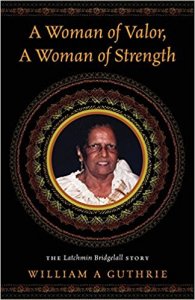
Author William Guthrie calls himself “a student of the human condition.” He’s written several books in various genres. However, the book I’m highlighting today is ahhh Biography/Memoir: A Woman of Valor, A Woman of Strength: The Latchmin Bridgelall Story. This story is heralded as a “touching story” written by the son of an “amazing family matriarch whose sacrifice, courage and wisdom shaped a generation of children.” AND…I will add…will continue shaping generations of children yet to be born.

This is the beauty of Memoir.  Guthrie understands this well and explains it saying: “…if something is not written down or recorded it is lost…. Then the family loses its history and its lore and all that has gone before is virtually lost to future generations. In a fundamental and almost visceral sense, it is what humanizes us on this planet and gives us a sense of identity among billions and billions of other earthlike creatures like ourselves.”

Guthrie also states that “whether we like it or not, we all stand on the shoulders of generations of relatives gone by.” This is also so true of the writers who have gone before us! Therefore, for those of us who have a passion for Memoir/Biography writing it is advised to read the work of the respected biographers such as: Leonie Frieda, author of Catherine de Medici: Renaissance Queen of France; John Taliaferro, author of All the Great Prizes: The Life of John Hay, from Lincoln to Roosevelt; and Humphrey Carpenter, author of J.R.R. Tolkien: A Biography.

Here are a few of my basic “tips” that will help you along the road:

  • Photographs are great memory-refreshers
  • Research into specific daily possessions used during various time periods is essential (cars, radios, telephones, etc.)
  • Letters and journals offer insight, but DO NOT over-step the boundaries of their use.
  • Find the voice of the main person the memoir is about and, if possible, the voices of those closest to them.

The main concept I’ve developed over the years about Memoir writing is this: Start from the heart. Don’t be afraid of the guts. Close with inspiration.

AND…don’t hesitate to self-publish! The “ordinary people” we write about have “extraordinary” information for us to share with the world showing us the way to survive the struggles of life with joy, love and laughter.  ⚓︎


Royalene

ABOUT ROYALENE DOYLE: Royalene has been writing something since before kindergarten days and continues to love the process. Through her small business—DOYLE WRITING SERVICES—she brings more than 40 years of writing experience to authors who need “just a little assistance” with completing their projects. This is a nice fit as she develops these blogs for Outskirts Press (OP) a leading self-publisher, and occasionally accepts a ghostwriting project from one of their clients. Her recent book release (with OP) titled FIREPROOF PROVERBS, A Writer’s Study of Words, is already receiving excellent reviews including several professional writer’s endorsements given on the book’s back cover.  

Royalene’s writing experience grew through a wide variety of positions from Office Manager and Administrative Assistant to Teacher of Literature and Advanced Writing courses and editor/writer for an International Christian ministry. Her willingness to listen to struggling authors, learn their goals and expectations and discern their writing voice has brought many manuscripts into the published books arena.

In Your Corner: Nom de Plume (Part I)

What is a nom de plume, and why should you care?

First of all, we’re talking about pen names.

Ever since J.K. Rowling began writing adult fiction under the pseudonym Robert Galbraith, there has been a resurgence of interest in pen names and what they can do for authors. But the practice predates her and has quite a long legacy; many of your favorite authors are probably using pseudonyms. The author who is Nora Roberts writes romance under that name, futuristic science fiction under another (J.D. Robb), and still more under the names Jill Marsh and Sarah Hardesty. Her real name is Eleanor Marie Robertson. And then there’s Elena Ferrante, who remains as-yet “unknown” in that the author’s real name has not yet been revealed, and James S.A. Corey, which is a collaborative pen name for authors Daniel Abraham and Ty Franck.

But there’s a right and a wrong way to go about using a nom de plume.


Back in the 18th Century, a pen name enabled writers, journalists, and artists to publish controversial and even illegal articles, letters to the editor, and other works of protest without being discovered––but these protections don’t necessarily hold true today, when publishing houses and companies can be subpoenaed for your contact information, among other things. A pen name can help you avoid overexposure, yes––as both Dean Koontz and Stephen King can attest––or to conceal your gender in a still-occasionally-sexist industry––as both Rowling and George Eliot were known to do––but it should never be used as cover for illegal activities, or trusted to protect you from political exposure.

Pen names are tied up with identity politics, and that’s a fact. But new authors should be focusing on the work itself, not on being “exposed” in the public eye, right? Well … probably. Maybe. If you’re writing a tell-all about the mafia, you still might want to consider a nom de plume.


PEN NAME PROS:

  • You can put together a name which no one else “owns.” The world is unlikely to need two David Baldaccis, and you can avoid painful confusion by picking a pen name to differentiate yourself.
  • You legitimately need to conceal your identity. Say you’re a physics teacher in a small town and you want to publish steamy romance books. It’s not illegal, but you want to avoid uncomfortable questions at work. Or perhaps you’re part of the LGBTQIA+ community, and you are afraid of reprisals from friends or family as you write your memoirs. There are reasons for concealment that have nothing to do with “lying.”
  • Your branding is “off” for the genre. You know how it goes … you walk into a bookstore and you can immediately tell what section you’re in by the kinds of names on the shelves. Yeah, that’s a thing. And sometimes, having a catchy name which hints at your genre can be an important selling point. This point leaves room for those of us with difficult to pronounce or remember last names. Findability is key; “weird” names are sometimes perfectly memorable, and there’s zero shame in either sticking to yours or changing it up––but ultimately that’s a decision you might be forced to make.
  • Your last book … didn’t go over so well. It happens. And when it does, sometimes you may need to put out your next book under a new name, to break old associations.


Next week, we’re going to take a look at some “cons” of choosing to use a pen name, like how obnoxious it can be to live and correspond with people under two or more names, and the legal side of things, too. Pen names aren’t the easiest thing in the world to pick up and use … but we’re confident that with the right information, you’ll make the right choice for yourself! So check back next week for Part II in this series on noms de plume!

screen-shot-2017-03-02-at-7-12-09-am

You are not alone. ♣︎


Elizabeth

ABOUT ELIZABETH JAVOR: With over 18 years of experience in sales and management, Elizabeth Javor works as the Manager of Author Services for Outskirts Press. The Author Services Department is composed of knowledgeable publishing consultants, pre-production specialists, customer service reps and book marketing specialists; together, they all focus on educating authors on the self-publishing process to help them publish the book of their dreams. Whether you are a professional looking to take your career to the next level with platform-driven non-fiction or a novelist seeking fame, fortune, and/or personal fulfillment, Elizabeth Javor can put you on the right path.

Decluttering … Digitally!

In the age of computers, our desks are not the only things that can get cluttered, but also our desktops, websites, social media platforms and web browsers. If you’re as OCD as I am, this type of clutter will be as, if not moreso, bothersome as the more tangible clutter we find lying around our homes.

So this week I’d like to take a look at the ways in which we can declutter digitally, something that is especially relevant for 21st century authors who utilize the ever pervasive technology of computers.

decluttering digitally


  • Streamline your author website


First off, if your domain name is anything beyond a combination of your first and last name, or some super vague play off of your favorite sports team, consider changing it, and if [yourauthorname].com isn’t available, try .org, .net or some other version of that.

If you use some free website hosting platform such as WordPress, make sure you choose a theme that is aesthetically appealing, and if you’ve had the same one for a while, consider changing it up.

Make sure that you have clearly branded yourself on your homepage with the type of writing you do and be sure to use relevant tags on all of your posts. If you have an outdated bio and/or photo, consider cleaning those up and making them fresh.

Don’t just have a cluttered list of all of your  books for readers to try and sift through. Create a page for each that they can easily purchase from. Be careful to not have too many pages though, as more isn’t always merrier. Also be sure that they’re labeled clearly–don’t try to get too creative and distract your readers from the content of your page.

  • Streamline your social media presence

Speaking of less sometimes being more, let’s talk social media. Now we all know we hate those folks that clog our newsfeed with 1,000 posts a day–from pictures of babies to overly political rants/links to news articles to inspirational quotes plastered over scenic backdrops of places you’ve never been. Those people tend to get “unfollowed” by me, meaning I could miss a lot of things they are posting that actually interest me.

First off, I highly recommend having a separate author page, so if you do post things like I mentioned above, they are not getting sent to your audience who probably does not care to see them. With your separate author page, be sure to only put out content that helps to promote your brand and the image you want your readers to have of you. If your post doesn’t meet that criteria, scrap it or delete it from the Timeline. You want readers to go to your page and scroll down and get a feel for you as an author right away.

  • Organize your documents!

This one may seem straightforward, but I know how easy it is to just save things with random titles in that all-embracing folder of “Documents.” However, when you go to look for that chapter outline you made four months ago before you even started your book and you named it something obscure that you can no longer remember…you’re going to waste precious time trying to hunt it down.

Folders are your friend. Create a folder for your manuscript and subfolders for planning, characters, chapters, etc. Each time you save something, plop it in the according folder and back it all up on Google Drive, or some other free online storage host, lest you fall prey to the almighty computer crash.

***

Hopefully these few tips will help you declutter your digitized reality, which has become almost more real than reality itself.


Thank you for reading!  If you have any questions, comments, suggestions, or contributions, please use the comment field below or drop us a line at selfpublishingadvice@gmail.com.  And remember to check back each Wednesday for your weekly dose of marketing musings from one indie, hybrid, and self-published author to another. ♠


Kelly

ABOUT KELLY SCHUKNECHT: Kelly Schuknecht is the Executive Vice President of Outskirts Press. In addition to her contributions to the Outskirts Press blog at blog.outskirtspress.com, Kelly and a group of talented marketing experts offer book marketing services, support, and products to not only published Outskirts Press authors, but to all authors and professionals who are interested in marketing their books and/or careers. Learn more about Kelly on her blog, kellyschuknecht.com