Self-Publishing News: 1.29.2017 – January Round-Up

January, illustrated name of calendar month, illustration

And now for the news!

Some highlights from this month in the world of self-publishing, wrapping up what’s new for you and yours in January 2018.

We’ll start off today with the announcement of a new kid on the block; every month it seems as though the self-publishing industry adds another heavyweight to the list of available options, and January was no different as America’s last big brick-and-mortar bookstore chain launched a self-publishing platform. This move, announced in a sweep of press releases, is seen by many in the industry as an attempt for the chain, which has suffered slow attrition in sales and the rapid exit of its e-reader (the Nook) in recent years, to rival the incredible popularity of Amazon’s Createspace and KDP services. What many may forget is that B&N already had a self-publishing platform, only it was tied to the Nook. The “new” Barnes & Noble Press™ is an update of that existing platform, untethered from its Nook associations. For more details, check out the press release.

Speaking of Amazon, more big news this month as Forbes took on the controversy surrounding the distribution giant’s ongoing treatment of self-publishing authors, which hasn’t always been easy to parse. This article by contributor Adam Rowe tackles what exactly happened during a brief interlude when many self-publishing authors found a 50% royalty option displayed on their author dashboard, an option which was both unselectable and surprising (the company typically provides 35% and 70% options, contingent upon book price). Writes Rowe, authors “and other industry  watchdogs are now speculating that an upcoming change may offer the 70% only to KDP-exclusive authors while giving authors who chose to also sell their ebooks in other markets the 50% rate for non-exclusive ebooks.” Not everyone has adopted that angle, but many, it would seem, are braced for bad news. Rowe concludes his article with a brief but interesting paragraph framing the current debate within equally current statistics; you can read the full article on the Forbes website.

Here’s an interesting piece from Jeff vonKaenel of the Sacramento News Review, on the nature of journalistic freedom by way of a review of the new Spielberg film, The Post. Sound a bit out of our wheelhouse? We thought so too, until we stumbled across the later paragraphs, all of which unspool why traditional print journalism has struggled to find a funding model that will continue to work in the age of Google Adwords and … you guessed it! … self-publishing. Yes, this editorial is somewhat of a rallying cry for well-vetted information in news media. Yes, it was written by someone with a fairly large stake in the newspaper’s success. And yes, it gives an unsubtle push for more people to invest in print journalism (specifically the News Review). It’s not, for lack of a better term, a self-disinterested piece. But it is thought provoking. Self-publishing has contributed to change not just within the world of books, but also the world of news. The world of magazines. The world of music. The world of comics. The world of gaming. The old models simply don’t work anymore. So what’s next, vonKaenel encourages us to ask? I think that’s up to us, the ones who have figured out another viable way.


spa-news

As a self-publishing author, you may find it helpful to stay up-to-date on the trends and news related to the self-publishing industry.This will help you make informed decisions before, during and after the self-publishing process, which will lead to a greater self-publishing experience. To help you stay current on self-publishing topics, simply visit our blog every Monday to find out the hottest news. If you have other big news to share, please comment below.

selfpubicon1

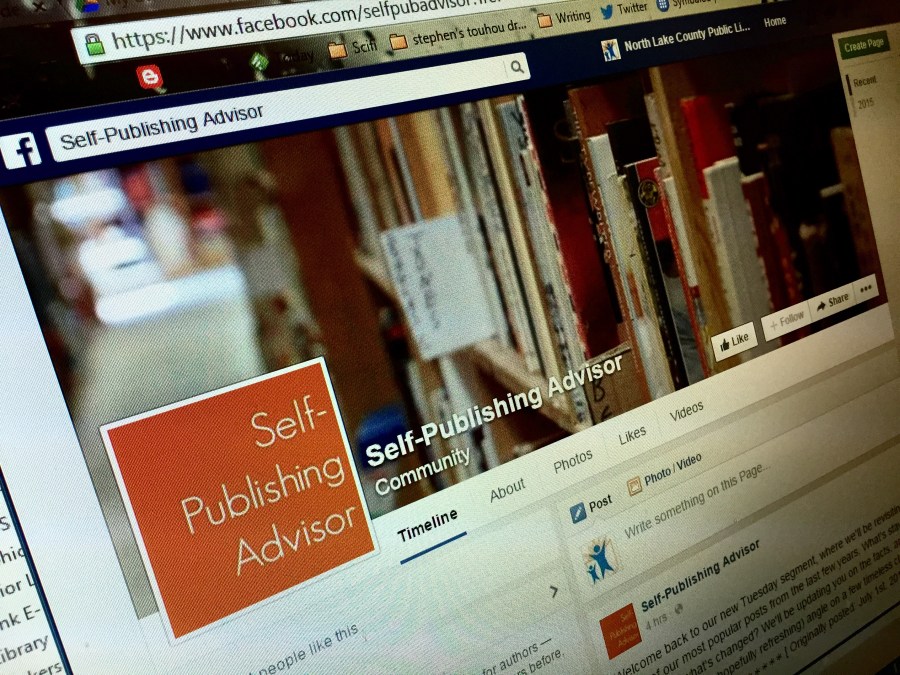
How to Market Your Book on Facebook

Facebook

Immediately after you’ve published your book, it’s time to get into marketing. Here’s what you need to understand in order to jumpstart your book marketing campaign on Facebook.

  1. You need a fan page – NOT a personal page.

Personal pages and fan pages function very differently. A fan page offers a one-way relationship between you and the fan; fans see your updates, but you don’t see theirs. A person only needs to click “like” to immediately become your fan. With a personal page, a potential fan has to send you a friend request, which is an intimidating barrier for people who don’t actually know you. Even more importantly, personal pages have a friend limit and only fan pages give you data on how fans are interacting with your posts.

  1. Any given Facebook post will only reach a small percent of your fans.

Fans are people who clicked “like” on your page, but they will not automatically see your updates.

Facebook has become so popular that it had to develop an algorithm to prioritize the flood of posts available for a person’s news feed each day. Say, for example, that one of your fans is a fan of 100 other pages and has 400 personal friends. All of those pages and friends represent hundreds of possible messages going to that person’s news feed. Only a few of those messages will be shown. Your new fan may actually never hear from you again, depending on whether or not you understand number 3…

  1. Likes, comments and shares mean almost everything on Facebook.

Facebook chooses what to show and in what order based on which friends and/or pages a person engaged with in the past. “Engaged with” means the person clicked, liked, shared or commented on a post.

If a fan doesn’t take one of those actions on your posts regularly, the algorithm will decide they aren’t really a fan, and that person will rarely, if ever, see your content again. You could have 10,000 fans but literally be talking to a near-empty room if Facebook is methodically removing your posts from their feeds due to lack of engagement. That means you should write every post in a way that facilitates likes, comments, or shares.

  1. Small tactics can make a big difference in driving “click engagement.”

Here are some tips for encouraging clicks:

  • Experiment with post timing. The average post is only shown in feeds for about 3 hours. If most of your fans are on Facebook in the evening but you always post in the morning, they’ll never see you.
  • Be concise. Studies have shown that posts between 100 and 250 characters (less than 3 lines of text) receive about 60% more likes, comments, and shares than posts greater than 250 characters.
  • Use different types of posts. Some fans click mostly on links, others engage mostly with questions, and some click mostly on photos. To maximize the number of fans who engage with you, use a variety of post types.
  1. Your cover photo is premium real estate to market your book.

You have 851 x 315 pixels worth of space to market your book. Use this space to show off an image of your book. You can also promote a tour or giveaway here.

  1. Connect Facebook with promotional apps.

Use Facebook to successfully host a book giveaway with apps like WooboxRafflecopter, or Shortstack on your Facebook page. Be sure to advertise it on your cover photo space. Or use a video app to create a book video to post on your Facebook Page (or purchase a book video trailer).  Show your readers the author behind the writing. People connect with those they can relate to and adding a video of your book will increase interest. Plus, Facebook’s autoplay video feature will entice users to pay attention.

  1. Link Facebook with a way to purchase your book.

Be sure to link to your online shop (whether that’s on your publisher’s site, Amazon, Barnes and Noble, or your own website). Dedicate a button on the dash below your cover photo for “Shop.”  This will be more successful if you regularly post positive book reviews on Facebook. Reviews are among the best ways to get more eyes on your book. Not only can you get in front of the reviewer, but the reviewer may also recommend your book to others. Don’t expect people to automatically review your book. Actively ask for reviews on your Facebook page.

  1. Use the “Promote” feature.

Under each of your Facebook posts, there is a button that says “Promote.” For a relatively small amount of money, you can get more of your fans to see specific posts. The cost depends on your particular fan base, but typically runs around $5 per thousand people you want to reach. You can also promote your post so friends of your fans will see it. Paid promotion is a great tool for getting important posts in front of as many people as possible. It’s also a great way to get back into the feeds of people you’ve lost due to lack of engagement in the past; if a person engages with a paid post, they’ll be more likely to see your future unpaid posts. Paid posts give you a chance to win fans back!

  1. Be consistent and generous.

The key to engagement is consistent posts that your fans consider valuable. Try to post daily. From time to time, post an image of your book and an offer they can’t refuse, such as free chapter of your new book. The most important thing is to grab people and bring them onto your page. Make sure you use the word “free” in your posts. You want to offer them something to reward for them visiting your page.


brent sampson
In 2002, Ernst & Young Entrepreneur of the Year Semi-Finalist Brent Sampson founded Outskirts Press, a custom book publishing solution that provides a cost-effective, fast, and powerful way to help authors publish, distribute, and market their books worldwide while leaving 100% of the rights and 100% of the profits with the author. Outskirts Press was incorporated in Colorado in October, 2003.
In his capacity as the Chief Executive Officer and Chief Marketing Officer, Brent is an expert in the field of book publishing and book marketing. He is also the author of several books on both subjects, including the bestseller Sell Your Book on Amazon, which debuted at #29 on Amazon’s bestseller list.

Self-Publishing News: 1.8.2018 – The Interviews!

thinkstockphotos-859091566.jpg

And now for the news!

Some highlights from this month in the world of self-publishing, specifically interviews with or articles written by self-publishing authors and experts!

“Heather Day Gilbert has had a busy few years,” begins this profile by Register-Herald features editor Michelle James. The author in question, Heather Day Gilbert, is what you might call dedicated, with nine books out and self-published in just four years. (Her latest is Guilt by Association.) Her path to publication begins in grade school, with writing competitions, and continued through her years in college at Bob Jones University and married life. But it wasn’t until a friend challenged her to participate in NaNoWriMo–an event and nonprofit we’re huge fans of here on Self Publishing Advisor–that Gilbert began the process of publishing her writing. Her first published novel centered on Viking Eric the Red’s ward, and the first recorded European child to be born in North America; later novels were also Viking-themed, before Gilbert moved on into writing crime fiction. Central to her own experience has been the necessity for self-publishing and self promotion; writes James, “even though not having a publisher was disappointing at first and life as a self-publisher has been busy, Gilbert says it’s turned out for the best. j’I have control over all the books,’ she says. I have three audiobooks. I pick my own narrator. It worked out the way it was supposed to.'” That said, Gilbert acknowledges the challenges set before self-publishing authors. You can read more by clicking the link to read the original article, here.

It’s the age-old question, isn’t it: How does a successful author make the magic happen? In this interview for the Rocky Mountain Outlook, Jordan Small questions Danielle Arsenault about her experiences self-publishing a zine (and later, cookbooks) while living abroad in South Korea. Says Arsenault of her zine, “The purpose of life is a life of purpose. These recipes have the power to heal the body and ignite the spirit. This is worth all the stress and uncertainty that being an entrepreneur comes with.” Inspiring, to say the least. But what about the practical details? Small also interviews Jamey Glasnovic (traditionally published) and Nancy O’Hare (self-published), both of whom discuss their separate paths to publication and their reasoning for making the choices that they did. Says O’Hare: “I self-published my book. Self-publishing gives the author complete flexibility over timing, pricing, marketing and hiring support such as editors, photography and design. I wanted to keep costs down, but deliver a high-quality product that I hoped readers would value.” We couldn’t sympathize more; O’Hare’s reasoning is more or less the guiding ethic of Self Publishing Advisor. We highly recommend you check out the rest of Small’s interviews at the link!


spa-news

As a self-publishing author, you may find it helpful to stay up-to-date on the trends and news related to the self-publishing industry.This will help you make informed decisions before, during and after the self-publishing process, which will lead to a greater self-publishing experience. To help you stay current on self-publishing topics, simply visit our blog every Monday to find out the hottest news. If you have other big news to share, please comment below.

icon logo self publishing advisor

5 Steps to Creating a Culinary Cookbook

What separates good cookbooks from bad ones? Just like everyone’s individual palate, the answer to that is largely a matter of personal taste, but these five hints just may help keep your cookbook from leaving a bad taste in someone’s mouth.

cookbook

  1. Include full-color photographs
    The number one most important thing you can do for your cookbook is include high-quality, full-color photographs of the food. Rare is the self-publishing author who can afford to spring for a professional photoshoot, but with today’s cameras, some 3-point bounce lighting, and a photo editing program like Photoshop, there’s no reason to limit your 5-star tartare to a 3-star photograph.  There are simply too many cookbooks on the market to publish one without images, or in black & white.  The old adage says you can’t judge a book by its cover and while that is proven false time and time again, nobody ever said such a thing about a cookbook – where you definitely CAN judge it by its cover. And its cover better look delicious! And so should the inside!
  2. Include original, unique, and exclusive recipes
    No matter how appetizing the pictures look, there has to be a reason for someone to buy your cookbook.  Sure, the design might be amazing, and the images breathtaking, but content trumps design every time, and that is especially true for cookbooks.  Your target market already knows how to make spaghetti, pot roast, and shrimp cocktail; you have to include recipes they’ve never seen before, or at least feature startling new takes on old standards that will justify their purchase, as well as satisfy their cravings.
  3. Allow content and design to dance
    Speaking of design and content, formatting a cookbook is much like dancing the tango, with the content and the design making magical music together as they flow in unison. Cookbooks require larger print than other books because people don’t “read” cookbooks, they “use” them (typically with wet fingers or flour-caked palms).  So, if you have too many recipes to hit your target page count at 14- or 16-point font, don’t decrease the font size to 12 just to make it fit.  Remove a recipe. Or, better yet, find a way to reword those three-page recipes into two-page spreads.
  4. Include finishing flourishes
    A good meal is like a good story (or a good cookbook); it has a beginning, a middle, and an end.  Anybody can print a recipe for baked Alaska from the Internet but only your cookbook contains the amusing anecdote about how making it for the first time led to a food fight with your grandson, which turned into a fond memory told over Thanksgiving Dinner for years to come.  Don’t be afraid to sprinkle some saffron into your prose to excite the senses and make the recipes in your cookbook truly your own.
  5. Obsess over the details
    The details of your recipes can make or break your cookbook. This includes the ingredients, as well as the instructions, down to the units of measurements and the cooking equipment.  If your audience is comprised mostly of US residents, don’t refer to grams or liters when your cook wants to see teaspoons, tablespoons, or cups, instead.  If your recipe calls for a very specific ingredient that is not available at the local grocery store, advise your cooks where to get their hands on it – a farmer’s market, online, a quick trip to China, etc.  By the same token, be informative and detailed about the pots, pans, molds, presses, graters, utensils, etc. you’ve used to create your inspiring dishes.  The purists will appreciate the opportunity to match your expertise and it gives the lay-cook something other than their prowess to “blame” when their soufflé flops.

To make a soufflé you’ve got to break a few eggs, but nobody warned you publishing a cookbook would be such a headache. It doesn’t have to be! Check out this One-Click Cookbook package over at Outskirts Press.


brent sampson
In 2002, Ernst & Young Entrepreneur of the Year Semi-Finalist Brent Sampson founded Outskirts Press, a custom book publishing solution that provides a cost-effective, fast, and powerful way to help authors publish, distribute, and market their books worldwide while leaving 100% of the rights and 100% of the profits with the author. Outskirts Press was incorporated in Colorado in October, 2003.
In his capacity as the Chief Executive Officer and Chief Marketing Officer, Brent is an expert in the field of book publishing and book marketing. He is also the author of several books on both subjects, including the bestseller Sell Your Book on Amazon, which debuted at #29 on Amazon’s bestseller list.

Self-Publishing News: 12.25.2017 – Merry Christmas!!

And now for the news!

Yes, yes, it’s Christmas! And we know you have some yuletide carols to sing, some gifts to open, and some people to see. We’ll keep it short, but we wanted to wish you a Merry Christmas first! Here are some highlights from this month in the world of self-publishing, specifically regarding publishing trends within the publishing industry, and their implications for all authors!

First off, the really really good news: Outskirts Press (with whom many of our writers over the years have worked) are offering a really spectacular deal this holiday season, with $800 off the package price of any of their One-Click Publishing suites. These suites already offer really spectacular discounts by combining services in order to drop prices, so this discount means that for a couple of days over this Christmas season, you’ll be getting everything at rock-bottom price. And if you’re not ready to commit to one of their One-Click Publishing suites, they’re also offering $300 off the package price for their Ultimate and Full-Color publishing services, which are excellent as well. Check out the press release (at the link) or visit their website at www.OutskirtsPress.com for a Christmas present all your very own!

Have you been thinking about self-publishing this holiday season, maybe taking advantage of that sweet deal (above)? Shirley McMarlin of the Tribune-Review has some words of wisdom for you as you move forward. Some of them are warnings, some are encouragements, but they are all of them very wise indeed. Take a peek as she explores some of the ups and downs of both traditional and self-publishing platforms, and digs into those specifics which sell books (it’s not always what you might expect!). Nobody ever said it would be easy … but with experts like McMarlin around, it’s certainly easier to make the right decision to fit your needs.

Oh, who are we kidding? We love a good and positive story during the holiday season, and Jeff Polman’s piece for HuffPost earlier in December truly fits the bill. Herein Polman shares how, as a previously self-published author, he made his first foray into traditional publishing … and then turned right around and returned to self-publishing. Why? He’d written a book he loved, in a voice he felt at home in, and afterward discovered that agents and publishers were looking for some specifics which would require him to rewrite the entire thing to suit. Rather than do that–and sacrifice his original vision for this newest book–Polman went his own way, again, proving the (maybe not-so-) old adage that self-publishing is a refuge for those creators who want to maintain creative control over their work. Read the full article for more!

Yes! Self-publishing is about more than books! We’ve written before on how the self-publishing industry has its roots in everything from printed literature like books and comics and magazines to digital materials like ezines and so forth … but this might just be one of the first times we’ve seen games brought into the conversation. And we love it! the Xbox (and its archcompany, Microsoft) might just be opening its doors to independent games publishers and creators, who formerly were barred from seeing their games used on the platform. This would be, if it truly comes to pass, a massive move in reshaping the gaming industry, with repercussions which will be felt for years to come. Indie game designers have been making inroads into the industry for a while, but the Xbox remains one of the primary hardware components to gaming, and this decision places a thumb very heavily on the scales in favor of the diversification and democratization of game-space. Read the full article, courtesy of Matt Liebl and GameZone, here.


spa-news

As a self-publishing author, you may find it helpful to stay up-to-date on the trends and news related to the self-publishing industry.This will help you make informed decisions before, during and after the self-publishing process, which will lead to a greater self-publishing experience. To help you stay current on self-publishing topics, simply visit our blog every Monday to find out the hottest news. If you have other big news to share, please comment below.

selfpubicon1