From the Archives: “How to Promote Your Self Published Book Using Video”

Welcome back to our Tuesday segment, where we’ll be revisiting some of our most popular posts from the last few years.  What’s stayed the same?  And what’s changed?  We’ll be updating you on the facts, and taking a new (and hopefully refreshing) angle on a few timeless classics of Self Publishing Advisor.

∗∗∗∗∗

[ Originally posted: February 27th, 2013 ]

Video is one of the hottest tools in advertising and marketing right now. Thanks to YouTube and smart devices, people are watching tons of videos, and this tool offers great marketing opportunities for self publishing authors. Here are three ways you can use the power of video to market your book.

Create a book trailer

Book trailers are a hot marketing tool right now. They are like commercials for your book. They are a great item to include on your website and social media pages, and they often increase exposure because readers can easily share videos they enjoy with their friends, family and social media followers.

Record yourself

Video isn’t just used to sell your book; it can also be used to sell yourself as the author. This is especially useful if you write about a topic you are an expert in. For instance, if you wrote a book about weight loss, you could create videos sharing weight loss tips with your readers.

Make it funny

Many of the online videos that go viral include humor. While this technique isn’t appropriate for all books and authors, most people can improve their video ratings by including some humor in their videos. Don’t be afraid to look silly.

I’d love to know, how do you use video to promote your self published book?

by Kelly Schuknecht

We’ve come a long way in three years!  Even in 2013, however, there was abundant evidence that video was rapidly becoming ubiquitous––becoming more than just another tool in the self-publishing author’s toolbox––and that authors like myself needed to catch up.  We now have an entire generation of megastars whose sole platform and original source of popularity was YouTube: Adam MontoyaAmber Lee EttingerBethany MotaCaspar Lee, and hundreds of others have now become household names in large part due to their savvy use of this one video platform.  If you needed proof that video really did kill the radio star, you have it.

Video is so ubiquitous, in fact, that you can now find embedded YouTube, Vimeo, and Instagram clips on every other social media site.  It’s easy to forget that YouTube is its own fully viable social media platform (for more on that, see my entry for YouTube in last year’s social media primer) because it is so fully conversant with Facebook, Twitter, Tumblr, and so on.  Videos can even be embedded into your Amazon author page, your email signature, and your personal website.  Basically, they can go everywhere and be everything to everyone.
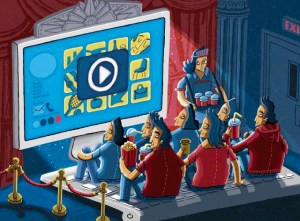
youtube video illustration

In a sense, my original points remain relevant untouched.  They are not, however, entirely complete.  The world of video marketing for self-publishing authors has evolved well beyond where it was three years ago, and while to a certain extent it will always continue to be a moving target, I think it well worth a little time and care to catch up, and cultivate a video presence online.  In fact, I think I’ll make that one of my goals for 2016: in some way, shape, or form, I will boost my engagement with online video marketing.  And of course, I’ll update you on my progress here at Self Publishing Advisor!

In closing, I think the most important tip that I left out of my original list is this:

Marketing your book is all about human connection, and video marketing is no different.  Many of video’s greatest assets––its immediacy, its ability to convey a lot of information very succinctly and sometimes entirely through context––tap into the our deepest emotional centers.  Video has the power to move people.  It has the power to capture your readers’ attention but it must do so quickly, in the first few seconds, or else they will move on to other content.  Human communication is almost entirely non-verbal, and within seconds of clicking your YouTube or Vimeo link, people will decide whether they like and trust you.

That’s a lot of pressure, if you approach video marketing this way.  And while I certainly advocate for keeping these facts in mind, I don’t think fear should serve as your primary motivation.  Instead, think about video as a backstage pass into what you do as a writer, an all-access ticket to the theme park of your book’s greater universe.  No single video will make or break your online presence, so make as many as possible, catapulting off of the energy and enthusiasm you feel for our work, and share them across as many social media platforms as you feel comfortable using.  If posting a video clip feels as quick and simple as posting a Facebook update, you’re doing it right!

If you have any other ideas, I’d love to hear them.  Drop me a line in the comments section below and I’ll respond as quickly as I can.  ♠

KellyABOUT KELLY SCHUKNECHT: Kelly Schuknecht is the Executive Vice President of Outskirts Press. In addition to her contributions to the Outskirts Press blog at blog.outskirtspress.com, Kelly and a group of talented marketing experts offer book marketing services, support, and products to not only published Outskirts Press authors, but to all authors and professionals who are interested in marketing their books and/or careers. Learn more about Kelly on her blog, kellyschuknecht.com.

Self-Publishing News: 3.7.2016

This week in the world of self-publishing:

“Not happy with your Amazon royalties?  Not thrilled with Amazon’s latest strategy to pay self-published borrowed books is a pool based on pages read?” asks Liesha Petrovich for HuffPost Business on March 3rd.  Answers Petrovich: “You’re not alone.”  And indeed, as she points out in her article, a number of high-profile as well as mainstream self-publishing authors are growing dissatisfied with Amazon’s offerings, services, and standard of treatment for its customers––readers and writers alike.  And just because Amazon may appear to have a stranglehold on the indie publishing marketplace doesn’t mean that it’s the only option available; as Petrovich writes, “If you’re a current or future writer, with dreams of making a living writing, Amazon isn’t the only path to self-published success.”  Her suggestions are threefold, and they don’t rely on switching companies––such as leapfrogging from Amazon to Kobo, or some other platform––but rather upon changing the sales paradigm altogether.  Her recommendations are to:

  1. Sell from your own site
  2. Sell on other platforms (such as the Apple store, or through B&N), and
  3. Create your own path to publishing success.

“You’re not limited,” says Petrovich, “and you may have to try a few [options] before you find the results you’re looking for. Just remember you choose to go independent for a reason, and not to increase Amazon’s profits.”  Amen to that.  For the rest of Petrovich’s article, follow the link!

Says Meg Kehoe of the Romper in another article from March 3rd, “The amazing range that self-published books provide can be hard to navigate, but thanks to sites like Indie Reader and Goodreads, the world of books becomes slightly less daunting.”  Kehoe herself is a handy resource for readers looking to break into the world of ebooks but find themselves without a map or compass.  Her list of books you can’t afford to miss includes Jabberwocky by Theodore Singer (CreateSpace)––with obvious ties to Lewis Carroll’s Alice in Wonderland series, just in time for a new movie coming out this summer––and Jack Hammond Junior’s The Last Hanging in Scots Bend (Lujack Press), Nina Ansary’s Jewels for Allah (Revela Press), and Russell Newell’s The Boy and the Bastard (Dog Ear).  I don’t know about you, but after perusing Kehoe’s list and reading her summaries of each, I definitely feel like cracking open a few new ebook covers (figuratively, at least) this next week!  You can view the entire list here.

Sometimes, it’s nice to hear from the very demographic we write so much about here on Self Publishing Advisor, and in his March 2nd column for The Beacon, the official (online and print) student newspaper of the Massachusetts College of Liberal Arts, Mitch Chapman speaks up for teen authors everywhere––and what he has to say may come as a surprise, in that he asks for us to stop defining teen authors as “teen authors” and instead define them simply by what they do (write) and how well they do it.  Says Chapman, “even before the rise of self-publishing platforms such as CreateSpace and Lulu, there has been an unusual fixation towards teenage authors that sometimes bleeds into college life.”  He goes on to argue that, although the phenomenon of the teen author pop icon has its roots in a fascination with the gifted youngsters among us, it has created a culture which commoditizes and monetizes an author’s age … and by turning age into currency, we of course perpetuate an opportunity for unhealthy exploitation.  The label “teen author” also has the undesirable side effect of following young writers into adulthood, and diminishing the true value of what they do.  Chapman concludes that, “At the end of the day, what matters is not your age, but the quality of your work and your personal integrity.”  Wise words for us all.  You can find the rest of his article at the MCLA Beacon website.


spa-news

As a self-publishing author, you may find it helpful to stay up-to-date on the trends and news related to the self-publishing industry.This will help you make informed decisions before, during and after the self-publishing process, which will lead to a greater self-publishing experience. To help you stay current on self-publishing topics, simply visit our blog every Monday to find out the hottest news. If you have other big news to share, please comment below.

KellyABOUT KELLY SCHUKNECHT: Kelly Schuknecht is the Executive Vice President of Outskirts Press. In addition to her contributions to the Outskirts Press blog at blog.outskirtspress.com, Kelly and a group of talented marketing experts offer book marketing services, support, and products to not only published Outskirts Press authors, but to all authors and professionals who are interested in marketing their books and/or careers. Learn more about Kelly on her blog, kellyschuknecht.com.

Defining The Hybrid Publishing Experience

If you’ve spent much time on this blog or researching your publishing options, you probably have a fairly substantial definition in mind for the terms “self-publishing” and “traditional publishing,” but can you say the same for “hybrid publishing“?  We use the term rather often here on Self Publishing Advisor as a catch-all for every company and business model that doesn’t fit neatly into the aforementioned binary––but what does it mean, really?  It’s not enough to define a thing by what it is not … we need some basis for a positive, holistic understanding of what hybrid publishing has to offer the indie author.

What qualifies as “hybrid”?

Biologically speaking, a hybrid is “the offspring of two plants or animals of different species or varieties, such as a mule (a hybrid of a donkey and a horse).” Most of us are familiar with a different kind of hybrid, which is to say the mythological kind, where different species find themselves mashed up into one single creature on a physical but not cellular level.  A centaur is a mythological hybrid between man and horse, the Sphinx between a woman, lion, and raptor.  Is a hybrid publishing company, then, the offspring of two warring traditions (self- and traditional publishing)––or is it some oddball thing that adopts the best or most distinctive features of other publishing traditions to serve an entirely different narrative?

Says Jane Friedman of Publisher’s Weekly, it has become “nearly impossible to categorize certain publishers and services; some wish to avoid being labeled altogether. They consider themselves innovators, providing an important alternative for authors.”  These companies self-advertise as providing a third way altogether, not just cutting the difference between the two established publishing modes.  This reality would seem to indicate that hybrid publishing shares more with a centaur than it does with a mule, but perhaps we’re splitting hairs.

Perhaps, when it all shakes out, we can safely define hybrid publishing on its own terms.  Brook Warner of Huff Post Books suggests  four categories that fit the catchall term:

Traditional publishers who’ve been brokering hybrid deals for years. […]

Partnership publishing models. […]

Agent-assisted publishing models. [… and]

Other assisted publishing models.

All four of these categories acknowledge “assistance” as a defining feature, but here’s the problem: assuming that self-publishing and traditional publishing don’t  offer assistance as a part of their mechanism creates a false dichotomy that does nobody justice, and many companies that Warner might call “hybrid” do in fact distance themselves intentionally from the term because it implies too heavy a reliance on paid assistance––or authors “taking the easy way out,” so to speak.  This just in: elitism may be the bread and butter of gatekeeping traditional publishing, but it doesn’t have to be the same for self-publishing!

This still leaves us with a problem, however: How to define hybrid publishing?  Let me suggest a new definition:

Hybrid publishing is any publishing model that allows authors to enter into direct, flexible, contractual collaborations with industry professionals that in traditional publishing would be indirect (they would be paid by the publishing house, not the author) and are not traditionally available to self-publishing authors.  This includes companies like Outskirts Press, which offers a range of collaborative services, and excludes the so-called “hybrid author,” or someone who has moved from traditional publishing into self-publishing or vice versa.

Playing the field:

As Friedman goes on to point out, each of the companies that might fit into the hybrid category operates on a different business model, making it difficult to compare them against each other.  She advocates asking a series of questions, such as “How will your books be distributed?” and “What marketing and promotion support do their titles receive?” before committing to a certain choice.  But this doesn’t exactly help new authors decide whether hybrid publishing and a “third way” is for them––and with so many options now available, narrowing the field is an important part of the decision-making process. Ultimately, the choice of whom to choose may rest on individual features such as those Friedman suggests evaluating … or it may rest instead on the complicated matrix of human need.  Hybrid publishing companies, despite their extreme differences, do seem to collectively meet authors’ desires for a human-driven, relational publishing experience.

In conclusion … for now:

The world of hybrid publishing is perhaps a bit too complicated to break down in its entirety within the constraints of an initial foray such as this one, but it is a world we will be returning to again and again here on Self-Publishing Advisor.  As the world of publishing evolves and diversifies, so too must the companies who serve to send our stories out into that world.


Thank you for reading!  If you have any questions, comments, suggestions, or contributions, please use the comment field below or drop us a line at selfpublishingadvice@gmail.com.  And remember to check back each Wednesday for your weekly dose of marketing musings from one indie, hybrid, and self-published author to another. ♠

KellyABOUT KELLY SCHUKNECHT: Kelly Schuknecht is the Executive Vice President of Outskirts Press. In addition to her contributions to the Outskirts Press blog at blog.outskirtspress.com, Kelly and a group of talented marketing experts offer book marketing services, support, and products to not only published Outskirts Press authors, but to all authors and professionals who are interested in marketing their books and/or careers. Learn more about Kelly on her blog, kellyschuknecht.com.

From the Archives: “Avoid these 5 mistakes when choosing your publisher”

Welcome back to our Tuesday segment, where we’ll be revisiting some of our most popular posts from the last few years.  What’s stayed the same?  And what’s changed?  We’ll be updating you on the facts, and taking a new (and hopefully refreshing) angle on a few timeless classics of Self Publishing Advisor.

∗∗∗∗∗

[ Originally posted: April 23rd, 2010 ]

1) DO NOT CHOOSE SPEED OVER QUALITY
Avoid publishers that claim to publish in 24 hours. After the time it took to write your book, do you want it published right, or overnight? Avoid overnight publishers no matter what they charge because the only one looking at your book will be a computer. It should take between 6-15 weeks.

2) DO NOT BE FOOLED BY HIGH ROYALTY CLAIMS
A royalty is simply a percentage of another number. The actual dollars and cents you earn depends upon that second number. The truest royalty is a royalty based upon the retail price of your book. Many publishers use “net royalty” which is a royalty based upon their profit. To be sure, always confirm your profit in dollars and cents.

3) DO NOT SIGN YOUR RIGHTS AWAY
The main advantage to self-publishing alternatively with a on-demand publisher is that you keep all the rights to your work. The rights are valuable. Read the contract. Your rights should clearly stay with you.

4) DO NOT BE CONFUSED BY BULK DISCOUNTS
If a publisher normally offers discounts to an author who buys their own book in bulk, that tells you two things. 1) It tells you they are more concerned with selling to you than to other readers. 2) It tells you they are charging you too much for lower quantities. Do you really want to be forced to buy 100 books at a time just to get a fair price? “Bulk” discounts simply trick the author into buying more books than they need, which defeats the whole advantage of on-demand printing.

5) DO NOT BE TRICKED BY AUTHOR DISCOUNTS
As an author, your per-book price should be based upon the production cost of the book, not the retail price. No wonder publishers inflate their retail pricing. You should always receive a below-wholesale price, regardless of how many you buy. You will never make money if you have to buy your own book at wholesale from the publisher.

When push comes to shove, all five of these points boil down to the same core idea:

You ought always to look for a self-publishing company that puts you––the author––first.  A company that shares your ethics and vision for rendering stories accessible to readers.  A company that knows how to treat people right and does so consistently, day in and day out.

A company that works solely to satisfy its bottom line and invested parties is a company that has forgotten the human element … and the whole point of self-publishing, to be perfectly frank.  Responsibility to shareholders and investors is one thing, but the deliberate choice to inflate profits at the expense of quality products, customer satisfaction, and author empowerment is unconscionable and inexcusable.  I sometimes wonder how much of the corporate soullessness we see in certain corners of the world today has its roots in people not loving the work they do––not finding value and meaning in enriching the lives of others in addition to their own, and not seeing the significance of their daily tasks or the opportunities to craft a career that is as much art as it is science.  But here I’m rambling!

Looking back nearly six years to this original post, I now see the five mistakes noted above to be more a list of symptoms than a list of “to-not-dos” … because each and every single one points to a company that prioritizes itself over its product and clients:

  • If a company maximizes profits by creating artificially high prices that only seem reasonable when reduced to a bulk or “author-only” rate, it is clearly a company that cares very little about balancing the need for profit and survival in a competitive market with the reality that self-publishing is a market and industry that demands transparency, accessibility, and progressive thinking.  It is a company that looks to trap its customers into a long-term, toxic, parasitic relationship.
  • If a company prioritizes speed over a quality product or quality customer service, then it’s a company that sells itself using gimmicks … and gimmicks, as we are all well aware, are the desperate empty gestures of a company lacking imagination.  Innovation and creativity do not produce inferior versions of a thing; they find new and fresh ways to look at problems and to improve upon that thing.

constraints in self publishing

In short, no, nothing really has changed in the six years since this post first hit the Self Publishing Advisor front page.  There were ungenerous self-publishing companies in existence then, and there are ungenerous self-publishing companies in existence now.  We haven’t changed that fact in half a decade, and we’re not particularly likely to change it in the next.  What we can change, however, is our own degree of discernment.  We can spot the warning signs––the symptoms above––and steer well away from companies that manifest them.  We can choose not to sell ourselves short, and to choose instead a publishing option that respects us as authors and empowers us to better ends than a bottom line.

If you have any other ideas, I’d love to hear them.  Drop me a line in the comments section below and I’ll respond as quickly as I can.  ♠

KellyABOUT KELLY SCHUKNECHT: Kelly Schuknecht is the Executive Vice President of Outskirts Press. In addition to her contributions to the Outskirts Press blog at blog.outskirtspress.com, Kelly and a group of talented marketing experts offer book marketing services, support, and products to not only published Outskirts Press authors, but to all authors and professionals who are interested in marketing their books and/or careers. Learn more about Kelly on her blog, kellyschuknecht.com.

Self-Publishing News: 2.28.2016

This week in the world of self-publishing:

In this February 28th article for Khaosod English (“a Bangkok-based news website providing coverage of Thai politics, economics, and culture to an English-language audience”), Chayanit Itthipongmaetee recounts the history of zines, particularly in eastern Asia, and the positive impact that they have had on Thailand’s literary scene.  Says Itthipongmaetee, the zine has its origins in a thoroughly Western context: they “started in Western countries […] with topics considered outsider, aggressive or antisocial such as hardcore punk or metal,” and “exploded in popularity when reproduction technology such as photocopying machines made it cheap and easy for anyone to create their own.”

The story of the zine is, in this context, the story of every narrative that breaks the mold and leaks out around the edges of “standard practice” and “standard interest” in traditional publishing.  But zines didn’t stay a Western concept.  As Itthipongmaetee recounts, “Whereas zines in the West vanished as soon as anyone could roll a Geocities site, they endured until internet access became widespread in Thailand in 2004 or so. Most Thais turned to blogs, boards or services such as Exteen, Pantip and Thaimail.”  This has made zines a more enduring expression of creative freedom in Thailand than they have been in the United States––and, since most zines are self-published, they have become a focal point around which the east Asian indie movement rotates.

For the rest of Itthipongmaetee’s excellent article, including her conclusions on where zines in Asia are headed in the near future, check out the original article here.

“Publishing is not really a business at all, it is a verb, the act of putting something into the wild, usually with a consequence,” writes Philip Jones in this February 26th article for The Bookseller: “They are creationists—in a good way. They need to believe. Yet there is a flip side. Publishers occupy positions of power: what they project into the world has an influence precisely because it has been ‘published.'”  This means that self-publishing, rather than just an exercise in ego and self-benefit, is truly a radical act that challenges the established information hierarchy of many nations and cultures.  It has the potential to effect real change in redressing many great wrongs that have been handed out to aspiring authors by the traditional publishing industry.

As Jones goes on to point out, “publishing may now be starting to listen (and act).”  He’s speaking, of course, about Penguin Random House’s decision earlier this year to sell its self-publishing business (Author Solutions): “acknowledging, one might hope, that investing in authors with one hand, while taking their money with the other, always looked at best uncomfortable and, at worst, an existential disaster.”  In a brilliant move that I highly recommend following up on, Jones then points his readers to  Penguin Random House’s (UK division) decision to roll out a comprehensive “Creative Responsibility strategy,” with CEO Tom Weldon remarking that a “publisher of our size really could be a force for good in society above and beyond the books we publish.”  The fact that Weldon and Penguin Random House recognize the fact that a healthy self-publishing sector boosts their traditional publishing sector––with everyone benefiting from increased value and increased sales––is a hopeful sign, indeed.  For the rest of Jones’ article, click here, and for a look at Penguin Random House’s creative responsibility strategy, click here instead.

In a February 25th press release for PRNewswire that was reposted to Crowdsourcing.org, the makers and runners of BookFuel––”a company that provides professional self-publishing services to aspiring authors”––announced the launch of FundMyBook.com, a website dedicated to helping authors “publish with the help of sponsorships and other support by friends and family. FundMyBook.comprovides a viable option to any writer who may have been intimidated by the effort required by other crowdsourcing sites or the expense of self-publishing.”  And we’re all very well aware of just how expensive it is to be an author, both in respect to the actual production of a book, and in the marketing campaign that follows.  FundMyBook.com is designed to serve as a book-specific analogue to Kickstarter and GoFundMe, two popular project-funding platforms that allow people to raise money from like-minded individuals.  There are several key differencees between FundMyBook.com and these other crowdfunding services, however.  As the press release points out, it is “difficult for writing projects to stand out” among all of the competition for the average person’s attention.  “These other crowdfundingsources also don’t provide the social media exposure or the help planning for the costs of the reward fulfillment that FundMyBook.com does for aspiring authors,” the press release states.

It looks like FundMyBook.com might be of legitimate use as authors look for new ways to reach untapped markets.  For the entire press release, follow the rabbit hole all the way down the link!

And last but not least in our lineup for this morning, I give you Jonathan Kile of the Tampa Bay’s Creative Loafing fame on the fundamentals of self-publishing.  In his February 24th article for CL, Kile begins with a subtle flourish of dark humor: “So, let’s get this out of the way. Amazon apparently works their people really hard, practices predatory pricing to establish dominance in whatever it is they choose to sell, and also has a special machine that crushes kittens.” But Amazon, Kile argues, is so omnipresent that resistance, in the classical sense and especially as pertaining to authors aspiring to break out into the self-publishing method and market, truly is futile.  The “why?” as Kile explains, is nowhere near as important as the “what next?”  And as Kile so simply puts it, this step consists of getting “into bed” with the Big Bad corporate world via Amazon.  It may not be the ideal situation, he writes, but it’s the one that we must face in any case.  “It takes a lot of work to write and publish,” says Kile, “and just as much work to get noticed.”  And while he states that this is simply the first salvo in an ongoing series about digital content and Amazon, Kile’s article captures a fascinating cross-section of opinion as regards the current state of indie publishing and how it intersects with the wonderful world of Amazon.  For the whole thing, follow the link.


spa-news

As a self-publishing author, you may find it helpful to stay up-to-date on the trends and news related to the self-publishing industry.This will help you make informed decisions before, during and after the self-publishing process, which will lead to a greater self-publishing experience. To help you stay current on self-publishing topics, simply visit our blog every Monday to find out the hottest news. If you have other big news to share, please comment below.

KellyABOUT KELLY SCHUKNECHT: Kelly Schuknecht is the Executive Vice President of Outskirts Press. In addition to her contributions to the Outskirts Press blog at blog.outskirtspress.com, Kelly and a group of talented marketing experts offer book marketing services, support, and products to not only published Outskirts Press authors, but to all authors and professionals who are interested in marketing their books and/or careers. Learn more about Kelly on her blog, kellyschuknecht.com.