In Your Corner: Next Steps

The end is in sight!  In fact, this week we’ll be wrapping up our epic eight-episode-long exploration of the difficult choices self-publishing authors must necessarily navigate to emerge on the other side.  It’s been a long and wild ride, with everything from …

… on the table.  And if that sounds rather … long and confusing … that’s because self-publishing can, in fact, be long and confusing.  We simply hope that, with this blog series in hand, it will be slightly less so.  More manageable.  More accessible.  More democratic.  More your own safe space.

But what happens once the book is out there?

What Next?

Dealing with the impossibility of moving on.

(Sort of.)

next steps

There aren’t a lot of sign posts on the way in or out of self-publishing.  There are the usual hints and indicators that authors share in common with all entrepreneurs–

  1. measure your success somehow,
  2. recalibrate and relaunch if necessary, and
  3. start thinking about the next project

–but how can these be adapted to suit the highly specific needs of authors, precisely?  We’ll take a look at each point in turn.

Measuring Success

First of all, did you just publish a book?  Yes, you did!  Take a moment, a long moment, to gather that in and feel the full reality of that truth. You’ve earned a little touch of self-satisfaction.  The fact that you’ve gotten your book from idea to the printed page is one very important indicator of success!  Just don’t linger there too long.  (And if you’re asking yourself whether it’s “too long” already, that might be a good indicator in and of itself.)

Book sales are another indicator of success–but don’t rely on them too heavily.  Engagement–online in social media or elsewhere in person at book readings and so forth–is equally if not more vital.  The just before and just after you publish is vital for marketing purposes, and having a sound marketing strategy in place will do more for you than any sales analytics after the fact–and that’s the absolute truth.  If you have a plan in place, complete with projected sales and engagement goals, you’ll quickly understand if you are or are not meeting those goals–and be able to implement Plan B or Plan C and take action to boost them.  If you have no marketing plan in place, your goals will be tethered only to your general “gut feeling,” and any lag in sales or engagement might slip by under the radar until it’s too far along to fix.

Recalibration & Relaunch

Consider the wise words of others that have come before:

Mixing it up–being responsive to what’s working and not working–being willing to approach things differently than you have done without letting it touch your ego–is critical for entrepreneurs and self-publishers alike.  And it’s so hard, in part because authors love their books like parents love their children, and it can feel like a cruelty or a betrayal or a compromise to alter one’s approach.  But it isn’t.  It’s simply business.  And if you look at the business of selling your book as a separate animal from the identity of your book, changes might come easier.

So what does recalibration look like for self-publishing authors?  It might look at trying out a new marketing technique you haven’t tried yet, or publishing a new edition of your book–Hardback, softcover, or ebook–to reach new audiences.  It might mean consulting with an expert to figure out the holes in your existing marketing strategy.  It might even mean getting a jump start on writing your next book, since there’s no better way to promote your current one than to have another in the works.

The Next Project

Seriously, though.  If you’re feeling at a loss as to what to do next with your current book, it’s time.  It’s time to find your next project altogether.  Maybe you’ve done all you can with your current book in terms of marketing, or maybe you need the step back from it in order to see it more clearly–and what better way than painting a new book on the canvas of your mind?

And last but not least, make sure you congratulate yourself.  You’ve written a book!  That’s amazing!  Maybe circling back to that first wash of feeling after finishing your book isn’t such a bad thing, after all.  Let it be your motivation.  Let it remind you of why you do what you do–and take you to that next place you need to go as an author.

You are not alone. ♣︎


Elizabeth

ABOUT ELIZABETH JAVOR: With over 18 years of experience in sales and management, Elizabeth Javor works as the Manager of Author Services for Outskirts Press. The Author Services Department is composed of knowledgeable publishing consultants, pre-production specialists, customer service reps and book marketing specialists; together, they all focus on educating authors on the self-publishing process to help them publish the book of their dreams. Whether you are a professional looking to take your career to the next level with platform-driven non-fiction or a novelist seeking fame, fortune, and/or personal fulfillment, Elizabeth Javor can put you on the right path.

In Your Corner: The Proof is in the Pudding

Get it?  We’re going talk about book proofs this week as a part of our ongoing series about choices–the choices you make as a self-publishing author in the midst (and mist!) of an often long and complicated process.  Previous entries in this series have included “Choosing a Self-Publishing Company,” “Choosing a Trim Size for Your Book,” figuring out how to “Know Thyself (& Thy Genre),” “Settling on a Price,” “Choosing a Cover,” and last week’s exploration of what we called “The Guts of the Thing” and which essentially boiled down to interior design–illustrations and formatting.  The assumption with last week’s post was that if you struggle to summon up the skills, time, or energy to worry about the graphic design components of your book, you can theoretically find assistance from exterior (and even paid professional) sources.

But what about proofing your book?

Proofing Your Book

That thing we all hate and try not to think about.

book proofing

Here’s the deal with proofing:

It’s not really something you want to outsource, even to a professional.  Copyediting, yes, but proofing … less so.  This is because the proof is the final step before actual publication, and it’s important that you be the last person to lay eyes on it before it goes to the presses.  It was your vision, after all, that led to its creation–and you want to make sure that it is your vision, in the end, which guides it to completion.

This is the moment of truth.  So how do events unfold?

The printed proof arrives on your doorstep, or in your mailbox, or perhaps you’re overexcited and actually show up at the printer’s to get it.  The point is, it’s in your hot little hands and ready to go.  Almost.

Up to this moment, the book you’ve been dreaming about and actively shaping has only ever been real to you in the way that pixels and Microsoft Word documents are real.  Maybe you’ve printed off a copy, to get a better look at layouts and formatting and illustrations and typography–but that’s not really the same thing as a finished book, is it?

And trust me, after that initial shiver of anticipation passes, it’s time to pull out the red pen, because there’s always something that’s slipped through the cracks and that needs addressing before you click the final keys or give your Publishing Consultant the final go-ahead.  Your proof is, as its name implies, the evidence that you’ve done everything correctly.  Or it ought to be.  As I said, your first proof is usually an exercise in addressing little errors that were invisible on your computer screen or in printouts but that, in printed form, pop off of the page.  It could be an incorrect font, a weird space, typographical errors, a misaligned paragraph–anything.  As perfect as your last manuscript was in digital form, sometimes it doesn’t translate perfectly to the printed page.


What should I watch out for?

First of all, take a deep breath.  Now, let it out.  Proofing can be painful in some ways, mostly because you’re having to spend more time obsessing over the minutiae of your book, but it’s worth it.  A few tips and tricks and mistakes to watch out for, and your book will look and feel as good as if it had gone through the entire rigmarole that traditionally published books have to.

  • Step One: Read your book like a book.

Just go for it.  Read the whole thing through, start to finish, checking for common typographical errors and inconsistencies as you would in reading a normal draft.  Check that the text is complete, and that no paragraphs are missing or sentences cut off by a page break.  Only you, the book’s author, are going to catch omissions like that.  And while you’re reading, keep an eye out for odd or inconsistent use of fonts, punctuation (particularly hyphens and the “curled” version of quotation marks), as well as line and word spacing.  You can pass the book on to someone else to double-check your impression on these last points, too–that never hurts.

  • Step Two: Squint and stare.

Once, in college, I was taking an illustration course and my professor gave me one of the most important pieces of advice I’ve ever heard: “Step back from what you’re working on, squint so that everything is just a touch blurry, and see what’s missing.”  By stepping back and letting things get a touch blurry, you as an author and artist are ignoring the content of the text and seeing it for what it is in addition to being a story: a collection of visual components.  You’ll be better able to spot orphans and widows (single lines at the bottom or top of a page), inconsistencies in running heads and chapter or part titles, and the dimensions and placement of graphic elements like illustrations, page numbers, chapter openers, and so on.  Double check that odd-numbered pages are on the right hand side of the centerfold.  Double check your references and footnotes if you have them–that they’re there, and that they’re on the right page–as well as the consistency of your paragraph indents and other alignments.

  • Step Three: Turn it over. And over.

Try it.  The front and back covers of your books should look exactly as you requested or input them to be, and they should meet your exact specifications of color, contrast, clarity, and placement.  The barcode, ISBN, blurbs, description, biographic information, and other nuts and bolts should all be in place, attractive, and correct in spelling and form like the rest of your book.

*****

Proofing your book isn’t simply a matter of going through the motions.  It’s vitally important that you care about this stage of the process the same way you care about every other stage–if you go through the trouble of correcting a proof and upload your revisions, you’ll have no doubts when it comes time to send your book out into the world to its new readers.  You’ll face whatever comes next with confidence, pride, and a sense of intrepid adventure.  And next week, we’re going to look at what some of those steps might be!

You are not alone. ♣︎


Elizabeth

ABOUT ELIZABETH JAVOR: With over 18 years of experience in sales and management, Elizabeth Javor works as the Manager of Author Services for Outskirts Press. The Author Services Department is composed of knowledgeable publishing consultants, pre-production specialists, customer service reps and book marketing specialists; together, they all focus on educating authors on the self-publishing process to help them publish the book of their dreams. Whether you are a professional looking to take your career to the next level with platform-driven non-fiction or a novelist seeking fame, fortune, and/or personal fulfillment, Elizabeth Javor can put you on the right path.

In Your Corner: The Guts of the Thing

Welcome to the sixth episode in our ongoing series about the myriad difficult decisions a self-publishing author makes in the process of pursuing publication!  In previous weeks, we’ve discussed:

But just as the decisions about the outside of your book are important, so too are the decisions you make about the inside.  That’s right, we’re talking about:

Illustrations & Formatting

OR: the ‘look and feel’ element.

We all know how important it is that your book look good on the outside, so that new readers will pick it up off of the bookstore shelf (or the library shelf) and have that immediate “AHA!” moment.  The problem is, while first impressions like these are one make-or-break moment for your relationship with your reader, so too is the moment when they thumb through the pages and take a look at the actual pages.  Most readers I know will crack a cover open before committing to taking a book to the check-out (or circulation) counter, so–what gives?  What elements of your book’s interior design will give a resounding second cheer to the good impression made by your book’s beautiful front cover?

ILLUSTRATIONS

As good a place to start as any, let’s take a look at illustrations and what role they play in a reader’s impression of your book.  First off, let’s clear the air: we recognize that the appeal of any single illustration is largely a matter of taste, and we’re not here to cast aspersions or shame at any self-publishing author’s style of illustration.  Many self-publishing authors crave the option to illustrate their own books, so there’s a wholeness of purpose sometimes behind illustrations that don’t immediately appeal to us–but again, that’s not what we’re really talking about here.

Take a look at these illustrations, all of which are courtesy of books my employer (Outskirts Press) has published in the past:

You can see that’s there no one common thread connecting them all.  They’re all different styles, all different degrees of visual impact.  They’re as unique as the books that give them a home.

Professional illustrations like these give your book an oomph–a real kick of appeal–that your book wouldn’t have without them.  But are they appropriate for every book?  Probably not.  You might see how one style of illustration–simple, cartoonish, minimal–might fit perfectly in a children’s picture book, and how something a little more stylistically complicated–with detailed, fine pencil work–might fit well in a book for older readers, perhaps young teens.  Novels for adults don’t often have illustrations–which isn’t to say they shouldn’t–but this may also be a question of audience.  And one might imagine contexts–a cookbook with historic recipes, for example, or a book involving complicated geography–might benefit from a couple of beautiful illustrations.  The key is to know thy audience and to make sure any illustrations you include are as polished and professional as they can be.

FORMATTING

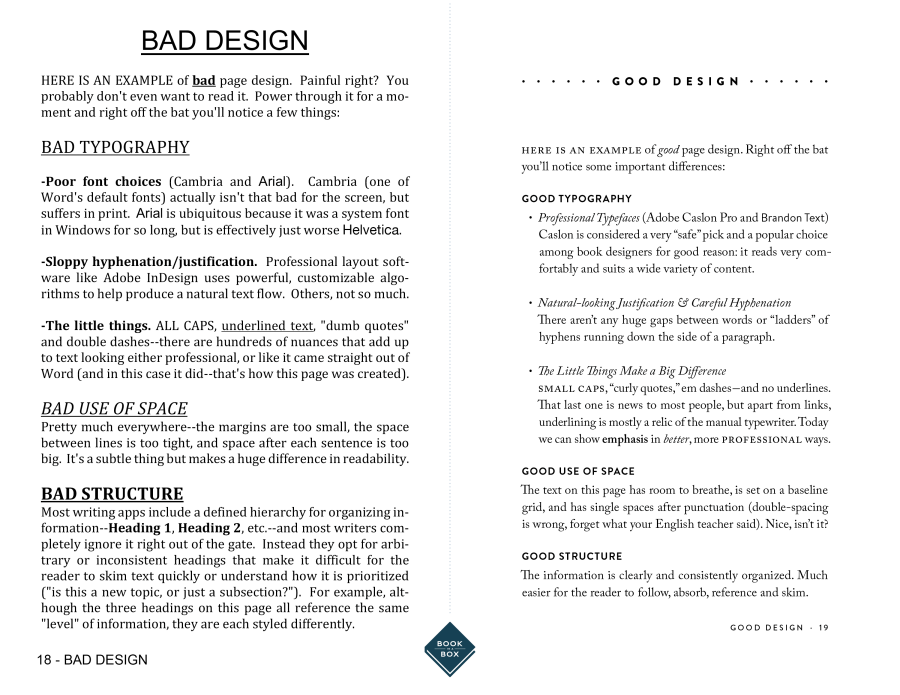
Ugh, now we’re really getting down to the nuts and bolts of your book aren’t we?  But your book’s formatting is a vital component of whether it can hold a new reader’s attention or not.  There’s nothing more frustrating than feeling like you’re being made uncomfortable by a book’s layout–and there are some rather well-research theories out there to explain why dense paragraphs, poor kerning or character spacing, poor font choices, and a poor handle on the virtues of white space can doom a book.  Without getting lost in the details, it’s rather easy to summarize the visual impact of bad vs. good formatting with the following comparison:

book formatting

Sound complicated?  It can be.  But it’s mostly a matter of balance, and consistency.

If you’re feeling … at sea, don’t worry.  As with good cover design and illustrations, there are quite a few resources out there to help you navigate the decisions that await–including whether or not you should outsource some of your design sensibilities to a paid professional.  We’re one resource, and companies like Outskirts are another, and there are plenty–and I mean an almost obscene number–of self-help guides out there.  The problem is, as it is with many things in the Internet age, that it’s almost impossible to know where to start.  And that’s why we’re here!  If you have design or formatting questions, give me a shout-out here on our blog, or track me and my compatriots down where we work.

You are not alone. ♣︎


Elizabeth

ABOUT ELIZABETH JAVOR: With over 18 years of experience in sales and management, Elizabeth Javor works as the Manager of Author Services for Outskirts Press. The Author Services Department is composed of knowledgeable publishing consultants, pre-production specialists, customer service reps and book marketing specialists; together, they all focus on educating authors on the self-publishing process to help them publish the book of their dreams. Whether you are a professional looking to take your career to the next level with platform-driven non-fiction or a novelist seeking fame, fortune, and/or personal fulfillment, Elizabeth Javor can put you on the right path.

In Your Corner: Choosing a Cover

Welcome to the fifth entry in our current and ongoing series–a series in which we examine some of the many choices which you will have to make as an author entering the world of self-publishing: choices ranging from the all-important “Choosing a Self-Publishing Company” to the nuts and bolts of “Choosing a Trim Size for Your Book” to figuring out how (and when) to “Know Thyself (& Thy Genre).” Last week, we felt our way through the topic of “Settling on a Price,” but this week we’re going to take a slightly different tack.  We’re going to look at the book as a physical object–and in fact, we’re going to look at the most defining feature of a book as a physical object:

Choosing a Cover

Piqued your interest yet? Good.

Here’s the thing about covers: we know a good one when we see one, and a bad one too, but we don’t often know the reasons why–we just … do–and knowing why a cover design works or doesn’t work is a crucial skill to develop as you yourself set about designing a book cover of your own.

GOOD NEWS FIRST. OR MAYBE GOOD COVERS INSTEAD.

Take a look at these, a few of my favorite covers from my time working at Outskirts Press:

Does anything jump out at you?  They’re all rather different, which makes sense given the fact that they’re appealing to different audiences.  Remember talking about audiences when we talked about genre?  Book covers are all about expressing the essence of your book’s content, and doing so in a common language shared with your ideal readers.  And readers are smart.  They’ve been reading a long time, and they know the visual cues that indicate a book’s atmosphere, or aesthetic.  Books of a self-help or nonfiction nature, for example, often present uncluttered, minimalist covers with people enacting some behavior connected to the theme (see Surviving Divorce God’s Way and Do You Know the Story of Superman?, above). Young Adult (YA) books, on the other hand, are targeting an age group interested in adventure and often romance, so the rich colors and exotic lettering of The Avant Champion are attuned to these expectations.

So much for expectations–what about execution?  A good book cover is more than just the sum of its parts, isn’t it?  There’s something to the way the parts are put together visually that matters.  That matters a great deal.

BAD NEWS NEXT. OR RATHER, BAD COVERS.

Everyone loves a bad book cover–the same way everyone loves a terrible audition for American Idol–in that we only enjoy witnessing someone else messing up badly.  When we mess up as authors, sales do not go well for us.  And sales are important.  And so, without being uncompassionate or trite, take a look at these covers:

Pretty bad, right?  But why?  Is it the hazy images or the busy backgrounds or the lack of contrast or the obnoxious font choices or the general impression that someone put these together using Microsoft Paint?

The thing is, we get it.

Making covers is hard, and not everyone has an eye (or software program) to make a brilliant, eye-catching, solidly designed cover.  So we’re not laughing behind our hands at bad covers; we are, however, wiser for exposure to some of the ways in which we might go astray.  Using a sub-par program or manipulating already poor quality images can never give us the perfect cover, and not having the time or expertise to download the perfect font can put us under, too.

The critical components to an eye-catching cover don’t come naturally to most of us.  But if you see yourself in this sentence, I have good news.  There are actually quite a lot of resources out there to help you, from self-help guides built in to self-publishing website like Amazon to the professional services offered by companies like the one I work for.  I’ve even known a couple of authors to make personal contact with illustrators and graphic designers on their own and see some success that way.  The key is to know your strengths and to be realistic about your weaknesses, and to accept help when you reach the end of your own capabilities.

You are not alone. ♣︎


Elizabeth

ABOUT ELIZABETH JAVOR: With over 18 years of experience in sales and management, Elizabeth Javor works as the Manager of Author Services for Outskirts Press. The Author Services Department is composed of knowledgeable publishing consultants, pre-production specialists, customer service reps and book marketing specialists; together, they all focus on educating authors on the self-publishing process to help them publish the book of their dreams. Whether you are a professional looking to take your career to the next level with platform-driven non-fiction or a novelist seeking fame, fortune, and/or personal fulfillment, Elizabeth Javor can put you on the right path.

In Your Corner: Settling on a Price

We’ve been at it for a few weeks now, examining a few of the many choices authors have to make during the self-publication and marketing processes, starting with the Big Whopper (“Choosing a Self-Publishing Company“) middling with the choices authors make regarding the text itself (“Choosing a Trim Size for Your Book“), and winding through deciding on a genre for your book–assuming, of course, that genre remains a useful identifier (“Know Thyself (& Thy Genre)“).  Today, we’re going to look at something a little different.  We’re going to ask the money question.  (Or … one of the money questions.)

How Much Do I Charge Per Book?

I’m already aware it’s complicated. Just tell me already.

It’s true.  Pricing is complicated, not least by the fact that we’re probably looking at two different products here, even when we’re talking about one book–because let’s face it, it’s a good idea to sell both a digital copy or ebook edition as well as a physical copy or print edition of your book.  The more diverse your offerings, and so on and so forth.

price in euros

Some facts hold true no matter which edition you’re looking at, however.  The first being:

  • Pricing your book too high relative to your competitors all but guarantees your readers will go elsewhere.

Readers are whatever the book version of an omnivore is called.  (A genrevore?  Never mind.  I’m terrible at coining memes.)  They’re far more likely to pick a sequel of a book they’ve already read than a book by a new author, and failing that, they’re more likely to pick a book within the same genre as an existing favorite.  But a book by an unfamiliar author that’s expensive compared to its shelfmates?  Not going to happen.

The second fact?

  • Pricing your book too low undercuts the perceived value of your book, unless the pricing is temporary.

When we talk about selling readers on a new book, we’re actually making a value proposition; we are attempting to cultivate a perceived value of the book in someone who has never encountered it before, and there’s nothing that shouts “Not worth my time!” than something that doesn’t come with its own built-in novelty factor. There should be a synergy between the quality of your book as an object in the hand and its price; and unless you’re creating the aforementioned novelty by running a short-term sale or discount, your book should be only fractionally lower than the average price of a new book in its genre.

Thirdly:

  • Print books need to account for physical manufacture costs.

So, yes, your ebook should probably cost less than your print edition. It follows.

And lastly:

  • Price is a question of audience.

What does your audience expect of a book like yours?  I’m not just talking about genre; I’m talking about length (Wolf Hall costs more than Moll Flanders, for example), paper and binding quality, whether it’s an oversize or mass market size, hardback or paperback.  The only real way to make a thoroughly researched decision on what these expectations mean in terms of pricing in today’s market is to wander through a bookstore.  Don’t just hang around in one section, either–walk every aisle.  Eye every book.  What qualities does your book share with each item?  What makes it stand out?  Flip through books of a similar page count.  Turn a few books with similar cover designs and aesthetics over to check the price.  Check the gloss of the pages.  Count the illustrations.

Ultimately, the price of your book can only be set and determined by you, so you will at some point have to just make a call and stick with it.  But if you’re feeling particularly brave, take your book in to a bookseller and without giving them much of a clue, let them handle the book and try to guess the price.  Let them estimate how much they would charge.  Neighborhood and indie bookstores are the best for this.  There’s no substitute for experience, and there’s not substitute for the assurance that you’re part of a larger network and system dedicated to putting books like yours in the hands of eager readers.

You are not alone. ♣︎


Elizabeth

ABOUT ELIZABETH JAVOR: With over 18 years of experience in sales and management, Elizabeth Javor works as the Manager of Author Services for Outskirts Press. The Author Services Department is composed of knowledgeable publishing consultants, pre-production specialists, customer service reps and book marketing specialists; together, they all focus on educating authors on the self-publishing process to help them publish the book of their dreams. Whether you are a professional looking to take your career to the next level with platform-driven non-fiction or a novelist seeking fame, fortune, and/or personal fulfillment, Elizabeth Javor can put you on the right path.