Self-Publishing News: 7.9.2018 – The Interviews!

July

And now for the news!

Some highlights from this month in the world of self-publishing, specifically interviews with or articles written by self-publishing authors and experts!

Every now and again, we all need a really good overcoming-adversity story, don’t we? Each of us goes through our various lives with such different tools and attitudes, but at the end of the day, struggle is universal and when we stumble across other peoples’ stories of struggle and survival in the midst of dark times, those stories themselves become another tool. Basically, what I’m saying is this: Reading stories like Geordie Stewart’s helps both put things in perspective and encourages us all to not give up. Stewart, whose new self-published book In Search of Sisu just came out this year, ran a kickstarter campaign to raise the funds necessary to get his book out there in the world. And the world is what Stewart is all about! His book chronicles his adventures in summiting Everest and other high-altitude peaks throughout the world, one of the most dangerous adventure sports in the world. (“Sports” doesn’t even seem remotely like the right word to describe the grueling rigors of such an activity.) His book received blurbs from figures which loom large over the outdoor adventuring community, including Sir Ranulph Fiennes and Bear Grylis. But his attitude is all modesty, and this interview with Craig Smith of The Courier may be just the emotional boost you need to start your week off right.

Diversity matters, and the concept of seeing oneself and one’s struggles fully represented in children’s literature is one that is unattainable for many marginalized groups, for a variety of reasons. Well, children’s author Nury Castillo Crawford is setting out to change that reality for bilingual children and the children of immigrants who may never have seen themselves in a picture book before–and she utilized self-publishing to get there! Crawford, whose bilingual book 3,585 Miles to Be an American Girl came out in February, is a passionate advocate for representation and literacy. As Jordan Meaker writes in this Red & Black interview, that number–3,585–has personal significance for Crawford, who now works as a director of community engagement for Gwinnett County Public Schools in Georgia. “The entire story is inspired by my personal journey,” says Crawford. When she first moved to the United States, decades ago, there were no ESL classes to ease new immigrants into a monolingual English-speaking world. Her book, and other bilingual books, serve as a bridge between those two world for immigrant children who may be looking to learn English but struggling with figuring out how.

Crawford isn’t just a defender of the child and the immigrant; she’s also a defender of self-publishing! “Once you have a contract with a traditional publishing company, you don’t own the book anymore,” she says. “I wasn’t happy about that, I didn’t want anyone to change anything. I decided I was going to have to work and get my own publishing company.” The rest of her interview is just as fascinating. Give it a look!

Speaking of women self-publishing books to assist kids learning how to read and speak, I give you Ashley Imlay’s interview with Amelia Murdock on the Deseret News. Murdock, author and illustrator of the Dash Into Reading series of phonics books for young kids, got started because she wanted something constructive and positive to complement her hours and work as a mother. She used her own background in the arts to write and illustrate the ten-book series, which she self-published in April. She field-tested some of the art and pages on Instagram, and after receiving a massively positive response there, decided to push forward with self-publishing despite rejections from the major traditional publishing houses as a result of phonics books being such a “niche” item. Her journey to self-publishing may not have been her first choice, but now she recognizes that it is a good fit with the material. All of her sales have been made through word-of-mouth recommendations, she says, and through her presence on Instagram. If that’s not a good reason to try out the social media platform, we don’t know what is!


spa-news

As a self-publishing author, you may find it helpful to stay up-to-date on the trends and news related to the self-publishing industry.This will help you make informed decisions before, during and after the self-publishing process, which will lead to a greater self-publishing experience. To help you stay current on self-publishing topics, simply visit our blog every Monday to find out the hottest news. If you have other big news to share, please comment below.


icon logo self publishing advisor

Tuesday Book Review: “Help! I Have a Brain Injury”

Book reviews are a great way for self-publishing authors to gain exposure. After all, how can someone buy your book if he or she doesn’t know it exists? Paired with other elements of your book promotion strategy, requesting reviews is a great way to get people talking about what you’ve written.
When we read good reviews, we definitely like to share them. It gives the author a few (permanent) moments of fame and allows us to let the community know about a great book. Here’s this week’s book review:

Help! I Have a Brain Injury: And It Feels Like I've Dropped Out of the Sky" by Kay Pratt

download

Help! I Have a Brain Injury: And It Feels Like I’ve Dropped Out of the Sky

by Kay Pratt

ISBN: 9781478718079

Synopsis*:

WHAT do you know about brain injury? How does it happen? How does it affect one’s life? What does it feel like? How long does it take to recover from a Traumatic Brain Injury? Will a survivor ever be the same again?

WHAT are your beliefs about the future of someone who’s sustained a Traumatic Brain Injury? The answers to these questions are as broad and unique as the individual’s who have sustained brain injuries. “In my own experience as a TBI survivor, I have come to understand that the degree to which we recover can be measured not only by our physical reality, but, by our personal and caregiver’s belief systems; after all, if, we are cognitively and physically able, what we believe, shapes our every outcome!” Kay Pratt.

In this Book, TBI survivors share the answers to these questions and more through the voice of their experience. It is with sincere hope that by doing so, your understanding and beliefs about brain-injured individuals will be broadened and your perspectives enlightened.

 * courtesy of Amazon.com

Featured Review

“Help! I Have a Brain Injury: And It Feels Like I’ve Dropped Out of the Sky” by Kay Pratt is one of the most amazing, informative and well written books I have read on this topic. Having had multiple mini-strokes in August of this year, I wish I had this book in hand afterwards.

The author shares her experience in her ten year recovery from her brain injury as well as the stories of others. Little did I realize all the anger, depression and loss I would feel when I lost the ability to write, walk and do small, everyday tasks. I am sure many going through this feel the same way.

Pratt and others talk about the pain, fear, anger and depression and the long road of physical, occupational, and sometimes emotional therapy to learn to walk and talk once again. What impressed me was in each story or discussion, Pratt includes a section on Important Takeaways – how one deals with the loss, anger and changes in our lives. Believe me, recovery will not happen overnight, and you will come to rely on many professionals, as well as family and friends to help in this process.

As a Psychologist, I found the information in this book to be very helpful, full of supportive tips and resources. It is very well researched, and provides information I hadn’t even considered. The examples Pratt provides on the impact of domestic violence and brain injury caught me off guard. Her statistics, lack of treatment and diagnosis was shocking, although it shouldn’t be. The undiagnosed impact of brain injury may be a reason why some women choose not to leave an abusive relationship; brain injury makes it difficult to get a job and be self-supportive. She also relates that according to some sources pushing a diagnosis may have unintended consequences such as being used against the women in custody battles.

What many people do not realize is that children who are abused may suffer from mild to severe TBIs (traumatic brain injuries). It is imperative to assess children for dizziness, change in personality, and change in behavior, and determine if they should be returned to a violent home. That means that caregivers, family or friends need to be observant and say something.

Part 5 of Pratt’s book, entitled Brain 101! includes vital information about what TBIs are, statistics, parts of the brain impacted and what that means. She goes on to discuss coping with challenges, length of time for recovery and provides numerous resources.

Since I am still early in my recovery, I showed this book to my Occupational Therapist, and she now has it in her hands to share with others. “Help! I Have a Brain Injury: And It Feels Like I’ve Dropped Out of the Sky” by Kay Pratt is a must read for all professionals, family members, friends and those who have diagnosed TBI, or not.

– reviewed by Carol Hoyer for Reader Views

Another Review

If you or a loved one has experienced a brain injury you most likely feel as if you are suddenly hurtling down a never ending road of pain, confusion, hard questions and a roller coaster ride of emotions, as you try and decipher the clinical terminology from well-meaning experts, as well as face the reality of what is. Given how brain injuries impact one’s life and those around them, it is hard not to be overwhelmed with fear and doubts at the long road ahead, let alone the day to day journey.

HELP! I Have a Brain Injury And It Feels Like I’ve Dropped Out of the Sky! by Kay Pratt is the result of all that she has learned throughout her 10 year journey and recovery from the time of her own brain injury to the present day. This is her third book in her HELP series on dealing with brain injuries and it answers quite possibly any and every question you might have on the topic. The book is extensively researched and thorough in it’s discussion of all aspects of brain injuries, from the first steps to take following the occurrence and diagnosis, the physical and emotional health concerns following the injury, understanding brain trauma, the importance of advocating for one’s self and tips on coping with daily challenges as you move forward in your recovery journey. Yet you never feel like you are reading about a medical issue nor do you ever feel inundated with medical terms. Ms. Pratt breaks everything down into a conversation between ordinary people. The book is about you, whether you are the patient, a family member or friend. It is always about you and your own personal journey.

Ms Pratt recounts as well moments of her own journey, the obstacles she faced and how she dealt with them. Also included are the personal stories of other brain injury survivors. On page after page Ms. Pratt’s inner grace, strength of spirit, wisdom and compassion infuse the book and her words with hope and give one the courage to go on, even when confronting what seem unsurmountable odds. I cannot say enough about how invaluable this book is for anyone suddenly finding themselves facing the unexpected reality following a brain injury.

 – reviewed on Amazon by reluctantmuse


tuesday book review

Thanks for reading!  Keep up with the latest in the world of indie and self-published books by watching this space!

Self Publishing Advisor

selfpubicon1

Self-Publishing News: 7.2.2018 – The Company Files!

july

And now for the news!

Some highlights from this month in the world of self-publishing, specifically news from or regarding self-publishing companies!

Like it or not, there’s a widespread cultural assumption right now that because bookstore chains are struggling, therefore so too must authors be. Mercy Pilkington of The Good e-Reader is here to complicate that picture with an article that opens with the above provocative question, and sets out to disentangle common misconceptions about the lives of self-published authors as well as their traditionally-published counterparts. So, what, exactly, “does the industry hold for the traditionally published authors, the ones who’ve managed to snag the Holy Grail of writing and find both an agent and a publisher?” Pilkington goes on to answer: “Here’s a hint: the clearance bin at your local dollar store is filled with books that had a traditional publishing deal.” Being traditionally published is no insulation against common market pressures, she infers. Being an author has always, except for the ultra-rare zero-point-one-percent-likelihood blockbuster breakout success, been more about the art than the money for obvious reasons. And Pilkington’s closing thoughts are just as hard hitting. She writes:

But is this a chicken-egg scenario? Are publishing contracts paying authors literally minimum wage because all deals are getting smaller, or are the deals getting smaller because authors are shunning publishers and they aren’t earning as much as they once did? Either way, this situation sheds light on the increased professionalism and credibility that now surrounds the indie author space, indicating that this is (still) a great time to self-publish.

What do you think?

If you haven’t heard about “book-stuffing” … well, don’t worry. Neither had we, until this latest Amazon controversy blew up. Apparently, the self-publishing wing of the website (Kindle Direct Publishing) quietly rolled out some new rules to prevent authors from bundling their books together to get around the page limits of its subscription reading service, Kindle Unlimited. But that’s not where the controversy stops. (This is Amazon after all.) In a turn which surprises no one, Amazon has failed to enforce any of these rules, according to a number of leaders from within the self-publishing community who are pushing for the industry giant to put some weight behind its regulations. The simple fact is that there’s little incentive for the company to do so; its sheer size and its often-accused-as-exploitative author contracts insulate it from many of the ill side effects that the authors themselves will face. The way that Kindle Unlimited is set up, everyone who elect to offer their books through the service is paid out of one shared pot, which is allocated proportionally to its most-read texts. Book-stuffing makes it possible for some authors to exploit loopholes at other authors’ expense, and is therefore not a neutral or mildly problematic activity; it actually threatens livelihoods. Here’s hoping Amazon listens to its detractors and does some enforcement on this issue.

Self-publishing is an emergent opportunity for game design companies these days, with Frontier (above), Bungie, and NieR Studio all making noise in the last few weeks over their intentions to start self-publishing games. Frontier, a British game design company, recently launched an entire self-publishing division after closing down its less successful work-for-hire division. Writes Christopher Dring of GamesIndustry.biz, “It completed its contract with Microsoft (which included the 2015 game Screamride and incubation work on HoloLens), built its own publishing team and now answers only to itself and its shareholders.” The company is now in the process of deciding on how to go about offering third-party publishing to game designers who want to break from the traditional games publishing process. “‘It has to speak to our values,’ [Frontier CCO] Watts says. ‘The games that we make, we want them to be remembered.'” The CEO and CCO of Frontier discuss the elements which make for successful video games, which sound an awful lot like the ingredients for a successful self-published book: authenticity, ambition, attempting something new, and attention to detail. The article serves as a deep dive into the history of one game design company which is “going indie,” but it might just serve as a template to follow for other such companies in the near future.


spa-news

As a self-publishing author, you may find it helpful to stay up-to-date on the trends and news related to the self-publishing industry.This will help you make informed decisions before, during and after the self-publishing process, which will lead to a greater self-publishing experience. To help you stay current on self-publishing topics, simply visit our blog every Monday to find out the hottest news. If you have other big news to share, please comment below.

icon logo self publishing advisor

The Importance of Interior Design for Self-Published Books

ebooks

The self-publishing industry has come a long way since the early 2000’s. Back then, self-publishing a book carried a huge stigma, but today, more books are self-published than traditionally published, and more self-published books are purchased than traditionally published books.  Yet, in many readers’ minds, the stigma still exists because self-published books are so often inferior to traditionally published books.

What can a professional self-published author do to overcome this mindset?

  1. Don’t worry about your publisher.  The vast majority of readers do not care who your publisher is. They won’t look at who published your book when deciding whether or not to buy it. So any fear you have about a stigma that is associated with your self-publisher of choice is unwarranted.  
  2. Invest in a custom cover design.  The first thing a potential buyer will see is your book cover. And the book cover is the single easiest way to tell if a book is self-published or not.  If asked, most people might not even be able to describe why a cover looks amateurish; but it doesn’t matter – an amateur cover will scream “self-published” to potential buyers and due to that stigma, they may shy away.
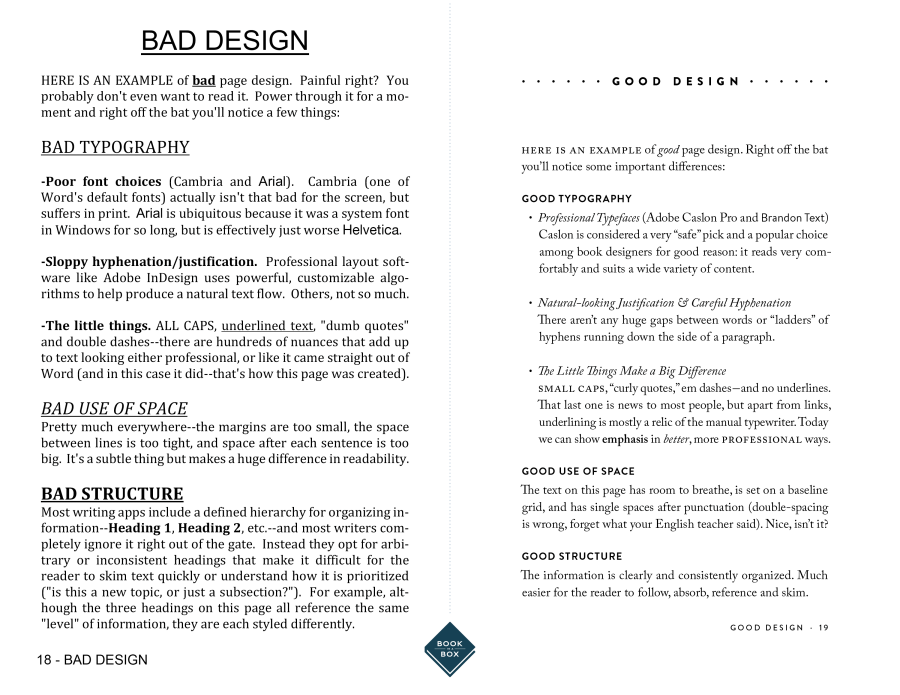
  3. Invest in professional interior formatting. The vast majority of self-published books are purchased from Amazon, and most of them feature the “look inside” element, which allows shoppers to view pages from within the book.  The interior of your book is the second way potential customers recognize self-published books. Interiors that are formatted by computers look like they were formatted by computers, and that makes them look like amateur, self-published books. Even worse, it looks like the author doesn’t care about what the book looks like.  If the author doesn’t even care what the book looks like, why should a potential reader buy it?

good-vs-bad-book-design_new

After the cover design, the interior design of your book is what separates most professional self-published books from “free” self-published books. Professional self-published books, like those published by full-service self-publishing providers, feature interior designs formatted by human beings.  “Free” self-published books, on the other hand, feature interior designs formatted by computers. The difference, when compared side by side, is staggering. Don’t allow your book to look amateurish and cheap by allowing a computer algorithm to format it for you. Your potential buyers will notice. They may not care who published it; they may think the cover looks great; but without a professional interior, they’re still going to know your book is self-published with just a glance. And, as a result, they’re going to think twice about ordering it.

Fortunately, it’s easy to make your book interior look professional.  Nearly all full-service self-publishing providers will professionally format your interior as a part of their publishing package fees.  And most will offer you the opportunity of “enhanced” or “custom” interior designs. Don’t pass on this opportunity lightly. While the standard interior formatting offered by most full-service providers is certainly better than anything a computer can do at those “free” places, enhanced or upgraded interior designs typically go one or two steps further – by integrating design elements, unique styles, and customizations to truly make your book one-of-a-kind. The improvement is usually worth the cost of admission.

Page-by-page custom interior designs are best suited for children’s books, or complex literature where the book itself is a work of art, like with some poetry or coffee table books. Rarely does a page-by-page custom design suit a typical black/white fiction or non-fiction work of average length (100-300 pages).  The result just doesn’t justify the cost.

When it comes to selecting a standard, included interior, do some research. Look at similar books in your genre and choose a similar style for your book.  While a cover should be unique and eye-catching, you don’t want your interior to rock the boat. Give the reader what they expect.

If you choose to enhance or upgrade your interior for a professional format that is more customized to your book and vision, work with your designer closely, and heed his/her advice. After all, this is what they do for a living; they know what they’re doing and their recommendations are worth their weight in gold. If you have a particular vision that contradicts your designer’s recommendations, have a strong, valid reason for going against conventions.  

If you choose to publish with a “free” publishing service, format your book in advance and save it as a PDF file. Do not allow their computers to “format” your book for you. That’s a sure way to make your book look self-published and, worse of all, cheap.  While formatting a book in Word is acceptable, and certainly preferable to computers, the better alternative is to use design software like inDesign. This is what professional designers use and this is what professional publishers use. Yes, your book’s interior design is that important. Most writers do not know how to design a book in inDesign, which, of course, is why most professional self-published authors use full-service publishing providers.


brent sampson
In 2002, Ernst & Young Entrepreneur of the Year Semi-Finalist Brent Sampson founded Outskirts Press, a custom book publishing solution that provides a cost-effective, fast, and powerful way to help authors publish, distribute, and market their books worldwide while leaving 100% of the rights and 100% of the profits with the author. Outskirts Press was incorporated in Colorado in October, 2003.
In his capacity as the Chief Executive Officer and Chief Marketing Officer, Brent is an expert in the field of book publishing and book marketing. He is also the author of several books on both subjects, including the bestseller Sell Your Book on Amazon, which debuted at #29 on Amazon’s bestseller list.