“The Journey Begins” : A Saturday Self-Published Book Review

Book reviews are a great way for self-publishing authors to gain exposure. After all, how can someone buy your book if he or she doesn’t know it exists? Paired with other elements of your book promotion strategy, requesting reviews is a great way to get people talking about what you’ve written.

When we read good reviews, we definitely like to share them. It gives the author a few (permanent) moments of fame and allows us to let the community know about a great book. Here’s this week’s book review, courtesy of Edge Induced Cohesion:

the journey begins: a walk of faith by lynn strong

The Journey Begins : A Walk of Faith

by Lynn M. Strong

Publisher: Outskirts Press

ISBN: 978-1478776932

Synopsis*:

Spiritually fed, spiritually led and poetically said. When Lynn Strong found himself forced into early retirement at age 58, he felt utterly lost. In desperation, he turned to God and prayed for answers-for guidance on this unplanned detour. That day, he surrendered his all and vowed to serve the Lord as never before. The Journey Begins: A Walk of Faith is a collection of poetry that reflects Lynn’s personal and spiritual journey. Inspired by the Spirit as God led him each day, the poems are simple and accessible, yet filled with raw emotion and a joyful celebration of faith.

Critique:

There are times where knowing something about the context of a book makes it more enjoyable to read.  This short book, about 90 pages in length, was written by the author when he was put on early retirement at the age of 58, and struggled with feeling old and unappreciated, and having a hard time finding good work again.  What he did was something remarkable, and wonderful, and that is writing this particular short book and sharing with the appreciative readers of this book his own reflects and thoughts and poetry.  As someone who has read many books from this publisher [1], this book definitely gets self-publishing right, and that is by providing something other people are going to want to read.  There are a lot of people who struggle with growing older and being forced into early retirement, and this book is short enough and well-written enough that it would be a comfort to many people and an encouragement for them to write about their own thoughts and feelings and to share their own struggles with the negativity involved in feeling like the purposes of life have been reduced by a lack of work.

After an introduction, that explains the genesis of the author’s writings, this book consists of more than 40 reflections with a particular format, given a title and with three verses or short passages from the Bible, a commentary of one to three paragraphs, and a short poem made up of quatrains with an ABCB rhyme scheme that sound like the metrical psalms popular in many English-speaking Protestant churches.  The titles generally give a fair picture of the contents:  Help Us Lord, Old Age, Power Monday, Our Walk / Your Way, Keep The Faith, In The Press, and Thoughts In Mind are some examples of the contents provided in these pages.  The contents are all very straightforward–this is not deeply symbolic and mysterious poetry but rather direct and often didactic poetry written in the first and second person.  As someone who has read more than my fair share of really bad poetry, it is nice from time to time to read poetry that has no pretensions and that manages to convey its point straightforwardly.  Those who read this book will not be in any mystery about what the author is talking about, and are likely to find some encouragement in the author’s words as well as the choice citations from scripture.

The title of this book gives the indication that there is likely to be more material from the author yet to come.  If, for example, this is the beginning of a journey, there may yet be more volumes of writing from the author, and that is likely to be enjoyable.  The author has been married to his high school sweetheart for 40 years and has also been involved in prison ministry, both of which are spoken of here in the book, and both of which likely can provide the author with insight for further books.  Perhaps having begun his writing with this particular volume, the success of these efforts will encourage the author to future books, which, if they are as good as this volume, will likely also be encouraging and pleasant to read.  The author strikes the reader as someone who was likely not encouraged to be a writer during his youth, and as a result the author appears not to have spent years practicing work.  It is noteworthy that it was a crisis of retirement that prompted the author to begin to write, and one can only hope that he found as much peace and enjoyment writing this book as others are likely to find reading it.  The world can always use more people who write honestly and well.

[ reviewed by Nathan Albright at Edge Induced Cohesion ]

Here’s what another reviewer is saying:

Yes it met all my expectation on a spiritual level, to be able to walk with Lynn through his spiritual journey. Praise God from whom all blessings flow!

– Amazon Reviewer Amazon Customer

* = courtesy of the book’s Amazon book page.


saturday self-published book review

Thanks for reading!  Keep up with the latest in the world of indie and self-published books by watching this space every Saturday!

Self Publishing Advisor

selfpubicon1

Conversations: 10/14/2016

INTRIGUE Plus SUSPENSE

Strengthens The TAPESTRY


To draw more fans to your club add threads of suspense to your novel and then blend with intrigue. Most of us who love Suspense/Intrigue genre of novels have read the books of John Grisham. Many of them have been made into movies and, for the most part, they remain close to the original plot and characters of his books. However, the real fun comes when I allow my imagination entrance into one of his novels as my heart beats to the rhythm of the detailed events he portrays.

From my years of creative writing perspective, here are some of the elements that weave suspense and intrigue together.  Much of it finds foundation upon the plot diagram one of my early elementary school teachers drew on the chalkboard. For the novel writer, these plot-points are repeated multiple times throughout the story and, as more suspense/intrigue is introduced, the points crisscross at very strategic places.

plot diagram

Intriguing/interesting character development: There are almost as many methods of doing this as there are authors of novels. Before you do a google search and follow the 5-7-12 steps in someone else’s process, jot down your own ideas about WHO this person is—inside and out. My favorite thing to do is close my eyes and imagine this character acting out one of the scenes I’ve placed in the outline (plot). As that image develops, and I begin to see the character, I stop and do an online search for actors that fit that image. Then I build my inside-out scenario of this person’s character traits keeping focused on making her/him as unique as I can: unique name and/or nickname; exceptional skills and/or knowledge; extraordinary strength or weakness; distinctive physical characteristics; etc. A quote from author Don DeLillo—that gives the Reader multi-level insight into one of his characters—is this: “He speaks in your voice, American, and there’s a shine in his eyes that halfway hopeful.”

PLOT the Plot: I’m one of those writers who likes to know a LOT about my characters before I work too hard in developing a novel outline—or plot—for the story they’ll be living.  However, it really doesn’t matter whether you’ve created your plot first, after or during the character development process. It is always good to RE-think the plot from this one main perspective: HOW MUCH RISK is each character taking as the story evolves. At every point on your plot/graph where a conflict occurs (whether between characters, within a character’s thoughts, or from outside sources) they must make a choice—how much of themselves are they willing to risk. THIS IS WHERE THE SUSPENSE BUILDS. Their resistance in making the choice that most Readers will want them to make will keep your Readers turning the pages. Some of these choices may be major life-changing events. Some choices may effect and affect many others with little consequence to the one making the decision. Continuing this process increases the Suspense and engages your Readers as they consider what they would do—what logical choices they would make—if faced with these circumstances.

Are you feeling the excitement of writing in this genre? Imagine that Plot Diagram (above) also being used to develop each of your characters. Imagine the point(s) when a circumstance seems to be resolved for them—then suddenly they fall apart leaving your characters with a whole new set of choices to make. IMAGINE!  Keep imagining! Before you know it your novel will become reality and you’ll be ready to PUBLISH! ⚓︎


Royalene

ABOUT ROYALENE DOYLE: Royalene has been writing something since before kindergarten days and continues to love the process. Through her small business—DOYLE WRITING SERVICES—she brings more than 40 years of writing experience to authors who need “just a little assistance” with completing their projects. This is a nice fit as she develops these blogs for Outskirts Press (OP) a leading self-publisher, and occasionally accepts a ghostwriting project from one of their clients. Her recent book release (with OP) titled FIREPROOF PROVERBS, A Writer’s Study of Words, is already receiving excellent reviews including several professional writer’s endorsements given on the book’s back cover.  

Royalene’s writing experience grew through a wide variety of positions from Office Manager and Administrative Assistant to Teacher of Literature and Advanced Writing courses and editor/writer for an International Christian ministry. Her willingness to listen to struggling authors, learn their goals and expectations and discern their writing voice has brought many manuscripts into the published books arena.


In Your Corner: The Guts of the Thing

Welcome to the sixth episode in our ongoing series about the myriad difficult decisions a self-publishing author makes in the process of pursuing publication!  In previous weeks, we’ve discussed:

But just as the decisions about the outside of your book are important, so too are the decisions you make about the inside.  That’s right, we’re talking about:

Illustrations & Formatting

OR: the ‘look and feel’ element.

We all know how important it is that your book look good on the outside, so that new readers will pick it up off of the bookstore shelf (or the library shelf) and have that immediate “AHA!” moment.  The problem is, while first impressions like these are one make-or-break moment for your relationship with your reader, so too is the moment when they thumb through the pages and take a look at the actual pages.  Most readers I know will crack a cover open before committing to taking a book to the check-out (or circulation) counter, so–what gives?  What elements of your book’s interior design will give a resounding second cheer to the good impression made by your book’s beautiful front cover?

ILLUSTRATIONS

As good a place to start as any, let’s take a look at illustrations and what role they play in a reader’s impression of your book.  First off, let’s clear the air: we recognize that the appeal of any single illustration is largely a matter of taste, and we’re not here to cast aspersions or shame at any self-publishing author’s style of illustration.  Many self-publishing authors crave the option to illustrate their own books, so there’s a wholeness of purpose sometimes behind illustrations that don’t immediately appeal to us–but again, that’s not what we’re really talking about here.

Take a look at these illustrations, all of which are courtesy of books my employer (Outskirts Press) has published in the past:

You can see that’s there no one common thread connecting them all.  They’re all different styles, all different degrees of visual impact.  They’re as unique as the books that give them a home.

Professional illustrations like these give your book an oomph–a real kick of appeal–that your book wouldn’t have without them.  But are they appropriate for every book?  Probably not.  You might see how one style of illustration–simple, cartoonish, minimal–might fit perfectly in a children’s picture book, and how something a little more stylistically complicated–with detailed, fine pencil work–might fit well in a book for older readers, perhaps young teens.  Novels for adults don’t often have illustrations–which isn’t to say they shouldn’t–but this may also be a question of audience.  And one might imagine contexts–a cookbook with historic recipes, for example, or a book involving complicated geography–might benefit from a couple of beautiful illustrations.  The key is to know thy audience and to make sure any illustrations you include are as polished and professional as they can be.

FORMATTING

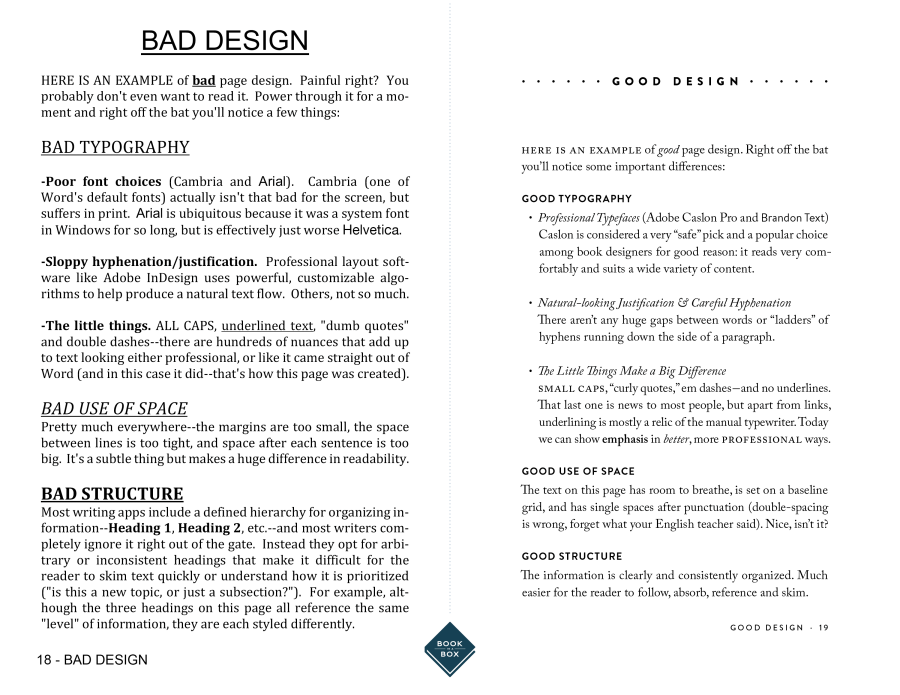
Ugh, now we’re really getting down to the nuts and bolts of your book aren’t we?  But your book’s formatting is a vital component of whether it can hold a new reader’s attention or not.  There’s nothing more frustrating than feeling like you’re being made uncomfortable by a book’s layout–and there are some rather well-research theories out there to explain why dense paragraphs, poor kerning or character spacing, poor font choices, and a poor handle on the virtues of white space can doom a book.  Without getting lost in the details, it’s rather easy to summarize the visual impact of bad vs. good formatting with the following comparison:

book formatting

Sound complicated?  It can be.  But it’s mostly a matter of balance, and consistency.

If you’re feeling … at sea, don’t worry.  As with good cover design and illustrations, there are quite a few resources out there to help you navigate the decisions that await–including whether or not you should outsource some of your design sensibilities to a paid professional.  We’re one resource, and companies like Outskirts are another, and there are plenty–and I mean an almost obscene number–of self-help guides out there.  The problem is, as it is with many things in the Internet age, that it’s almost impossible to know where to start.  And that’s why we’re here!  If you have design or formatting questions, give me a shout-out here on our blog, or track me and my compatriots down where we work.

You are not alone. ♣︎


Elizabeth

ABOUT ELIZABETH JAVOR: With over 18 years of experience in sales and management, Elizabeth Javor works as the Manager of Author Services for Outskirts Press. The Author Services Department is composed of knowledgeable publishing consultants, pre-production specialists, customer service reps and book marketing specialists; together, they all focus on educating authors on the self-publishing process to help them publish the book of their dreams. Whether you are a professional looking to take your career to the next level with platform-driven non-fiction or a novelist seeking fame, fortune, and/or personal fulfillment, Elizabeth Javor can put you on the right path.

Ringing in the Holidays!

The trees have shed their colorful fall foliage, the air has grown crisp, the kids are back in school, and you know what that means? The holidays are just right around the corner. This is a time of year to celebrate, not only because it means the return of pumpkin spice lattes and apple crisp, but because it is a time of year devoted to giving thanks, sharing delicious food and thoughtful gifts, and it is a time to gather with and spend time with those we love and cherish.

You can further celebrate this time of year as an author by innovating your marketing strategies, as there are certain advantages to marketing this time of year that aren’t available to you on just any summer day.

With an increased amount of shoppers trying to fill stockings and fill out the base of their Christmas trees, it is imperative that you’ve nailed down who exactly your audience is. Is your book a children’s book? Make sure your book is made available in local toy stores and maybe put some flyers up in local day care centers, libraries, and schools. Also, think of how great your book could be as a stocking stuffer for family members; being generous with your book this time of year could lead to more readers not only within your family, but whoever your family ends up sharing it with as well.

This is also a great time of year for holiday giveaways online. Vamp up your blog with relevant tags, and host your giveaways there! Post on pages relevant to your story–this could be anything from a Facebook page of the state your book takes place in, a Facebook group of readers that your book might appeal to, or maybe even to a Facebook event in your area that fits the theme of your book.

Remember that Christmas stockings are often full of Amazon gift cards; do you have an ebook to offer all these new potential buyers? Going digital means that there were literally be MILLIONS of people who will have access to your book, who never would’ve come across it otherwise. If you already have an ebook version, ask your readers for a priceless holiday gift: a good review online.

We know here at Outskirts Press how busy this time of year is. We know that you’re also out shopping for you families, preparing turkey feasts for your families, carving pumpkins for your porches, etc. etc. Don’t hesitate to treat yourself to the gift of our services that can help you with these marketing tasks that are so important this time of year!

holiday sales marketing

At Outskirts, we have a marketing package that includes a custom press release, an author platform setup through social media, a book trailer with social network distribution, AND you get 5 hours with your own personal marketing elf…I mean, assistant. This is a great way to ensure you don’t miss out on the perks of holiday marketing, but also ensuring that you don’t miss out on the holiday cheer because you’re too busy worrying about marketing your book!

Click here to find out more:
http://outskirtspress.com/book-marketing.html


Thank you for reading!  If you have any questions, comments, suggestions, or contributions, please use the comment field below or drop us a line at selfpublishingadvice@gmail.com.  And remember to check back each Wednesday for your weekly dose of marketing musings from one indie, hybrid, and self-published author to another. ♠


Kelly

ABOUT KELLY SCHUKNECHT: Kelly Schuknecht is the Executive Vice President of Outskirts Press. In addition to her contributions to the Outskirts Press blog at blog.outskirtspress.com, Kelly and a group of talented marketing experts offer book marketing services, support, and products to not only published Outskirts Press authors, but to all authors and professionals who are interested in marketing their books and/or careers. Learn more about Kelly on her blog, kellyschuknecht.com

From the Archives: “Self Publishing for the Eco-Conscious”

Welcome back to our Tuesday segment, where we’ll be revisiting some of our most popular posts from the last few years.  What’s stayed the same?  And what’s changed?  We’ll be updating you on the facts, and taking a new (and hopefully refreshing) angle on a few timeless classics of Self Publishing Advisor.

∗∗∗∗∗

[ Originally posted: December 6th, 2011 ]

As our society becomes more concerned with environmental issues such as climate changes, pollution and land use, many authors want to know how they can publish a book that fits their environmental values. These authors want to know about the practices of the companies they publish with as well information about the materials used to print their books. If sustainability and conservation are important to you, here are a few things to consider before publishing your book.

1) Ask About the Ink – Some self-publishing companies use non-toxic ink. This is important for many reasons. For instance, it means…

  • Your book can later be recycled or composted without the fear of toxic ink seeping into the soil.
  • Once recycled, the finished product will not have a grayish-yellow appearance like the recycled papers of the ’90s.
  • The ink in your book will pose no threats to those who come in contact with it. (If your two-year-old child decides to nibble on the pages, he or she is perfectly safe.)

2) Ask About the Paper – Some self-publishing companies will print your book on recycled paper. There are also companies that use certified paper products. For instance, Outskirts Press uses bookblock paper that is Sustainable Forestry Initiative (SFI) Certified and Forest Stewardship Council (FSC) Mixed Credit. These practices are important to prevent deforestation, which causes global warming and species endangerment.

3) Ask About Certifications – It is important to find out about the practices and products used by your self-publishing company. One way businesses prove that they use environmentally conscious practices and products is certifications such as SFI Certified and FSC Mixed Credit. Most companies will be more than willing to share this information with you, so ask your publishing company what certifications they have.

4) Ask About Best Practices – There are plenty of ways individuals and businesses can help the environment. Just a few ideas include energy-efficient appliances, telecommuting and recycling. Ask yourself-publishing company what they do to reduce their carbon footprint. Do they value sustainability and conservation? Do they encourage their staff to share their values by taking small, eco-conscious actions?

When choosing a self-publishing company, it is important to find a company that shares your goals and values. Before committing to aself-publishing company, do your research. Find out about their practices and products. Don’t be afraid to ask questions. An honest company will be more than happy to answer them.

– by Cheri Breeding

eco friendly

If we’ve learned anything in the half decade since Cheri first wrote on our blog about the environmentally friendly potential of self-publishing, it’s that the imperative to do what we can to mitigate the damaging effects of our art has only increased. The world is feeling the effects of what we do, and if we have the opportunity to reduce those effects, we have a moral and ethical responsibility to seize upon that opportunity.

Cheri was right, too, to point self-publishing authors towards the questions of paper, certifications, and best practices. Many companies, traditional and indie alike, preach a message of going green–but few enough actually follow through when the chips are down and it’s time for the serious work of publishing your book. Or worse, they offer their promise of being eco-friendly as a lure to get you to commit, and then only offer green options for a pretty price above and beyond the usual.

These days, most “green” schemes in self-publishing focus on choosing better, more environmentally-conscious materials. They preach the values of recycled papers and nontoxic inks. But the materials your books are made up form just one small slice of the larger publishing picture, and the choices you make are surrounded by a looming bulk of practices that can pose significant environmental threats. It’s a balancing act; wise choices on your end often lead to offenses committed during resource acquisition, printing, manufacturing, transport, assembly, packaging, storage, distribution, warehousing, retailing, and disposal–not by you, of course, but by the company you hire to print and distribute your book.

Think about it: we’re talking about companies that, ultimately, have to look after their shareholders and the bottom line. It is every company’s operational imperative to maximize benefits to shareholders and customers alike in order to maintain a steady flow of business, and to minimize expenses so as to reap the greatest possible profit. This isn’t a bad thing–necessarily. But not every company builds in to its framework the understanding that what’s good for the environment is also good for its financial stakeholders, and what’s bad for the environment is also bad (very, very bad) for its (past, present, and future) customers. Recycled materials costs a lot, relatively speaking. It takes energy to collect and process them into their new form, and sometimes there are chemical hazards created as well. It stands to reason that companies would look to make up for the energy-hungry recycling process by scraping a few extra pennies from their customers … assuming those customers have the money to spend and are none the wiser. But this system sets up a world in which self-publishing authors are actually more likely to choose eco-unfriendly options because those are the ones they can afford.

Not good.

Ultimately, the best thing you can do as a self-publishing author interested in pursuing eco-friendly printing and distribution practices is to talk about it.  Talk about it with your Publishing Consultant and with your friends, family, fans, and fellow authors. See what eco-friendly options are available, and whether or not your chosen self-publishing company is interested in rising to a higher standard. Don’t settle for pat lines and shrugs. Hold your industry accountable! The only way forward is to make these practices accessible and sustainable for everyone. You can be a green champion today!

eco friendly

Thanks for reading.  If you have any other ideas, I’d love to hear them.  Drop me a line in the comments section below and I’ll respond as quickly as I can.  ♠


Kelly

ABOUT KELLY SCHUKNECHT: Kelly Schuknecht is the Executive Vice President of Outskirts Press. In addition to her contributions to the Outskirts Press blog at blog.outskirtspress.com, Kelly and a group of talented marketing experts offer book marketing services, support, and products to not only published Outskirts Press authors, but to all authors and professionals who are interested in marketing their books and/or careers. Learn more about Kelly on her blog, kellyschuknecht.com.