Self-Publishing News: 10.2.2017 – The Company Files!

And now for the news!

Some highlights from this month in the world of self-publishing, specifically news from or regarding self-publishing companies!

Rejection is a part of every author’s experience, isn’t it? But even the most determined author starts to question what’s good and what’s not after 47 rejections … unless that author is Ashwin Sanghi, who received that exact number of rejections before carrying on to publish huge hits The Rozabal LineThe Krishna Key and Chanakya’s Chant. If you think that’s a punch of encouragement to get you through the morning, get this: Sanghi is a believer in self-publishing. “The technological tools available today are so immense that there is no reason why you should not be able to make your book at least visible,” he says, and self-publishing now offers the kinds of opportunities you’d only find with traditional publishing houses when he first started out. “Self-publishing as a concept didn’t exist prior to 2007. In fact, in those days what existed was vanity press, where you paid to have copies of your book printed.” He then proceeds to walk readers through the benefits of self-publishing, and to encourage them to push forward. The rest of the article is well worth a read!

Susan Miles Gulbransen, of Santa Barbara’s Noozhawk, has some words this last week on the subject of bestsellers … and how they’re often made, not born. Now, most of us involved in writing and publishing harbor no illusions that publishing is a fair and equitable environment that rewards those who’ve put in the labor in order to produce masterpieces. But just in case you did … well, maybe bursting bubbles isn’t the most worthwhile thing to do with our time. And maybe it is. Gulbransen has some serious questions: “What is the difference between individual and bulk sales? Which books have the right literary quality? Does it take money to get a book listed? Or, which bookstores get counted? When I researched what it takes to make the NYT bestseller lists, it became obvious that the system is complicated, secretive and not based on straight sales calculations.” Want to know how the magic is made, and the implications for self-publishing authors? Dig into the rest of her article at the Noozhawk.

Ben Fox Rubin of CNet has some insights into Amazon’s latest attempt to tweak the ebook platform it has spent so long carefully building, and they’re not all optimistic. Says Rubin, “The online retailer on Wednesday filed five separate legal actions through the American Arbitration Association to cut down on a variety of alleged scams used to make money on Amazon’s Kindle self-publishing service.” These scams have plagued the platform since its beginning, although Rubin reiterates that they are not the majority of transactions taking place on Kindle Direct. But Amazon is getting serious about fixing things: “Amazon since 2015 has been using these kinds of legal actions to fight against scams and already sued over 1,000 entities involved in allegedly creating fake product reviews on its sites. The company last year also sued alleged counterfeiters.” It’s a step…but will it be enough? Rubin has some interesting speculations on that score, well worth reading up on.


spa-news

As a self-publishing author, you may find it helpful to stay up-to-date on the trends and news related to the self-publishing industry.This will help you make informed decisions before, during and after the self-publishing process, which will lead to a greater self-publishing experience. To help you stay current on self-publishing topics, simply visit our blog every Monday to find out the hottest news. If you have other big news to share, please comment below.


icon logo self publishing advisor

Conversations: 9/29/2017 (on Coffee & Mulled Cider Day!)

SEPTEMBER HOLIDAYS CELEBRATE WRITERS!

COFFEE and Mulled Cider Day!

Thank you, Thank you, to whoever placed this day on our calendars! Most of the writers I know enjoy going to coffee houses, finding a quiet corner (really?), opening their laptop and working on the next chapter of the their book. Personally, I prefer to make my coffee at home and working at my desktop. However, I do accept gift cards to coffee shops! Enjoying my favorite latte while talking about books, authors and/or writing projects is THE BEST!

mulled apple cider

So as I sip my morning coffee today, I’ll share some of the best techniques I’ve learned about “mulling over” plot ideas and allowing characters (and their personalities) to warm the innards of our imaginations. As Beatrix Potter is quoted saying, “There is something delicious about writing the first words of a story. [While drinking coffee, of course.] You never quite know where they’ll take you.” As writer and illustrator of her own books, Potter is an excellent example of a creative heart finding a way to become published (she self-published the 1st copies of The Tale of Peter Rabbit).

  • Allow yourself to daydream. Our brains are not wired to stay focused every minute of the day. It needs rest—and not just at night. When we daydream our imaginations allow us to see various scenarios that relate to character, plot and setting.
  • Imagine the possibilities. Take time to let your thoughts OUT of the box of absolute and possible, and imagine the impossible.
  • Persevere. At least one character you’re developing will have the character trait of perseverance in order to complete the adventures you’re plotting for them. So must the author.
  • Remember that reading is a central part of our creative process. Stay connected with what is being published by reading at least one book published in the current year, and at least one classic.
  • Accept the role of C.S.I (crime scene investigator) and Forensic Pathologist. Write down every detail that can possibly relate to your characters, settings, and each individual event. You will not use “every detail” in one particular book, however, they will help you write with authenticity—and may provide ideas for the next book(s).
  • Describe with all five senses. If the sun is shining, show the Reader the contrast between the shadow created by aspen trees and the slice of brilliant light cutting through the leaves.
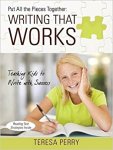
  • Give yourself a refresher course in writing. The book, Put All the Pieces TogPut All the Pieces Together: Writing That Works, by Teresa Perryether: Writing That Works, by Teresa Perry, is an excellent quick reference that can help every writer no matter what their age and expertise. Sometimes, we just need to be reminded of the Basics.

Johann Wolfgang von Goethe is quoted saying: “The person born with a talent they are meant to use will find their greatest happiness in using it.” SO TRUE! When we exercise our writing talents and produce something that makes our hearts sing, our personal happiness zings to the top—and so will the happiness of Readers who purchase our books.

So follow your creative process to success. Enjoy the swirling flavor of your morning coffee and your smooth mulled cider as you release your imagination to the winds. And, when you’re ready, seek the support of publishing experts who will walk with you as you climb the steps to grab hold of your book(s) in print. ⚓︎


Royalene

ABOUT ROYALENE DOYLE: Royalene has been writing something since before kindergarten days and continues to love the process. Through her small business—DOYLE WRITING SERVICES—she brings more than 40 years of writing experience to authors who need “just a little assistance” with completing their projects. This is a nice fit as she develops these blogs for Outskirts Press (OP) a leading self-publisher, and occasionally accepts a ghostwriting project from one of their clients. Her recent book release (with OP) titled FIREPROOF PROVERBS, A Writer’s Study of Words, is already receiving excellent reviews including several professional writer’s endorsements given on the book’s back cover.
Royalene’s writing experience grew through a wide variety of positions from Office Manager and Administrative Assistant to Teacher of Literature and Advanced Writing courses and editor/writer for an International Christian ministry. Her willingness to listen to struggling authors, learn their goals and expectations and discern their writing voice has brought many manuscripts into the published books arena.

In Your Corner: Future-Thinking

When I last blogged three weeks ago, I spent some time looking at the evolution of self-publishing from where (and what) it was when I first got started in the business well over a decade ago to where it is now, in 2017. And the history of self-publishing is, in many ways, a history of self-reflection writ large into the future. One might even say that the self-publishing author is, always has been, and likely always will be, a visionary. But what does that actually mean?

visionary future thinker horizon

A visionary sees things differently.

On a fundamental level, I mean. A visionary thinks in terms, not of what is possible, but what could be possible. And that’s a big difference. When someone is limited by what is versus what could be, the future narrows to predictable outcomes rooted in measurables that exist today. Meanwhile, visionaries have no such restrictions–they’re more interested in creating altogether new systems of thought, of measurement, of ambition. It’s not that the measurables don’t matter at all, or that visionaries are necessarily detached from real-world and present-day concerns, but they do have a dash of something a little bit extra, and the capacity to think outside of the box. To build a new box from scratch–from materials that didn’t even exist when the idea was first born.

Think of Steve Jobs:

In his biography of this tech titan, Walter Isaacson repeatedly mentions Jobs’ predilection for creating devices and inventions for which no infrastructure yet existed. He always had the iPhone constantly in mind, but he had to invent (or reinvent, depending on who you ask) cloud storage–the iCloud–and the software–iTunes and more–to make the iPhone possible. And in the meantime, the hardware itself didn’t exist–he wanted a good camera, a good battery, and a surface that didn’t exist yet.

He made it from scratch, from materials that didn’t yet exist.

That’s future thinking. And this isn’t to reinforce some mythology of Steve Jobs which ignores the other future-thinkers necessary to his enterprise. The iPhone, like everything else at Apple, was a group effort. Jobs first had to recognize a need for, then go looking for, talented engineers and technicians and managers and so on to infinity who could create these as-yet-nonexistent materials and systems. They deserve every bit as much praise.

And together, they made something new.

Self-publishers do this all the time, and they do it in what often comes across as a vacuum. They conceive of a book, but there’s no one on hand–no editors, no agents, no publishers, no marketing team–to make that book come into being. Self-publishers are talent scouts, like Steve Jobs, only on a much tighter budget. They have to be able to construct new ways of getting the job done, using systems and procedures and materials they may never even have heard of. When you think about it that way, it’s clearer than ever that self-publishers are visionaries. Are future-thinkers.

So, what do we do with this information? We find ways to support each other, first of all. We will always have to create some of our own resources, it’s true, but also we ought to support each other in this enterprise. By creating shared resources, by offering support and guidance, and by empowering the individual author to go after that ambiguous, often frightening future.

In my upcoming posts, I’ll be looking at ways we can both become and support future-thinking in self-publishing. Watch this spot!

You are not alone. ♣︎


Elizabeth

ABOUT ELIZABETH JAVOR: With over 20 years of experience in sales and management, Elizabeth Javor works as the Director of Sales and Marketing for Outskirts Press. The Sales and Marketing departments are composed of knowledgeable publishing consultants, customer service reps and book marketing specialists; together, they all focus on educating authors on the self-publishing process to help them publish the book of their dreams. Whether you are a professional looking to take your career to the next level with platform-driven non-fiction or a novelist seeking fame, fortune, and/or personal fulfillment, Elizabeth Javor can put you on the right path.

Tuesday Book Review: “Simple Witness”

Book reviews are a great way for self-publishing authors to gain exposure. After all, how can someone buy your book if he or she doesn’t know it exists? Paired with other elements of your book promotion strategy, requesting reviews is a great way to get people talking about what you’ve written.
When we read good reviews, we definitely like to share them. It gives the author a few (permanent) moments of fame and allows us to let the community know about a great book. Here’s this week’s book review:

simple witness bob siqveland

Simple Witness

by Bob Siqveland

Publisher: Outskirts Press

ISBN: 9781478751588

Synopsis*:

Harold Bartz, aka Bandit, has a low IQ which contrasts sharply with his delusions of grandeur. He flees Minneapolis after witnessing a murder. Once in Las Vegas, rather than hiding, he starts cooking up schemes. His pals, Banger and Diggs, soon join him. Bandit has company in Vegas: Yuri Vostov and Nikki Kerlenko, two Russian hit men sent by the sadistic Jethro Plack. A shady telemarketer, Plack separates guileless customers from their money. His company is in Minnesota, but he oversees Internet swindles from a hidden office in London. Plack’s scam, Fortune Fate Lottery, gains the attention of Sean O’Dell, a St. Paul police lieutenant. O’Dell is investigating the explosion of Internet crime and its elderly victims. “C. J.” Johannson, a Minneapolis cop, is assigned a suicide case. Lana Winton’s death however, doesn’t fit the profile of a suicide. C.J. begins gathering clues that lead him to Plack’s office in St. Paul. Plack’s elaborate scheme has evaded detection thus far. Working against him this time however, is his own man, hacker extraordinaire Tommy Ling, who becomes uncomfortable with the idea of destroying the lives of innocent victims. Ling hatches a plan to scam the scammers and become the Robin Hood Hacker. When Bandit finally comes forward, C. J. can go after Plack for murder and O’Dell can foil Plack’s Internet scheme in London. With Plack behind bars, the Robin Hood Hacker makes headlines while Bandit and his pals stumble into a surprise in Vegas.

 * courtesy of Amazon.com

Featured Review:

Harold Bartz is not your usual guy. He has a low IQ, but he is not exactly dumb. When Harold accidentally witnesses a murder, Jethro Plack, the dangerous mob boss, sends some equally dangerous hit men to end his life. Instead of running for the hills, he starts to make plans, starting a chain reaction that makes things worse. Will Harold be able to save his own life? Or will the mob guys get him and end his plans once and for all?

Simple Witness by Bob Siqveland has many characters and all of them bring something different to the story. With nine main characters, the story should have been confusing and irritating. I was so sure that I would put the novel down after I read the first ten chapters, but my heart was telling me to give this novel a chance. Now, I am so glad that I listened to my heart. The story is phenomenal. It is like reading a movie, the thrill, the mystery and the action of the novel was so real that I could almost feel it happening right around me.

Bob Siqveland wrote such vivid descriptions and imagery that I felt could almost taste the action and the feelings of the characters. Each and every character felt real. The novel is not long and the chapters are short, but the reader does not feel left out. Everything you need to know is there and you do not even have to concentrate really hard to find it. There is a charm in the novel and the way it was written. The dialogues were perfect and somewhat complex.

By the time the reader reaches the fifth chapter, he is invested beyond belief. I was taken away by the story and I forgot where I was. This is perfection and one of the best novels I have read so far this year. There is nothing faulty or even questionable. Superb writing skills, best characters and amazing story line! Five stars for a job well done!

– reviewed by Rabia Tanveer for Readers’ Favorite

 Other Reviewers Are Saying …

Bob Siqveland may not have been a sprinter, but a marathon runner he certainly wasn’t either. This tale starts out at a reasonable pace, and then picks up and up and up until you are racing to the end in a frenzy. Couple that with a cast of goofball characters that draw you into their world, everything from the diabolically evil villain Jethro Plack to the angelically stupid Bandit, and you’ve got a recipe for success. With some chapters as short as one and a half to two pages in length it is amazing how the author packs so much detail into such a small space, and leaves you racing from one chapter to the next in anticipation. This is a wild ride, a great read, and just plain a lot of fun.In a world of such cruel uncertainty as ours, it is good to read a tale where the villain gets his just deserts, the good guy gets the girl, and the clueless actually get a break. But I won’t give away the ending, you’ll just have to read it for yourself, something I highly recommend you do. Page turner, plot twists galore, scenes from stodgy old London all the way to the warm streets of Las Vegas, Simple Witness has it all. A good book I can heartily recommend.

– Amazon Reviewer Amazon Customer

This was an awesome story! I’m not sure where to begin about what I liked best about the book itself so I’ll just start with the writing. Mr. Siqveland is a very intelligent writer. I loved the wide variety of vocabulary in this entire story, he uses many terms that I don’t see often in books.

His writing style was very interesting when he introduces and describes characters and events. I felt like I was watching a movie that Guy Ritchie wrote and directed because Mr. Siqveland’s writing in very similar to how Guy Ritchie tells his stories in his movies. For example, some of the chapters are really short, like two pages short, which is fine because it’s just another part of the story that we as readers are catching up on or we are learning something new. There are many characters involved that are all involved in the plot. Each chapter is the point of view of first person from a different character. In the book, I would read about one character and then the next chapter would be from a character in a different environment who I haven’t heard from since 5 chapters ago. This reminded me of Guy Ritchie’s character jumping in his movies when he switches up his scenes. The banter, wit and charm of the dialogue was entertaining. The way Mr. Siqveland writes the funny banter between characters is very similar to how Guy Ritchie wrote Snatch and Lock, Stock & Two Smoking Barrels; it was sharp and poignant.

Normally I don’t like many references to other works of any kind in books but Mr. Siqveland did a nice job on intertwining references and philosophies in this book. It wasn’t over done and it added to the thoughts and feelings to the story.

Besides all of that, the plot was fantastic! There is quite a lot that happens with various characters. I won’t give anything away. The description might look a little confusing with all the characters and descriptions but the book itself is wonderfully written and flows well so it’s not so confusing.

All the characters were very well developed. I felt like I knew all the characters well and I enjoyed them all. I liked that every character in this story had their own agenda going on while there were so many others involved. Every character was unique from one another and brought something different to the story.

Overall, I would highly recommend this story to anyone that wants to read a very smart interesting thriller. Or if you’re a fan of the movies Snatch or Lock, Stock & Two Smoking Barrels; give this book a chance, I’m sure you’ll like it!

I would like to thank Mr. Siqveland for sharing his work with me, it was a pleasure.

– Amazon Reviewer Protozoan

Book Trailer


tuesday book review

Thanks for reading!  Keep up with the latest in the world of indie and self-published books by watching this space!

Self Publishing Advisor

selfpubicon1

Self-Publishing News: 9.25.2017 – Publishing Trends

september

And now for the news!

Some highlights from this month in the world of self-publishing, specifically regarding publishing trends within the publishing industry, and their implications for all authors!

We’re coming out of the gate with a controversial item today, an article by Gautam Bhatia for The Times of India, one of the region’s most widely-read and well-regarded dailies. In this article, Bhatia digs into what he calls “the rapid privatisation of urban life, and the consequent trivialisation of public culture” and how this has altered public perceptions and quality control in achievement-based celebrations like architectural and literary awards. He hearkens back to a golden age when “Newspapers reported facts; opinions were reserved for the few whose long-term experience of those facts gave credibility to their voice” (which are highly debatable assumptions) and takes time to lament what he considers the downsides of self-publishing, too:

An accountant friend uses Photoshop techniques to make paintings and then sells them as signed prints; another penned a salacious novel, self-published, and critically reviewed and acclaimed by himself on the internet. “I am not a writer,” he claimed modestly, “it just came to me one night.” Both were good reasons for disqualification.

Bhatia is determined to vilify technology, social media, and the “‘I-me-my’ world with its instant gratification [which] has replaced the long-term value of a selective discriminating public space.” What do you think? Do you agree that the way our world works today, including self-publishing, has cheapened perceptions of value and the push for quality? Our own bias may be implicit, but we’re genuinely curious.

On a more positive note, Jane Friedman of Publisher’s Weekly released an article this week about the new ways and means available to authors seeking to reach new readers and therefore sell more books. “Start where you are,” she writes: “Use the power of your community—and the people you know—to gain momentum.” But … how exactly does that work in our modern, tech-savvy age? She argues that “indie authors can become obsessed with Amazon rankings and optimization.” And:

It’s not that those things don’t have a role to play, but national attention and great rankings are sometimes the result of doing a great marketing and promotion job within a community that knows you. It’s often easier to gain traction that way, and encourage word of mouth to ripple further out as a stepping-stone to the more difficult PR wins.

Hm. There’s a lot to unpack in Friedman’s article, which deconstructs the experiences of several specific authors and their books before moving on to providing some key pointers and recommendations. What with Facebook’s targeted ads making news headlines every other week, it’s well worth a look to see what ways going local–and going targeted–can benefit you!

Last but not least, this week we recommend you take a look at a new series just begun on The Guardian‘s website, chronicling the weird little intricacies of making money. This first article traces the path of one book series–J.K. Rowling’s crime fiction series, published under the pseudonym Robert Galbraith–to success. But this article, by Donna Ferguson, has a twist: she wants to know what algorithms have got to say about literature, and about success. Self-publishing only merits a passing mention, but much of the meat and potatoes of the article applies to authors everywhere, no matter their means of publication. “It doesn’t matter whether a book is published as literary fiction, romance, sci-fi, crime or any other genre, there are some latent features of bestseller-dom in manuscripts and these patterns are detectable by a computer algorithm,” Ferguson quotes expert Jodie Archer as saying. What are those patterns? You’ll have to read the full article to find out. And then, of course, report back to us whether it shapes up with your experiences or not!


spa-news

As a self-publishing author, you may find it helpful to stay up-to-date on the trends and news related to the self-publishing industry.This will help you make informed decisions before, during and after the self-publishing process, which will lead to a greater self-publishing experience. To help you stay current on self-publishing topics, simply visit our blog every Monday to find out the hottest news. If you have other big news to share, please comment below.
selfpubicon1