We’ll be back next week with more fresh & original content to get you through the self-publishing process!

Self publishing advice from writing to marketing and everything in-between.




Help! I Have a Brain Injury: And It Feels Like I’ve Dropped Out of the Sky
by Kay Pratt
ISBN: 9781478718079
Synopsis*:
WHAT do you know about brain injury? How does it happen? How does it affect one’s life? What does it feel like? How long does it take to recover from a Traumatic Brain Injury? Will a survivor ever be the same again?
WHAT are your beliefs about the future of someone who’s sustained a Traumatic Brain Injury? The answers to these questions are as broad and unique as the individual’s who have sustained brain injuries. “In my own experience as a TBI survivor, I have come to understand that the degree to which we recover can be measured not only by our physical reality, but, by our personal and caregiver’s belief systems; after all, if, we are cognitively and physically able, what we believe, shapes our every outcome!” Kay Pratt.
In this Book, TBI survivors share the answers to these questions and more through the voice of their experience. It is with sincere hope that by doing so, your understanding and beliefs about brain-injured individuals will be broadened and your perspectives enlightened.

Thanks for reading! Keep up with the latest in the world of indie and self-published books by watching this space!
Self Publishing Advisor


Some highlights from this month in the world of self-publishing, specifically news from or regarding self-publishing companies!
Like it or not, there’s a widespread cultural assumption right now that because bookstore chains are struggling, therefore so too must authors be. Mercy Pilkington of The Good e-Reader is here to complicate that picture with an article that opens with the above provocative question, and sets out to disentangle common misconceptions about the lives of self-published authors as well as their traditionally-published counterparts. So, what, exactly, “does the industry hold for the traditionally published authors, the ones who’ve managed to snag the Holy Grail of writing and find both an agent and a publisher?” Pilkington goes on to answer: “Here’s a hint: the clearance bin at your local dollar store is filled with books that had a traditional publishing deal.” Being traditionally published is no insulation against common market pressures, she infers. Being an author has always, except for the ultra-rare zero-point-one-percent-likelihood blockbuster breakout success, been more about the art than the money for obvious reasons. And Pilkington’s closing thoughts are just as hard hitting. She writes:
But is this a chicken-egg scenario? Are publishing contracts paying authors literally minimum wage because all deals are getting smaller, or are the deals getting smaller because authors are shunning publishers and they aren’t earning as much as they once did? Either way, this situation sheds light on the increased professionalism and credibility that now surrounds the indie author space, indicating that this is (still) a great time to self-publish.
What do you think?
If you haven’t heard about “book-stuffing” … well, don’t worry. Neither had we, until this latest Amazon controversy blew up. Apparently, the self-publishing wing of the website (Kindle Direct Publishing) quietly rolled out some new rules to prevent authors from bundling their books together to get around the page limits of its subscription reading service, Kindle Unlimited. But that’s not where the controversy stops. (This is Amazon after all.) In a turn which surprises no one, Amazon has failed to enforce any of these rules, according to a number of leaders from within the self-publishing community who are pushing for the industry giant to put some weight behind its regulations. The simple fact is that there’s little incentive for the company to do so; its sheer size and its often-accused-as-exploitative author contracts insulate it from many of the ill side effects that the authors themselves will face. The way that Kindle Unlimited is set up, everyone who elect to offer their books through the service is paid out of one shared pot, which is allocated proportionally to its most-read texts. Book-stuffing makes it possible for some authors to exploit loopholes at other authors’ expense, and is therefore not a neutral or mildly problematic activity; it actually threatens livelihoods. Here’s hoping Amazon listens to its detractors and does some enforcement on this issue.
Self-publishing is an emergent opportunity for game design companies these days, with Frontier (above), Bungie, and NieR Studio all making noise in the last few weeks over their intentions to start self-publishing games. Frontier, a British game design company, recently launched an entire self-publishing division after closing down its less successful work-for-hire division. Writes Christopher Dring of GamesIndustry.biz, “It completed its contract with Microsoft (which included the 2015 game Screamride and incubation work on HoloLens), built its own publishing team and now answers only to itself and its shareholders.” The company is now in the process of deciding on how to go about offering third-party publishing to game designers who want to break from the traditional games publishing process. “‘It has to speak to our values,’ [Frontier CCO] Watts says. ‘The games that we make, we want them to be remembered.'” The CEO and CCO of Frontier discuss the elements which make for successful video games, which sound an awful lot like the ingredients for a successful self-published book: authenticity, ambition, attempting something new, and attention to detail. The article serves as a deep dive into the history of one game design company which is “going indie,” but it might just serve as a template to follow for other such companies in the near future.


The self-publishing industry has come a long way since the early 2000’s. Back then, self-publishing a book carried a huge stigma, but today, more books are self-published than traditionally published, and more self-published books are purchased than traditionally published books. Yet, in many readers’ minds, the stigma still exists because self-published books are so often inferior to traditionally published books.
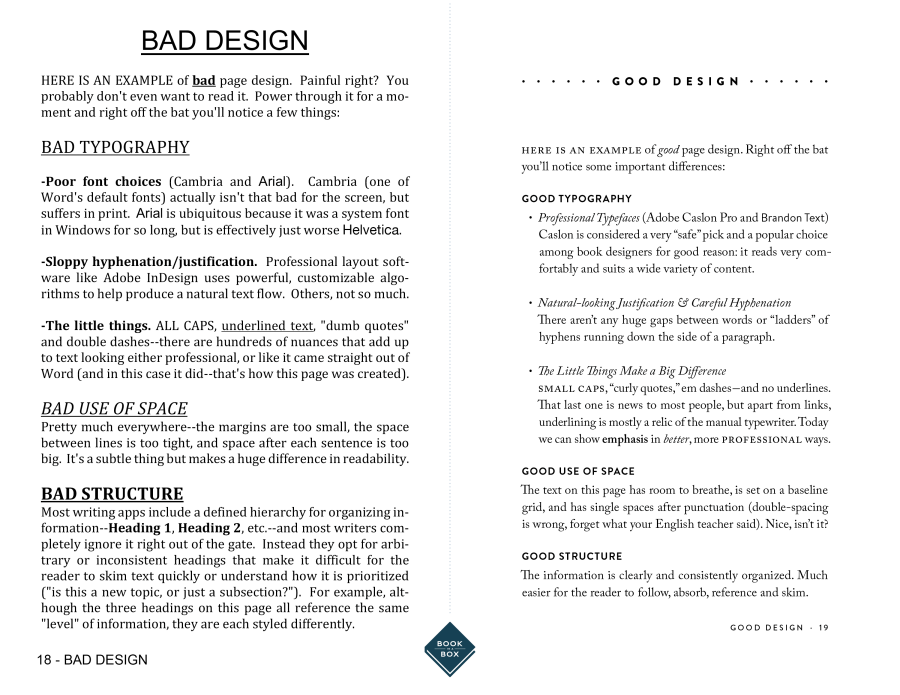
After the cover design, the interior design of your book is what separates most professional self-published books from “free” self-published books. Professional self-published books, like those published by full-service self-publishing providers, feature interior designs formatted by human beings. “Free” self-published books, on the other hand, feature interior designs formatted by computers. The difference, when compared side by side, is staggering. Don’t allow your book to look amateurish and cheap by allowing a computer algorithm to format it for you. Your potential buyers will notice. They may not care who published it; they may think the cover looks great; but without a professional interior, they’re still going to know your book is self-published with just a glance. And, as a result, they’re going to think twice about ordering it.
Fortunately, it’s easy to make your book interior look professional. Nearly all full-service self-publishing providers will professionally format your interior as a part of their publishing package fees. And most will offer you the opportunity of “enhanced” or “custom” interior designs. Don’t pass on this opportunity lightly. While the standard interior formatting offered by most full-service providers is certainly better than anything a computer can do at those “free” places, enhanced or upgraded interior designs typically go one or two steps further – by integrating design elements, unique styles, and customizations to truly make your book one-of-a-kind. The improvement is usually worth the cost of admission.
Page-by-page custom interior designs are best suited for children’s books, or complex literature where the book itself is a work of art, like with some poetry or coffee table books. Rarely does a page-by-page custom design suit a typical black/white fiction or non-fiction work of average length (100-300 pages). The result just doesn’t justify the cost.
When it comes to selecting a standard, included interior, do some research. Look at similar books in your genre and choose a similar style for your book. While a cover should be unique and eye-catching, you don’t want your interior to rock the boat. Give the reader what they expect.
If you choose to enhance or upgrade your interior for a professional format that is more customized to your book and vision, work with your designer closely, and heed his/her advice. After all, this is what they do for a living; they know what they’re doing and their recommendations are worth their weight in gold. If you have a particular vision that contradicts your designer’s recommendations, have a strong, valid reason for going against conventions.
If you choose to publish with a “free” publishing service, format your book in advance and save it as a PDF file. Do not allow their computers to “format” your book for you. That’s a sure way to make your book look self-published and, worse of all, cheap. While formatting a book in Word is acceptable, and certainly preferable to computers, the better alternative is to use design software like inDesign. This is what professional designers use and this is what professional publishers use. Yes, your book’s interior design is that important. Most writers do not know how to design a book in inDesign, which, of course, is why most professional self-published authors use full-service publishing providers.

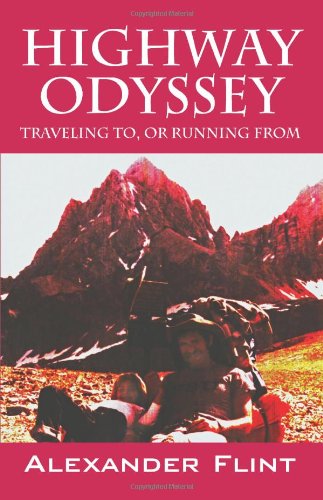

Highway Odyssey
by Alexander Flint
ISBN: 9781432766696
Synopsis*:
Highway Odyssey began in the summer of 1978 with a man and his seven year old son. They drove from New York to Colorado in search of adventure. The man soon realized that he was searching, not for adventure, but for his identity. Having recently been separated from his wife of fifteen years and having five kids together, the man was emotionally overwhelmed by the change in his status.
What was originally planned to be a short visit with old friends turned into an understanding of his responsibility in his position as a single father.
Flint found matters of interest among the culturally diverse families he stayed with and many interesting characters along the way. These events led him to understand the struggle with the self doubts that originated with his rejection from his fifteen year marriage.
Backpacking to the high altitude snow fields of the Grand Teton Mountains in Wyoming, turned into an event that made his seven year old son a candidate for the Guiness Book of World Records. This occurred with the challenge of climbing over a closed pass, without any technical gear, on to Hurricane Pass.
Highway Odyssey covering a period that reaches well back into the nineteenth century and the lives of his ancestors, is based on thoughts drawn into his memory as he drove thousands of miles across highways. Such was his enjoyment, that Flint continued this marathon trek over twenty four consecutive summers. Sitting behind the wheel of his custom van in 1978, Flint begins the examination of his identity.
From rodeo riding, motorcycle touring, competing in hundred mile bicycle road races, pedaling on single track mountain trails with his fat tire bike to ghost towns and overnight horseback trips on the isolated Colorado Trail, Flint found his nirvana.
Through the close connection with his children, the deaths of friends and his parents, this man comes to realize the priorities in his life..
Thanks for reading! Keep up with the latest in the world of indie and self-published books by watching this space!
Self Publishing Advisor
 Self Publishing Advisor