From the Archives: “The Importance of Distribution in Self Publishing”

Welcome back to our new Tuesday segment, where we’ll be revisiting some of our most popular posts from the last few years.  What’s stayed the same?  And what’s changed?  We’ll be updating you on the facts, and taking a new (and hopefully refreshing) angle on a few timeless classics of Self Publishing Advisor.

∗∗∗∗∗

[ Originally posted: April 6th, 2010 ]

If a publisher focuses on discounts to an author who buys their own book in bulk, that often communicates two things. 1) That publisher is more concerned with selling to you than to other readers. 2)  The publisher is charging you too much for lower quantities. Do you really want to be forced to buy 100 books at a time just to get a fair price? “Bulk” discounts simply trick the author into buying more books than they need, which defeats the whole advantage of on-demand printing.

I’ve seen many authors go down that road, and then end up with lots of books sitting in their garage or basement that no one knows about, because the distribution piece is missing.  The power of the on-demand printing and EDI distribution offered in custom self-publishing take advantage of wholesale availability via multiple sales channels including Amazon, Barnes & Noble, Borders, Baker and Taylor, and Ingram—North America’s largest distributor.  Look also to see that your book is available through I-Page, the book ordering system available at over 25,000 bookstores and retail chains world-wide.

Do look also for a publisher that will sell your book to you at a special author discounted price as well.  It’s never a bad idea to have access to an inventory to compliment your virtually endless on-demand inventory.

The power of distribution when paired with flexible pricing creates an advantageous sales combination for the self-publishing author.

distribution

There’s no easy way to sell books, but as this post back in 2010 points out, there’s no point to purchasing in bulk if you can’t actually move the copies into the hands of your readers.  And as the original post expounds, an effective means of distribution remains absolutely essential in order to steer clear of stocking your basement and not those same readers’ bookshelves.

So how do you distribute books?  Word-of-mouth can work, certainly, as is illustrated by the extraordinary case of Christopher Paolini, although one might argue that his case is only extraordinary because it was eventually “discovered” by the traditional publishing industry and afterwards became a massive hit.  Paolini only relied on word-of-mouth and his own ardent self-marketing methods for a short while, when looking at the total “life cycle” of his Inheritance series.

It seems that selling through an online distributer is perhaps the way to go, especially when those distributers (namely, Amazon and Barnes & Noble) come with all of the might and power of a massive international company.  There are certainly some extraordinary benefits to taking advantage of their systems, toward which end many hybrid publishing companies (such as Outskirts Press) provide packages geared specifically to exploit.  And their digital distribution platforms, while perhaps too bulky to be truly “cutting edge,” do have all of the perquisite customer support and technical maintenance that you could wish for.  There’s always an upside to walking down a path that many others are also walking down.  (I’m thinking specifically of user how-to guides and FAQ forums, here––since I take advantage of those, and often.)

The ultimate point is, however, not to rely on making bulk purchases of your own book as an author, even with the possibility of an author discount.  You want readers to be connecting some of the dots themselves, and buying through these (socially networked and easily findable) ecommerce platforms instead of only through you.  If you are the only person who is selling your book, then that creates a kind of bottleneck for sales.  Diversifying who sells your book and where it can be found is a vital component of any effective self-marketing strategy.  ♠

KellyABOUT KELLY SCHUKNECHT: Kelly Schuknecht is the Executive Vice President of Outskirts Press. In addition to her contributions to the Outskirts Press blog at blog.outskirtspress.com, Kelly and a group of talented marketing experts offer book marketing services, support, and products to not only published Outskirts Press authors, but to all authors and professionals who are interested in marketing their books and/or careers. Learn more about Kelly on her blog, kellyschuknecht.com.

News From the Self-Publishing World: 10/19/15

This week in the world of self-publishing:

This week, the interview that caught our eye was one between Sussex author Fiona Cane and Argus news editor Lucy Pearce, published on October 16th.  In the interview, Cane reveals that Peter James and Eddie Izzard had a hand in her choice to pursue self-publishing her latest book, The Other Side Of The Mountain.  “It’s just so difficult now; publishing companies take on maybe one or two authors a year,” says Cane.  But she didn’t want to become bogged down in the politics of publishing––she wanted to get her book out there, despite encouragement from other quarters to chase after a more traditional route to publication.    The Other Side of the Mountain is not Cane’s first book, but it is the one she is most proud of: “It is much more the book I have always wanted to write but was never sure if I could.”  Lucky for us that her childhood schoolfellow Izzard happened to stop by with some sage words of wisdom at just the right moment!  “He told me that I had to really push, and want it, and believe,” says Cane.  And now we have yet another stellar entry into the canon of self-published geopolitical dramas; The Other Side of the Mountain takes place in Haiti in 2001, and amidst the political and social chaos of that year.

Ever wondered where exactly AmazonCrossing stands in respect to the world of self-publishing?  How about self-publishing abroad?  Just last week, on October 15th, Porter Anderson of The Bookseller published an article with some of the much-needed details––but he admits that it wasn’t easy to put together the material: “As more indie authors focus on opening international markets, more questions than answers are at hand. It is early days in the deep field of foreign self-publishing.”  According to Anderson, the matter of translation remains a huge stumbling block for foreign authors seeking self-publication; AmazonCrossing has, however, been taking steps to help ameliorate the difficulties.  Quoting Chad Post, director of the University of Rochester’s (New York) Three Percent translation project, Anderson reveals one key detail: “With more than 150 books translated now, this Amazon Publishing traditional imprint has become the US’ most prolific translation publisher.”  That’s a lot of books, but it’s nowhere near, in our humble opinion, enough!  (Though let’s face it, there will never really be enough….in our opinion.)  Throughout the remainder of his article, Anderson attempts to unspool some of the complicating factors that surround self-publishing a translated work (or, more correctly, finding cost-effective ways to translate your already self-published book).  Well worth a read, we think.

It’s an exciting time to be a Green Bay Packers fan!  Daniel Kramer, son of the legendary Packers player Jerry Kramer, recently revealed his plans to fund and self-publish a book of his photography and essays to PRNewswire in an October 15 press release.  The project, which is being funded by a Kickstarter campaign (ending on October 20th), reached its funding goals days before its deadline … and then some.  The book itself, which takes a close look at the 1996-1997 football season, will include material co-written with award-winning author Dick Schaap and feature Jerry Kramer’s own photography, taken on the ground with a privileged insider’s view of the goings-on.  The book will be released on the 20th anniversary of the season it documents.  And even if you’re not a Packers fan, any self-published, crowd-funded project that reaches this kind of stratospheric public acclaim is very, very good news.

In more news from across the pond, celebrated Blues scholar Adam Gussow is releasing his first piece of fiction––a novel, to be precise––through BookBaby.  In an October 15th article for HottyToddy, senior managing editor Callie Daniels Bryant writes that Gussow’s book is already receiving stellar reviews on Kirkus, where the book is said to be “a fast-paced, enjoyable one, with the harmonica blues angle putting a unique spin on the European trip narrative.”  If that isn’t enough to whet your appetite, consider the fact that Gussow is “noted for his longtime partnership with guitarist Sterling “Mr. Satan” Magee as the duo Satan and Adam.”  As a self-publishing author, Gussow has found success through alternative means of self-marketing, and has captured the attention of many potential readers through his carefully curated YouTube channel.  Gussow’s own experience as a street performer, or busker, provided much of the fundamental texture of his novel––Busker’s Holiday––so necessary to conveying the actual and authentic experience.  If you’re looking for something to take away from the news this week, here it is: the pairing of authenticity with a tech-savvy approach to social media may just be the start of something great.


As a self-publishing author, you may find it helpful to stay up-to-date on the trends and news related to the self-publishing industry.This will help you make informed decisions before, during and after the self-publishing process, which will lead to a greater self-publishing experience. To help you stay current on self-publishing topics, simply visit our blog every Monday to find out the hottest news. If you have other big news to share, please comment below.

KellyABOUT KELLY SCHUKNECHT: Kelly Schuknecht is the Executive Vice President of Outskirts Press. In addition to her contributions to the Outskirts Press blog at blog.outskirtspress.com, Kelly and a group of talented marketing experts offer book marketing services, support, and products to not only published Outskirts Press authors, but to all authors and professionals who are interested in marketing their books and/or careers. Learn more about Kelly on her blog, kellyschuknecht.com.

The Current State of E-Readers | An Author’s Guide (Part III )

Did you know that Barnes & Noble sells an e-reader?  If you haven’t stopped by one of their brick and mortar stores in the last few years, you might never have known.  This is because the tablet in question never quite got the sales momentum that its primary rivals, the Kindle and the iPad, had automatically built in.  (More on that in a moment.)  And the NOOK, as Barnes & Noble has dubbed their creation, already seems to be on the way out.  I stopped by a Barnes & Noble while driving through central Montana, and … gone are the enormous beautiful displays, the wide sweeps of banners and posters emblazened with larger-than-life-size images of the tablet, its logo, and cheery recommendations on what ebook to read next.  It looks as though we’re back to basics when it comes to our favorite (by default, since it’s our only) big brick and mortar bookstore!

But what about the NOOK?  Should you as an author care about the rise and fall of this non-gargantuan piece of technology?  The short answer is yes.  The reasons why can never quite be summarized as a “short answer,” but I’ll do my best to stick to the important bits.

William Lynch, Chief Executive Officer of Barnes & Noble, holds up the new Nook Tablet at the Union Square Barnes & Noble in New York

The first NOOK was launched in October 2009, almost exactly six years ago.  By 2011, the NOOK had captured approximately 13.4% of the total global market share for e-reading devices.  But as 

The NOOK store still does brisk business.  This is in part because readers still love a good physical book in hand, and B&N is now the only large remaining bookseller, and therefore it has both a solid built-in captive audience for its internal promotions.  It may also be attributable in part to the parent company’s deft hand at package deals and perqs.  (If you bring your NOOK into a B&N store, you have free access to their entire ebook collection while there!  Who knew?  Not me, until I started researching for this blog post!)  Here are the numbers according to number-crunching website Statista.com:

NOOK sales according to Statista

As you can see, NOOK sales are certainly, shall we say, “plunging.”  But Statista still reports approximately $263.8 million dollars in sales for 2015 to date, and that’s not an insignificant percentage of the total ebook market.  The real concern, for you as an indie or self-published author, is whether any of those sales translate into profits for authors outside of the traditional Big Five publishing houses.  And that data simply isn’t available, though anecdotal evidence seems to indicate that the NOOK store is not the most profitable place to publish your ebook.  Which is not to say that it’s not a worthwhile place … however, it’s far more likely you’ll connect with a greater number of new readers through the Amazon Kindle store or through Apple’s iTunes/iBooks interface.  This is because most search engines and indexing algorithms will promote results in these two digital stores over that of Barnes & Noble, for whatever reason (and there may be several reasons, some shady and some legitimate, and some mere rumors).  And although Kindle sales have fallen and tablet sales seem to have plateaued across the entire global market, Amazon and Apple have both proven innovative and flexible enough to roll with the punches, and their devices have held up better to changing market demands.

Half of your job as a self-published author is to tackle matters of self-promotion and marketing with the business acumen of an entire PR department and the ruthlessness of a CEO.  Is a strategy proving ineffective?  On the chopping block it goes.  Is one particular edition of your book not selling?  Out the window, sayonara.  Is a social media platform or blogging interface sucking up more of your time than seems worthwhile when balanced against outreach to new readers?  It may be time to refocus.  This is why it’s so vital that you know what’s going on with the NOOK before you decide whether or not you want to pay a hybrid publishing company to publish or spend hours of your own time agonizing over the creation of an ebook edition to sell on the NOOK Store.  If your book is already moderately successful, you may find that it helps round out your total bundle of offerings.  But if you’re just starting out and you don’t have much of a budget, you may want to stick with options that are guaranteed failsafes.

Don’t despair for the NOOK.  Just don’t be sucked into thinking that, just because Barnes & Noble has been around a long time (and now enjoys a certain kind of monopoly over the physical bookstore market), readers will pay back your investment in the NOOK store with any kind of enthusiasm.  As the ebook and ereader markets mature, one thing is becoming increasingly clear: more iterations of the same device will not equate to more ebooks sold and read.  In fact, readers are turning back in droves to the physical book … and that’s not such a bad thing, in the long run.

Thank you for reading!  If you have any questions, comments, suggestions, or contributions, please use the comment field below or drop us a line at selfpublishingadvice@gmail.com.  And remember to check back each Wednesday for your weekly dose of marketing musings from one indie, hybrid, and self-published author to another. ♠

KellyABOUT KELLY SCHUKNECHT: Kelly Schuknecht is the Executive Vice President of Outskirts Press. In addition to her contributions to the Outskirts Press blog at blog.outskirtspress.com, Kelly and a group of talented marketing experts offer book marketing services, support, and products to not only published Outskirts Press authors, but to all authors and professionals who are interested in marketing their books and/or careers. Learn more about Kelly on her blog, kellyschuknecht.com.

The Current State of E-Readers | An Author’s Guide (Part II)

Last week, I launched us into a new series about e-readers, and the pros and cons of using each different e-device (don’t worry, this won’t be quite the epic saga that the Beginner’s Guide to Social Media primer turned out to be!).  This week, I’ll be taking a closer look at perhaps one of the most talked-about e-readers of all time, the Kindle.  No doubt you’ve heard a lot about Amazon’s entry into the e-book sphere before, and elsewhere, in part because it was launched by a massive company still on the upswing in popularity, with the built-in infrastructure to ensure a strong debut––and in part because it remains a solid performer, especially in its newer incarnation, the Kindle Fire.

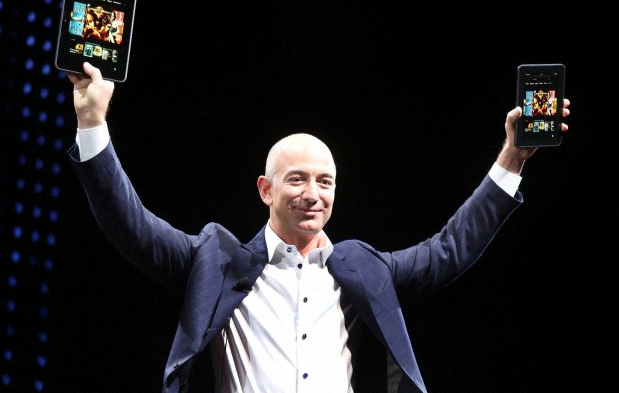
jeff bezos with the kindle
Amazon CEO Jeff Bezos with the new Kindle Fire HD

Just how many people own a Kindle?  A 2014 Forbes article reported that “roughly 43.7 million Kindle devices had been cumulatively sold till the end of 2013,” but, well, Amazon isn’t really talking, except when it’s super proud of itself, so the data Forbes was using may or may not be representative.  Even though in 2014 the Pew Research Center was marking an uptick in e-reader (specifically, Kindle) and everyone seemed, for the most part, highly optimistic about e-readers and therefore e-book distribution, some more recent data seems to indicate a plateauing of that trend … if not a slight reversal.  According to an article by Business Insider contributor James Cook, “for the first time ever the number of tablets shipped has decreased”––and Amazon’s Kindle line has been the hardest hit, with a decrease of some 69.9% in respect to shipments.  That’s a lot.  And the numbers are still so new that few tablet users are speculating yet as to why the Kindle has taken the brunt of the market change.  Is it because users have grown bored, or because Amazon hasn’t reinvented the wheel since the Kindle Fire was released two years (or two lifetimes, in today’s rapid-fire technology-hungry universe)?  But wait––what about the Kindle Paperwhite (the “Kindle 3”)?  Why does nobody seem to be getting on the Paperwhite train?  Is it because people are actively migrating away from Amazon, or from tablet computers, or from e-books?  The numbers seem to be holding mostly steady for e-books downloaded and read, so what’s the deal?

I’ll let you know as soon as I know.

Still, in the meantime, here’s what you need to know about the Kindle (Fire and Paperwhite):

They’re beautiful devices, designed and manufactured specifically to make thumbing through your digital library as tactile and responsive a practice as running a hand across a physical bookshelf––or at least, these e-readers are about as close as you can get without engaging your sense of smell.  (They do, however, make use of your fingertips and your ears as well as your eyes.  There’s some benefit to a multimodal interface, in terms of absorption of information, or so I’ve been told.)

And don’t forget that while sales may have dropped this last year (and significantly), the Kindle and Kindle Fire have out-sold almost every other dedicated e-reading device out there.  There are millions––dozens of millions––of Kindles out there already in use.  So yes, it still remains completely and absolutely worthwhile to sell your book as an e-book edition through the Kindle Store.  The total number of units sold alone should indicate this, but as the aforementioned Pew Research Center report also says, 3 in 10 American adults read an e-book last year, most of them on a tablet or dedicated e-reading device.  That’s a lot of e-books, my friends.  And Jim Tierney over at Loyalty360 reports that Amazon Prime Membership jumped by 53% in 2014––to around 40,000,000 (that’s 40 million) total adults.  And what with the advent of the Kindle Lending Library––a controversial offering, to be sure––Prime subscribers can opt to read certain select e-books for free.  That’s a lot of potential future readers.

Not much has changed when it’s come to the disadvantages of owning a Kindle, except for the fact that Amazon has taken away any grounds for complaint about the graphics, display quality, and user interface.  Their customer support system is pretty nifty, too, and users seem to like it.  No, you still can’t take the Kindle into the bathtub with you, and you probably don’t want to hurl it off the edge of a parking garage unless you actually want to watch it break, but these tablets do qualify as robust, insofar as tablets are allowed to.  Lending books to friends is possible, but still not quite intuitive.  Universities are starting to get on board with letting students use e-book editions for courses, but this still remains an underutilized possibility.  And no, it’s not an actual book you can hold in your hand and sniff for that “old-book” smell.  (But that’s what perfume is for, right?!)

I’m not about to try and sell you on buying a Kindle––or any e-reader, for that matter––but I do think it’s worth oohing and aaahing a little over the modern creature comforts technology has provided us.  An interlinked dictionary that I can access while reading?  Handy.  Highlighting and bookmarking?  Essential.  And much more difficult to “lose” when we’re speaking of a digital item.  And it’s nice, too, to have the option of reading multiple file formats on the same dedicated e-device without having to switch between apps.  PDFs?  No problem.  TXT?  DOC?  The Kindle’s got you covered.  And for now, people aren’t quite tossing them in a blender just to watch sparks fly, so I wouldn’t quite put up the crime scene tape just yet––if Amazon has proven anything, it’s proven just how much it loves to be on top!

Thank you for reading!  If you have any questions, comments, suggestions, or contributions, please use the comment field below or drop us a line at selfpublishingadvice@gmail.com.  And remember to check back each Wednesday for your weekly dose of marketing musings from one indie, hybrid, and self-published author to another. ♠

KellyABOUT KELLY SCHUKNECHT: Kelly Schuknecht is the Executive Vice President of Outskirts Press. In addition to her contributions to the Outskirts Press blog at blog.outskirtspress.com, Kelly and a group of talented marketing experts offer book marketing services, support, and products to not only published Outskirts Press authors, but to all authors and professionals who are interested in marketing their books and/or careers. Learn more about Kelly on her blog, kellyschuknecht.com.

From the Archives: “Using Listmania to Promote your Self-Published Book”

Welcome back to our new Tuesday segment, where we’ll be revisiting some of our most popular posts from the last few years.  What’s stayed the same?  And what’s changed?  We’ll be updating you on the facts, and taking a new (and hopefully refreshing) angle on a few timeless classics of Self Publishing Advisor.

∗∗∗∗∗

[ Originally posted: August 22nd, 2008 ]

If your self published book is available on Amazon.com, there are a lot of ways to promote it.  Since Amazon sales should account for a large percentage of your overall book sales, this site is a good place to concentrate a lot of your efforts.

I’m going to tell you about creating a “listmania” list on Amazon. Have you ever noticed when you browse for something on Amazon, there are lists that are related to that subject that are mentioning other books and/or products?

By strategically listing products on your lists, (including YOURS of course), you can start to generate more traffic to your book listing.

Here’s how YOU can create just such a list:

Sign up for an Amazon Author Connect account if you don’t have one yet. Or sign-in to your current account.

Click on your personal “store” on the top tabs. Then select “Your Profile” from the sub-menu.

You will see lots of things you can personalize, including your bio and your online photograph.

But scroll down and you will see a section called “Listmania!” And this is where you create a listmania list.

Creating a Listmania List is a good way to increase exposure for your book.

Obviously, you want to ensure that your book is on your list.

But the real trick to a successful Listmania list depends upon the OTHER books you put on your list, the ones written by other people.

There are two ways to go about it.

1 – Adding books to your list that are applicable to your subject. The idea behind this concept is easy — if someone reads your list because they were browsing a similar book, they’ll be more apt to buy YOUR book because they’re interested in the subject.

2 – On the other hand, you can add very popular books to your list, since more people may have a chance of seeing it, even if fewer of them will be interested in your book.

I recommend creating multiple lists and trying different tactics to see which is more successful. Amazon lets you track the number of times your list was viewed. Use these numbers to create better lists in the future.

If you have more specific questions about creating a listmania list, the Amazon FAQ will help you.

Amazon Listmania

So here’s the thing: Listmania doesn’t really exist anymore!  Back in 2013, Amazon ceased offering support and guidance on using the Listmania interface, and it was entirely dismantled and rendered unusable over the months following.  (Adrienne Dupree over at Leave The Corporate World Behind even wrote a lovely little lament to mark its final passing.)  And this fact means that, on the one hand, we have to throw the baby out with the bathwater when it comes to our original post … but on the other hand, this presents the perfect opportunity to present you with new and fresh ways of utilizing Amazon for your self-promoting and self-marketing ends (as a self-publishing author).

First, we need to break down exactly what Listmania offered the average author.  Essentially, this featured compiled lists–and this makes sense, given its name–but it was not to be confused with Amazon’s wish lists, gift lists, and registries, or even Goodreads’ Listopia lists (which still exist).  These lists were designed to focus a reader’s attention on products that were similar or in some way related to products that a customer had already been viewing. By strategically listing popular products on your lists, including your own book, you were–in theory–able to generate more traffic to your book listing when people viewed your Listmania lists.  This brings us full circle to that one key word I’ve been lobbing around a lot lately: findability.  An Amazon Listmania list was supposed to render you and your book more findable, but to many people it remained just another one of the giant retailer’s many algorithmic mysteries.

And yet … findability remains important.  There simply are better ways of going about it!

Here are my top 3 recommendations for filling that gaping hole in your heart once occupied by Amazon Listmania:

  1. Start a Pinterest page.  Not just any Pinterest page, mind.  (And I’ve written about Pinterest recently in depth, so I won’t make like a broken record and repeat myself too much here.)  Whip up a Pinterest page (or “pin” to a “board”) where you collect together other books along with other somehow related objects that your ideal reader might want to purchase.  For example, someone who reads Hugh Howey’s Wool might want to pick up some tickets to tour the Titan Missile Museum outside of Tucson, or perhaps some Wool-inspired art prints.
  2. Create a public Amazon Wishlist.  This is easy to do, and it serves much the same function as a Listmania list–only, you’ll have to do a touch more legwork to advertise the list’s existence, since these wishlists aren’t necessarily designed to be searchable.  For more information, hop on over to the Amazon how-to page for wishlists, and peruse at your leisure.  Each wishlist is shareable across any platform you might wish, and you can snag a web link to copy and paste into emails or Twitter, Tumblr, Facebook, Instagram, or any other kind of social media feed you can imagine.
  3. Take a stab at an entirely new social media platform.  The reason why Listmania disappeared is that nobody was using it, or at least, too few people were using it to make it worth Amazon’s efficiently allocated time to advertise and maintain.  It had a function, but it wasn’t one that really connected with Amazon’s user base.  To make yourself findable these days, you must needs throw yourself into the post-millennial age, and go where your readers are.  I’m not necessarily an advocate of just trying anything–you should always do a little cross-demographic market research to see if your readers actually are the sort who use Snapchat or Instagram or Tumblr or Twitter–but as a good friend told me last week, “Just doing what you’ve always done and expecting things to improve is a special kind of lunacy. Sometimes you have to innovate.”  So–innovate, with calm but cautious optimism. ♠
KellyABOUT KELLY SCHUKNECHT: Kelly Schuknecht is the Executive Vice President of Outskirts Press. In addition to her contributions to the Outskirts Press blog at blog.outskirtspress.com, Kelly and a group of talented marketing experts offer book marketing services, support, and products to not only published Outskirts Press authors, but to all authors and professionals who are interested in marketing their books and/or careers. Learn more about Kelly on her blog, kellyschuknecht.com.