News From the Self-Publishing World: 11/02/15

This week in the world of self-publishing:

The big news this month is, of course, the yearly advent of NaNoWriMo (National Novel Writing Month), a challenge undertaken by tens of thousands of people the world over––including around four thousand in India.  Aditi Maithreya, in a November 1 article for the Times of India, reports on what writers are doing there.  According to Maithreya, one Chennai-based blogger, Nandhithaa Hariharan, says that “Many of us have a story at the back of our minds but are lazy to write. The challenge brings in a kind of discipline that pushes you to pen down your thoughts.”

Camp-Participant-2015-Web-Banner

Hariharan, who is based out of Chennai, is undertaking NaNoWriMo for the first time, but many writers in India return year after year to write 50,000 words in the month of November.  And because NaNoWriMo operates outside the boundaries of traditional publishing, Maithreya writes, it presents opportunities to writers of regional dialects and fringe interests in a way that intersects nicely with self-publishing.  Depending on circumstances and output, participants may be eligible to receive discounts on Scribner, a manuscript-friendly word processing software program, or to receive free e-book editions of their novels.  But NaNoWriMo writers must remain cautious, Maithreya warns, especially since the breakneck pace of writing so many words a month can lead to loopholes and continuity errors slipping in under the radar.  She quotes Mumbai author Neil D’Silva, who warns participants that “NaNoWriMo writers must remember that after the first draft they need to edit and proofread before publishing.”  Luckily, there are plenty of services out there to help move busy authors from first drafts to final ones.  For more information, check out both Maithreya’s article and the NaNoWriMo website.


If you’re participating in NaNoWriMo 2015, we’d love to be there to support you!  Drop a line in our comments section to let us know, or send us the link to your NaNoWriMo profile and we’ll follow your progress and keep the digital equivalent of coffee and pep talks waiting in the wings.


If you were wondering, India is a phenomenal powerhouse of a market when it comes to the publishing industry, but it’s also rapidly becoming a leader when it comes to self-publishing, as well.  In another November 1 piece for the Times of India,  Gunjan Verma transcribes an interview with the freelance writer and self-published author, Ganesh V., whose debut book (The Underage CEOs) follows the stories of eleven successful student entrepreneurs.  When asked about his thoughts on where readers are at in respect to self-publishing, Ganesh V. replied that “the audience is ready. They want to read different genres, especially something which is off literary fiction. People [have] realized that heavy literary fictions are not for the masses and so the mood of the audience currently is right for the content which resonates with the common man.”  By simultaneously providing both a broader appeal and more niche genres, self-publishing simply presents both readers and writers with more options, Verma reports.  Before his book, says Ganesh V., “no one wrote about student entrepreneurs who dared to do something different. These are young entrepreneurs, in their 20s, who have just finished college and said a ‘No’ to the conventional path of the corporate world.”  Sounds like a fitting entry into the canon of self-publishing masterpieces, doesn’t it?  For more of this week’s interview, drop on by Verma’s article.

The numbers are in, reports Tom Holman, as of his October 29 report for The Bookseller.  The big takeaways are as follows:

1. Mobile overtakes tablets and dedicated e-readers as the device of choice […]

2. Digital sales are still growing, but they are also slowing […]

3. Self-love levels recede as many indie authors report lower satisfaction levels […]

4. Publishing remains very much divided on matters digital […]

5. … And the majority believe publishers remain unprepared for what is coming [….]

And while I’d love to sit here and unpack these points first thing on a Monday, I think you deserve more and better than that.  So, as I wrap up my Wednesday series on e-readers, I’ll be turning my eye towards this year’s Digital Census and the other materials that have emerged from The Bookseller’sFutureBook” conference that have profound implications for the self-publishing author.  There’s a lot to take in.  In the meantime, check out Holman’s summary of events!


As a self-publishing author, you may find it helpful to stay up-to-date on the trends and news related to the self-publishing industry.This will help you make informed decisions before, during and after the self-publishing process, which will lead to a greater self-publishing experience. To help you stay current on self-publishing topics, simply visit our blog every Monday to find out the hottest news. If you have other big news to share, please comment below.

KellyABOUT KELLY SCHUKNECHT: Kelly Schuknecht is the Executive Vice President of Outskirts Press. In addition to her contributions to the Outskirts Press blog at blog.outskirtspress.com, Kelly and a group of talented marketing experts offer book marketing services, support, and products to not only published Outskirts Press authors, but to all authors and professionals who are interested in marketing their books and/or careers. Learn more about Kelly on her blog, kellyschuknecht.com.
The Current State of E-Readers | An Author’s Guide (Part V––iPads )

I started off this series by examining the Kindle, and then the NOOK, and then the Samsung Galaxy Tab.  This week, I’m going to take a (quick) look at the whole suite of Apple products that have by and large eroded any hold the dedicated e-reader held over the general reading public.  I’m talking about the computers you carry around in your pockets and backpacks, the mobile forward operating bases and command centers of your life, the little devices that have had a big impact on how we interpret our lives and arrange our days: the iPhone and the iPad.  Apple manufactures laptops, too, though making room for more traditional computers in this conversation might lengthen it to a mere century or two in length.  You might say that I could “talk for hours” about the changing role of the home or personal computer in everyday life.  I’m just going to allude to the fact that you can use an Apple Air or its predecessors to read e-books, using the same apps you might use on your mobile device.

It’s possible. It’s just that a laptop tends to not be the preferred device for most consumers who own more than one kind of Apple device.  And there are a lot of people who own multiple Apple devices.  In 2012, USA Today reported that roughly half of American households had at least one Apple product.  And the numbers didn’t end there; the article also stated that: “Americans don’t stop with just one device. Homes that own least one Apple, own an average of three. Overall, the average household has 1.6 Apple devices, with almost one-quarter planning to buy at least one more in the next year.”  And that was in 2012!  And when it comes to the iPad specifically, there’s even more reason to be hopeful: according to a report from the Stamford Advocate (drawing upon a longer piece for the Business Insider)  that’s so hot off the press it might smudge if you even look at it, Apple Inc just reported its quarterly earnings and the outlook for iPads remains good, despite a slight decline in total global tablet sales.  The Stamford Advocate’s Jay Yarow records Apple’s CEO Tim Cook as saying: “70% of people planning to buy a tablet plan to buy an iPad, per [a] ChangeWave survey.”  Seventy percent!  And that’s on top of the 200+ million units sold prior to 2014.  So, in summary … there are a lot of iPads out there, and there will be plenty more, as Apple continues to dominate the tablet market.

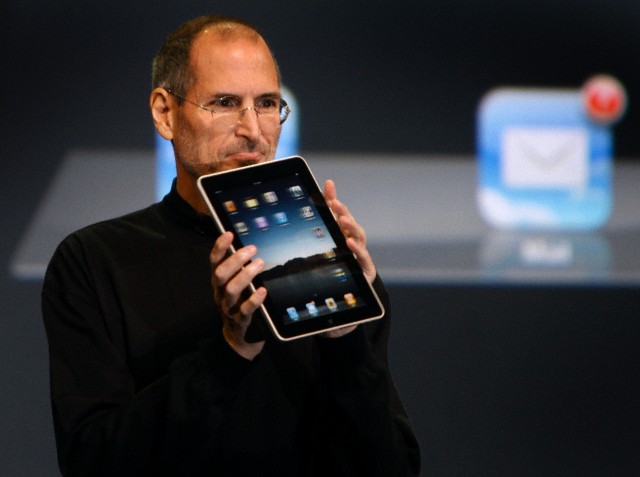
steve jobs with ipad

But what does this mean for you as an indie, hybrid, or self-publishing author?  Do people really use iPads the way they would use dedicated e-readers like Kindles and NOOKs?  As illustrated by this article for PC Magazine, the matter of what constitutes a dedicated e-reader and how it’s different from a tablet like the iPad has grown steadily more confusing.  Everyone more or less admits that they like the look and feel of the dedicated devices (which eschew backlighting, making for a more comfortable experience) but they are more likely to purchase a tablet like the iPad because of its versatility.  An iPad can simply do more, the general opinion runs, even though many devices like the new Kindle have a whole suite of apps a la tablet, and many tablets (including the iPad) have Kindle apps to sync a person’s reading experience via the Cloud.

In theory, it would be entirely possible to own a Kindle, an iPhone, an iPad, and a Macbook laptop, and move seamlessly from one device to another, picking up on one where you left off on the other––including if you happen to be listening to an audiobook version on your iPhone and use the WhisperSync function.  WhisperSync means you no longer have to worry about trying to find your place, even if you’re switching back and forth between reading and listening to a given book.  (Have I mentioned that I “nerd out” over technological innovations like this?  Ones that actually make life easier?  I do.  Often.)

So, yes, people really do use their iPads as their primary reading devices, in part because they’re so easily integrated into a larger “reading experience” as designed and made possible by Apple’s entire product line.  And because the iPad runs on an app-based (or “application-based”) operating system, you as an author need to know how best to make your books discoverable to the average iPad user.  Consider this list by ZDNet of top ebook apps as downloadable through the App Store:

  1. iBooks (Apple’s own signature e-reading app)
  2. Amazon’s Kindle app
  3. Barnes & Noble’s NOOK Library app
  4. The Kobo Books app
  5. The Google Play Books for iPad app
  6. The Bluefire Reader for iPad app

… and it’s worth noting, before even discussing the pros and cons of each app, that all of these apps are downloadable for free through the App Store, even if the content for them must be subscribed to, purchased, or loaned (in the case of both Bluefire and the Overdrive Media Console app, which are favorites of many public libraries which offer downloadable ebooks in addition to their physical lending collections).  Books with half a century under their belts are (for the most part) available under Public Domain, and many of these classics are available for free in a variety of formats.

Now, don’t get me wrong, but even while all of this is great news for readers, it doesn’t necessarily make for light work for you, the indie author.  Why?  Because, with so many reading app options easily available on the iPad, the chances of readers discovering your work diminishes with every app your book is not available through.  Not to mention, you probably want to make a profit, so a library’s free ebook loaning system doesn’t benefit your bottom line at all––unless readers run out of time and end up purchasing a copy in order to finish (which does, on occasion, happen).  In summary, it’s a good idea to cover all of your bases and not just the “big three” of ebook sales (Amazon, Apple, and B&N).  Google Play has been on the uptick ever since its creation as the primary sales conduit to devices running Android operating systems, but now it’s emerging as a contender for iPad owners as well, after the development of an attractive and intuitive app for iPads.  The Kobo Books app and the Adobe Reader app should also be kept in mind––many readers enjoy the streamlined experience of opening .PDF files with the Adobe Reader app, so you should not rule out offering a .PDF download of your book through some online retailer or your own personal website.  Basically, the more places a reader is likely to see your book, coupled with more ways and editions and formats in which it can be downloaded, the more likely that reader is to spend hard-earned currency on purchasing your book.  Balancing expense (of time, energy, and money) against discoverability is, perhaps, one of the trickiest of self-marketing arts that you must master––but you’re not alone.  We’re here to help, and to be a sounding board for your own strategic plan!

Thank you for reading!  If you have any questions, comments, suggestions, or contributions, please use the comment field below or drop us a line at selfpublishingadvice@gmail.com.  And remember to check back each Wednesday for your weekly dose of marketing musings from one indie, hybrid, and self-published author to another. ♠

KellyABOUT KELLY SCHUKNECHT: Kelly Schuknecht is the Executive Vice President of Outskirts Press. In addition to her contributions to the Outskirts Press blog at blog.outskirtspress.com, Kelly and a group of talented marketing experts offer book marketing services, support, and products to not only published Outskirts Press authors, but to all authors and professionals who are interested in marketing their books and/or careers. Learn more about Kelly on her blog, kellyschuknecht.com.
From the Archives: “7 Reasons to Self-Publish, From the Top…”

Welcome back to our new Tuesday segment, where we’ll be revisiting some of our most popular posts from the last few years.  What’s stayed the same?  And what’s changed?  We’ll be updating you on the facts, and taking a new (and hopefully refreshing) angle on a few timeless classics of Self Publishing Advisor.

∗∗∗∗∗

[ Originally posted: November 19th, 2009 ]

I’ve helped savvy authors transition their books away from traditional publishing houses, newly publishing authors make informed decisions to pursue other options, and even had personal experience publishing under my own traditional contract. Here are the top 7 or so reasons to re-consider holding out for that traditional contract and self-publish today…

7 – Traditional publishers lose money on over 85% of the books they publish, so they only accept 2% of those that are submitted.

6 – Traditional publishers typically accept manuscripts only from established authors who have already demonstrated a proven platform.

5 – Authors lose all control of their content during the editing process with a Traditional Publisher.

4 – Authors must still invest an enormous amount of time, energy, and money promoting a traditionally-published book.

3- Traditional Publishing: Authors typically receive 5-10% royalty on the wholesale price of the book, and from that have to give 15-25% to their agent. Do the math.

2 – The majority of books published by Traditional publishers go out of print within 3 years. Many books that are stocked on book shelves remain stocked for as little as five weeks before being returned, unsold, to the publisher.

1- Traditional publishers acquire all rights to your book and keep them, even when the book goes out of print or the publisher goes out of business!

– Karl Schroeder

.

manuscripts

If you happened to read Karl’s original post six years ago and if you happened also to keep up with current affairs in the self-publishing and traditional publishing industries, you’ll know that very little–if anything–has changed.  Many authors turn to indie, hybrid, and self-publishing platforms because they’re driven away from the Big Five, either by the industry professionals themselves (i.e. outright rejections of book proposals) or by ideological differences and a desire to remain at the helm of their own publishing experiences.  This is what I call “white space thinking,” in which the predominant motivation is to define our choices by what they are not (“I am not going to publish traditionally because of x, y, or z”) or by what they want to steer clear of (“I don’t want to align myself with x, y, or z trend I see at Hachette, or HarperCollins, or some other Big Five publisher”).  What’s left outside of the margins, in the so-called “white space,” can be loosely described as “independent” publishing.

You don’t have to be running from traditional publishing to choose an alternate method, however.  There are a lot of reasons to run to self-publishing, without reference to the ills and crimes of a more traditional path.  While the reasons Karl states above remain accurate and true, I’d like to thicken out his list with a few additions that illustrate how positivity can actually be one of the foundational motivating factors for indie authors today.  And so, without any further ado, here are my additional 7 reasons to self-publish:

  1. You get to create your own timeline, from start to finish.  Your book might take two months, or two years, or two decades, but it will ultimately turn out true to your vision if you get to define your own benchmarks, deadlines, and so on.
  2. The process is simple, and not even  “simpler than….”  It’s just plain streamlined, start to finish, because you are your own middleman, and you are a marketing, design, and decision-making committee of one.  There will always be some fine print to wade through, but on the whole it’s not uncommon to panic at the sheer ease with which you can click your way into self-publication.
  3. The time is right.  There’s a whole slew of options to choose from in terms of indie, hybrid, and self-publishing platforms–and they’re all pretty good, and they’re all continually pushing themselves to do better, since the competition between developers and software designers is fierce.  We’ve crossed a kind of rubicon when it comes to forward momentum in the industry: companies have all the motivation they need to keep improving the user experience.  Self-publishing has gained the luster of a successful niche market, and is rapidly leaving stigma behind in the dust, while commercially successful self-published books rake in the film options and substantial net profits.  You can now make a name for yourself as an indie author!
  4. You can actually break new ground.  Without the checks and balances that tie up any big industry or company, you can quite literally strike out into uncharted waters and be at the forefront of a conversation, putting out timely book after timely book that reaches people where they’re at, while this or that specific issue is at the peak of popular interest.  You can write a book that future readers will call “prescient,” simply because you’re on the cutting edge, predicting and creating new paradigms–and perhaps even new genres!
  5. You can revise your book on the fly, at will.  You created this book, you own all of the rights to it, and you can re-release it if something about it strikes you as needing a little more work later on down the line.  This falls in line with other matters of creative control, as you get to call the shots on every detail that you want to … and you can offload the minutiae to a hybrid publishing company to free up your valuable time to do more of what you really love.  Which is, of course, writing.
  6. You can write responsively, because you have at your disposal some of the finest analytics tools ever designed for authors.  You can watch, in real time, what readers respond to–and tweak your writing process to deliver more of the same, or, alternatively, to make an unexpected turn and give them something they never knew that they wanted, something that isn’t pandering to popular acclaim.  You see everything, and you can make decisions in response to reader interactions that no one in the history of publishing–of any kind, period–has been able to make before!
  7. You’re a believer.  You don’t just own the rights to your self-published book, you own the vision for its totality, from the first splash of ink to the last burst of pixels.  You don’t need a team to tell you what’s what or how good a writer you are; you already know.  You already know that you have something to say that others need to hear, or see, but above all encounter.  And with that kind of conviction, you can cut through all the white noise and baffling criticisms and bureaucracy and simply do what you were born to do: write your book, and publish it on your own terms.  You believe in yourself and your book, and I do to.  All of us here at Self Publishing Advisor do!  ♠
KellyABOUT KELLY SCHUKNECHT: Kelly Schuknecht is the Executive Vice President of Outskirts Press. In addition to her contributions to the Outskirts Press blog at blog.outskirtspress.com, Kelly and a group of talented marketing experts offer book marketing services, support, and products to not only published Outskirts Press authors, but to all authors and professionals who are interested in marketing their books and/or careers. Learn more about Kelly on her blog, kellyschuknecht.com.

News From the Self-Publishing World: 10/26/15

This week in the world of self-publishing:

This has been a huge week for self-publishing, in that there doesn’t seem to be a large media outlet left untouched.  Take this October 23rd article in Publishers Weekly, for example, in which contributor Alex Palmer demystifies a few tried-and-true self-marketing methods.  Why is this such a big deal?  For starters, when an industry giant like PW dedicates significant page-space to a (for lack of a better term) “self-help” piece specific to self-publishing authors … well, this is a tacit acknowledgement that there are enough self-publishing authors out there to make them a significant reading bloc that PW is clearly willing to go to great lengths to woo.  Ten years ago, or even five, PW would have been far more likely to publish “discovery” pieces aimed at readers (past, present, or future) of self-published books and traditional publishing experts, rather than self-publishing authors themselves.  So this is exciting.  And the tips Palmer lists (like: “call ahead to make an appointment with the librarian or bookstore owner rather than just appearing unannounced” and “build […] ties to communities long before books come out so [authors and librarians or booksellers] won’t be strangers when the time comes to ask for arranging author events and distribution”) pack a punch and are backed up with useful insights from a variety of experts.  This has to be one of the best (and most interesting) assistive pieces I’ve read this year.

Talk about making serious press with serious media outlets; this week in The Bookseller‘s “FutureBook” section, contributor Porter Anderson walks us through a variety of self-publishing related news items (some of them in the lead-up to a #FutureChat Twitter event on Oct 23), but far and away the most interesting (I find) is his commentary on the divisions and contentions that exist between the different players in publishing today, and between traditional publishers and the self-publishing author.  He asks the question: “Is independent publishing ‘the contrary’ of the Trade?” by which he means, “Do we really have to frame every conversation about self-publishing and traditional publishing as a case of binary opposites?”  (My wording on that one.)  This is partially in response to some comments made by Hachette Livre’s Arnaud Nourry at the recent Frankfurt Bookfair (in which he described self-publishing as “the contrary of my business. We look at books and decide what we do and do not want to invest in”).  Anderson comes to no conclusions, leaving the field open to conversation in the “FutureBook’s” #FutureChat and at the upcoming Author Day conference on November 30th in London.

You thought it couldn’t get any bigger, didn’t you?  Well, it did.  And by “it,” I mean “self-publishing authors making a big splash in major headlines this week.”  Take this October 20th article for People Magazine‘s online edition by contributor Drew Mackie, in which we are presented with exactly what the title promises: seven movies that have their roots in the self-publishing book industry.  The Martian has gotten plenty of press lately, and Still Alice made the rounds and raked in a whole bunch of awards as both a book club favorite and an indie film darling, but some of the other titles might surprise you: Legally Blonde, for example.  Who knew?  Not me.  And I certainly am excited to hear that Hugh Howey’s Wool has FINALLY been moved out of “Development Hell” and into pre-production.  Mackie quotes Howey as saying, “Traditional publishing is much too restrictive. I don’t want to pump out the same book over and over. I want to challenge myself and produce the work that I feel is missing from the marketplace.”  And that, dear readers, is exactly the kind of rip-roaring rallying cry we all need to hear once in a while!

This one goes out to those of you from across the Pond––no, the other pond.  Australian media supergiant Yahoo7 highlighted the accomplishments of a self-publishing Aussie in a detailed October 21st article by contributor Sophie Smith.  Beau Taplin, a native Melbournian, has been making waves not just in the self-publishing industry Down Under, but among celebrities the world over.  He counts Kim Kardashian, Jessica Stam, Sophia Bush, Bindi Irwin, and Lauren Phillips among his many readers, but far and away he can credit his social media prowess with garnering him a wide readership.  Writes Smith, “Mr Taplin is making a living from the full-time occupation [of writing] despite choosing not to refer his work, which has attracted 281,000 followers on Instagram, 16.3K on Twitter and 10,000 on Facebook, to a commercial publisher.”  Taplin, who self-professes to “lean toward the shy end of the spectrum,” sees the novel as falling naturally in line with the traditional publishing model––but he wanted to do something different.  His book, Buried Light, comprises only 100 pages of prose, but it has rapidly eclipsed Taplin’s previous two books in sales.  Of finding his voice through self-publishing, Taplin has much to say: “I was lost before this.”  You can read more about his book at the link.


As a self-publishing author, you may find it helpful to stay up-to-date on the trends and news related to the self-publishing industry.This will help you make informed decisions before, during and after the self-publishing process, which will lead to a greater self-publishing experience. To help you stay current on self-publishing topics, simply visit our blog every Monday to find out the hottest news. If you have other big news to share, please comment below.

KellyABOUT KELLY SCHUKNECHT: Kelly Schuknecht is the Executive Vice President of Outskirts Press. In addition to her contributions to the Outskirts Press blog at blog.outskirtspress.com, Kelly and a group of talented marketing experts offer book marketing services, support, and products to not only published Outskirts Press authors, but to all authors and professionals who are interested in marketing their books and/or careers. Learn more about Kelly on her blog, kellyschuknecht.com.

The Current State of E-Readers | An Author’s Guide (Part IV––the Samsung Galaxy Tab)

Last week, I examined the dedicated e-reader designed for use with Barnes & Noble’s stores, both digital and brick and mortar––the NOOK.  And if you read that post, you’ll recall that I mentioned Barnes & Noble will no longer be producing a dedicated e-reader, and in fact is no longer producing an e-reader at all; it is, however, lending its name and all of the might of its online platform to the latest incarnation (or should I say “one of the latest incarnations?”) of the Samsung Galaxy Tab.  The resulting hybrid will give Barnes & Noble customers the necessary continuity to keep using the interfaces to which they have become accustomed, while also lifting the burden of production and distribution (at least, partially) from a company that is still, ultimately, struggling to keep its foot in the door of print book distribution.  Amazon’s Kindle store and Apple’s iPad have collectively changed the course of ebook distribution and consumption, whether we like it or not––and like so many others, Barnes & Noble and Samsung are hoping to create the next best thing, or a near-approximation of the iPad that still gives the bookseller an edge of control over the end user.

(There are altogether too many options on the iPad for a bookseller’s tastes––too many apps and too many readable file formats within those apps.  The more options, the less easily a bookseller can drive sales in a particular direction––and profits.)

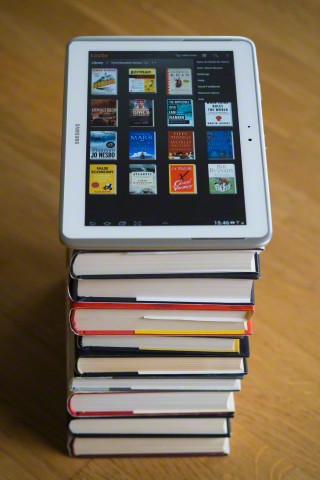
Samsung Galaxy Tab

But we’re not here to talk about the new tablet (although you can read a most thorough CNET review here).  We’re here to talk about the original Samsung Galaxy Tab series, which is now up to at least its tenth iteration … if not a higher number (they throw in variant names, with the “Galaxy Tab S” and “Galaxy Tab Pro” and so on complicating a neat and orderly numbering system).  The entire line is noted, however, first and foremost for being the first (or among the first, depending on who you ask) to embrace a full Android operating system––and as such, it became a solid, distinct, and direct competitor to both the iPad (which runs on Apple’s iOS) and the Kindle (which varies a bit from iteration to iteration, but for the most part employs a heavily modified and limited version of Android).  I think it’s worth mentioning both tablets like the iPad and dedicated e-readers like the Kindle in the same breath when it comes to the Samsung Galaxy, because the relationship between the two is hybridizing so quickly as partnership projects like the Samsung Galaxy NOOK become the new normal.

Here’s the thing with the Samsung Galaxy Tab series that gives it an edge over the Kindle and the original NOOK: it’s a fully-fledged tablet, with a far wider range of capabilities as a device than a dedicated e-reader.  You can access the Google Play store, and run a whole slew of apps that have little or nothing to do with books, and yet the reading-related apps you can download are beautifully designed and presented, so the e-reading experience is still highlighted and underscored as important to app developers.  Many people rate the average Samsung device as somewhat less responsive and intuitive than the iPad, but Apple is famously canny about using software to create closed loops around its hardware (that is, the average iPad has to be “jailbroken” before it is “hackable”––you have to actually tamper with the operating system to render it more adaptable).  Basically, Android-based operating systems like the ones the Samsung Galaxy Tablets run are way more easy to customize, tinker with, and generally geek out over.

Samsung Galaxy NOOK

And there are a lot of Samsung Galaxy Tabs out there.  There are no hard and fast numbers for me to quote to you, but it’s safe to say they’re not hurting too badly if they have the capital to launch “boutique” or specialized lines like the NOOK hybrid.  (Each iteration costs a lot of money and time and talent capital to design and maintain and run support for.)  Some recent reports do, however, indicate that sales were not quite as high as they should have been––and as the company supposedly reported them to have been––and this is a matter of great concern.  Samsung has the benefit of a large support network and a diverse portfolio to fall back on if one project or device doesn’t sell well; Barnes & Noble had no such safety net, and thus lost its ability to respond effectively to rapidly shifting market demands.

Here’s what you need to know as an author when it comes to the Samsung Galaxy Tab: it’s not going anywhere.  Oh, iterations come and go the way my love of rain comes and goes (and boy, does that one fluctuate a lot).  But the great thing about a series like this one is that Samsung will continue to make new additions as long as the market exists and as long as there is a demand for Android-based devices that aren’t locked into being dedicated e-readers like the Kindle.  Customers want variety and customizability, games and work and literature all in one device, without the need to untangle multiple cables or swap out chargers on the nearest wall outlet.  And as long as there are Android-based operating systems, the Google Play store will remain an important distribution point to keep an eye on.

Are you selling through Google Play?  I personally hope so, and if you are and would like to share your story, please (please please) drop me a line in the comment section with all of the details.

Thank you for reading!  If you have any questions, comments, suggestions, or contributions, please use the comment field below or drop us a line at selfpublishingadvice@gmail.com.  And remember to check back each Wednesday for your weekly dose of marketing musings from one indie, hybrid, and self-published author to another. ♠

KellyABOUT KELLY SCHUKNECHT: Kelly Schuknecht is the Executive Vice President of Outskirts Press. In addition to her contributions to the Outskirts Press blog at blog.outskirtspress.com, Kelly and a group of talented marketing experts offer book marketing services, support, and products to not only published Outskirts Press authors, but to all authors and professionals who are interested in marketing their books and/or careers. Learn more about Kelly on her blog, kellyschuknecht.com.