Marketing Missteps Episode 8 : Not Finding Your People

As the weeks go by, our list of marketing missteps grows longer, but here’s the thing: no matter which step you take next, or which foot you put forward, whether it turns out to be a mistake or a blinding success, there are options.  This is because you have chosen to self-publish, and self-publishing by its very nature puts the narrative into your hands at all stages of the process.  And while I do not advocate for underestimating the impact of these missteps I’m chronicling and examining here, I do advocate for not giving up if you happen to make one.  There are ways to overcome disaster–and I’ll write about those, too, in my next series!

The Missteps So Far:

This week, I’ll be looking at a mistake that at first glance might seem like a directive to the Millennial Generation, what with its emphasis on social connectivity and whatnot, but is actually a guidepost for us all.  The misstep?

Not Finding Your People

Many years back, when I was still in college, I took a course on the architecture of Frank Lloyd Wright.  (Yes, yes, I know.)  I’m more than 90% sure that I took the class exclusively because of inglenooks, a strange little architectural quirk endemic to Wright’s earliest buildings.  “And pray, what is this inglenook?” you might ask.  It’s a fireside niche, or place to tuck yourself away in, with a book and a quilt and a hot mug of coffee.  It’s a tiny little retreat that Wright carved out of designs that seemed to leave no room for more experimentation.

Forgive me if architectural anecdotes seem a little out of line with marketing your self-published book, but here’s the thing: niches aren’t just useless ornamentation, whether we’re talking about someone’s home or someone’s book hitting the market.  We need niches.

building blueprint

When it comes to publishing your book, we’re talking about placing something into a market already packed with hundreds of thousands of new books published each year.  It’s more important than ever for authors to understand their niches if they want to sell books, because niches provide access to readers through hyperspecific keyword searches and in the “If you liked this book, you might also enjoy…” tools generated by websites like Amazon, Goodreads, and so forth.

Ideally, authors should figure out what niche their books will fall into before they even write their book, but it’s never too late to put the power of niche marketing at your fingertips.  I’m not just talking about broad sweeping genre categories–like “Western” or “Crime”–but the hyperspecific demographic of who among the world’s millions of devoted readers will really love and devour your book.  Whether your book is in its beginning conceptual stages or is well down the road to publication, it’s well worth sitting down and making a list that takes into account all the major demographic data points: ages, genders, interests, hobbies, and geographic locations.  This will help you narrow down your target audience.  And once you know your target audience, you can start compiling another list of keywords that relate to these people (think “parachute silk” or “dinosaur bones”) and that you can use to flesh out your website and book page metadata to make your book more findable by people interested in these specific things.

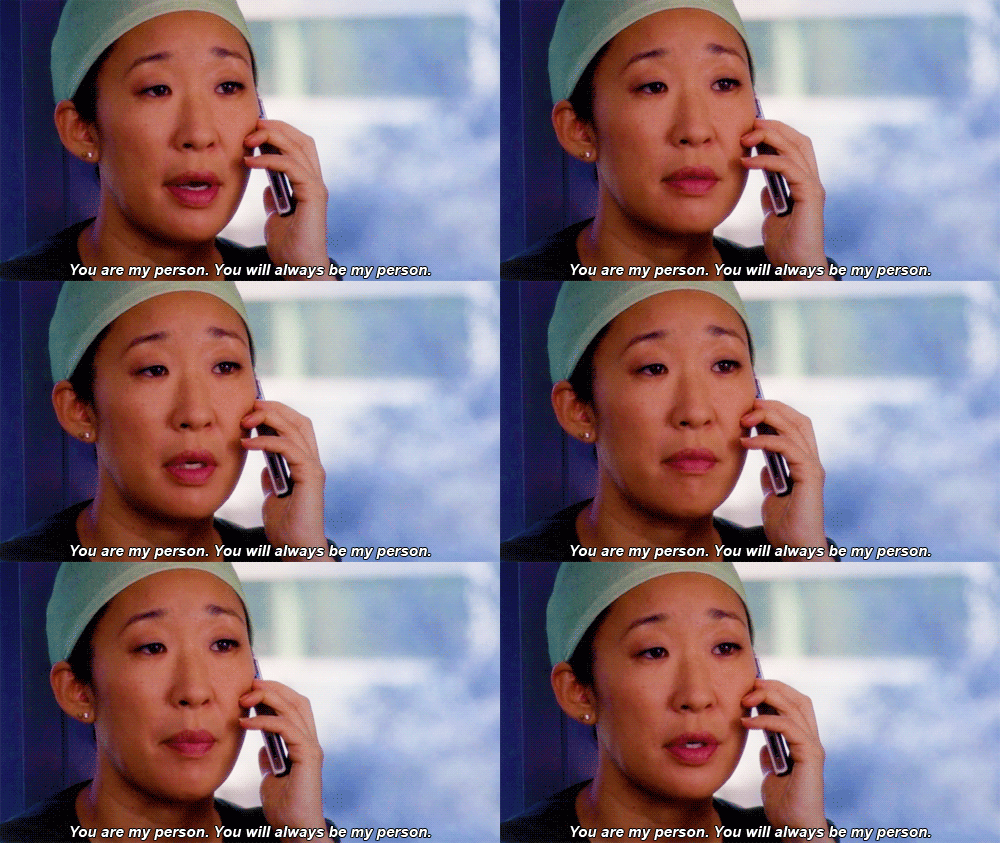
I absolutely guarantee that it’s easier to market your book if you sell it as a piece about baking out-of-doors in a kiln oven with all-natural ingredients than to sell it as a simple organic cookbook.  A book that is confident in its niche–in its dedicated readership–is a book that knows where they’re at and how to sell to them.  You want to be the one selling a book that declares:
tumblr_inline_nhma94hBqD1qbk0s4


I suppose, when push comes to shove, what I mean to say is this: you both need to find your people and make them your people.


Thank you for reading!  If you have any questions, comments, suggestions, or contributions, please use the comment field below or drop us a line at selfpublishingadvice@gmail.com.  And remember to check back each Wednesday for your weekly dose of marketing musings from one indie, hybrid, and self-published author to another. ♠

KellyABOUT KELLY SCHUKNECHT: Kelly Schuknecht is the Executive Vice President of Outskirts Press. In addition to her contributions to the Outskirts Press blog at blog.outskirtspress.com, Kelly and a group of talented marketing experts offer book marketing services, support, and products to not only published Outskirts Press authors, but to all authors and professionals who are interested in marketing their books and/or careers. Learn more about Kelly on her blog, kellyschuknecht.com. 10:00 AM

Marketing Missteps Episode 7 : Failing to Ask “What’s Next?”

Marketing is a minefield for self-publishing authors, and sometimes it feels as though there’s nothing we can get right–and a lot we can get wrong.  And I’m not going to lie: the marketing missteps I’ve chronicled in prior weeks, listed below, can cut off any chance of success.  But don’t look at this list as a litany of discouragements, even as it grows over the weeks to come.  I’m a firm believer in the old adage that “knowledge is power,” and I’m convinced that if you know the pitfalls that can await you, you’re almost guaranteed to steer clear.

It’s the greatest misfortune of all that self-publishing authors are launched into the world without a guide–imagine Dante facing purgatory without Virgil!–and are somehow expected to make a success of their work the first time out of the gate.  To that end, I’m compiling the following set of missteps I and other self-publishing authors have made, so that you don’t have to!

This week, I’ll be tackling a misstep which at first may seem a tad hard to define.  It’s the misstep that fails to innovate, that is content to settle into a routine without continuing to push the envelope:

Failing to Ask “What’s Next?”

Two sides of the same coin:

  • There’s nothing more worth cultivating in the world of marketing than the restless and questioning spirit of an innovator.
  • At the same time, there is nothing more toxic to marketing success than sinking into a routine without constantly asking “What more can I do?”

There’s no way around the fact that you’ve taken on quite a challenge in choosing to self-publish.  Many close friends of mine, whose books are perfectly suited to the world of indie publishing and whose moral compasses are aligned with the indie pursuit of authorial rights and control, have nevertheless chosen the path of constant disappointment so common to traditional publishing because they just can’t face the prospect of marketing solo.

“The bottom line is that I don’t think I’m at all a good publicist,” one of my friends told me this week. “I have next to zero web presence, either via website (although I am putting together a professional website!) or social media.”  In his case, the sheer volume of work and energy it would take to develop a web presence and push his book was hard enough, much less add that extra layer of questioning and innovation that’s necessary to really succeed.

But it doesn’t have to be that daunting.

Screen Shot 2016-05-04 at 7.30.34 AM

While scrolling through our Facebook feeds all day does not a strong book marketing campaign make, there are quite literally endless opportunities to procure exposure for your book in creative way–and yes, social media does play a big hand in many of them.  My advice?  Establish a routine for what I call a “Bare Minimum Marketing Campaign” (BMMC) that you can keep up with minimal effort week in and week out. On top of that BMMC, challenge yourself to add one new out-of-the-box promotion per week.  Make a custom photo, film an author video or a book trailer, craft an infographic, host a giveaway, do a planned or guerrilla book reading or signing, contact a favorite author of yours, and take advantage of the calendar to create targeted promotional gestures.  Brainstorm a list of possibilities and pin it up beside your computer or workspace, and start ticking off items as you move through it.  Once you finish your list, take it down, tuck it in your journal, and write a new one!  And don’t be afraid to look to what others have done–hop on Google, read a couple of interviews with self-publishing authors, and maybe even post some direct queries.  If Rilke can carry out a fruitful long-term advisory correspondence, so can you!

In short, don’t give up if your campaign feels a little stale.  Take your strategy stratospheric with ambition, one week at a time.  Keep what’s vital, and cut out the dead wood so you can move on.  Your marketing strategy doesn’t have to look like anyone else’s–it just has to look like something you find useful, and that you are proud of.

(And here’s a secret: I’m already proud of the steps you’ve taken!)


Thank you for reading!  If you have any questions, comments, suggestions, or contributions, please use the comment field below or drop us a line at selfpublishingadvice@gmail.com.  And remember to check back each Wednesday for your weekly dose of marketing musings from one indie, hybrid, and self-published author to another. ♠

KellyABOUT KELLY SCHUKNECHT: Kelly Schuknecht is the Executive Vice President of Outskirts Press. In addition to her contributions to the Outskirts Press blog at blog.outskirtspress.com, Kelly and a group of talented marketing experts offer book marketing services, support, and products to not only published Outskirts Press authors, but to all authors and professionals who are interested in marketing their books and/or careers. Learn more about Kelly on her blog, kellyschuknecht.com. 10:00 AM

Marketing Missteps Episode 5 : Printing Anything Other Than On Demand

This series is my love letter to marketing for self-publishers.  But you know what’s more fun than reading love letters?  Reading hate mail.  So while I remain a firm advocate of thinking positively and of making as many innocent errors as is necessary to refine our techniques to perfection, I have been framing this series–now four weeks gone–in the context of the dangerous and the deadly in terms of marketing missteps. Thus far, I have addressed the following errors:

As I mentioned last week, each of these things can tank your book sales singly and for a long time, and a combination of these mistakes will leave you struggling to recover years in the future.  And while some other steps off of the narrow path to success won’t necessarily damage you irrevocably–a few mistakes are, as I said, useful for making adjustments–these ones just might.  These are the Big Bads, the missteps you don’t want to make.

So today, I’m writing hate mail to self-publishing packages that lock you into massive initial print runs.  The error?

Printing Anything Other Than On Demand

Some authors out there will caution you against doing a print run without already having  solid distribution deal in place, but I’ll take it one step further and caution you against buying into any publication package that locks you into an unsupportably large print run.  The average hybrid publishing company (also sometimes and misguidedly referred to as a “vanity press”) will offer a range of packages to choose from, depending on your budget, and many of them include these massive print runs in order to set you up to compete with traditional publishers and their even more massive print runs.

The problem is this: we can’t compete with traditional publishers by replicating their behaviors.  Self-publishers simply don’t have the same budget, and the same margin for error.  Traditional publishers want to flood the market with a book in order to sell as many copies as possible by simple exposure alone, but they also have the distribution deals to get their books into a lot of different markets to do so.  These distribution deals mean that if a book sells poorly in one corner of the world, Hachette or Penguin or whoever can simply bundle up all of those books and send them somewhere where they are selling well.  Or, if they’re selling poorly everywhere, the loss is attenuated by the profits from other books entirely–books that are selling well.

Campus Bookstore at University of Pennsylvania

Unless you have the reach and courier services of a traditional publishing company, I caution against these massive initial print runs.  I am a firm advocate for printing some copies of your book from the outset–they’re useful for ARCs, for book readings, and for giveaways–but they should be a tool, not a burden.  If your garage is stacked floor to ceiling with printed copies of your book that you can’t sell and can’t move, that benefits no one–and it’s a needlessly expensive price to pay in a market where ebooks continue to be a profitable source of income for the self-publishing author.

I’m not saying that there aren’t benefits to printing your books in bulk: you do save money.  But what do you lose?  You end up covering shipping expenses later, and having to manage distribution through your own personal website.  That’s a lot of work, and most authors don’t have the time or resources after that initial purchase to operate within luxurious margins.

So: keep that first print run small, until you can gauge future demand.  Better to sell out that first print run entirely and put in another order via Print on Demand (POD) copies than to end up sending your books to landfill.  (And believe me, this is such a common experience among my self-publishing acquaintance.)  Better yet, start with POD instead of turning to it as a second option.  Hybrid publishing companies like Outskirts Press, my own employer, offer several packages that allow you to cut back on the numbers–or to start without a built-in print run, with the option of going straight to POD copies purchased wholesale.  Other hybrid publishing companies offer similar deals with some variation, but the fact remains: this kind of plan helps keep initial costs down, and frees up your money for other, more carefully targeted marketing strategies.


Thank you for reading!  If you have any questions, comments, suggestions, or contributions, please use the comment field below or drop us a line at selfpublishingadvice@gmail.com.  And remember to check back each Wednesday for your weekly dose of marketing musings from one indie, hybrid, and self-published author to another. ♠

KellyABOUT KELLY SCHUKNECHT: Kelly Schuknecht is the Executive Vice President of Outskirts Press. In addition to her contributions to the Outskirts Press blog at blog.outskirtspress.com, Kelly and a group of talented marketing experts offer book marketing services, support, and products to not only published Outskirts Press authors, but to all authors and professionals who are interested in marketing their books and/or careers. Learn more about Kelly on her blog, kellyschuknecht.com. 10:00 AM

Marketing Missteps Episode 4 : Designing your own book cover

Three weeks ago, I began this series to define and explore some of the many important marketing mistakes I’ve made or seen made over my many years of experience in the self-publishing industry.  I say “important” because each of the missteps I’ve listed: Devolving into a self-centered campaigner,  confusing the sales message with the marketing campaign, and waiting till the book is done to start marketing–each of these things can tank your book sales singly and for a long time, and a combination of these mistakes will leave you struggling to recover years in the future.  The worst part is, they’re all incredibly easy to make, and making one or two is no bad reflection on you as a person and writer, but the inevitable consequence of those of us who do know choosing not to share that information.  After all, there are so many hundreds of thousands of blog posts, advice columns, and self-help books out there these days–it seems impossible to filter them all.

That’s why this series is here. These are the Big Ones, the Absolute Disasters, the mistakes you really must work to avoid when possible, and work to minimize if unavoidable. And what’s this week’s misstep, you may very well ask?

Designing your own book cover.

book covers

… or at the very least, designing your own book cover without seeking professional advice.

A book cover is a powerful thing.  It’s the first thing your readers see when they pull books off of the self at their local indie bookstore.  It’s the first thing they see when they Google your name and click on your Amazon author page.  It’s what distinguishes your book, on sight, from every other book on the market–and at the same time, a good cover will clue your readers in on the genre and atmosphere of your book.  It’s one of the most important puzzle pieces in your marketing plan, so crafting a good book cover just isn’t enough.  You need to craft a perfect book cover.

Hiring a graphic designer is worth it.  You’ll hear a lot of waffling on this subject in various corners of the internet, and allowing for the remote possibility that you may be a working graphic designer yourself, perhaps you yourself do have the skill to create something that will knock new readers flat with its beauty and efficacy.  In general, however–and the graphic designers amongst you can affirm this–the best artistic work is done by paid professionals on the clock, working as part of a responsive design team who can provide feedback as the design process is underway.  Graphic designers who have worked in the book industry for years are more than just paid consultants for your book cover: they have been around long enough to know the ins and outs of the big picture, and they are invaluable resources in positioning your book for success in both visual and contextual ways.

The other day, I was browsing the Goodreads giveaway page, and I noticed something.  Every book with a beautiful custom cover that displayed well at the size of a postage stamp had more than a thousand entries–a thousand people vying for copies of that book.  And every book with one of those tacky, generic-looking free template covers?  The numbers fell to somewhere between twenty and forty.  There are of course other mitigating factors (books published by traditional means will have a large-scale marketing campaign funneling more people on to Goodreads in the first place, for example), the trend was noticeable enough to be undeniable.  You want your book to grab people, even in competition with high-powered traditionally published works!

So find yourself a designer, or purchase a package from a hybrid self-publishing company that puts your book in the running for Most Beautiful Book on the Goodreads Giveaway Page.  You want your book to be that book.


book cover design


Thank you for reading!  If you have any questions, comments, suggestions, or contributions, please use the comment field below or drop us a line at selfpublishingadvice@gmail.com.  And remember to check back each Wednesday for your weekly dose of marketing musings from one indie, hybrid, and self-published author to another. ♠

KellyABOUT KELLY SCHUKNECHT: Kelly Schuknecht is the Executive Vice President of Outskirts Press. In addition to her contributions to the Outskirts Press blog at blog.outskirtspress.com, Kelly and a group of talented marketing experts offer book marketing services, support, and products to not only published Outskirts Press authors, but to all authors and professionals who are interested in marketing their books and/or careers. Learn more about Kelly on her blog, kellyschuknecht.com. 10:00 AM

Marketing Missteps Episode 2: Confusing the Sales Message with the Marketing Campaign

Those of you who have been following my Wednesday posts here on Self Publishing Advisor for a while will probably have picked up on a couple of my habits by now, and one of them is diving into series that examine the many facets of an issue under a microscope.  I like to see every angle, follow every lead, and to be thorough.  Which is why, in continuing this new series that began with last week’s post on the subject of “Marketing Missteps” I want to do full justice to the heart of the matter.

What, then, is the heart of marketing?

This is the question that has rightfully dominated boardroom discussions at the top traditional publishing houses as well as the living rooms and kitchens and offices of thousands of entrepreneurial independent authors’ homes. Marketing, when push comes to shove, is about raising both awareness about and motivated interest in your product.  And by “motivated interest,” I mean the kind of interest that leads to product sales.  But note one thing: the sales come after the awareness.  To push for sales with a mercenary if understandable motive is, as an author, to do both your book and your readers a disservice.

To prioritize sales above the human being on the other end of the Facebook group, the email listserv, the Twitter feed, the phone line, the book signing table, and the Goodreads book page is to declare your financial gain to be more important than quality human communication, and art.  Readers, like everyone else in the market for new acquisitions, have a sixth sense about pushy and over-eager sellers.  And here’s a fact:

Your readers want you to be a storyteller, not the stereotype of a used-car salesman.

sales

So, what does “pushy” look like and how can you avoid it?

Many first-time self-publishing authors release a book accompanied by persistent announcements across all social media platforms––and not just cute little notices, but noisy and self-interested announcements.  (And if you’ll remember, we talked about the self-centered marketing campaign last week in detail.)  Marketing is a more subtle endeavor than a Sears Factory Clearance ad, however.  You are entering a crowded market––with around five hundred thousand new books released each year––with every other entry clamoring for readers to spend money.  When you as an indie author begin shouting into the void, cramming shotgun marketing messages into every available Tweet and post and picture and conversation––well, you do nothing but damage.  You have become part of the background noise readers must filter through every day, in search of a story they actually connect with.

And how not to become yet another unheard voice?  Lead with your wit and your humanity.  Look to the authors you admire on social media and their blogs and elsewhere––how much space do they dedicate to explicitly sales-related messaging?  I guarantee you it’s not much.  Instead of constantly pushing links to sales pages, the successful self-publishing author and marketer is increasing the value proposition of both their own personal brand––as an author and person––as well as the value proposition of the their work (published and ongoing).

We’ve mentioned it many times before and elsewhere that the best marketing strategy is to write another book and to talk about that process instead of constantly pushing sales for an already published book––readers will have their interest piqued by a work still in progress in a way they won’t be by something they can simply hop on to Amazon or Goodreads to read detailed reviews about.  The mystery of an unfinished novel is an incredible asset!  Whatever else you do, don’t stop writing––offline.

Don’t confuse sales messaging with a healthy and engaged marketing campaign.  Do remember how you first fell in love with a book, an author, and filling your bookshelves.  That is the kind of positive impulse that you want to tap into.

sales


Thank you for reading!  If you have any questions, comments, suggestions, or contributions, please use the comment field below or drop us a line at selfpublishingadvice@gmail.com.  And remember to check back each Wednesday for your weekly dose of marketing musings from one indie, hybrid, and self-published author to another. ♠

KellyABOUT KELLY SCHUKNECHT: Kelly Schuknecht is the Executive Vice President of Outskirts Press. In addition to her contributions to the Outskirts Press blog at blog.outskirtspress.com, Kelly and a group of talented marketing experts offer book marketing services, support, and products to not only published Outskirts Press authors, but to all authors and professionals who are interested in marketing their books and/or careers. Learn more about Kelly on her blog, kellyschuknecht.com. 10:00 AM