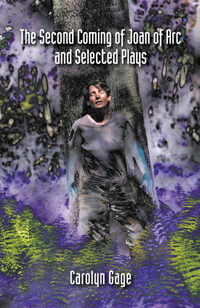
Self-Published Book Review of the Week: The Second Coming of Joan of Arc and Selected Plays

joanofarc_coverThe Second Coming of Joan of Arc and Selected Plays
by Carolyn Gage


“As Carolyn Gage is one of the best lesbian playwrights in America, the book is an intellectual banquet… the reader will get the education of a lifetime.”– Lambda Book Report, Los Angeles


 The explosive, underground classic The Second Coming of Joan of Arc is back in print at last! For two decades, Carolyn Gage’s revolutionary play about a cross-dressing, teenaged, runaway lesbian Joan of Arc has been rousing women to resistance—inspiring them to walk out of patriarchal institutions and fight for a feminist vision.

This new collection includes six other powerful Gage plays:

The Last Reading of Charlotte Cushman

The greatest actress of the 19th century, a lesbian butch, makes a riotous last stand.

Calamity Jane Sends a Message to Her Daughter

A lesbian butch stakes her claim to a place in men’s history the only way she can.

Cookin with Typhoid Mary

History’s most notorious typhoid carrier tells her side of the story.

The Parmachene Belle

The Maine hunting guide who loved Annie Oakley offers a lesson on fly fishing.

Harriet Tubman Visits a Therapist

Radical activism meets one-day-at-a-time therapism in a fight-to-the-death.

Artemisia and Hildegard

Two of the most powerful women artists in history square off on a volatile panel about strategies for survival.

For more information or to order this book, visit the author’s webpage.

Consumer Product Safety Act and Self-Publishing Children’s Book Authors

What this means for you…

As a self-publishing Children’s book author, you may have seen news of a new lead testing requirement established in the Consumer Product Safety Information Act (CPSIA) on ALL children’s products, including Children’s books. The deadline for self-publishing authors and printers are looking at for acceptable lead levels is an approaching February 10 of this year.

Testing and certification takes place at the book printer level and full-service self-publishers of children’s books are working hard to make sure they meet requirements.  If you are in the process of publishing or currently looking for a self-publishing option don’t worry. There are those out there already covering their bases. Here is a statement from one printer/publisher posted earlier this week:

publisher and other book printing organizations are continuing their efforts to obtain a complete exemption by the CPSC by providing test results showing that the lead content level is either nonexistent or well below the standard set by the Act.

If it is determined that books are indeed covered by the Act, publisher will comply with the Act’s requirements by February 10, 2009, as the new limits on lead content begin to go into effect for products directed at children age 12 and under.

Make sure to check with your publisher when researching your options and establishing direction for your children’s book.

Have fun and keep writing.

– Karl Schroeder 

Traditional Retailers and Self-Published Books

On Monday I mentioned how to find a Barnes and Noble near you to promote your self-published book. Whether you’ve already self-published or you are considering self-publishing, it is important to keep in mind that traditional book retailers often look for four things when deciding whether or not to stock a book on their shelves:

1) Availability with a distributor
2) A very attractive trade discount
3) A returns policy (Keep this in mind if you are searching for an on-demand company for your book since not all POD publishers offer a returnable option.)
4) And demand. As a self-published author, creating demand, or “buzz,” is up to your promotional efforts, but make sure the POD publisher you choose provides the necessary means to fulfill the other criteria.

Good luck and have fun!
Kelly Schuknecht
selfpublishingadvice.wordpress.com

Promoting your Self-Published Book to Barnes & Noble

Sometimes the hardest part about promoting your self-published book is knowing where to go. The good news is, the Internet can help you find the locations of all the Barnes & Noble (and B. Dalton) bookstores in the nation.

It’s easy! There just might be one right around the corner from you.

Just go to:
barnesandnobleinc.com/stores/find_a_store.do

Good luck and have fun!
Kelly Schuknecht
selfpublishingadvice.wordpress.com

Self-Publishing Stats: Retail and Royalty

The self-publishing journey isn’t always an easy one, even though we often claim it to be. There are many decisions to be made, and sometimes choices can get confusing.

While many of my posts may refer to authors who have yet to publish, the information is really universal. One thing I generally see successful self-published authors do is constantly learn and research. 
 
If you have published your book already, you may be starting to recognize some of the “fine print” issues involved with your publisher. For example, you may be discovering with your current publisher that their “20% royalty” is not what you expected.  Or you may be learning that your author’s copy price keeps increasing year after year, or that you have to buy 100 copies at a time just to get a fair price. You may be discovering that the royalty you earn for Amazon sales is much, much lower than the royalty they told you when you signed up. High royalties are usually reserved for publisher’s bookstores, but most books are purchased from Amazon and Barnes & Noble.

Or you may be discovering that once your book was published, your publisher stopped communicating with you entirely and left you to figure out how to promote your book yourself.

These are all “tricks of the trade” and things that a good self-publisher will not do. Many authors have discovered that switching publishers is actually more profitable in the long run, even with additional upfront fees.

I recently reviewed one case study in which a best-selling author from “Publisher A” to another leading full-service self-publisher and that was the best decision he ever made. His royalties increased from 15% of his retail price to 55% of his retail price as a result. Instead of $3.74 per book, he started making nearly $14 for every book he sold on Amazon.

The good news is switching publishers is easier than you might think. Almost all publishers offer non-exclusive contracts, and you’ve already gone through the process once, after-all.

Have fun. Keep writing and keep learning!


– Karl Schroeder