The Current State of E-Readers | An Author’s Guide (Part II)

Last week, I launched us into a new series about e-readers, and the pros and cons of using each different e-device (don’t worry, this won’t be quite the epic saga that the Beginner’s Guide to Social Media primer turned out to be!).  This week, I’ll be taking a closer look at perhaps one of the most talked-about e-readers of all time, the Kindle.  No doubt you’ve heard a lot about Amazon’s entry into the e-book sphere before, and elsewhere, in part because it was launched by a massive company still on the upswing in popularity, with the built-in infrastructure to ensure a strong debut––and in part because it remains a solid performer, especially in its newer incarnation, the Kindle Fire.

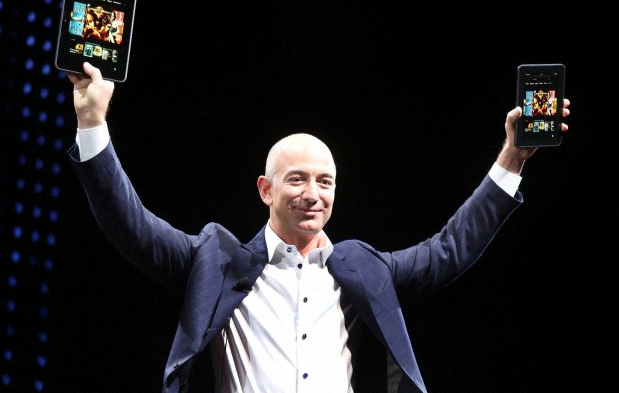
jeff bezos with the kindle
Amazon CEO Jeff Bezos with the new Kindle Fire HD

Just how many people own a Kindle?  A 2014 Forbes article reported that “roughly 43.7 million Kindle devices had been cumulatively sold till the end of 2013,” but, well, Amazon isn’t really talking, except when it’s super proud of itself, so the data Forbes was using may or may not be representative.  Even though in 2014 the Pew Research Center was marking an uptick in e-reader (specifically, Kindle) and everyone seemed, for the most part, highly optimistic about e-readers and therefore e-book distribution, some more recent data seems to indicate a plateauing of that trend … if not a slight reversal.  According to an article by Business Insider contributor James Cook, “for the first time ever the number of tablets shipped has decreased”––and Amazon’s Kindle line has been the hardest hit, with a decrease of some 69.9% in respect to shipments.  That’s a lot.  And the numbers are still so new that few tablet users are speculating yet as to why the Kindle has taken the brunt of the market change.  Is it because users have grown bored, or because Amazon hasn’t reinvented the wheel since the Kindle Fire was released two years (or two lifetimes, in today’s rapid-fire technology-hungry universe)?  But wait––what about the Kindle Paperwhite (the “Kindle 3”)?  Why does nobody seem to be getting on the Paperwhite train?  Is it because people are actively migrating away from Amazon, or from tablet computers, or from e-books?  The numbers seem to be holding mostly steady for e-books downloaded and read, so what’s the deal?

I’ll let you know as soon as I know.

Still, in the meantime, here’s what you need to know about the Kindle (Fire and Paperwhite):

They’re beautiful devices, designed and manufactured specifically to make thumbing through your digital library as tactile and responsive a practice as running a hand across a physical bookshelf––or at least, these e-readers are about as close as you can get without engaging your sense of smell.  (They do, however, make use of your fingertips and your ears as well as your eyes.  There’s some benefit to a multimodal interface, in terms of absorption of information, or so I’ve been told.)

And don’t forget that while sales may have dropped this last year (and significantly), the Kindle and Kindle Fire have out-sold almost every other dedicated e-reading device out there.  There are millions––dozens of millions––of Kindles out there already in use.  So yes, it still remains completely and absolutely worthwhile to sell your book as an e-book edition through the Kindle Store.  The total number of units sold alone should indicate this, but as the aforementioned Pew Research Center report also says, 3 in 10 American adults read an e-book last year, most of them on a tablet or dedicated e-reading device.  That’s a lot of e-books, my friends.  And Jim Tierney over at Loyalty360 reports that Amazon Prime Membership jumped by 53% in 2014––to around 40,000,000 (that’s 40 million) total adults.  And what with the advent of the Kindle Lending Library––a controversial offering, to be sure––Prime subscribers can opt to read certain select e-books for free.  That’s a lot of potential future readers.

Not much has changed when it’s come to the disadvantages of owning a Kindle, except for the fact that Amazon has taken away any grounds for complaint about the graphics, display quality, and user interface.  Their customer support system is pretty nifty, too, and users seem to like it.  No, you still can’t take the Kindle into the bathtub with you, and you probably don’t want to hurl it off the edge of a parking garage unless you actually want to watch it break, but these tablets do qualify as robust, insofar as tablets are allowed to.  Lending books to friends is possible, but still not quite intuitive.  Universities are starting to get on board with letting students use e-book editions for courses, but this still remains an underutilized possibility.  And no, it’s not an actual book you can hold in your hand and sniff for that “old-book” smell.  (But that’s what perfume is for, right?!)

I’m not about to try and sell you on buying a Kindle––or any e-reader, for that matter––but I do think it’s worth oohing and aaahing a little over the modern creature comforts technology has provided us.  An interlinked dictionary that I can access while reading?  Handy.  Highlighting and bookmarking?  Essential.  And much more difficult to “lose” when we’re speaking of a digital item.  And it’s nice, too, to have the option of reading multiple file formats on the same dedicated e-device without having to switch between apps.  PDFs?  No problem.  TXT?  DOC?  The Kindle’s got you covered.  And for now, people aren’t quite tossing them in a blender just to watch sparks fly, so I wouldn’t quite put up the crime scene tape just yet––if Amazon has proven anything, it’s proven just how much it loves to be on top!

Thank you for reading!  If you have any questions, comments, suggestions, or contributions, please use the comment field below or drop us a line at selfpublishingadvice@gmail.com.  And remember to check back each Wednesday for your weekly dose of marketing musings from one indie, hybrid, and self-published author to another. ♠

KellyABOUT KELLY SCHUKNECHT: Kelly Schuknecht is the Executive Vice President of Outskirts Press. In addition to her contributions to the Outskirts Press blog at blog.outskirtspress.com, Kelly and a group of talented marketing experts offer book marketing services, support, and products to not only published Outskirts Press authors, but to all authors and professionals who are interested in marketing their books and/or careers. Learn more about Kelly on her blog, kellyschuknecht.com.

From the Archives: “Using Listmania to Promote your Self-Published Book”

Welcome back to our new Tuesday segment, where we’ll be revisiting some of our most popular posts from the last few years.  What’s stayed the same?  And what’s changed?  We’ll be updating you on the facts, and taking a new (and hopefully refreshing) angle on a few timeless classics of Self Publishing Advisor.

∗∗∗∗∗

[ Originally posted: August 22nd, 2008 ]

If your self published book is available on Amazon.com, there are a lot of ways to promote it.  Since Amazon sales should account for a large percentage of your overall book sales, this site is a good place to concentrate a lot of your efforts.

I’m going to tell you about creating a “listmania” list on Amazon. Have you ever noticed when you browse for something on Amazon, there are lists that are related to that subject that are mentioning other books and/or products?

By strategically listing products on your lists, (including YOURS of course), you can start to generate more traffic to your book listing.

Here’s how YOU can create just such a list:

Sign up for an Amazon Author Connect account if you don’t have one yet. Or sign-in to your current account.

Click on your personal “store” on the top tabs. Then select “Your Profile” from the sub-menu.

You will see lots of things you can personalize, including your bio and your online photograph.

But scroll down and you will see a section called “Listmania!” And this is where you create a listmania list.

Creating a Listmania List is a good way to increase exposure for your book.

Obviously, you want to ensure that your book is on your list.

But the real trick to a successful Listmania list depends upon the OTHER books you put on your list, the ones written by other people.

There are two ways to go about it.

1 – Adding books to your list that are applicable to your subject. The idea behind this concept is easy — if someone reads your list because they were browsing a similar book, they’ll be more apt to buy YOUR book because they’re interested in the subject.

2 – On the other hand, you can add very popular books to your list, since more people may have a chance of seeing it, even if fewer of them will be interested in your book.

I recommend creating multiple lists and trying different tactics to see which is more successful. Amazon lets you track the number of times your list was viewed. Use these numbers to create better lists in the future.

If you have more specific questions about creating a listmania list, the Amazon FAQ will help you.

Amazon Listmania

So here’s the thing: Listmania doesn’t really exist anymore!  Back in 2013, Amazon ceased offering support and guidance on using the Listmania interface, and it was entirely dismantled and rendered unusable over the months following.  (Adrienne Dupree over at Leave The Corporate World Behind even wrote a lovely little lament to mark its final passing.)  And this fact means that, on the one hand, we have to throw the baby out with the bathwater when it comes to our original post … but on the other hand, this presents the perfect opportunity to present you with new and fresh ways of utilizing Amazon for your self-promoting and self-marketing ends (as a self-publishing author).

First, we need to break down exactly what Listmania offered the average author.  Essentially, this featured compiled lists–and this makes sense, given its name–but it was not to be confused with Amazon’s wish lists, gift lists, and registries, or even Goodreads’ Listopia lists (which still exist).  These lists were designed to focus a reader’s attention on products that were similar or in some way related to products that a customer had already been viewing. By strategically listing popular products on your lists, including your own book, you were–in theory–able to generate more traffic to your book listing when people viewed your Listmania lists.  This brings us full circle to that one key word I’ve been lobbing around a lot lately: findability.  An Amazon Listmania list was supposed to render you and your book more findable, but to many people it remained just another one of the giant retailer’s many algorithmic mysteries.

And yet … findability remains important.  There simply are better ways of going about it!

Here are my top 3 recommendations for filling that gaping hole in your heart once occupied by Amazon Listmania:

  1. Start a Pinterest page.  Not just any Pinterest page, mind.  (And I’ve written about Pinterest recently in depth, so I won’t make like a broken record and repeat myself too much here.)  Whip up a Pinterest page (or “pin” to a “board”) where you collect together other books along with other somehow related objects that your ideal reader might want to purchase.  For example, someone who reads Hugh Howey’s Wool might want to pick up some tickets to tour the Titan Missile Museum outside of Tucson, or perhaps some Wool-inspired art prints.
  2. Create a public Amazon Wishlist.  This is easy to do, and it serves much the same function as a Listmania list–only, you’ll have to do a touch more legwork to advertise the list’s existence, since these wishlists aren’t necessarily designed to be searchable.  For more information, hop on over to the Amazon how-to page for wishlists, and peruse at your leisure.  Each wishlist is shareable across any platform you might wish, and you can snag a web link to copy and paste into emails or Twitter, Tumblr, Facebook, Instagram, or any other kind of social media feed you can imagine.
  3. Take a stab at an entirely new social media platform.  The reason why Listmania disappeared is that nobody was using it, or at least, too few people were using it to make it worth Amazon’s efficiently allocated time to advertise and maintain.  It had a function, but it wasn’t one that really connected with Amazon’s user base.  To make yourself findable these days, you must needs throw yourself into the post-millennial age, and go where your readers are.  I’m not necessarily an advocate of just trying anything–you should always do a little cross-demographic market research to see if your readers actually are the sort who use Snapchat or Instagram or Tumblr or Twitter–but as a good friend told me last week, “Just doing what you’ve always done and expecting things to improve is a special kind of lunacy. Sometimes you have to innovate.”  So–innovate, with calm but cautious optimism. ♠
KellyABOUT KELLY SCHUKNECHT: Kelly Schuknecht is the Executive Vice President of Outskirts Press. In addition to her contributions to the Outskirts Press blog at blog.outskirtspress.com, Kelly and a group of talented marketing experts offer book marketing services, support, and products to not only published Outskirts Press authors, but to all authors and professionals who are interested in marketing their books and/or careers. Learn more about Kelly on her blog, kellyschuknecht.com.

News From the Self-Publishing World: 10/05/15

This week in the world of self-publishing:

Often, the highlight of my day is spent reading the stories of others who have come to be involved in the world of self-publishing, and the best interviews often feature someone who has worked in both traditional and self-publishing platforms, or has transitioned from the one to the other.  Why?  Because motives are important.  And that’s one of the reasons why I love this article by author Jordan Dane in an October 4th article for The Oklahomian.  When it comes to experience and expertise, Dane has got you covered; she can speak as an authority when it comes to the differences in creative control, price control, and cash flow between the two modes of publishing.  And that’s just the first page of her article!  She also goes on to address time management, book releases, subsidiary and foreign rights, and the real cost of production––along with many other enlightening comparisons.  Well worth a read!

The big news this week is that we have a new debutante on the self-publishing market: Pronoun.  In an October 4th article for TechCrunch, John Biggs writes that co-founder Josh Brody set out to create a platform that gathers together and combines all of the best features found separately in the self-publishing industry.  Biggs interviewed Brody, who made his name running the publishing statistics engine Booklr, and the result is a combination of press release and rallying cry.  Here’s just a small snippet:

“Pronoun is different because it’s the only platform that gives authors everything they need to create and publish their book, track its performance, and improve its online visibility over time,” said Brody. “Second, we’re the only platform that performs data analysis on the entire book market to help every author position their book for maximum visibility. Third, we bring together a network of professional service providers – editors, cover designers, and publicists – all of whom have been endorsed by authors and vetted by Pronoun. Finally, it’s all free.”

We like free.  But we also really like an exceptional platform, so we’ll be watching closely as Pronoun’s user base grows and the reviews come in.

Have you ever heard of San Diego Comic Con?  If you have, you already know it’s a temporary superhub for all sorts of magical things happening in the worlds of media and entertainment.  If you haven’t, just imagine throwing over a hundred thousand people together who love creating, consuming, and participating in these things––and the conversations that are sparked when industry professionals land in the midst of their most ardent fans, and the networking that follows.  Bleeding Cool contributor Shawn Perry chronicles, in an October 2nd article, an encounter he had with Mark Frankel of Wayward Raven Media, an indie publishing company that specializes in comics.  (I mentioned earlier that I like interviews, right?)  Perry’s piece is perhaps a good representation of how the magic of SDCC isn’t just reserved for supermassive industry giants like Marvel Comics and DC––it can be a happy home for those of us who like to think small, and remain in creative control.  That’s the best kind of news, I think!


BONUS ADDENDUM (as of 10/5/15 at 1:30 PM): In other Comic Con news, the New York Comic Con starts in 3 days, and one of the panels (on Saturday the 10th) is geared specifically toward indie and self-publishing authors and artists!  Here’s the blurb from the Hollywood Reporter website:

ComiXology Submit: The Future of Self-Publishing

Creators who’ve found success through self-publishing on the leading digital comic platform in North America talk about their experiences, and offer tips for newcomers on how to avoid mistakes they made.Room 1A18, 4pm-5pm

If you live in the New York area and have a chance to go, let us know what you think!


As a self-publishing author, you may find it helpful to stay up-to-date on the trends and news related to the self-publishing industry.This will help you make informed decisions before, during and after the self-publishing process, which will lead to a greater self-publishing experience. To help you stay current on self-publishing topics, simply visit our blog every Monday to find out the hottest news. If you have other big news to share, please comment below.

KellyABOUT KELLY SCHUKNECHT: Kelly Schuknecht is the Executive Vice President of Outskirts Press. In addition to her contributions to the Outskirts Press blog at blog.outskirtspress.com, Kelly and a group of talented marketing experts offer book marketing services, support, and products to not only published Outskirts Press authors, but to all authors and professionals who are interested in marketing their books and/or careers. Learn more about Kelly on her blog, kellyschuknecht.com.

Weekly Self-Published Book Review: “That Pet Finder Kid Catnapped”

Book reviews are a great way for self-publishing authors to gain exposure. After all, how can someone buy your book if he or she doesn’t know it exists? Paired with other elements of your book promotion strategy, requesting reviews is a great way to get people talking about what you’ve written.

When we read good reviews, we definitely like to share them. It gives the author a few (permanent) moments of fame and allows us to let the community know about a great book. Here’s this week’s book review, courtesy of the Midwest Book Review:

That Pet Finder Kid Catnapped

That Pet Finder Kid Catnapped

Scott Clements

Publisher: Outskirts Press

ISBN: 9781460068513

Synopsis:

Have you ever felt your pets are your only true friends? That’s exactly how thirteen-year-old Chet Parker felt every day of his life. After failing at sports, music, and almost everything imaginable, he gave up on ever finding his place in the world. But thanks to an accidental dose of modified dog DNA, things were about to change for Chet. With a new found connection to his six month old dog Zoe, Chet learns that Mr. Fluffy Pants, the cat of the most popular girl in school, has gone missing. Will Chet’s off-the-wall investigative methods drive him further down the social ladder? Or will they lift him up to claim his spot as That Pet Finder Kid?

A delightful detective story, sure to melt the heart of every pet lover.

Critique:

From sports to music, 13 year old Chet Parker fails at anything he ever attempts to do. He also does not fit in with other kids at school. That’s why he is more into animals because they love you no matter what you do, he thinks. When he takes his dog to the vet something happens and he gets the shot meant for his dog. A short time later he is aware that he can sense what animals around him are thinking and his sense of smell is increased. He learns that Heather, a fellow student, lets him know her cat Mr. Fluff Fluff is gone, and she thinks he has run away. Chet aids her and realizes that for some reason someone has stolen her cat. Later there is a ransom note and now Chet has a purpose, that being who took her cat. Chet also becomes friends with a new neighbor and a severely overweight kid named “Ton” who has the reputation of eating kids he does not like. Scott Clements who works on the hit USA network series “Burn Notice” is also a very talented writer of YA novels this being one of them. Chet and all the characters in the novel are well defined in a story that rapidly moves along to the revealing ending where readers find out who stole the cat. That Pet Finder Kid Catnapped is a first class YA mystery novel that would make a great series of adventures for amateur detective Chet Parker.

reviewed by Gary Roen ]

Here’s what some other reviewers are saying:

I’m an adult reading a young adult novel, but an adult who has some pretty fond memories of YA reading and some books I continually revisit. Having said that, I really enjoyed this journey through a YA mystery with Scott’s characters in “That Pet Finder Kid: Catnapped.” I like the characters, story, and the world these kids inhabit, especially the attention to pets. I think kids reading the book or listening to it will enjoy it, too. It’s a world they know, with the attendant adolescent miseries. But it’s also got some fun mysteries going on that will keep them intrigued. What’s more, they can find their own heroes solving the mysteries and gaining some self-esteem in the process. Worthy lessons for us all.

The pacing is great for readers of every age to enjoy the ride. Middle school kids will enjoy reading it themselves. It’s good bedtime read-aloud stuff for the younger kids: The book can be done in serial selections with enough cliffhangers to have them begging for more. As for me, I’m looking forward to more stories of Chet and his friends, animal and human.

Amazon Reviewer Karen Leckey

Another great children’s book by Scott Clements! Scott has an amazing ability to create fully formed characters that spring to life right from the very first page. I really like the kids in Scott’s books–they’re bright, inquisitive and full of life and personality. The side kick friend in this book was hilarious–I laughed out loud at his jokes and shenanigans all the way through the book.

I recommend this book highly for young teens and younger children. It has a little mystery, a little magic in the way Chet can communicate with his pets, and a nice fast-paced story. And lots of really loving and fun interaction with pets for those of us who love the furry creatures. Can’t wait for the next book from Scott. If you haven’t already read it, I also highly recommend Gasparilla’s Treasure.

Amazon Reviewer P. Wells


Thanks for reading!  Keep up with the latest in the world of indie and self-published books by watching this space every Saturday!

Self Publishing Advisor

selfpubicon1

Conversations With A Self-Publishing Writer: 10/02/2015

THE NOAH WEBSTER LEGACY

It was a gift from a friend—the 1828 American Dictionary of the English Language by Noah Webster.  Somewhere in my memory I recalled that Mr. Webster’s name appeared in a list of our nation’s Founding Fathers, however, I remembered nothing about the details of his life or legacy. The dictionary that has always resided on my shelf is the Merriam-Webster version and any association of the hyphenated name to Noah Webster had escaped me.

american dictionary of the english language

Yet, over the last decade of my writing endeavors (after receiving this gift), my appreciation of Mr. Webster continues to grow. Without his push toward education and his extensive work in defining words my abilities to develop such pieces as this blog would be sorely strained.  Here are a few facts to chew on…

  • Born in Hartford, Connecticut, Noah Webster, Jr. was raised in a very active environment, being homeschooled by his mother in spelling, math and music and observing his father’s activities beyond farming as Noah, Sr. was always intellectually curious and a supporter of education for everyone. He even mortgaged their farm so that Noah Jr. could attend higher education classes.
  • By the age of six, Noah joined neighborhood children in a dilapidated one-room primary school which could have dissuaded him from seeking further education because of teachers he later referred to as “the dregs of humanity.” (Are children today faced with that, too?) However, this experience only fortified his later desires to improve the educational experiences of future generations.
  • At the age of fourteen he was tutored in the languages of Latin and Greek preparing him for enrollment in Yale just before his sixteenth birthday.
  • This timeframe was also the season of our country’s revolution. Food shortages and the threat of the British invasion of mass military forces caused the president of Yale to scatter teachers to various towns where classes could safely be held.
  • Attempting to keep up with his classes, Noah still joined the Connecticut Militia. He believed that American nationalism was superior to Europe because American values were superior. Thus began his pamphlet writing career publishing them under the pen name “A Citizen of America.”

My hope in sharing this information with you today is to encourage you to KEEP WRITING even in the midst of life’s challenges.  The living (survival) conditions for folks in the late 1700s early 1800s left little time for “learning letters” let alone studies at “higher education” levels.  However, Webster (and many of his compatriots) knew that unless people were given the opportunity communicate with words (spoken or written) that carried a specific definition—a distinctly American definition—many more battles would be fought and lives needlessly lost.

Yes, word lists were being produced 2300 years ago in regions of Samaria. Yet many believe that it wasn’t until approximately 400 BC that a “vocabulary list…with meanings of rare Homer-style words and other words from local dialects” was produced. You and I live in an AGE OF WORDS with access to online dictionaries from around the world—times past and times present. How marvelous to enjoy such finger-tip definitions giving us the ability to creatively exercise our writing skills and produce the books that will inform and bring enjoyment to future generations. ⚓︎

RoyaleneABOUT ROYALENE DOYLE: Royalene has been writing something since before kindergarten days and continues to love the process. Through her small business—DOYLE WRITING SERVICES—she brings more than 40 years of writing experience to authors who need “just a little assistance” with completing their projects. This is a nice fit as she develops these blogs for Outskirts Press (OP) a leading self-publisher, and occasionally accepts a ghostwriting project from one of their clients. Her recent book release (with OP) titled FIREPROOF PROVERBS, A Writer’s Study of Words, is already receiving excellent reviews including several professional writer’s endorsements given on the book’s back cover.  

Royalene’s writing experience grew through a wide variety of positions from Office Manager and Administrative Assistant to Teacher of Literature and Advanced Writing courses and editor/writer for an International Christian ministry. Her willingness to listen to struggling authors, learn their goals and expectations and discern their writing voice has brought many manuscripts into the published books arena.