Marketing Missteps Episode 5 : Printing Anything Other Than On Demand

This series is my love letter to marketing for self-publishers.  But you know what’s more fun than reading love letters?  Reading hate mail.  So while I remain a firm advocate of thinking positively and of making as many innocent errors as is necessary to refine our techniques to perfection, I have been framing this series–now four weeks gone–in the context of the dangerous and the deadly in terms of marketing missteps. Thus far, I have addressed the following errors:

As I mentioned last week, each of these things can tank your book sales singly and for a long time, and a combination of these mistakes will leave you struggling to recover years in the future.  And while some other steps off of the narrow path to success won’t necessarily damage you irrevocably–a few mistakes are, as I said, useful for making adjustments–these ones just might.  These are the Big Bads, the missteps you don’t want to make.

So today, I’m writing hate mail to self-publishing packages that lock you into massive initial print runs.  The error?

Printing Anything Other Than On Demand

Some authors out there will caution you against doing a print run without already having  solid distribution deal in place, but I’ll take it one step further and caution you against buying into any publication package that locks you into an unsupportably large print run.  The average hybrid publishing company (also sometimes and misguidedly referred to as a “vanity press”) will offer a range of packages to choose from, depending on your budget, and many of them include these massive print runs in order to set you up to compete with traditional publishers and their even more massive print runs.

The problem is this: we can’t compete with traditional publishers by replicating their behaviors.  Self-publishers simply don’t have the same budget, and the same margin for error.  Traditional publishers want to flood the market with a book in order to sell as many copies as possible by simple exposure alone, but they also have the distribution deals to get their books into a lot of different markets to do so.  These distribution deals mean that if a book sells poorly in one corner of the world, Hachette or Penguin or whoever can simply bundle up all of those books and send them somewhere where they are selling well.  Or, if they’re selling poorly everywhere, the loss is attenuated by the profits from other books entirely–books that are selling well.

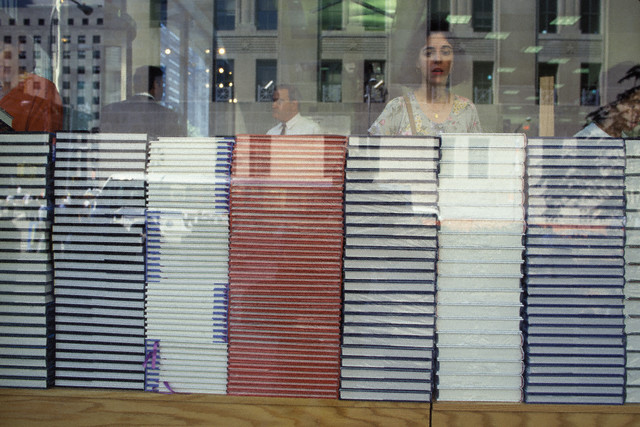
Campus Bookstore at University of Pennsylvania

Unless you have the reach and courier services of a traditional publishing company, I caution against these massive initial print runs.  I am a firm advocate for printing some copies of your book from the outset–they’re useful for ARCs, for book readings, and for giveaways–but they should be a tool, not a burden.  If your garage is stacked floor to ceiling with printed copies of your book that you can’t sell and can’t move, that benefits no one–and it’s a needlessly expensive price to pay in a market where ebooks continue to be a profitable source of income for the self-publishing author.

I’m not saying that there aren’t benefits to printing your books in bulk: you do save money.  But what do you lose?  You end up covering shipping expenses later, and having to manage distribution through your own personal website.  That’s a lot of work, and most authors don’t have the time or resources after that initial purchase to operate within luxurious margins.

So: keep that first print run small, until you can gauge future demand.  Better to sell out that first print run entirely and put in another order via Print on Demand (POD) copies than to end up sending your books to landfill.  (And believe me, this is such a common experience among my self-publishing acquaintance.)  Better yet, start with POD instead of turning to it as a second option.  Hybrid publishing companies like Outskirts Press, my own employer, offer several packages that allow you to cut back on the numbers–or to start without a built-in print run, with the option of going straight to POD copies purchased wholesale.  Other hybrid publishing companies offer similar deals with some variation, but the fact remains: this kind of plan helps keep initial costs down, and frees up your money for other, more carefully targeted marketing strategies.


Thank you for reading!  If you have any questions, comments, suggestions, or contributions, please use the comment field below or drop us a line at selfpublishingadvice@gmail.com.  And remember to check back each Wednesday for your weekly dose of marketing musings from one indie, hybrid, and self-published author to another. ♠

KellyABOUT KELLY SCHUKNECHT: Kelly Schuknecht is the Executive Vice President of Outskirts Press. In addition to her contributions to the Outskirts Press blog at blog.outskirtspress.com, Kelly and a group of talented marketing experts offer book marketing services, support, and products to not only published Outskirts Press authors, but to all authors and professionals who are interested in marketing their books and/or careers. Learn more about Kelly on her blog, kellyschuknecht.com. 10:00 AM

From the Archives: Self-publishing, Literature and Pop Culture

Welcome back to our Tuesday segment, where we’ll be revisiting some of our most popular posts from the last few years.  What’s stayed the same?  And what’s changed?  We’ll be updating you on the facts, and taking a new (and hopefully refreshing) angle on a few timeless classics of Self Publishing Advisor.

∗∗∗∗∗

[ Originally posted: August 19th, 2009 ]

I opened the Books section in yesterday’s New York Times “Urban Eye” to read the headline, “Why Literature Doesn’t Matter.” Really? How sad. It matters to me. It matters to my family, friends, and colleagues. It matters to the self-publishing authors I work with every day. Literature doesn’t matter… I wish someone would have told me.

According to “Urban Eye,” a recent Sunday Book Review article penned buy novelist Kurt Anderson was to fill me in. Anderson writes, “During the 1960s and ’70s…people who hadn’t read a word of a first-rate contemporary novel — no Cheever, no Bellow, no Salinger, Heller, Styron, Doctorow, Updike or Roth — nevertheless knew the novelists’ names… And then everything changed.”

But book sales in the US have remained strong, and are even growing over previous years in Europe. Despite the current recession effects, statistics show that readers are still buying books. Not matter? Anderson goes on to claim, “But irony of ironies, after literature was evicted from mass culture, pop culture itself began to fragment and lose its heretofore defining quality as the ubiqui­tous stuff that everybody consumed.”

Ah, I’m seeing to whom, or rather to what, Literature doesn’t matter to – pop culture. Wait, then this is a good thing for authors and readers. The fragmentation that Anderson talks about is the segmenting of consumers into smaller, more clearly defined profiles. What that means to self-publishing authors of fiction, non-fiction, etc., is not that your work doesn’t matter, that Literature doesn’t matter, but that it doesn’t matter to everyone. Perfect, now you can coordinate and focus your subject matter and marketing efforts to readers who will benefit from, and buy your books.

Talk to your self-publisher early on about your custom marketing plan.

– by Karl Schroeder

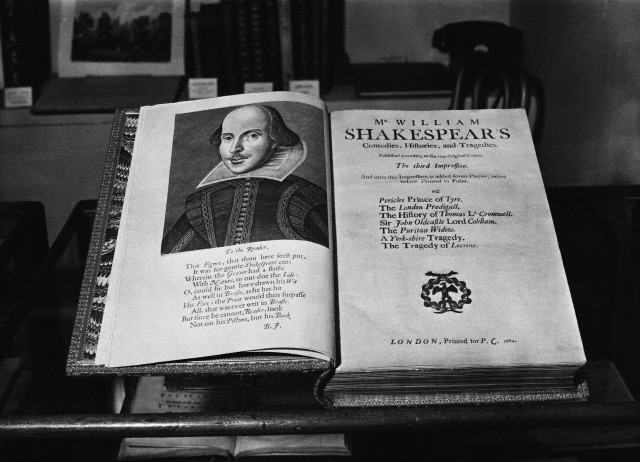
These days, when someone refers to “Literature,” most people think of only one thing:
third folio

But the Classics, I would argue, are not the sole proprietors of the word “Literature”–and they never have been.  And “Literature,” as defined by Merriam-Webster, can mean “written works (such as poems, plays, and novels) that are considered to be very good and to have lasting importance” or simply “books, articles, etc., about a particular subject.”  I know some of my professors in years past would argue that there’s a profound distinction between “literature” (with a lower-case “l”) and “Literature” (with an upper-case “L”)–but then we’re getting into that dreaded world of semantics, where words are bent to match whichever connotations the arguing parties need them to.

I think there are two primary reasons why books become classics:

  1. Someone in a position of power decides they’re worth preserving, and
  2. They continue to make a lasting impression on readers, across cultures and decades.

The first item explains why a great number of quality works (by women, or people of color, and so forth) have been excluded from what is considered “Canon Literature,” and which even today comprises a large part of every American schoolkid’s reading list.  And the second item explains the gaps in the first: many works that were not considered appropriate for lasting acclaim have survived through the centuries for seemingly no other reason than they still connect with people.  The first item is an exercise in the mind, and the second in the heart. I have a couple of examples in mind, but I don’t want to turn today’s post into an exercise in literary theory.  (As much as I love it!)

uncle tom's cabin

The fact of the matter is, books mean a lot to people.  Today.  In the here-and-now. The generation lauded as bringing about the “end of literature”–the generation that cut its teeth on supposedly un-literary books like Harry Potter and The Hunger Games–reads more than any generation prior.  And they not only read, they write.  That’s right–they have created a vast market for new stories, and they have stepped up to flood that market with material.  Best of all, they understand one simple and very important truth: a self-published book like The Martian or Wool or Eragon can move them in ways that “Canon Literature” sometimes can’t.  Stigma has lost its power over “kids these days,” and they’re proud to be voracious readers of books that mean something to them, not to the folks putting together SAT reading lists.

I can’t tell you the last time I cried over Vanity Fair or The Adventures of Tristram Shandy.  I appreciate a good dollop of Jane Austen and Charles Dickens and Shakespeare, but I haven’t wept over them recently.  I have wept over The Martian.  (I won’t even hint at my reaction to Harry Potter when I re-read the series this last winter.)  I don’t think there’s room to despair over the “Death of Literature,” or any more support for the argument that literature “doesn’t matter” today than there was when Karl wrote this post back in 2009.  Our definitions of literature have been too narrow, and our expectations of the current generations of readers have been wrong.  Literature is more diverse, more colorful, and more exciting than anyone ever gave it credit for–and it means more now than ever!

And … I’ve made this post run long.  Next week I’ll revisit it, because there’s one crucial component I’ve failed to address today: How literature’s continued “mattering” impacts you as an author, and how you can use it to your advantage!

Thanks for reading.  If you have any other ideas, I’d love to hear them.  Drop me a line in the comments section below and I’ll respond as quickly as I can.  ♠

KellyABOUT KELLY SCHUKNECHT: Kelly Schuknecht is the Executive Vice President of Outskirts Press. In addition to her contributions to the Outskirts Press blog at blog.outskirtspress.com, Kelly and a group of talented marketing experts offer book marketing services, support, and products to not only published Outskirts Press authors, but to all authors and professionals who are interested in marketing their books and/or careers. Learn more about Kelly on her blog, kellyschuknecht.com.

Self-Publishing News: 4.18.2016

This week in the world of self-publishing:

“The past few weeks have been a busy period for the publishing industry,” write Publisher’s Weekly correspondents Jim Milliot, Andrew Albanese, and Diane Roback in this April 15th article. Milliot, Albanese, and Roback report from the far afield as they cover the events taking place at the Bologna Children’s Book Fair and the London Book Fair as well as the 28th Independent Book Publishers of America (IBPA) Publishing University, held in Salt Lake City. While the book fairs are not themselves specifically focused on indie, hybrid, and self-publishing authors, certain self-publishing-related events proved extremely popular, “with the popular Authors HQ once again facing overflowing audiences for its presentations on best practices and services, how to find an agent, and more. Emerging technology was also prominent, with sessions on virtual reality, and on artificial intelligence,” write Milliot, Albanese, and Roback. The IBPA’s Publishing University, unlike the two book fairs, is all to do with independent publishing–and “approximately 230 independent publishers and self-published authors turned out,” cutting across all demographics and disciplines.  Newbery-winner Kwame Alexander delivered a keynote on his own road to success as a self-publishing author running his own small press.  For the full report from Publisher’s Weekly on these international book festivals, visit the original article here.

“Everybody has a novel in them, so they say,” begins this April 15th article by Guy Kelly for the Telegraph: “Yet even if the idea for a book comes easily, the challenge of having that dormant masterpiece accepted by iron-clad publishing houses has long seemed a Herculean task, even for the most promising manuscripts.”  Kelly goes on to explain how this landscape is slowly but irrevocably shifting under the influence of self-publishing, a process which removes obstacles and allows “anybody to become an entirely self-reliant, published author in a matter of minutes. And if you’re prepared to be shrewd about it, the move could prove extremely lucrative.”  He goes on to paint a portrait of Mark Dawson, a 42-year-old self-publishing author whose books have been downloaded over two million times, and whose sales are in excess of six figures–each year. Dawson, writes Kelly, has now launched something called “The Self-Publishing Formula, a range of courses designed to advise others on how best to monetise their writing in the modern, internet-driven world.”  His journey to success was a long one, giving him plenty of insight into the traditional publishing model which he left in order to pursue his own course.  To follow that entire journey, follow the link.


In this April 15th article for the South China Morning Post, contributor CNBC writes that “The e-book business is thriving, despite the competition between digital, print and audible books, according to the boss of an e-reader company.” The “boss” CNBC mentions is Michael Tamblyn, the CEO of Kobo, “which sells e-reader apps and devices, as well as e-books.” And importantly, the market CNBC mentions is the international e-book market, giving us insight into a world much larger and much more diverse than the standard American publishing outlook.  Tamblyn, according to the article, “also discussed the increasing success of self-published books on the market. Last year, 22 per cent of e-books sold in the U.K. were self-published.” 2015 was in many ways a recovery year for the international book market–not just in terms of ebooks, but in terms of overall print and digital sales, traditionally or independently published–after a two-year slump. “Agents and publishers still dominate the market but self-published has become a real, viable channel,” CNBC quotes Tamblyn as saying: “More often than not the customer who’s buying this doesn’t necessarily know they are buying a self-published book. They are so well produced, so well edited, so well designed that they just sit on the shelf with everything else.” The fact is this: self-published books are beginning to lose their stigma, and that’s a very good thing for everyone.  Well, everyone who is invested in making sure authors get their due.  For more of CNBC’s article, you can find the South China Morning News piece here.

spa-news

As a self-publishing author, you may find it helpful to stay up-to-date on the trends and news related to the self-publishing industry.This will help you make informed decisions before, during and after the self-publishing process, which will lead to a greater self-publishing experience. To help you stay current on self-publishing topics, simply visit our blog every Monday to find out the hottest news. If you have other big news to share, please comment below.

KellyABOUT KELLY SCHUKNECHT: Kelly Schuknecht is the Executive Vice President of Outskirts Press. In addition to her contributions to the Outskirts Press blog at blog.outskirtspress.com, Kelly and a group of talented marketing experts offer book marketing services, support, and products to not only published Outskirts Press authors, but to all authors and professionals who are interested in marketing their books and/or careers. Learn more about Kelly on her blog, kellyschuknecht.com.

Saturday Book Review: “The Reluctant Soldier”

Book reviews are a great way for self-publishing authors to gain exposure. After all, how can someone buy your book if he or she doesn’t know it exists? Paired with other elements of your book promotion strategy, requesting reviews is a great way to get people talking about what you’ve written.

When we read good reviews, we definitely like to share them. It gives the author a few (permanent) moments of fame and allows us to let the community know about a great book. Here’s this week’s book review, courtesy of Books, Reviews, etc:

The Reluctant Soldier by Marnie Mellblom

The Reluctant Soldier

by Marnie Mellblom

Publisher: Outskirts Press

ISBN: 978-1478757405

Synopsis:

The Reluctant Soldier spotlights the “forgotten war” – Korea, in hundreds of letters written by Neil Mellblom, an Army combat reporter with the Pacific Stars & Stripes and the Third Division’s Public Information Office, the United Nations sanctioned police action comes to life. Neil received the Bronze Star for “aggressive reporting” which made the division one of the best known of the Korean war. It may be the definitive book on a soldier’s life in wartime. Funny, yet deeply moving, it records Neil’s growth from a cocky Montanan to a seasoned adult.

Critique:

If you are intrigued by historical books that this one will interest you. A soldier, Neil Mellblom, is a combat reporter for the Pacific Stars and Stripes. A collection of over one  hundred letters written by Neil Mellblom of the wartime experience. This is a non-fiction book mainly about his letters to his  Marnie. Will romance bloom during this time of fear? War at some time or another, is inevitable.  There will always be a group of people who can’t or won’t get along with another group. The war in this book, World War II, has forever remained in the hearts and minds of those left behind.  Whether you were part of the war, part of a family in the war or born later, World War II will never be forgotten.  War brings fear, and that fear is from, what is going to happen to me, to us?  War is a loss on all sides, loved ones are lost and souls are scarred for life.  Neil received the Bronze Star for “aggressive reporting”. He wrote of a soldier’s life, the funny, the sad and the transformation of a  cocky Montanan into a mature adult. Any man or woman who goes into the military field, whether it be war or not, should be treated with respect. Some lay down their lives for those at home, those who are friends, family and those who are unknown. The book is well written and has a pace that keeps your attention and yet, doesn’t bore you. Grab a copy of  THE RELUCTANT SOLDIER and journey through the world, seeing it through the eyes of Neil.

reviewed by Gayle Pace of Books, Reviews, Etc  ]

Here’s what another reviewer is saying:

The Reluctant Soldier by Marnie Mellblom is an interesting compilation of letters that her husband, Neil Mellblom, wrote her almost every day between September 1, 1950 as he was waiting to be shipped to Japan, and September 3, 1951, when he is home in Havre, Montana.

Marnie was an Army brat and her father was stationed at Carlisle Barracks. Neil had apparently joined the Army to become a journalist, had been trained as a reporter, working for six months on the Jackson, MI, Clarion-Ledger. Assigned to Carlisle, he met 20-year-old Marnie and they became close. When North Korea invaded South Korea in June 1950, Army shipped Neil to Japan where he first worked on the Pacific Stars and Stripes, an independent newspaper within the Army that covers military news. The paper sent him to Korea where he was ultimately assigned to the 3rd Infantry Division’s Public Information Office.

He assures Marnie repeatedly that he is staying out of danger. “Combat reporter” does not mean being shot at. In fact, it is not clear from the book exactly what he was doing as a reporter. Other than interviewing a Turkish general and having one of his stories picked up by UPI (without credit), he says very little about the stories he was writing.

Instead, his virtually daily letters to Marnie describe—more or less—his daily life first as a PFC then as a corporal during the war. “I got a shower today . . . a real accomplishment . . . they don’t have a fancy shower here—a tin-and-canvas-enclosed area a lard bucket with holes overhead—and a little Korean boy-san pours hot water in it as long as you stay under the bucket. . . . ”

“We adopted a boy today. No kidding, the three of us here found a little guy on the streets and moved him in with us. We checked on him, found his mother is dead, his father is sick, and one ten-year-old brother is roaming the streets somewhere . . . We washed him up, got his hair cut, and outfitted him with clothes. . . ” Six months later, the kid is the group’s houseboy and working as an interpreter.

“We’ve been writing stories on combat awards and decorations. I picked up a file on a lieutenant and a corporal who had been together on the same mission. Except for their names, the citations were identical to the word—they stayed under fire and evacuated about forty casualties. There was only one difference. The lieutenant was awarded the Silver Star and the corporal got the lesser Bronze Star . . .”

Now a personal note: Because I was in Korea for sixteen months, I was particularly interested in reading Mellblom’s book. The Army assigned me to the 7th Infantry Division just south of the DMZ in August 1955. What struck me was how closely my experiences two years after the cease-fire resembled his. He comments on the dust, the cold, the stink of the rice paddies, the Army SNAFUs, the drinking, the heat, the rainy season (Marnie’s letters to Neil were destroyed when his tent flooded), the importance of mail, the food (we said the combat rations we got in the field were better than the powdered eggs, dehydrated potatoes, and reconstituted milk the mess hall served).

Although The Reluctant Soldier contains pictures of Neil in Korea and some shots of Marnie’s family, the average reader would have been helped with a sketch map of Korea showing where, exactly, Neil was writing from. Also, a little more context would help. Neil either does not know what is going on with the war as a whole or he assumes Marnie knows by reading a newspaper and doesn’t bother. But few readers will know about the Pusan perimeter, the Inchon landing, the race to the Yalu, Chosin Reservoir (Neil participated in the evacuation from Hungnam Harbor), and the stalemate after January 1951—all of which would help Neil’s story.

The book contains an epilogue that adds immeasurably to the story. And for me, the book stirred up hundreds of memories. An interesting picture of the kind of war that most GIs experience.

– Amazon Reviewer Wally Wood

Book Trailer:

Conversations: 4/15/2016

THE MUSIC OF WORDS part THREE

Impressions of Nature in Black and White by Wiliam Carlson

With the recent release of his book of photography and verse, IMPRESSIONS OF NATURE IN BLACK AND WHITE, author Bill Carlson quoted one of the most famous composer/pianists of all time at the close of his Introduction saying, “As I ponder the thousands of spectacular moments I’ve enjoyed while creating my portfolio of photography, I add this additional thought, attributed to Ludwig Van Beethoven: ‘Mother Nature is the Revelation of God.’” This recognition of the marriage between sight (photography), sound (symphonies), and poetry is a more complete definition of what is being honored each April—the National Poetry Month. And what all writers can learn from exploring the best of past and present poets is their unique ability to touch a Reader’s heart and soul with their words.  Here are a few of the best pieces of writing advice that I’ve collected from poets over the years:


  • “People will forget what you said, people will forget what you did, but people will never forget how you made them feel.” Maya Angelou
  • “The moon gives you light, And the bugles and the drums give you music, And my heart, O my soldiers, my veterans, My heart gives you love.” Walt Whitman
  • “I am not a teacher, but an awakener.” Robert Frost
  • “Draw a crazy picture, Write a nutty poem, Sing a mumble-gumble song, Whistle through your comb. Do a loony-goony dance’ Cross the kitchen floor, Put something silly in the world That ain’t been there before.” Shel Silverstein
  • “Every answer asks a more beautiful question.” e.e.Cummings
  • “Those who dream by day are cognizant of many things that escape those who dream only at night.” Edgar Allan Poe
  • Mistakes are a fact of life. It’s the response to the error that counts.” Nikki Giovanni
  • Work like you don’t need the money. Love like you’ve never been hurt. Dance like nobody is watching.” Mark Twain


Are their poets, artists, musical composers, lyricists, sculptures, banjo players you know who inspire your work? What about the famous photographers of the world? The renowned magazines National Geographic and Life have published a collection of photos from on earth and beyond—just for your inspiration pleasure.

We writers can also learn the importance of tenacity. Most know that Beethoven was almost totally deaf by the last decade of his life. Yet he never stopped creating beautiful music. Maya Angelou survived a very difficult life in her early years. And yet, each poet was able to reach inside and find their “muse”—that irresistible presence (or voice) that draws the artist toward their light of creativity.

What you are writing today may just be the next piece of poetic inspiration the world needs. If you notice things that others don’t see or sounds that others don’t hear and find meaning in your dreams, you are a poet/writer. If you are never satisfied with quick explanations but seek the truth, you are a poet/writer. Don’t wait for applause. Many may not “get” what you’re writing, but you must not stop.

Study the greats. Find your own voice! Write and write and write! Then…PUBLISH! ⚓︎

RoyaleneABOUT ROYALENE DOYLE: Royalene has been writing something since before kindergarten days and continues to love the process. Through her small business—DOYLE WRITING SERVICES—she brings more than 40 years of writing experience to authors who need “just a little assistance” with completing their projects. This is a nice fit as she develops these blogs for Outskirts Press (OP) a leading self-publisher, and occasionally accepts a ghostwriting project from one of their clients. Her recent book release (with OP) titled FIREPROOF PROVERBS, A Writer’s Study of Words, is already receiving excellent reviews including several professional writer’s endorsements given on the book’s back cover.  

Royalene’s writing experience grew through a wide variety of positions from Office Manager and Administrative Assistant to Teacher of Literature and Advanced Writing courses and editor/writer for an International Christian ministry. Her willingness to listen to struggling authors, learn their goals and expectations and discern their writing voice has brought many manuscripts into the published books arena.