Self-Publishing News: 5.23.2016

This week in the world of self-publishing:

First off, this little press release put out by Author Solutions on May 18th via PRWeb: the self-professed “world leader in supported self-publishing services” made an announcement last Monday to the effect that “it has entered a development partnership with immersive content studio Legion of Creatives. Through the relationship,” the press release goes on to state, “Legion will actively review indie book titles within the Author Solutions catalogue for possible film, television and digital adaptations.”  For fans of Author Solutions this is pleasant news indeed, but the company has its fair share of detractors.  Even critics have to admit, however, that the prospects for self-publishing as a whole are broadened by these kinds of pioneering partnerships–in the future, they are likely to not only be available to all self-publishing authors, but to be made much more affordable as the market broadens and competition increases.  For the original press release, follow the link!

In this, the first of two articles put up by Publisher’s Weekly on May 20th related to hybrid publishing, contributor Nicole Audrey Spector puts together a comprehensive guide to getting started with hybrid publishing––much as we did with our March 2nd blog post.  As Spector puts it, going hybrid is to seize upon a “third option”––an option “which fuses aspects of traditional publishing with self-publishing, often for an up-front fee. At least that’s one definition,” she writes: “as any author exploring the territory of hybrid publishing will find, it’s complicated.”  It’s complicated in part because hybrid publishing is not the same thing as being a hybrid author––the former involves a specific publishing model which incorporates the flexibility and authorial rights of self-publishing with the resources of traditional publishing … and the latter is usually used to describe an author who has published through both the traditional and self-publishing models (and may also have dabbled in the hybrid one) or may have moved from one to the other.  Spector goes on to describe the workings of various hybrid publishing companies and the experiences of several authors who have used them, and closes with this warning: “Hybrid publishing does have its drawbacks and is assuredly not for everybody.”  The “key,” she writes, is “for authors is to do their homework, connect with peers who have published with hybrids, and determine their expectations and goals from the start.”  Wise words all around, I should think.  You can read the rest of Spector’s guide here.

Brooke Warner contributed the second May 20th piece on hybrid publishing to Publisher’s Weekly, and her interest isn’t in explaining the concept to beginners a la Spector’s piece, but rather to project a forecast for the hybrid publishing market over the coming years (an equally vital task, I think!).  Says Warner, founder of hybrid firm She Writes Press, “Within hybrid publishing there exist many creative models, defined largely by what we’re not.”  The struggle has been for self-realization and self-definition, and to exist at the center of their own narrative––that is, not on the fringes of the self-publishing vs. traditional publishing catfight.  “As more hybrid publishers continue to enter the market,” she argues, “we need to start to define ourselves more by what we are, which requires certain standards to be adopted and certain industry practices to change.”  How to go about oding this?  Well, Warner has an idea––in the form of a brief manifesto:

Hybrid publishers ought to be meeting the standards of their traditional publishing counterparts—both editorially and in design. Hybrid publishers ought to have traditional distribution, or to find better inroads into the marketplace than currently exist in the self-publishing sector. Hybrid publishers ought to qualify to submit their books to be reviewed traditionally and to enter contests without being barred because of their business models. Their authors ought to qualify to join any professional organization they want without facing the discrimination that currently exists against any author-subsidized model.

Well, that’s a rallying cry if I ever heard one.  And with a pedigree like Warner’s to back it up, maybe the various power-players will listen.  Even if they don’t, Warner writes, “We’re tapping on industry doors and witnessing some acceptance and some pushback, but, since we’re here to stay, we’ll just let our books do the talking.”  Powerful stuff.  To read the rest of Warner’s article, click here.


spa-news

As a self-publishing author, you may find it helpful to stay up-to-date on the trends and news related to the self-publishing industry.This will help you make informed decisions before, during and after the self-publishing process, which will lead to a greater self-publishing experience. To help you stay current on self-publishing topics, simply visit our blog every Monday to find out the hottest news. If you have other big news to share, please comment below.

KellyABOUT KELLY SCHUKNECHT: Kelly Schuknecht is the Executive Vice President of Outskirts Press. In addition to her contributions to the Outskirts Press blog at blog.outskirtspress.com, Kelly and a group of talented marketing experts offer book marketing services, support, and products to not only published Outskirts Press authors, but to all authors and professionals who are interested in marketing their books and/or careers. Learn more about Kelly on her blog, kellyschuknecht.com.

Marketing Missteps Episode 9 : Thinking: “Aw, but these rules don’t apply to me!”

Week after week, for the last eight weeks, we’ve unpacked some of the biggest DON’Ts in the business, ranging from exaggerated self-interest to taking on tasks beyond your skill level to waiting.  But this week marks the penultimate misstep–the second to last misstep–the misstep that precedes the ultimate and most fateful of missteps.  Want to know what the worst of the worst of the worst is–at least, in my experience?  Stick around one more week!

But first, before I dive into today’s episode of wrong-footedness, a quick recap–

The Missteps So Far:

This week’s misstep is, as you might expect, in line with the general trend of the last few weeks.  Which is to say, it’s a misstep that has its root in a disconnect between knowing what self-publishing means and really knowing what self-publishing requires.  The misstep?

Thinking: “Aw, but these rules don’t apply to me!”

Once upon a time, I attended a conference with a number of other self-publishing authors and industry professionals.  After a panel session had finished and I was tidying up to leave, one of the other authors approached me and unloaded a small elevator speech about her book (which is actually good thing!  I always love a good elevator speech!).  The book sounded interesting in premise, but I was struck with surprise at not having heard anything about it before, especially since this was the last day of the conference and I’d spent a lot of time browsing among the various stalls that vendors and authors had set up in the hotel atrium.

“Where can I find this book?” I asked.  “I don’t remember having seen it outside.”

“Oh, well, you can find it on Amazon,” said the author, looking vaguely discomfited.

Fair enough.  But ever on the lookout to gather the top tips and tricks–and by “gather” I mean “steal”–of other authors, I took the opportunity to pivot and ask about marketing: “What are you doing to promote this book?”

Here’s the rub.  She said: “Nothing much, really.”  It turned out that she was worried that marketing her own book would take up too much time and wouldn’t do much to boost the sales of a book that came built-in with its own appeal and a timely subject.  She felt that her book hit all the “hot-button issues” of the moment and that this, ultimately, was the primary reason why books sold or didn’t, and that self-promotion was just a lot of hot air.

She couldn’t have been more wrong.  A month or two later, I remembered the conversation and pulled up her Amazon book page, discovering in the process that only two people had reviewed her book and they were both clearly personal acquaintances.  Her sales must have been very limited, indeed.  And as far as I could tell, she’d mentioned the book a couple of times on her personal Facebook account but hadn’t extended her marketing campaign to include standalone representation through Facebook, Twitter, or any other social media platform.

And she’s not alone!  Neglecting to market at all may very well be the worst mistake authors make–and among the most frequent.  But I’m here to be a little reality check: The basic rules of self-promotion do apply to you.  You might be famous, or mix with folk of a stiff upper lip, or be writing about a subject that touches on the lives of every single person on the planet in a useful and relevant way.  But–BUT!–if you don’t work and work hard, you will only ever find that the doors to healthy sales will stay shut to you.  Yes, there’s an element of the miraculous and the coincidental that helps determine a book’s blockbuster success, but very few self-published books reached acclaim without a good dollop of elbow grease to smooth the way.

Look, I’m not saying I’m the only expert out there.  I may not even be someone whose opinion you respect.  But my decades of experience in self-publishing on both sides of the published/publisher aisle can be distilled down to a handful of take-away statements, and here’s one: Even the traditionally-published author has to work, and work hard, to sell books.  Midlist authors rarely get a break, and they technically have the full force of a team of marketers and promotion experts behind them!  Self-publishing puts that weight on the author’s shoulders even as it returns the decision-making process and rights and royalties where they belong: in the author’s hands.  I guess what I’m trying to say is that no matter what kind of author you want to be, you should put together an actionable plan for marketing your book–a plan that extends beyond a few conversations at a conference.


Thank you for reading!  If you have any questions, comments, suggestions, or contributions, please use the comment field below or drop us a line at selfpublishingadvice@gmail.com.  And remember to check back each Wednesday for your weekly dose of marketing musings from one indie, hybrid, and self-published author to another. ♠

KellyABOUT KELLY SCHUKNECHT: Kelly Schuknecht is the Executive Vice President of Outskirts Press. In addition to her contributions to the Outskirts Press blog at blog.outskirtspress.com, Kelly and a group of talented marketing experts offer book marketing services, support, and products to not only published Outskirts Press authors, but to all authors and professionals who are interested in marketing their books and/or careers. Learn more about Kelly on her blog, kellyschuknecht.com. 10:00 AM

From the Archives: “6 Ways Watching Real Housewives of New York Can Help You Market Your Book”

Welcome back to our Tuesday segment, where we’ll be revisiting some of our most popular posts from the last few years.  What’s stayed the same?  And what’s changed?  We’ll be updating you on the facts, and taking a new (and hopefully refreshing) angle on a few timeless classics of Self Publishing Advisor.

∗∗∗∗∗

[ Originally posted: July 27th, 2011 ]

Do you watch Real Housewives of New York? If not, surely you’ve seen all the press about the show. Did you know that you can learn a lot about how to market your book and build your author brand by watching it? Here are just a few of the lessons to be learned when watching the show for any period of time (some old and some new):

  • Follow trends: Take note from Ramona and her jumping on the “renew your vows” trend. Sure, it is a good idea to be unique most of the time, but sometimes you have to “do the stuff everyone else is doing” in order to get your momentum going. After all – it works well for everyone else – isn’t it at least worth a “try”?
  • Defend the grapes: Bethenny offered to “stomp the grapes” to make wine. Not if Kelly had anything to do with it – she planned to eat those grapes. If you take a stand on some issue or cause that you really believe in and make this public knowledge, that’s a good way to network and build demand for you and your book.
  • Start your own team: It works for the Twilight saga (remember “Team Edward” and “Team Jacob”?) and is even working for RHONY with the “Team Blonde” and “Team Brunette” fiasco. Have you considered starting “teams” for the main characters in your book? This will build audience excitement for sure because people love to choose sides.
  • Refer to yourself in the third person: Did you see how Sonja referred to herself in the third person on the recent reunion show? Well, don’t do it that way, but this is a great way to write an effective author bio that will stand out amongst the crowd. Author bios should never be written in first person (neither should social media profiles and the like).
  • Toss modesty to the wind: Also in the recent reunion show, Kelly mentioned that Cosmo rated her as one of the Five Nicest Celebrities. Why can’t you do the same as an author? Naturally, you don’t want to tout your achievements at inappropriate times, but don’t be afraid to brag a little – especially when it comes to your bestselling author status.
  • Wear cream to the wedding: This is not the best thing to do in “real life”, but it can be very effective when promoting a book. Don’t allow other authors in your genre to get all of the spotlight. It’s OK to steal the show just a bit for yourself.

Many newly-published authors are faced with the question of: “How do I market my book?” Believe it or not, your answer could be as close as your nearest TV set.

– by Elise L. Connors

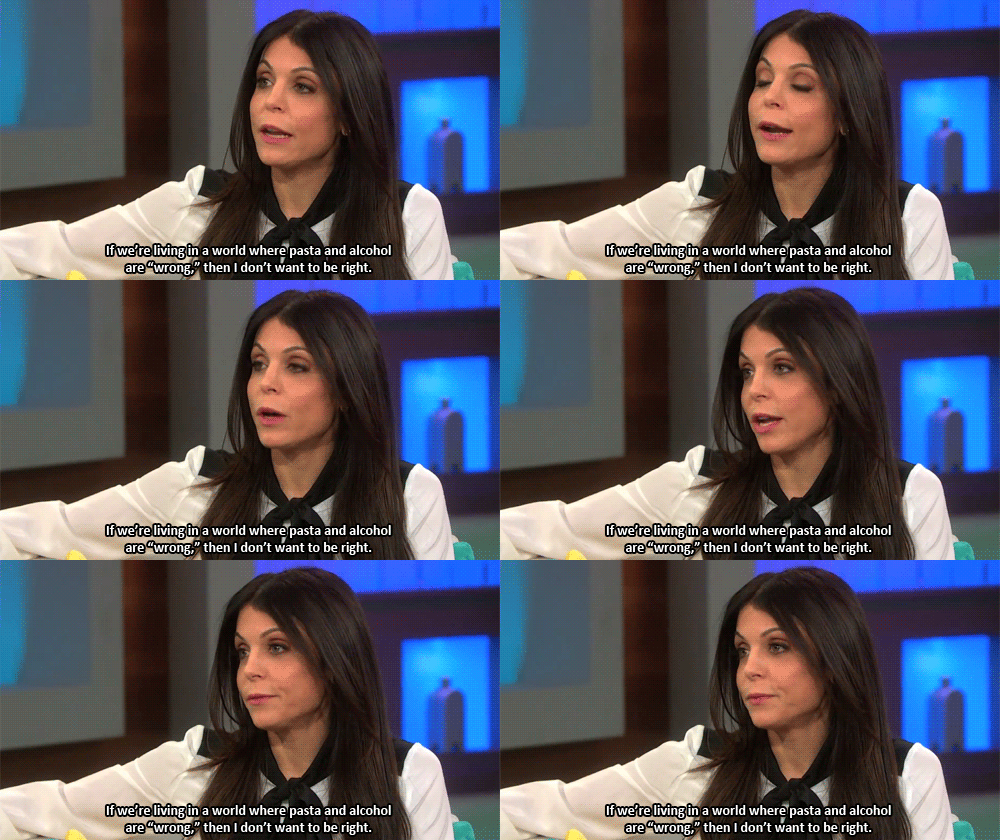
Does anyone still watch reality television these days?  I remember the day, back in 2008, when Real Housewives of New York premiered–and even further back, it must be said, to a day before any of the Real Housewives cluster of shows aired.  Since Real Housewives of Orange County is now in its eleventh season, you can imagine that that’s quite a ways further back!  But let’s face the facts.  A show that births such classic one-liners as:

dbcaa06f-7682-48d4-90bf-41d61ccef42d

… and:

tumblr_mzwkifYkUB1qk08n1o1_500

… just can’t die.  I won’t let it.  That’s not a world I want to live in–a world of sincerely self-aware nature documentaries is a fine and wonderful thing, but it can never rival a world in which the absurdly rich are given finely scrulpted eyebrows and scripted lines worthy of Homer.  And Bravo, home to all things Real Housewives, has some of the most loyal fans out there.  Over 1.4 million people proved their loyalty by tuning in for the premier of last season, the weakest yet.  But 1.4 million?  That’s still a lot of people.  And while the jury’s out on whether sticking around for another round of brunches and office tours with the rich and famous qualifies Real Housewives of New York marks quality decision-making, the show’s longevity puts the proof in the pudding of Elise’s 2011 blog post, above.

Track_15_3

Don’t take this as a drawn-out advertisement for a television show that I don’t even watch–but do take it as a reminder not to turn off your “out-of-the-box” skills when it comes to strategizing and marketing your self-published book.  Elise found value and inspiration in a television show because she refused to just sit back and “shut off.”  Her mind was active and engaged–even when watching reality television!  Maybe your inspiration will come through some other unorthodox channel, like a podcast or a nature walk or a recipe in a kitsch 80’s cookbook.  But it’s still valid.

It doesn’t matter how good ideas come to us, not nearly so much as it matters that we put them into real-world application.  When push comes to shove, the television we watch and the books we read and the lines we repeat to ourselves in moments of crises aren’t what define our success or failure as self-publishing authors.  Only we get to draw the line, and make the call, and cast the judgment.  What matters is the work, and that we stick with it–and keep coming back with new ideas to move that work forward!  Find your inner diva, dear readers.  Find your Real Housewives.  Be innovative.  Defy the critics, and the numbers.  Be indomitable!

Thanks for reading.  If you have any other ideas, I’d love to hear them.  Drop me a line in the comments section below and I’ll respond as quickly as I can.  ♠

Self-Publishing News: 5.16.2016

This week in the world of self-publishing:

This piece–written by Tonya Riley for “The Kernel” on The Daily Dot for the week of May 15–explores the rise and fall of one of self-publishing’s most recent features: the community-ranked and community-driven sort-of self-publishing competition website.  If you haven’t heard of InkPop, you  might have heard of Figment or Swoon Reads, both of which operate on a similar principle: would-be authors upload their manuscripts for other authors and readers to vote on and rank, and the top-ranked manuscript goes on to sign a contract with a publishing house.  In the case of InkPop, that was HarperCollins, a “Big Five” publishing house which went on to shutter InkPop in 2012 after publishing only two manuscripts through the platform.  Riley takes an up close and personal look at why InkPop ultimately failed, despite all of the things it did right.  She interviews author Wendy Higgins, one of InkPop’s two success stories, as well as other members of the InkPop forums.  To read her entire article, follow the link!

[CONTENT WARNING: LANGUAGE]

“Sometime last decade,” writes Katie Rife for The A.V. Club in this May 12 news piece, “Amazon introduced Kindle Direct Publishing, which allows aspiring authors to upload their work to Amazon directly, spending less time dealing with the dinosaurs in the publishing industry and more time writing stories about dinosaurs f***ing people.”  Rife, who eschews more politically correct language to make a point, is referencing an earlier article published by The A.V. Club about the careers of two authors of dino-erotica, one of the many subgenres (many of which are, one hopes, more innocently self-aware) that the self-publishing industry and Amazon in particular has made possible.  (No, I won’t provide that other link here.  Hop on Google if you must!)  But Rife has actual news to share, news which has rocked the self-publishing and video communities: “Amazon, being the pervert that it is, isn’t satisfied. It wants video.”  What she means is, Amazon has deliberately placed itself as a competitor to YouTube and therefore YouTube’s parent company, Google.  Amazon’s new platform probably sounds very familiar: users upload videos to Amazon’s “Video Direct” service that they have made or at least own the right to, decide if they want the video to be free, rentable or purchasable, or free on Amazon Prime (which earns income dependent on performance).  As Rife points out, the content of these videos will probably be determined by equal parts self-interest and the whim of the watching public, which could lead to some … er, interesting material.

“As a former gatekeeper, I’m fascinated by the gatekeeper divide in book publishing, where the role gets falsely propped up by supporters of traditional publishing and completely dismissed by those who favor the indie space,” states Brooke Warner of She Writes Press fame in this May 12 HuffPost Books piece.  She pits former Random House editor Daniel Menaker against self-publishing success story Hugh Howey, each of which paints their chosen platform with the language of perfection–particularly as regards “gatekeeping,” or the tendency of people in positions of authority and power to filter the tastes and interests of those under their influence.  “I take issue with both extremes,” writes Warner, whose own website falls somewhere in the middle between traditional and self-publishing models.  She rejects the sexism and predestinate careers of both parties and instead opts to argue that “there’s another gatekeeper arising in our midst that no one is talking about—and that’s the distributor.  And while she goes on to make the contestable argument that self-publishing churns out inferior books, she follows this up by positing it may in fact be a problem of recognition: there is no system in place to ensure that high-quality self-published materials rise to the top and received the acclaim they deserve, raising the tenor of self-publishing overall.  For more of Warner’s fascinating argument, check out the original article at HuffPost Books.


spa-news

As a self-publishing author, you may find it helpful to stay up-to-date on the trends and news related to the self-publishing industry.This will help you make informed decisions before, during and after the self-publishing process, which will lead to a greater self-publishing experience. To help you stay current on self-publishing topics, simply visit our blog every Monday to find out the hottest news. If you have other big news to share, please comment below.

KellyABOUT KELLY SCHUKNECHT: Kelly Schuknecht is the Executive Vice President of Outskirts Press. In addition to her contributions to the Outskirts Press blog at blog.outskirtspress.com, Kelly and a group of talented marketing experts offer book marketing services, support, and products to not only published Outskirts Press authors, but to all authors and professionals who are interested in marketing their books and/or careers. Learn more about Kelly on her blog, kellyschuknecht.com.

Marketing Missteps Episode 8 : Not Finding Your People

As the weeks go by, our list of marketing missteps grows longer, but here’s the thing: no matter which step you take next, or which foot you put forward, whether it turns out to be a mistake or a blinding success, there are options.  This is because you have chosen to self-publish, and self-publishing by its very nature puts the narrative into your hands at all stages of the process.  And while I do not advocate for underestimating the impact of these missteps I’m chronicling and examining here, I do advocate for not giving up if you happen to make one.  There are ways to overcome disaster–and I’ll write about those, too, in my next series!

The Missteps So Far:

This week, I’ll be looking at a mistake that at first glance might seem like a directive to the Millennial Generation, what with its emphasis on social connectivity and whatnot, but is actually a guidepost for us all.  The misstep?

Not Finding Your People

Many years back, when I was still in college, I took a course on the architecture of Frank Lloyd Wright.  (Yes, yes, I know.)  I’m more than 90% sure that I took the class exclusively because of inglenooks, a strange little architectural quirk endemic to Wright’s earliest buildings.  “And pray, what is this inglenook?” you might ask.  It’s a fireside niche, or place to tuck yourself away in, with a book and a quilt and a hot mug of coffee.  It’s a tiny little retreat that Wright carved out of designs that seemed to leave no room for more experimentation.

Forgive me if architectural anecdotes seem a little out of line with marketing your self-published book, but here’s the thing: niches aren’t just useless ornamentation, whether we’re talking about someone’s home or someone’s book hitting the market.  We need niches.

building blueprint

When it comes to publishing your book, we’re talking about placing something into a market already packed with hundreds of thousands of new books published each year.  It’s more important than ever for authors to understand their niches if they want to sell books, because niches provide access to readers through hyperspecific keyword searches and in the “If you liked this book, you might also enjoy…” tools generated by websites like Amazon, Goodreads, and so forth.

Ideally, authors should figure out what niche their books will fall into before they even write their book, but it’s never too late to put the power of niche marketing at your fingertips.  I’m not just talking about broad sweeping genre categories–like “Western” or “Crime”–but the hyperspecific demographic of who among the world’s millions of devoted readers will really love and devour your book.  Whether your book is in its beginning conceptual stages or is well down the road to publication, it’s well worth sitting down and making a list that takes into account all the major demographic data points: ages, genders, interests, hobbies, and geographic locations.  This will help you narrow down your target audience.  And once you know your target audience, you can start compiling another list of keywords that relate to these people (think “parachute silk” or “dinosaur bones”) and that you can use to flesh out your website and book page metadata to make your book more findable by people interested in these specific things.

I absolutely guarantee that it’s easier to market your book if you sell it as a piece about baking out-of-doors in a kiln oven with all-natural ingredients than to sell it as a simple organic cookbook.  A book that is confident in its niche–in its dedicated readership–is a book that knows where they’re at and how to sell to them.  You want to be the one selling a book that declares:

tumblr_inline_nhma94hBqD1qbk0s4


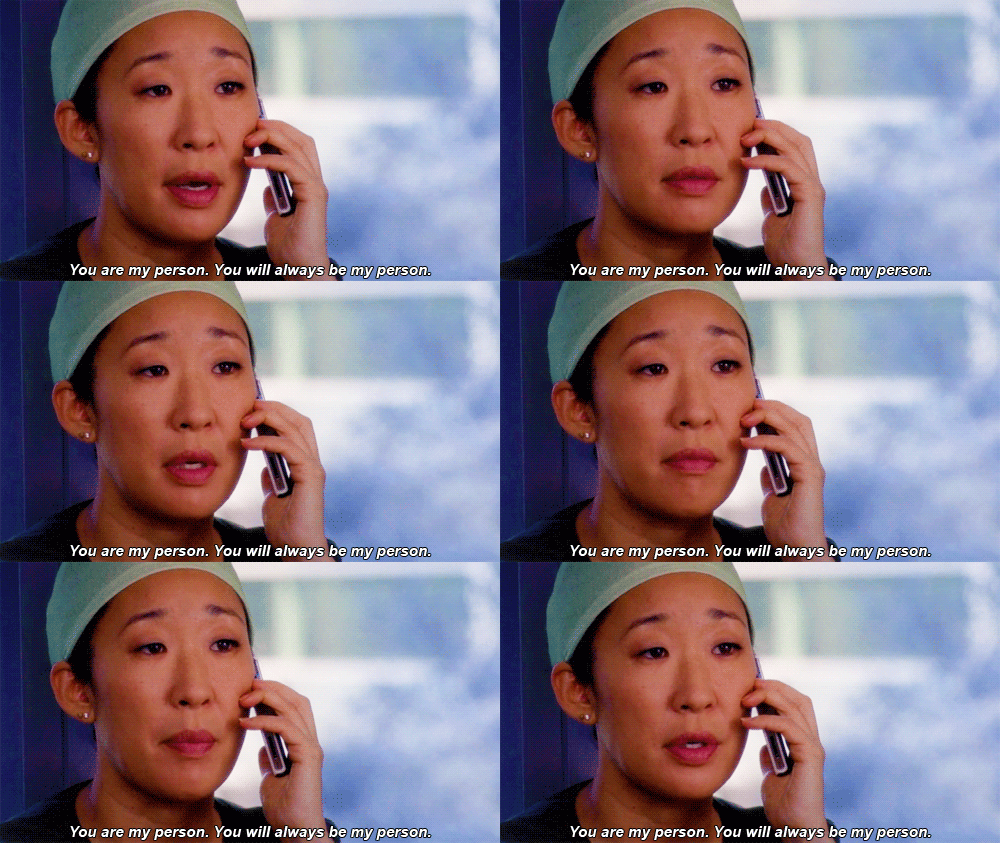
I suppose, when push comes to shove, what I mean to say is this: you both need to find your people and make them your people.


Thank you for reading!  If you have any questions, comments, suggestions, or contributions, please use the comment field below or drop us a line at selfpublishingadvice@gmail.com.  And remember to check back each Wednesday for your weekly dose of marketing musings from one indie, hybrid, and self-published author to another. ♠

KellyABOUT KELLY SCHUKNECHT: Kelly Schuknecht is the Executive Vice President of Outskirts Press. In addition to her contributions to the Outskirts Press blog at blog.outskirtspress.com, Kelly and a group of talented marketing experts offer book marketing services, support, and products to not only published Outskirts Press authors, but to all authors and professionals who are interested in marketing their books and/or careers. Learn more about Kelly on her blog, kellyschuknecht.com. 10:00 AM