Marketing Missteps – Summary Episode

The day has come: we have finished our series of the top ten most common marketing missteps taken by self-publishing authors.

They were : (drumroll please)

But what does this actually mean?  When push comes to shove, shouldn’t we be looking to optimize our strengths, not obsess over our weaknesses and past errors?

Yes.  Absolutely yes.  Which is not to say that this list doesn’t have a place, or recognizing our mistakes an important role to play in upping our game and taking our marketing strategy to the next level.  But mistakes, and avoiding them, only gets us partway to success–just as swerving to avoid a sinkhole has its advantages (no jolts or damaged suspension) but ultimately leaves drivers no further down the road than before.  To push the analogy just a touch further, a serving driver has three probable choices: to swerve onto a sidewalk or ditch, to swerve into a parallel lane, or to swerve into oncoming traffic.  The swerve avoids a definite danger–total vehicular destruction–but the choice of which direction to swerve determines the ultimate fate of the driver (not to mention, pedestrians and other innocent lives).

Sure, the metaphor breaks down in places (no pun intended there), but it serves the point: we need more than just phase one.  We need a phase two.  We need to make active, positive choices to pursue success in addition to active, positive choices to avoid complete disaster.  To this end, over the coming weeks I’ll be launching phase two: a series of what will turn out to be, in essence, the opposite of a misstep.  What’s the opposite of a misstep, a bungle, a slip-up, a blunder, gaff, a faux pas?  Here it is: a triumph, a victory, a gain, a coup de maitre … in other words, the opposite of a misstep is a master stroke.

golf

Bear with me a second.  Marketing your self-published book is not golf.  Nor is it tennis, or one of those fun heist movies from the early 2000s.  But every artist, even a con artist, has his or her trump card–his or her master stroke.  And you’re not a con artist!  You have real art to sell, and you’re master of both your form and your material.  You have something on offer that’s valuable, and worthwhile.  We’re just going to take a closer look at how you can polish a few of your marketing moves, with insights from–you got it!  The masters of self-publishing.

Check in next week as we launch Phase Two!


Thank you for reading!  If you have any questions, comments, suggestions, or contributions, please use the comment field below or drop us a line atselfpublishingadvice@gmail.com.  And remember to check back each Wednesday for your weekly dose of marketing musings from one indie, hybrid, and self-published author to another. ♠

KellyABOUT KELLY SCHUKNECHT: Kelly Schuknecht is the Executive Vice President of Outskirts Press. In addition to her contributions to the Outskirts Press blog at blog.outskirtspress.com, Kelly and a group of talented marketing experts offer book marketing services, support, and products to not only published Outskirts Press authors, but to all authors and professionals who are interested in marketing their books and/or careers. Learn more about Kelly on her blog, kellyschuknecht.com. 10:00 AM

From the Archives: “How to Get Your Self-Published Book in A Library”

Welcome back to our Tuesday segment, where we’ll be revisiting some of our most popular posts from the last few years.  What’s stayed the same?  And what’s changed?  We’ll be updating you on the facts, and taking a new (and hopefully refreshing) angle on a few timeless classics of Self Publishing Advisor.

∗∗∗∗∗

[ Originally posted: September 21st, 2011 ]

You have an ISBN. You have a LCCN. So libraries should be able to find your book, and therefore, will purchase your book, right? Wrong. Unfortunately, libraries rarely “order” self-published books. This doesn’t mean they don’t house self-published books and that they won’t stock your book. It simply means you need to do a little work to get on their radar. Here are a few ways to get your book in a library.

  • Donate a copy (or several copies) of your book to the library. Be sure to go through the proper donation channels.
  • Host a book reading at your library. This will not only introduce the library to your book but also introduce your book to potential readers.
  • If your book is geared towards children, give a school presentation on your book’s subject. School libraries are always looking for new books.
  • Connect with librarians via social networks. Twitter, Facebook, and LinkedIn are powerful ways to network.
  • Send promotional materials such as flyers and letters to local libraries. Be sure to include of the essential information about your book such as subject, genre, audience and purchasing information.
  • Try to get a book review in a local publication. This will bring positive attention to your book and encourage libraries to buy it.

Libraries are a powerful part of your book promotion strategy. Creative marketing tactics can increase your chances of a library stocking your book. They can also lead to great relationships with librarians and readers. The best way to find out what your local library wants is to talk to the librarians. Work on building an honest relationship, and you may just find one your book’s best promoters.

– by Cheri Breeding

Well, it’s 2016 and a lot has changed, both within the world of self-publishing and the world of libraries in America.  On the one hand, the opportunities and platforms available to authors looking to self-publish have only multiplied, whereas on the other hand, libraries have suffered from continuous cutbacks to budgeting–leaving libraries desperate for cost-effective ways to continue offering their core services.  And yes, that includes books.

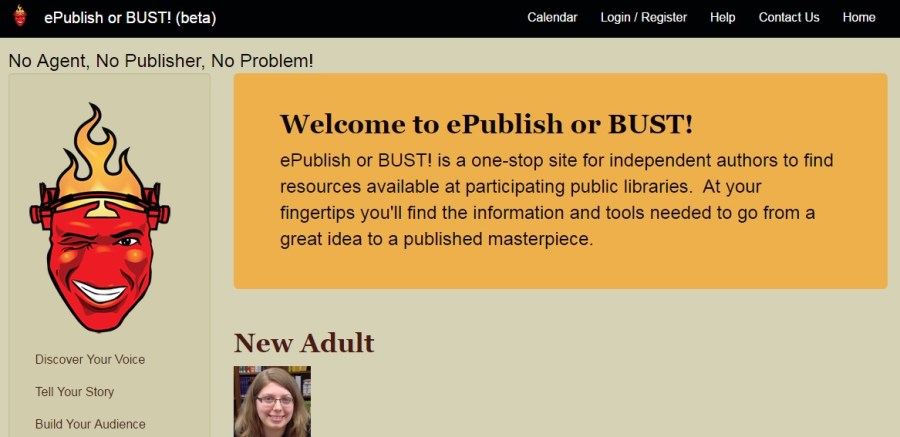
Luckily for everyone, necessity really is the mother of invention.  (Thanks, Plato.)  And in that same vein, a number of people much smarter than I happen to be have gone and made lemonade out of, well, a sub-optimal situation.  For example, if you live in the lovely state of Kentucky, you’re lucky enough to benefit from the collaboration between the director of Davies County Public Library (DCPL) in Owensboro, KY, andl librarian Jim Blanton of Henderson, who partnered up to create ePublish or Bust.  This website allows indie and self-published authors to book appearances at local libraries (there are 24 libraries in Kansas that participate, at present) and to access a variety of other resources.  While the website remainsin a beta stage as Blanton and others iron out the wrinkles with their system, it provides a glimpse of new possibilities as libraries and authors collectively look to prepare for a digitally-driven future.

epublish or bust

And ePublish or Bust is just one of several innovations in process.  There are also the SELF-e Literary Awards!  Librarians have long sought more guidance on self-published books as well as books by authors of color. Aiming to answer both needs is this new(ish) award offered by the Black Caucus of the American Library Association (BCALA) and BiblioBoard (the company that partners with LJ on SELF-e). It honors the top self-published fiction and poetry ebooks by African American authors who were born in the United States, with the winners receiving $500, formal recognition at the Black Caucus of the American Library Association (ALA) Literary Awards, and a BCALA Literary Award Seal to use on their books. Not only is the lauding of self-published books a first for the BCALA, the new award will also be the group’s first to recognize digital content. Awards are a great way for authors to gain exposure and credibility–especially within the library community.

Not surprisingly, Library Journal has become an anchor amidst the rapidly changing library & indie author relationship.  Over the last two years, they have published at least three articles (here, here, and here) detailing these changes and several other innovations in response to them.

The best news is this: libraries are taking note.  It’s not just a one-sided relationship!  The Springfield-Greene County Libraries of Missouri had over 300 self-published titles in their collection by 2014, and were working to continue building their catalogue of these specific kinds of item–because they recognize that there’s a demand for them.  I spoke to the Director at my local public library, and her policy is that she’ll put a self-published title into circulation if it meets four criteria:

  1. It has an ISBN (other libraries vary on this, but she requires it);
  2. It’s local (in respect to author or content);
  3. It’s a physical copy and not an ebook (our library subscribes to an online database of pre-selected titles for download, and only the parent company can opt to include specific title–that’s not a decision left up to the end user/library); and
  4. It’s free (i.e. donated.  She does not solicit self-published titles except in the rare case that the library is hosting a reading.  This has to do with a longstanding handshake agreement with the local indie bookstore: we buy through them to supply the stock for our readings, and they have to have access to the book in the right quantity.)

I realized rather quickly that the situation was far more complicated than I’d expected, and I’d forgotten one very crucial detail: Libraries are not bookstores.  They neither function like one (and in fact, often have very complicated relationships with local bookstore) nor do authors and distributors of self-published titles receive the same benefits from placing their books in a library as they do in a bookstore.  After all, libraries usually only stock one or two copies of any given book–they’re not going to account for a huge chunk of change anyway.  The bookstore is where you sell your books, and libraries are where you raise awareness about your books.  Exposure at the library can drive sales, but otherwise it doesn’t pad your bottom line.  This is why I recommend approaching the library as more than just a stock-it-and-run storage locker for your work.  Libraries have demonstrated they’re ready, eager, and waiting in the wings with a lot of innovative strategies to be your partners in promotion.  If you stop looking at them as a mediocre sales point, you’ll see them for what they really are: allies.

Thanks for reading.  If you have any other ideas, I’d love to hear them.  Drop me a line in the comments section below and I’ll respond as quickly as I can.  ♠

Self-Publishing News: 5.30.2016

This week in the world of self-publishing:

I can’t think of a better way to launch you into the week to come than with this piece, courtesy of Kylie Dunn for the HuffPost Books blog on June 29th.  Here Dunn, author of Do Share Inspire and Write to Launch, recounts her experiences self-publishing and lists her top six lessons learned.  And they’re good lessons!  “You need a professional editor,” she says to start, because “You will experience a full range of doubts and fears when you put your creation into the world [and] having a trusted professional on your side helps.”  Her other points range from “Done is better than good”–quoting Elizabeth Gilbert–to “It’s not a short game” to “It’s scary and exciting,” with one final admonition to “Make sure you have good support mechanisms around you to cater for the days you think you should give up.”  Says Dunn, “This is also why you need a marketing and launch plan, so you aren’t making emotional decisions on the fly.”  Solid advice from one self-publishing author to another, I think.  To read the rest of Dunn’s excellent article, follow the link!

Whoever claims literature is somehow above or beyond the reach of politics hasn’t read the news in India lately, where self-publishing author Rana Ayyub has broken with the powers that be in order to expose systemic corruption.  As chronicled by Arif Hussain for TwoCircles.net in this May 29th article, Ayyub’s story is one that places her firmly in the context of a Ghandi or a Rosa Parks:

A journalist in her twenties decides to go undercover to find the facts about the handling of 2002 Gujarat riots, a series of fake encounters and the murder of ex-home minister Haren Pandya. Over the eight months of subterfuge, she gains trust, breaks trust, comes hairbreadth close to getting caught, goes through phases of self-doubt and anxiety but in the end comes out with a lot of potentially explosive first hand accounts. So much so that her otherwise supportive editors develop cold feet about publishing it and pull the plug on the sting operation.

She then does the logical thing and tries to publish her account as a book. But no publisher worth its name would touch it, no TV news channel would talk about it and very few newspapers would talk to her. In the India of 21st century CE the reigning context of fear is so absolute and the risk of state reprisal so imminent that a mere act of publishing a book can ruin your business.

But of course, self-publishing offers a route free of “gatekeepers,” so Ayyub’s work found a natural home there.  By self-publishing, Hussain notes, “Ayyub also shows a path to people who want to go it alone or just don’t want to toe the “mainstream line.”  We’re all about that here at Self-Publishing Advisor!  To read more of Hussain’s article on Ayyub’s revolutionary work, check out the original piece here.

“The array of [self-publishing] offerings is spurring some writers to leave their publishing houses,” writes Karen Angel for Bloomberg Businessweek in this May 26th article: “particularly midlist authors whose books receive scant marketing support.”  It has long been true that these authors, the ones whose books are accepted for publication by the Big Five publishing houses but whose works aren’t deemed “blockbuster-worthy,” often suffer from poor marketing services and even poorer authorial support.  But there are too many options on the horizon for authors to despair, Angel writes, including self-publishing websites like Pronoun, Reedsy, Leanpub, and Amazon Kindle Direct.  More importantly, she uses the stories of authors themselves as a compass to navigate the complicated world of self-publishing–authors like Janice Graham (of NYT-bestselling Firebird fame) and erotica author Meredith Wild.  She also recounts the story of Greg White, an author whose “last straw came when his publisher forgot to ship copies of his book to the launch party last October.”  And so: self-publishing!  “‘Five years ago,'” Angel quotes White as saying, “‘self-publishing was a scar. Now it’s a tattoo.'”  That’s about as rousing an endorsement as we could ask for.  To read the rest of Angel’s article, click here.


spa-news

As a self-publishing author, you may find it helpful to stay up-to-date on the trends and news related to the self-publishing industry.This will help you make informed decisions before, during and after the self-publishing process, which will lead to a greater self-publishing experience. To help you stay current on self-publishing topics, simply visit our blog every Monday to find out the hottest news. If you have other big news to share, please comment below.

KellyABOUT KELLY SCHUKNECHT: Kelly Schuknecht is the Executive Vice President of Outskirts Press. In addition to her contributions to the Outskirts Press blog at blog.outskirtspress.com, Kelly and a group of talented marketing experts offer book marketing services, support, and products to not only published Outskirts Press authors, but to all authors and professionals who are interested in marketing their books and/or careers. Learn more about Kelly on her blog, kellyschuknecht.com.

Marketing Missteps Episode 10 : Forgetting to Party (Hard)

Today, as I intimated in my post for last week, I will be examining our tenth and final marketing misstep.  We’ve examined nine others in rapid succession over the last two months, with root causes ranging from ignorance to self-absorption to poor logic.  But the common thread is, of course, personal experience.  I’ve seen people make all of these mistakes–and I’ve made a few of them myself!  These pitfalls are easy to avoid if we know what they are and why they’re a problem, but they’re equally easy to stumble in to if we’re not actively working to avoid them.  Whether or not you’re a veteran self-publishing author or brand-new to the field, the most important thing you can be doing for your marketing campaign is reminding yourself to invest your time, energy, and money wisely.

The Missteps So Far:

This week’s misstep is, as you might expect, in line with the general trend of the last few weeks.  Which is to say, it’s a misstep that has its root in a disconnect between knowing what self-publishing means and really knowing what self-publishing requires.  The misstep?

Forgetting to Party (Hard)

Look, it’s simple: if you’re not having a good time while marketing your book, no one else will.  Readers are drawn to the authors who love what they do, and let their enthusiasm for their book and their life as a self-published author seep into the margins of everything they do.  We can thank the rise of social media for this, perhaps, and digitization in general because readers now have more access to more details about the things they care about than ever before.  Whatever tweet, Instagram picture, Facebook post, blog, or Youtube video they stumble across is part of a whole–it helps them build a full picture, a context, for your work.

Excitement is like sneezes and the mumps: it’s contagious!  If you adopt a joyous, positive, “you first!” mentality while carrying out your marketing, that attitude is guaranteed to rub off on your future readers.  (And capture more future readers’ attention, to boot!)  Positive thinking begets positive thinking, and your readers will feed that back to you in the best kind of positive feedback loop!

Approach your work like you would a holiday party.  Your marketing process is a celebration of your dreams and vision, of Art (with a capital “A”) and all that is good in live.  Your job is to invite everyone you know and everyone you want to know to the party, then get out of the way so they can enjoy the main event.  If it’s a rough night and you’re not feeling up for rabid enthusiasm or passing the pretzels, it might be a good night to double down on the things you do enjoy, and save the rest for a day when you’re ready to meet the world.  But I’m betting, like any good holiday party, you might feel some trepidation about diving in to the marketing process–and that’s fair–but once you’re in the thick of it, chugging cider and swapping stories with friends and strangers alike, the world will look all the brighter.


Thank you for reading!  If you have any questions, comments, suggestions, or contributions, please use the comment field below or drop us a line at selfpublishingadvice@gmail.com.  And remember to check back each Wednesday for your weekly dose of marketing musings from one indie, hybrid, and self-published author to another. ♠

KellyABOUT KELLY SCHUKNECHT: Kelly Schuknecht is the Executive Vice President of Outskirts Press. In addition to her contributions to the Outskirts Press blog at blog.outskirtspress.com, Kelly and a group of talented marketing experts offer book marketing services, support, and products to not only published Outskirts Press authors, but to all authors and professionals who are interested in marketing their books and/or careers. Learn more about Kelly on her blog, kellyschuknecht.com. 10:00 AM

From the Archives: “Self-Publishing Statistics – Trends in E-book Consumerism”

Welcome back to our Tuesday segment, where we’ll be revisiting some of our most popular posts from the last few years.  What’s stayed the same?  And what’s changed?  We’ll be updating you on the facts, and taking a new (and hopefully refreshing) angle on a few timeless classics of Self Publishing Advisor.

∗∗∗∗∗

[ Originally posted: June 6th, 2012 ]

Since November 2009, Consumer Attitudes Toward E-Book Reading, a survey conducted by Book Industry Study Group’s (BISG), has been tracking the habits and preferences of book consumers who have acquired an e-book or a dedicated e-reading device within the past 18 months. The report shows important information for authors and publishers. Not only do the findings squash the pessimistic rumors that the publishing industry is dying, but the report also gives authors and publishers a glimpse at the future of publishing. Here is an overview of some of the most interesting and hopeful statistics.

  • Readers’ preference for designated e-readers has dropped from 72% to 58%, while readers’ preference for multi-functional tablets has increased from 13% to 24%.
  • The Apple iPad was not the preferred tablet; instead, readers choose non-Apple devices, such as those offered by Amazon and Barnes and Noble.
  • More than 62% of survey respondents reported an increase in dollars spent on e-books.
  • More than 72% of survey respondents reported an increase in the number of e-books they are purchasing.

The movement from e-readers to tablets is important for authors and publishers to be aware of because it offers insight to what readers want. As multi-functional tablet devices become more popular, authors and publishers will be expected to produce a richer, more interactive e-book experience. In addition, the increase in e-book sales is great news for authors and publishers. It shows that there is a demand for great writing and that publishing, though in a new format, is still alive. If you are considering self-publishing a book, be sure to consider offering both a print and electronic version of your book. This will ensure that you appeal to both e-book and print consumers.

– by Kelly Shuknecht

We’ve written about the changes in the long-term outlook for e-books more recently than this 2012 post, but I think it’s important to look a little further back in time–to a moment in the history of e-books when it looked as though both print and e-book models might have unlimited growth possibilities.  But of course, they don’t–unlimited growth often looks possible in the early stages of a new market, only to slow and eventually plateau when that market’s growth reaches a balance with existing ones.

Bowker Report

In the case of e-books, the market held steady through some fairly revolutionary changes within the distribution platform––from dedicated e-readers to iPads and tablets to mobile––but the bottom ultimately dropped out after Hachette and Amazon resolved their price-fixing dispute.  And I have to be careful when I weigh the consequences of this dispute, since one of the oft-quoted reasons Hachette brought its suit in the first place was to negotiate better terms for its authors.  One of the end results has been, of course, that booksellers and publishers were able to jack up their prices for e-books, often reducing the price difference between print and e-book editions to a pittance.  And if buying an e-book saves readers just two or three dollars off of a print price (often in excess of $20 for new books), the preference for the weight of a print book in hand wins out.

Or at least, that’s what sales figures are showing. People still read print books.  And they’re not about to stop reading e-books either, due to their portability.  But there’s no getting around it: “Consumer behavior has changed,” says Randy Petway, Chief Revenue Officer at Ingenta.  When asked by Publishing Perspectives what the greatest challenge facing publishers today might be, he responded that it’s “Understanding and adapting to the way content is bought and read since the rise of digital publishing.”  We may have reached a new equilibrium in the quantity of e-books sold, but we have yet to fully contextualize this new market in other ways––including finance and law. This place we’ve reached is a messy one, as Petway reminds us, but it’s also rife with opportunities.  What will be our next step forward?

Thanks for reading.  If you have any other ideas, I’d love to hear them.  Drop me a line in the comments section below and I’ll respond as quickly as I can.  ♠