In Your Corner: Fall Abundance (Part I)

Here in North America, it’s now well and truly Fall. Depending on how far north of the equator you live, your weather may or may not have turned yet––it has a bit, here, just enough that you can smell it in the rain––but the reality is incontestable.

fall book reading autumn

This being Fall, and this being a self-publishing blog, you might justifiably wonder if we’re going to talk about why you should publish your next book this season. And yes, there are plenty of good reasons to do so; book sales are at their annual highest between September and December. I recently read that indie booksellers move 50% of their books over this period, in part because of holiday sales boosts and in part because of the book awards season timetable, which makes this a fruitful time of year to release a book and generate buzz. I could also point to those holiday sales as a reason unto themselves––self-publishing authors can really benefit from having a “hook” like a significant holiday or an anniversary to hang their book release on.

But that’s not all that I want to talk about today. In the weeks to come, yes, I’ll be writing frequently to highlight the various things one might do to boost sales around each upcoming holiday. But today? Today I want to talk about the Fall abundance, and focus on the writing of a book for a moment, not just the sales.

Fall is quite literally the season of abundance. Or not, depending on how your garden did this year. It’s the time of year when we feel most reflective, looking back at the long arc of a year of hard work. If you’re like me, that means you end up with a grab-bag of mixed feelings: pride (I did that!), anxiety (what will happen next?), grief (that didn’t go well), and hope (maybe I can do better in the years to come). In a way, then, Fall is the most abundant of seasons in respect to what it makes us feel, not just what it brings forth from the earth or unearths in our lives.

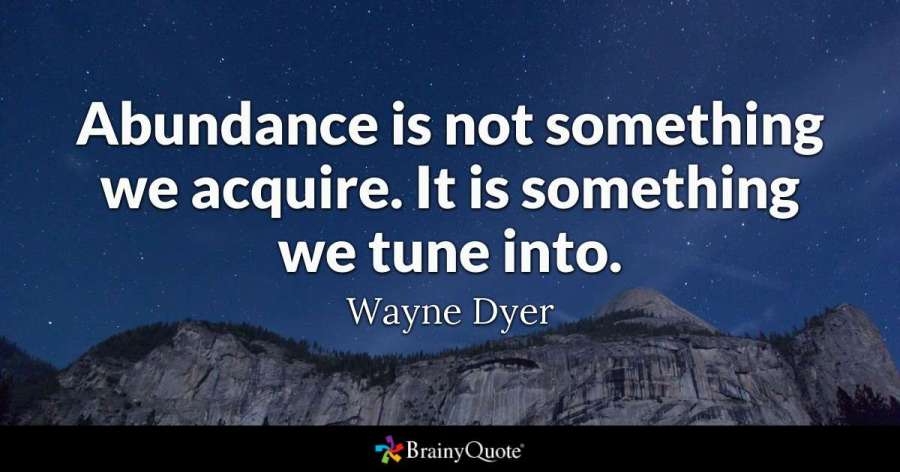
Author and speaker Wayne Dyer had a lot to say about abundance, but one of my favorite things he ever said was this:
wayne dyer abundance quote

As I begin shifting gears in blog posts to come and address ways to tackle the holidays, I’d like to start with this notion of “tuning in” to abundance. There’s certainly plenty of hard work and elbow grease required to make a success of self-publishing, but an abundant experience in self-publishing comes from the same place as abundance in all other things: your heart, your life, and your relationship to the world. All the lists of tips and tricks in the world can’t substitute for the simple truth that the best way to succeed is to understand what it is you want and need out of the experience, and to celebrate your unique relationship to the publishing process––and yes, by way of publishing, the world.

Watch this space in the weeks to come for those lists and tips and tricks, but tonight? Spend a minute with your abundant feelings. Think a little bit about what you want. The harvest is due any minute, and this is the moment to catch your breath.

3d rendering of cup of coffee on wooden windowsill with leaves in front of colorful forest

You are not alone. ♣︎

Do you have ideas to share? Please don’t hesitate to drop us a line in the comments section, and I’ll make sure to feature your thoughts and respond to them in my next post!

Elizabeth

ABOUT ELIZABETH JAVOR: With over 20 years of experience in sales and management, Elizabeth Javor works as the Director of Sales and Marketing for Outskirts Press. The Sales and Marketing departments are composed of knowledgeable publishing consultants, customer service reps and book marketing specialists; together, they all focus on educating authors on the self-publishing process to help them publish the book of their dreams. Whether you are a professional looking to take your career to the next level with platform-driven non-fiction or a novelist seeking fame, fortune, and/or personal fulfillment, Elizabeth Javor can put you on the right path.

In Your Corner: The Back to School Crunch

Sometimes, the seasons seem to matter more than at other times. When it comes to Fall, it often seems to matter more if A) you are an Autumn aesthete who loves the holiday season as well as pumpkin spice lattes, among other things, or B) you are a parent, teacher, or otherwise have children in your life, as the Fall brings a sudden rift in schedules. And never fear! For those of you who are either (or both) aesthetes or follow the school-year calendar, I will be walking you through specific marketing strategies relating to each holiday and Fall moment that can benefit your book. After all, that’s my specialty. (And I also love pumpkin spice, cozy nooks, roaring fires, quilts, cats, and all other aesthetically appealing things.)

For now, though, I want to take a moment just to recognize the turn in seasons, and to honor the fact that we’ve come this far. Well done, you. It’s no small thing, making it through summer, whether it’s busy or tediously boring; it never seems to be just … an average three months, does it? It’s always something else.

A lot of life happens in the summer.

back to school books student

Ahhh, that’s better. Now on to business!

Wouldn’t it have been oh-so-much easier to execute the perfect holiday book sales plan if you’d started just that little bit earlier in the year? Well, I’m here today with a reminder as you start to look down the barrel of yet another end-of-year holiday frenzy: it’s time now! If you want to put your holidays in order, you have to start thinking about your marketing plan today. Yes, in August. If not July!

So let’s make a plan!

First stop: Who’s your audience? You’ll be able to plan an effective strategy only if you know who your ideal readers are–or who their parents with the pocketbooks and credit cards are, in the case of children’s books–and where to reach them, either online and in terms of raising awareness about your book, or in person through events and a campaign that they can conveniently connect to.

Second stop: What’s your format? If your book is digital, then giveaways are a must. An absolute must! There are also some great freebies–free chapters, free peeks, etc–that you can do by integrating your material into your website, social media, and so on. Make sure you give your website a face-lift if you haven’t in a while–you want to be ready for the holidays, not just responding to them when they happen!

If your book is print, then yes–giveaways are still a must! But also book signings, book readings, and perhaps even workshops and teaching opportunities. The more ways–and the more creative ways–you can put your book into the hand of a potential buyer, the higher your chances of actually getting that buyer to pull out the pocketbook! Print books offer a great opportunity to distribute shiny merch like bookmarks, postcards, and so on to readers–even when your book may not be present or being sold! Think of the places people pick up their merch–banks, hotels, libraries, restaurant waiting areas–and partner with local businesses to see about featuring your book in these places.

Third stop: Get a move on! By the time those holidays roll around–whether Labor Day, Halloween, Thanksgiving, or Christmas–it’s already too late to put together a comprehensive plan to reach new readers at that time. You really have to think ahead! Which is why we’re here. We’ve been there. If we’re honest with ourselves, we still are there. We know what it’s like–but here’s a guarantee: if you plan ahead, you will sell more books than if you don’t.

Sure, we can take it easy on ourselves, and feed ourselves the same line we did last year: “Oh, but there’s always next year.” And it’s true, for most of us. There will be more time to perfect our methods. But for this book, and this year, there isn’t a moment to waste–and it really would be a shame to push back our perfect holiday season another year simply because we let ourselves off of the hook today. Because for as many wonderful and eloquent “New Year’s Resolutions” posts we put up here on Self Publishing Advisor that we really do intend to keep, there’s always something that gets away from us. So we keep at it. Better todays mean better tomorrows mean a strategically stress-free Fall and Winter 2019!

But don’t worry, I’m not saying I’m anywhere near perfect. All we can ask is that we get a little bit better every go-around, right?

You are not alone. ♣︎

Do you have ideas to share? Please don’t hesitate to drop us a line in the comments section, and I’ll make sure to feature your thoughts and respond to them in my next post!

Elizabeth

ABOUT ELIZABETH JAVOR: With over 20 years of experience in sales and management, Elizabeth Javor works as the Director of Sales and Marketing for Outskirts Press. The Sales and Marketing departments are composed of knowledgeable publishing consultants, customer service reps and book marketing specialists; together, they all focus on educating authors on the self-publishing process to help them publish the book of their dreams. Whether you are a professional looking to take your career to the next level with platform-driven non-fiction or a novelist seeking fame, fortune, and/or personal fulfillment, Elizabeth Javor can put you on the right path.

In Your Corner: Keeping Ahead of the Summer Rush

Holiday suitcase

Look, summer presents unique challenges to writers, doesn’t it? By July, everyone’s deep into their vacations, children are running riot while out of school, family streams in and out in a series of reunions, and … it can be hard to continue writing.

Of course … there are remedies. And this week, I suggest trying your hand at a schedule––and then, of all things, sticking to it!

Now, those who know me well know that I’m not aways given over to structured practicalities and organizational tricks. I know how to kick back and relax, especially in summer. After all, if you work in publishing or with authors, as I do, you’ll know that victories are hard-won and well worth celebrating! So … don’t take this as heavy-handed pontification from someone who’s eminently hypocritical. I often suggest many things which I do not myself do all the time, since I’m as firm a believer in changing the habits to fit the situation as I am that success in self-publishing is the nexus of persistence, skill, and good luck.

I recommend schedules for everyone. If not for always, than for a season––and there’s no better season to try your hand at scheduling in summer, when the emotional, physical, and social stakes are so high … and very little writing is getting done anyways, so why not try a new approach? You may be writing by a pool with a mimosa at your side, but you can still work a schedule like nobody’s business, and churn out more writing than you would otherwise. Anyone with a plan can make it work!

In garden a woman surfing on internet with laptop.

Oh … but a plan? How do I come up with one of those?

Here’s where I get a little bit … experimental. As the first step to developing a schedule, I recommend starting a bullet journal. You have probably heard this term before, and associated it with highly neurotic, organized, possibly even OCD? people with phenomenal artistic skills. sure did, and refused to start a bullet journal, until I dug into a great conversation at the local library with a young mother named Melissa.

Melissa bullet journals. No surprise there! But wow, she has zero artistic skills. I mean, not a single artistic bone in her body! She was a bit reticent to show me her bullet journal, since she felt insecure about the lettering and such, but I was eventually able to persuade her. And I was incredibly impressed! Melissa has gotten to the heart of what a bullet journal is all about, which is to say, she started hers with lists––shopping lists, to-do lists, etc––and by tracking the little things she does throughout the day. Then she took it one step further and started to set goals … once she knew what her days usually already looked like, and what was feasible.

That, my friends and dear readers, is the value of a bullet journal. It can eventually help you shape behaviors, yes, but first it shows you what you already do––and therefore, what you’re already good at, and maybe some areas to work on. It’s like Google Analytics, but for a person’s daily productivity!

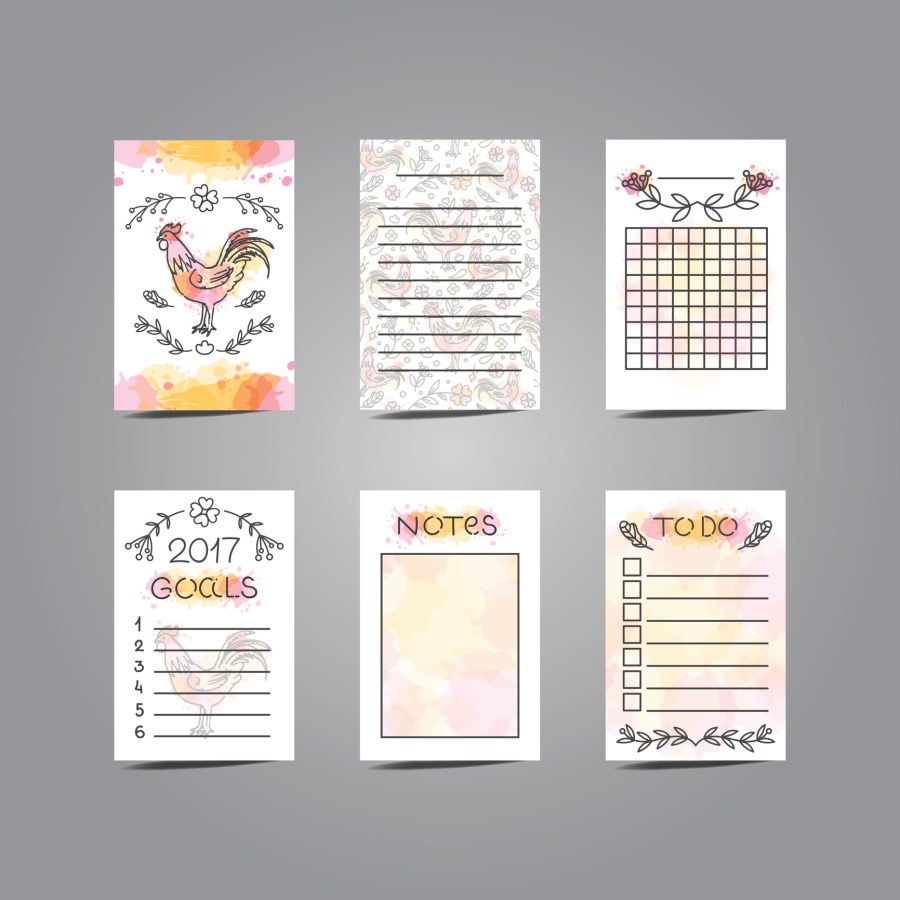
Printable Journaling Cards with Rooster Illustration. Line Style

You can put a bullet journal to work describing your days and then use the data you gather––when meals happen, what they look like, how many hours you’re sleeping a night, what your weekly and daily commitments look like and how they change in the summer––to transform or tweak your schedule just a little to squeak some more writing in. Poolside, or otherwise.

It’s all about sustainability. Radically altering your writing behaviors without a plan just isn’t a good idea––and it isn’t, ultimately, sustainable. Small changes are great, however, and over time you can build one change upon another until your summers are your most productive months, rather than the opposite! But it starts with knowing where you are, first.

If you’re looking for insight into bullet journaling, hop on Google or YouTube! There are literally thousands of them out there, but beware: many are a bit deceiving, touting life-altering effects and demonstrating uncannily beautiful hand lettering skills. You don’t have to make all the big changes at once, and you don’t need to be a gifted artist to figure out a better summer schedule by bullet journaling!

Still, here’s a quick snippet to get you started:

You are not alone. ♣︎

Do you have ideas to share? Please don’t hesitate to drop us a line in the comments section, and I’ll make sure to feature your thoughts and respond to them in my next post!

Elizabeth

ABOUT ELIZABETH JAVOR: With over 20 years of experience in sales and management, Elizabeth Javor works as the Director of Sales and Marketing for Outskirts Press. The Sales and Marketing departments are composed of knowledgeable publishing consultants, customer service reps and book marketing specialists; together, they all focus on educating authors on the self-publishing process to help them publish the book of their dreams. Whether you are a professional looking to take your career to the next level with platform-driven non-fiction or a novelist seeking fame, fortune, and/or personal fulfillment, Elizabeth Javor can put you on the right path.

In Your Corner: Getting Started With Amazon Sales Rankings (Part III: The OTHER Algorithms)

First of all ….

happy 4th of july independence day

Hopefully this newest addition to my latest series of blog posts finds you resting at home, or on some lake shore, or on a deck somewhere, with a large glass of sweet iced tea at your elbow and the scent of grilled burgers wafting on the warm summer breeze. Wherever this finds you, and whatever country you might reside in, I hope that you’re having a splendid afternoon.

Over the last month, I’ve been slowing down and taking a close-up look at some of Amazon’s most useful––and oft-controversial––features when it comes to selling and marketing your self-published books. First, we looked at sales rankings. Next, we looked at pre-orders––and how pre-orders can affect sales rankings. Today, we’re going to spend some time with Amazon’s other algorithms––the ones that you might not even know about, but which are just as important in respect to sales.

First of all, before we get started, a quick proviso: I am neither a computer programmer nor a systems specialist. I’m coming at this subject as, I suppose, a studious and well-informed amateur. I don’t just read about these algorithms––whether we’re talking about Amazon or Google or eBay or any other profit-making enterprise that uses one––once and consider myself knowledgeable; if anything, the most important thing I’ve learned over the years is that the algorithms are constantly changing and being reinvented, so we all need to be constantly dipping in and out of the subject to stay abreast of the latest developments.

What algorithms are those?

An algorithm can be broad in its scope or more constrained; it will vary depending on the needs of its users and the business that develops it. In the case of Amazon, most of what I’m about to talk about are aspects, or mere elements, of what the larger algorithm is capable of. They can be talked about on their own, since they’re units of code with separate goals and applications, but they ought also to be talked about as part of a much larger whole. Amazon has a whole subsidiary––A9––that is dedicated entirely to developing search engine technology and coding architecture.

Amazon’s sales ranking algorithm feeds into its search engine and look-alike (AKA “recommendations”) algorithms in predictable ways: the higher your ranking (the lower your ranking number), the more popular your book is, and the more tried-and-true and the more likely it is in Amazon’s eyes that your book will be salable if it links it to other products. Therefore, if your book achieves a good sales ranking, it’s more likely to be boosted by these other algorithms (or units of the larger Amazon algorithm) and the more likely it will be to show up in front of new readers when they go searching for other products on Amazon.

Amazon’s algorithms are capable of cracking your book open and mining it for information, too. We’ve all heard about the insanity taking place over at Microsoft with its book platform in weeks past, and we’re all aware of the copyrights complaints leveled at Google for its book platform over the years, and Amazon is just as big and just as bad (or good, depending on your perspective) when it comes to picking through your original content for details it can use. This is particularly true if you enable the “Look Inside” feature when selling your book, or if you put up an e-book version for sale through Amazon. For the most part, this mining process is benign in intent, with the goal of figuring out what bits of what you’ve written are most likely to appeal to customers and making that accessible to them. It does, however, also mean that Amazon gets to use your content in ways that haven’t fully been mapped and analyzed yet––particularly since most of Amazon’s algorithm is, as a proprietary development, not transparent to public assessment.

The real value of reading up on Amazon’s algorithms is a heightened awareness of the balance between personal and public rights, between copyright protections and the engine of a profit-driven market. There are too many forces at work, and too many nuances to each of those forces in question, to truly “get to the bottom” of any one question we might have about how things work and how we ought to make decisions as authors, but it certainly pays to keep an eye on the headlines and one foot in the door of learning about advances in algorithms as they happen.

And ultimately, even when it seems that you’re just grist in the wheel of profit-making, you do have allies––us here on the blog, and all of your fellow authors in the business. We’re here for you!

You are not alone. ♣︎

Do you have ideas to share? Please don’t hesitate to drop us a line in the comments section, and I’ll make sure to feature your thoughts and respond to them in my next post!
Elizabeth

ABOUT ELIZABETH JAVOR: With over 20 years of experience in sales and management, Elizabeth Javor works as the Director of Sales and Marketing for Outskirts Press. The Sales and Marketing departments are composed of knowledgeable publishing consultants, customer service reps and book marketing specialists; together, they all focus on educating authors on the self-publishing process to help them publish the book of their dreams. Whether you are a professional looking to take your career to the next level with platform-driven non-fiction or a novelist seeking fame, fortune, and/or personal fulfillment, Elizabeth Javor can put you on the right path.

In Your Corner: Summer is Coming

Look, we know summer is just around the corner, and we also know you’ve all been mainlining the latest season of *ahem* a certain popular fantasy show, so here’s our thirty-second shout-out:

brace-yourselves-summer-is-coming-quick-meme-com-4945958

Okay, now that that‘s done, we can move on from wisecracks to talking about preparing for summer book sales and marketing plans.

As a self-published author, you’re no doubt already well-aware that book sales are seasonal. According to this excellent report from Springer (which is dedicated to taking a numbers approach to publishing), the winter holidays remain the season with the highest book sales, followed by summer. The report writers state that:

In early January, the lowest median sales over the years is close to 15,000 copies a week, a number higher than the highest median sales of any other time of the year except late December. For fiction, a similar but less pronounced peak is observed during the summer months with median sales surpassing 10,000, likely due to book purchases in preparation for the summer vacation. In nonfiction, there is no such summer peak. During these periods of elevated sales a book needs to sell more copies to make it to the New York Times bestseller list than during other months. We also note that in general, fiction books sell more copies than nonfiction, a gap which is largest during summer and decreases considerably during the holiday season, where the sales of both fiction and nonfiction are significantly elevated.

The writers also point out that not only are “the first year sales are the most important for a hardcover,” but also that “most fiction books have their peaks strictly in the first 2–6 weeks [… while] for nonfiction, even though peaks at weeks 2–5 are common, the peak can happen any time during the first 15 weeks.” While on a surface level this might lead one to believe that it would be smart to time a book’s publication with an upcoming sales peak, the reverse may actually be the case. As the Springer report’s authors point out, one has to sell a lot more books during a sales peak than at any other time of year to hit bestseller lists—or see a boost in the Amazon sales rankings. This is because there is more competition during sales peaks (winter holidays for nonfiction, and both summer and winter holidays for fiction). Your sales ranking, for those who may not know, shows how high you rate compared to other authors and books in the same category—the lower the number, the more popular you or your book is. (There are separate rankings for authors and books.)

A book can see successful sales at any time of year, of course, and a refined marketing plan is probably more of a determining factor when it comes to sale than time of year of publication, but it’s well worth keeping certain questions in mind: Can you make effective use of your sales ranking (on Amazon and elsewhere)? That may just be a deciding factor in what you choose to do next in your summer marketing plan.

Next time, I’m going to break those sales rankings down for you, and demonstrate how you can use your Amazon sales ranking to better market and sell your self-published book!

You are not alone. ♣︎

Do you have ideas to share? Please don’t hesitate to drop us a line in the comments section, and I’ll make sure to feature your thoughts and respond to them in my next post!

Elizabeth

ABOUT ELIZABETH JAVOR: With over 20 years of experience in sales and management, Elizabeth Javor works as the Director of Sales and Marketing for Outskirts Press. The Sales and Marketing departments are composed of knowledgeable publishing consultants, customer service reps and book marketing specialists; together, they all focus on educating authors on the self-publishing process to help them publish the book of their dreams. Whether you are a professional looking to take your career to the next level with platform-driven non-fiction or a novelist seeking fame, fortune, and/or personal fulfillment, Elizabeth Javor can put you on the right path.