Self-Publishing News: 7.30.2019

July

And now for the news!

Some highlights from this month in the world of self-publishing!

This article came as a bit of a (welcome) surprise, courtesy of The Richest, and contributor Karen Simao. Simao provides brief biographical snippets about each author she features, with a quick reminder that “the internet has also changed this market. Since some years ago, the public has seen talented writers who self-published their books online and are making a fortune. Some of them were rejected many times by traditional publishers.” A quick note, though: this list is not synonymous with the top ten authors in regards to earnings, but every author included has become a millionaire as a result of their work, traditionally or self-published—and that alone puts them all in the top tier of author-earners. Of the self-publishing authors she profiles, we’ve mentioned a few already here on the blog: Amanda Hocking, EL James, and David Chilton come to mind. A number of other authors, including Michael J. Sullivan, have published through both traditional and self-publishing channels, demonstrating yet again that these choices are not always in competition with each other. Self-publishing has a healthy and important role in the marketplace, democratizing access for both readers and authors.

Another great article this week comes from Nicole Serena Silver, an author as well as founder of Ignitingfp.com and GROWmyfuture.org, two entrepreneurial-inspired (and inspiring) portals for the curious-minded. Silver set out to write without a clear idea of what the publication process might look like. She writes, “I did not realize the complexity of the journey I was about to embark on.” The challenges were numerous:

Did you know paperweight makes a huge difference on how potential buyers subconsciously perceive the quality of your book? Yup, I did not know that. Did you know that the newest trend is soft touch books? Soft touch books feel cheap like wrapped plastic books, yuck. At least in my opinion — no offence meant if you like them. Did you know that Shopify rocks?! It’s a super helpful resource for selling your book independently without Amazon taking a ginormous cut and it can also increase your brand quality. There are lots of little details, all which I am figuring out every step along the way.

And while Silver’s article is not itself long, it opens an important door in the conversation about self-publishing, and also points readers to more of her thoughts on the subject, which can be found through her various social media platforms. More at the link!

This piece from Barbara Lane of Datebook is an important one, as it deals with a question at the heart of self-publishing: what is the value and role of a so-called “vanity press”? Many times, you’ll find self-publishing companies fighting to create linguistic distance between what their businesses do and what vanity presses do, given what Lane is talking about when she writes that “In many cases […] having your book published by a vanity press, as the name implies, carries something of a stigma. After all, if your book is any good, wouldn’t one of the reputable publishing houses want the honor of bringing it into the world and pay you for the privilege?” The answer might be a surprising one to some, given that Lane sees vanity presses and hybrid publishing companies as helping to fill a growing void and answering a need in the publishing industry. Writes Lane, “As the publishing world becomes increasingly competitive and the purse strings ever more tightly drawn, it’s become harder and harder to get a contract with a traditional publisher. To meet the needs of writers dying to get their work out, a new crop of hybrid publishers has sprung up. It’s a whole new game out there.” Nobody likes to spend money if they (a) don’t think they need to, or (b) are not receiving fair value for their investment. And Lane acknowledges that $7,500.00 (the cost to publish through She Writes Press) is a hefty price tag, but she also notes that many authors who choose a similar route are turning to crowdsourcing in order to pay off publishing fees. She also notes that one’s reason for publishing plays an important role in determining which publishing route is best suited. A worthy opening salvo of what we hope is an ongoing conversation!


spa-news

As a self-publishing author, you may find it helpful to stay up-to-date on the trends and news related to the self-publishing industry.This will help you make informed decisions before, during and after the self-publishing process, which will lead to a greater self-publishing experience. To help you stay current on self-publishing topics, simply visit our blog each month to find out the hottest news. If you have other big news to share, please comment below.

icon logo self publishing advisor

In Your Corner: Keeping Ahead of the Summer Rush

Holiday suitcase

Look, summer presents unique challenges to writers, doesn’t it? By July, everyone’s deep into their vacations, children are running riot while out of school, family streams in and out in a series of reunions, and … it can be hard to continue writing.

Of course … there are remedies. And this week, I suggest trying your hand at a schedule––and then, of all things, sticking to it!

Now, those who know me well know that I’m not aways given over to structured practicalities and organizational tricks. I know how to kick back and relax, especially in summer. After all, if you work in publishing or with authors, as I do, you’ll know that victories are hard-won and well worth celebrating! So … don’t take this as heavy-handed pontification from someone who’s eminently hypocritical. I often suggest many things which I do not myself do all the time, since I’m as firm a believer in changing the habits to fit the situation as I am that success in self-publishing is the nexus of persistence, skill, and good luck.

I recommend schedules for everyone. If not for always, than for a season––and there’s no better season to try your hand at scheduling in summer, when the emotional, physical, and social stakes are so high … and very little writing is getting done anyways, so why not try a new approach? You may be writing by a pool with a mimosa at your side, but you can still work a schedule like nobody’s business, and churn out more writing than you would otherwise. Anyone with a plan can make it work!

In garden a woman surfing on internet with laptop.

Oh … but a plan? How do I come up with one of those?

Here’s where I get a little bit … experimental. As the first step to developing a schedule, I recommend starting a bullet journal. You have probably heard this term before, and associated it with highly neurotic, organized, possibly even OCD? people with phenomenal artistic skills. sure did, and refused to start a bullet journal, until I dug into a great conversation at the local library with a young mother named Melissa.

Melissa bullet journals. No surprise there! But wow, she has zero artistic skills. I mean, not a single artistic bone in her body! She was a bit reticent to show me her bullet journal, since she felt insecure about the lettering and such, but I was eventually able to persuade her. And I was incredibly impressed! Melissa has gotten to the heart of what a bullet journal is all about, which is to say, she started hers with lists––shopping lists, to-do lists, etc––and by tracking the little things she does throughout the day. Then she took it one step further and started to set goals … once she knew what her days usually already looked like, and what was feasible.

That, my friends and dear readers, is the value of a bullet journal. It can eventually help you shape behaviors, yes, but first it shows you what you already do––and therefore, what you’re already good at, and maybe some areas to work on. It’s like Google Analytics, but for a person’s daily productivity!

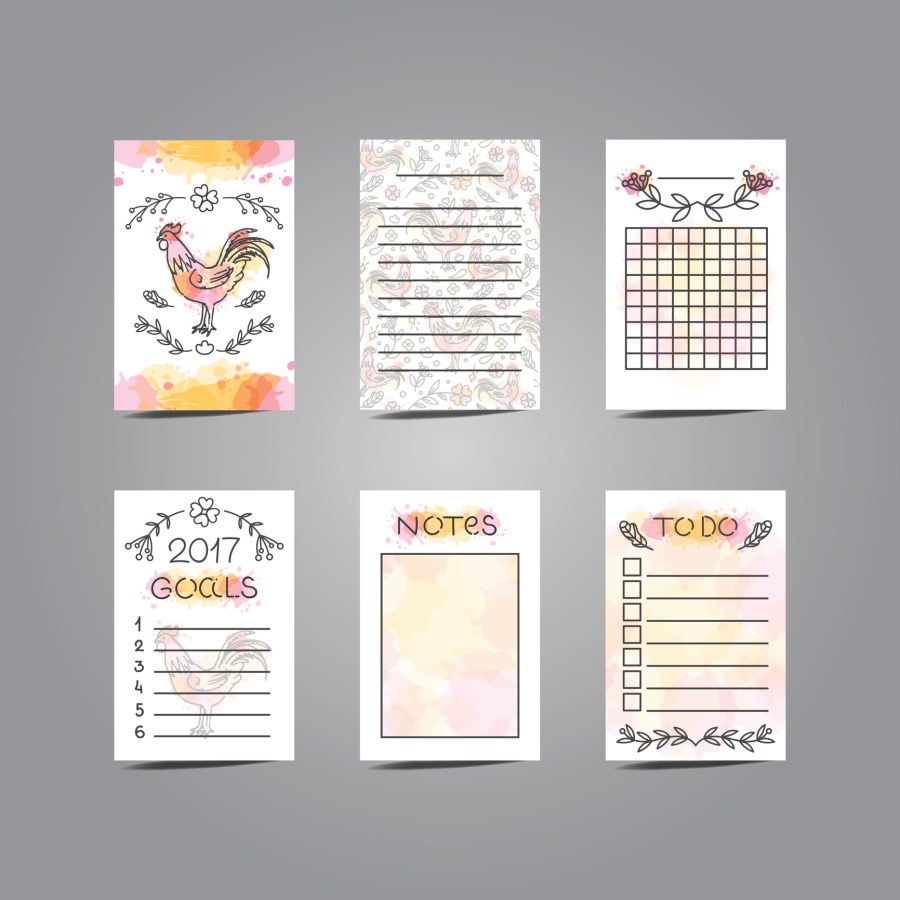
Printable Journaling Cards with Rooster Illustration. Line Style

You can put a bullet journal to work describing your days and then use the data you gather––when meals happen, what they look like, how many hours you’re sleeping a night, what your weekly and daily commitments look like and how they change in the summer––to transform or tweak your schedule just a little to squeak some more writing in. Poolside, or otherwise.

It’s all about sustainability. Radically altering your writing behaviors without a plan just isn’t a good idea––and it isn’t, ultimately, sustainable. Small changes are great, however, and over time you can build one change upon another until your summers are your most productive months, rather than the opposite! But it starts with knowing where you are, first.

If you’re looking for insight into bullet journaling, hop on Google or YouTube! There are literally thousands of them out there, but beware: many are a bit deceiving, touting life-altering effects and demonstrating uncannily beautiful hand lettering skills. You don’t have to make all the big changes at once, and you don’t need to be a gifted artist to figure out a better summer schedule by bullet journaling!

Still, here’s a quick snippet to get you started:

You are not alone. ♣︎

Do you have ideas to share? Please don’t hesitate to drop us a line in the comments section, and I’ll make sure to feature your thoughts and respond to them in my next post!

Elizabeth

ABOUT ELIZABETH JAVOR: With over 20 years of experience in sales and management, Elizabeth Javor works as the Director of Sales and Marketing for Outskirts Press. The Sales and Marketing departments are composed of knowledgeable publishing consultants, customer service reps and book marketing specialists; together, they all focus on educating authors on the self-publishing process to help them publish the book of their dreams. Whether you are a professional looking to take your career to the next level with platform-driven non-fiction or a novelist seeking fame, fortune, and/or personal fulfillment, Elizabeth Javor can put you on the right path.

Self-Publishing News: 7.23.2019

July

And now for the news!

Some highlights from this month in the world of self-publishing!

Our first item of news is a fascinating one, coming this week from the GoodEReader’s Michael Kozlowski, who sets out to answer the question of “why are there so few places to buy ebooks?” The answer, he explains, is not quite as complex as you might think: the big distributors—all of which are familiar household names, from Amazon to Apple, Barnes and Noble to Kobo, and Google—already have created a collective monopoly, and they’re able to exert pressure on small startups by virtue of their existing partnerships with the Big 5 publishers (who would be distributing traditionally published ebooks) and major self-publishing companies (who would be distributing many self-published ebooks). Writes Kozlowski, “Starting an ebook store is challenging. Major publishers refuse to do business with anyone that wants to get involved in selling digital content, they have their small list of preferred vendors and that’s it.” It’s a difficult market to break into, and there are few structures in place to make it happen. And since competition is an engine of affordability, the availability of diverse options is something readers would definitely benefit from. Worth keeping in mind.

Adam Rowe of Forbes shows up for self-publishers everywhere yet again in this week’s article on book cover design, a subject we’ve discussed numerous times here on the blog ourselves. But first, what is the “7-second test”? Rowe explains:

You might not have heard of book cover design’s “7 second” test, but if you’ve ever wondered through a bookstore, you’ve undoubtedly tried it yourself. Pick up a book, glance at the front and back covers, and you’ll likely make the decision to either nestle it back on the shelf or seriously consider buying it. That tiny window of time is all an author has to sell their story, and it all comes down to a great book cover design.

With that in mind, authors have to pump up the visual appeal of their book covers in order to have a chance of out-competing fellow authors and seeing their books fly all the way from physical or digital bookstore shelves to the checkout aisle (or virtual checkout, as the case may be). Rowe has some suggestions, all of them good, from reflecting genre expectations to expressing emotion, crafting an attractive thumbnail image, keeping it simple, and ensuring it’s unique. Even in a digital age, when authors aren’t always holding physical books in their hands, Rowe implies, it’s important to consider all of the elements that go into making a beautiful and attractive book cover. A must-read article!

Last but not least, a sweet little article from Laura Hamm of The Bookseller, a privately-owned industry magazine and news engine. Writes Hamm,

I didn’t think I’d ever call myself part of the publishing industry, I’m still not sure I can. I started approaching stories with digital eyes, and have come full circle to print. So I’m now a double self-publisher – I started a self-publishing platform for kids, Fabled, and now I’m creating a book of kid-authored stories, The Future Is Make Believe (live on Kickstarter now). A strange sort of industry beast to be sure, but I think how I’ve grown may be of some interest to the traditional animals out there too.

Hamm’s goal is to render self-publishing accessible and useful to children, a population that by and large has been left untargeted by self-publishers. (There are reasons for that, including the prohibitive costs associated with producing beautiful hardbound books in all the various unusual sizes typical of picture books.) After describing her process and background in creating not just a platform but a book full of stories written by real kids, Hamm closes out with a moving endorsement for all self-publishing authors looking to reach kids:

I think the strange fluidity I’m in as I build my brand mirrors the way children interact with stories. Children are story first and format second – they don’t come with our snobbery about form. They play at Spiderman mashed up with Harry Potter, they read Winnie-the-Pooh, collect the Shopkins and watch Paw Patrol, and it is all fodder for their imagination. It all gets whirled and re-spun in daydreams and their stories. If we give them space to do it that is, if we listen. And I intend to.

We love that.


spa-news

As a self-publishing author, you may find it helpful to stay up-to-date on the trends and news related to the self-publishing industry.This will help you make informed decisions before, during and after the self-publishing process, which will lead to a greater self-publishing experience. To help you stay current on self-publishing topics, simply visit our blog each month to find out the hottest news. If you have other big news to share, please comment below.
icon logo self publishing advisor

Self-Publishing News: 7.17.2019

July

And now for the news!

Some highlights from this month in the world of self-publishing!

If you needed a laugh (that’s also, admittedly, kind of a groan), check out Kelly Burke’s article on 7News.com.au (an Australian news website), in which she covers the duplicitous exploits of “contrepreneur” and “demotivational speaker,” Mike Winnet. Winnet, who more or less makes his living (or earns his street cred) from similar pranks and social media efforts, set out to tackle Amazon’s self-publishing process this time around. His prank was simple: self-publish a book (titled How to get a #1 Amazon best-seller) that contains nothing but blank pages, and see what happens. In this case, the system, which is designed to pick up on fraudulent sales of this nature, missed the mark and Winnet’s book became listed on Amazon as a best-seller, even though it sold fewer than 50 copies. The book was only pulled from distribution after Winnet ‘fessed up on social media, which begs the question of how closely Amazon is actually watching its self-publishing platform, and what sorts of legitimately fraudulent activity may be taking place on the site. This may or may not impact authors’ decisions to publish or not publish through Amazon, but it’s worth keeping an eye on.

To end this week’s news post on a positive note, cast your eyes toward author Amanda Alcántara, whose most recent book Chula inspired this article by Erica Nahmad of BeLatina.com. Writes Nahmad, Chula is “an autobiographical look at her childhood as a Latina in the Dominican Republic and later in the United States, is exactly as inspiring and entertaining as you might imagine.” What follows is a resoundingly positive and lengthy look at Alcántara’s background and the details of the book proper, as well as the author’s decision to self-publish. Says Nahmad, “Author Amanda Alcántara had a story to tell, a story that could not wait and that needed to be shared. And despite the typical obstacles in getting a book published, she took matters into her own hands and told the tale she was born to tell.” Later in the article, Nahmad includes a lengthy section titled “How Alcántara was Empowered by Self-Publishing Her Debut Book,” in which she details Alcántara’s experiences. Writes Nahmad:

“I didn’t want to wait one year to find an agent then one year to find a publisher. I didn’t want to wait three years to publish my book,” she told People En Español. “I didn’t want to compromise on the Spanish and English or the format.”

And that creative control allowed her to preserve the very personal tone and also ensure that she built a team that was connected to her vision and her experiences — the editorial team, cover illustrator and photographer are all of Dominican heritage.

How cool is that?


spa-news

As a self-publishing author, you may find it helpful to stay up-to-date on the trends and news related to the self-publishing industry.This will help you make informed decisions before, during and after the self-publishing process, which will lead to a greater self-publishing experience. To help you stay current on self-publishing topics, simply visit our blog each month to find out the hottest news. If you have other big news to share, please comment below.

icon logo self publishing advisor

Self-Published Book Review: Dear Folks — A Farm Boy Leaves Home to Fight in the Great War and Falls in Love with an English Lass

Book reviews are a great way for self-publishing authors to gain exposure. After all, how can someone buy your book if he or she doesn’t know it exists? Paired with other elements of your book promotion strategy, requesting reviews is a great way to get people talking about what you’ve written.
When we read good reviews, we definitely like to share them. It gives the author a few (permanent) moments of fame and allows us to let the community know about a great book. Here’s this week’s book review:

Dear Folks: A Farm Boy Leaves Home to Fight in the Great War and Falls in Love with an English Lass walt hazelton


Dear Folks: A Farm Boy Leaves Home to Fight in the Great War and Falls in Love with an English Lass

by Walt Hazelton

ISBN: 9781478793632


Synopsis*:

A true story of war and romance. Raised by devout parents on a Canadian farm, naive 17-year-old Walter enlists in the Canadian Infantry during World War I. After six months of training, his unit is active in the trenches near Ypres, Belgium, where he encounters the horrors of warfare, poison gas, and rat-infested trenches. After being sent back to England to recover from illness, Walter falls in love with an English lass-and the relationship blossoms. They become engaged, but there are obstacles. She has been raised in a low-income community, while Walter’s father is a well-educated, practicing doctor. Amid all the uncertainties of war, the two lovers postpone their marriage and continue to see each other as often as possible. But when the war suddenly ends, Walter is shipped back home-alone. Can their wartime romance survive an ocean of distance? Take a step back into history and experience this true story firsthand through Walter’s letters to his parents. Dear Folks is a warm and wonderful read about youth, love, war, and commitment.

 * courtesy of Amazon.com

Reviews

Fascinating Read About Life in the Trenches of WWI
Great read. Fascinating to hear a first-hand account of what it was like to fight in the trenches in WWI.

Great book!

I am almost done reading this and have really enjoyed this. Its even more fun to read because I am related to everyone mentioned in the book. I love seeing all the letters that Walter wrote during his time away at war and hearing about how things were back then. Very good read!

– reviewed by LauraJ on Amazon

An intimate and compelling portrait of a young man in the throes of both love and war, drawn from his letters home, by his own son.

– reviewed by Carol Morris on Amazon


tuesday book review

Thanks for reading!  Keep up with the latest in the world of indie and self-published books by watching this space!

Self Publishing Advisor

selfpubicon1