Color Printing vs. Black and White Printing… What is the Difference?

When you choose to self-publish a book, you must decide you want the interior of your book printed in color or black and white. This decision impacts the look of your book as well as the price. When considering your options, it is important to understand the process as well as the benefits of each choice.

Colored Printing

Colored printing is typically used for smaller manuscripts averaging 30 to 50 pages. These are usually books geared towards children. Because illustrations tell half of the story in a picture book, color is extremely important in children’s books. It captures the imagination and brings the story to life.

Black and White Printing

Black and white printing is typically used for longer manuscripts. This not mean that you will have a black and white cover. It simply means that the interior pages of your book will be printed in black and white. This option is more cost-effective for longer manuscripts because of production cost and market price.

How is this different from traditional publishing?

In traditional publishing, the black and white pages of a manuscript are printed on one press while the colored pages are printed on another. After all of the pages are printed, the manuscript is assembled. Print on demand (POD) publishing works a bit differently. Each page is printed individually on the same press. This means that just some spot of color will require your manuscript to be printed on the colored press. This immediately increases the cost of your book because the colored press is more expensive to maintain and operate. It requires a more skilled operator and heavier, more expensive paper.

What options do authors of long manuscripts have?

As an author of a long manuscript, you need to not only consider the production cost of your book but also the market price. Long manuscripts that are published in color have a higher market price because of the production cost. This in turn typically results in poor sales because readers are unwilling to buy a book that is overpriced compared to other books of similar lengths.

This does not mean that you have to publish a dull book. If you want to include images in your longer length manuscript, you can use a grayscale. Your manuscript will still be printed on the black and white printer, but your colored images will be converted to black and white. This is an option that is frequently and successfully used by POD authors.

If you are passionate about your book being published in color, it is an option. Just be prepared for higher costs, and plan for a higher market price. One of the perks of self-publishing is that you are in control of your book. You decide how it will look, so make the choice that is best for you and your readers.

ABOUT WENDY STETINA:
Wendy Stetina is a sales and marketing professional with over 30 years experience in the printing and publishing industry. Wendy works as the Director of Author Services for Outskirts Press. The Author Services Department is composed of knowledgeable customer service reps and publishing consultants; and together, they all focus on educating authors on the self-publishing process in order to help them publish the book of their dreams. Whether you are a professional looking to take your career to the next level with platform-driven non-fiction, or a novelist seeking fame, fortune, and/or personal fulfillment, Wendy Stetina can put you on the right path.

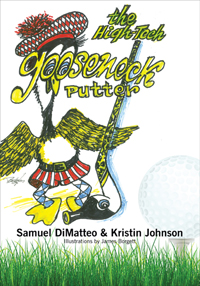
Self-Publishing Weekly Book Review: The High-Tech Gooseneck Putter by Samuel DiMatteo & Kristin Johnson

Book reviews are a great way for self-publishing authors to gain exposure. After all, how can someone buy your book if they don’t know it exists? Paired with other elements of your book promotion strategy, requesting reviews is a great way to get people talking about what you’ve written.

When we read good reviews, we definitely like to share them. It gives the author a few (permanent) moments of fame and allows us to let the community know about a great book. Here’s this week’s book review by Midwest Book Review:


The High-Tech Gooseneck Putter

Samuel DiMatteo & Kristin Johnson

Publisher: Outskirts Press

ISBN: 9781432764500

Genre: Children’s Book/Sports

Reviewed by Midwest Book Review

To be a champion is the goal of anyone who seeks a sport seriously. “The High-Tech Gooseneck Putter” is a children’s book. It is a story of Sami DeMani,   a golfing gander whose his career ruined when his luck goes over. But with the help of technology, Sami might very well be able to play again. The authors present a story of perseverance and tenacity in the face of ill fortune. “The High-Tech Gooseneck Putter” is worth considering for reading for any golf lover and their children.

Does Offering An Online Preview of Your Book Devalue It?

Earlier today, I was reading through old emails, and I found one sentence from an author that intrigued me. She said, “Sharing too much minimizes the impact of my book.” This ignited many thoughts, but mainly I thought about content marketing and how effective it can be (and has been for many people). I also began to wonder why authors feel the need to hold out on “free” content to get book sales. The author’s book is available online only, and she was expressing concerns about her book’s availability on Amazon’s Search Inside the Book. I was trying to show her the value of that extra visibility, and she was fighting me tooth and nail on it.

Here a few key reasons why every author should consider making their book available for online preview:

  1. Your reader may not know you. Unless your book has been recommended to them, what reason do readers have to trust you? This is especially true if you are a new self-published author.
  2. The reader may know you but may not be too sure about the content of your book. In your eyes, your book is gold. You know you’ve created the perfect book that everyone should want to read. The question is, will everyone feel the same way? Or worse yet, how will they know what to think of your book if they can’t at least take a peek.
  3. The “real” bookstore experience is lost online. People can’t skim the pages of a book to see if they may enjoy its content – unless you have a preview for your book. Giving readers the option to glance over your book’s content first helps them get a feel for your work and can work to ease the pain of opening the pocketbook.

So, with all of these benefits, why was she so opposed to Search Inside? She was afraid that people wouldn’t buy her book because the preview would reveal too much. She felt her written word was as good as gold, and as such, people should pay a fair price for access. It’s good that she takes pride in her work, but this line of thinking can turn buyers away – especially in the case of nonfiction books.

Think of it this way – would you buy an item from a store that doesn’t have a return policy if their price was comparable to a store that does have a return policy? Possibly – but more often that not, most people will put more trust in the store that does offer a return policy. Consider offering a return policy for your book so that you can instill a little bit of faith. I assure you that unless you share the entire book online, people will still buy your book after reading the preview if they’re interested. Remember – you can’t go wrong with content marketing.

What are your thoughts on sharing your book with readers before they commit to buying it?

Elise Connors ABOUT ELISE L. CONNORS:
Elise works as the Manager of Author Support of Outskirts Press.  She also contributes to the Outskirts Press blog at blog.outskirtspress.com. Elise and a group of talented book marketing experts assist not only published Outskirts Press authors, but also all authors and professionals who are interested in getting the best possible exposure for their book.

Self-Publishing Book Review of the Week: Irises to Ashes by Charlie Hudson

Book reviews are a great way for self-publishing authors to gain exposure. After all, how can someone buy your book if they don’t know it exists? Paired with other elements of your book promotion strategy, requesting reviews is a great way to get people talking about what you’ve written.

When we read good reviews, we definitely like to share them. It gives the author a few (permanent) moments of fame and allows us to let the community know about a great book. Here’s this week’s book review by Kaye Trout at Midwest Book Review:

Irises to Ashes

Charlie Hudson

Publisher: Outskirts Press

ISBN: 9781432773892

Genre: Fiction – Family/Adventure/Dreams

Reviewed by: K. Trout for Amazon

Rating: Very Good

According  to the back cover, Irises to Ashes is

“A BOOK FOR ANYONE WHO HAS EVER STRUGGLED TO PURSUE A DREAM.” The cover also declares that “Charlie Hudson, military veteran and author, brings a different type of book in Irises to Ashes. Her comfortable writing style and touches of humor are still present in a story that explores self-discovery and the price we sometimes pay for choices that we make. See all of Charlie’s books at www.charliehunson.net.”

“Young Maggie Stewart loves the beaches of the Outer Banks, but that doesn’t take away from her desire to travel beyond the ocean’s edge. She knows that her family expects her to marry and settle down. It is an unexpected encounter with Amelia Hatcher, the village recluse, that leads to surprising opportunities that can open a path for Maggie to find a new future. Thus begins the intertwined stories of Maggie and Amelia: a fifteen year relationship between a young woman seeking to find her own way and an older woman seeking redemption for a past she has kept shrouded in secret.”

Irises to Ashes is divided into three parts: Part One – Maggie’s Beginning – Summer 1976 – Summer 1978, Part Two – Maggie’s Time – Fall 1978 – Spring 1992, and Part Three – Amelia’s Secrets – April 1992. This is not only a novel about young Maggie Stewart’s self-discovery but also about the de-mystification of Amelia Hatcher. Throughout Hudson’s novel, the page-turning tension flows from one page to the next, starting with: will she give up her virginity to Billy Ray?; how can she get to know the recluse Amelia?; how will they keep their relationship a secret; how will she work around obstinate parents; how will she get to Paris; will she succeed?; how will she deal with negative family jealousy; will she have to choose between family expectations and a successful career; and why is there no meaningful relationships? Then, you find out the secrets that led Amelia to choose the life of a recluse.

Irises To Ashes has a great beginning to pull you in, tension to keep you turning, and a satisfying conclusion to fit the title. Hudson excels at descriptive writing and character development, which bring this story to life. Can you relate to  Maggie? Might you distort the truth to get what you want? And, in some ways, Irises to Ashes is a light mystery. Will she break from family? Will she succeed? What are Amelia’s dark secrets? Other books by Charlie Hudson include: Your Room at the End, Parallel Worlds, Islands in the Sand, Orchids in the Snow, Shades of Murder,  and Parents’ Guide to Business Travel. And yes, I can highly recommend this novel.

Should You Hire An Editor?

In traditional publishing, there is a process to ensure that manuscripts are flawless, or at least near flawless; we all know that mistakes occasionally make it in to print. After submitting your manuscript to a publisher, it is reviewed by an editor and returned to you, the author, for review. After you have reviewed the manuscript and addressed any issues, the editor reviews the manuscript again, but it doesn’t end there. The manuscript is then proofread, either by the author or a professional proofreader. If everyone does their job correctly, you should publish a flawless book.

In self-publishing, however, it is up to you to edit your work. You can use spelling and grammar tools, but these programs are not flawless. They are not capable of recognizing typos or misused words, and believe it or not, sometimes the grammar suggestions are incorrect. The biggest problem with these tools is inconsistencies. Word processing programs are not designed to recognize style inconsistencies or factual inconsistencies. Only human eyes are capable of identifying these issues.

So how do you make sure your manuscript is flawless? One possibility is hiring a professional editor. This individual will be able to edit your manuscript with a fresh set of unbiased eyes. In addition to correcting spelling, grammar, and style errors, an editor can point out areas in the manuscript that are unclear or contradictory. Best of all, an editor will make your manuscript more professional. One of the biggest misconceptions about self-publishing is that the books are poorly written and filled with errors. The easiest way to dispel that myth is to treat your manuscript as a professional book and take charge of the editing process.

To find an editor, check out websites such as craiglist.com, elance.com, guru.com, and outskirtspress.com. You can also search Google for editors near you, and ask other writers for recommendations.

Cheri Breeding

ABOUT CHERI BREEDING:
Since 2005 Cheri Breeding has been working as the Director of Production for Outskirts Press. In that time, she has been an instrumental component of every aspect of the Production Department, performing the roles of an Author Representative, Book Designer, Customer Service Representative, Title Production Supervisor, Production Manager and, Director of Production. She brings all that experience and knowledge, along with an unparalleled customer-service focus, to help self-publishing authors reach high-quality book publication more efficiently, professionally, and affordably.