An Indie Author’s Social Media Primer | YouTube

You already use it to watch every video your friends send you on Facebook, Twitter, Tumblr, and elsewhere.  Chances are, nine out of every ten video links you’re ever going to click (in this decade, at least) will link to something on YouTube.  It’s about time that indie and self-published authors get in on the action, don’t you think?  Only, wait a minute: they already are!

YouTube Screenshot

But before we dive into just how you can use YouTube to launch your self-marketing campaign, let’s address some of the basics.  What is YouTube?  It’s a video storage and hosting service which allows pretty much anyone who signs up for a free account to upload video files for public consumption (or private; like every other good social media platform, YouTube allows its users to toggle a number of privacy settings for each individual video as well as for their profile pages).  Once a video is posted to YouTube, fans and followers can distribute the link themselves, which makes it a great platform for viral campaigns.  And because videos are visceral in a way text sometimes isn’t, they make a fantastic impact on viewers’–and readers’!–imaginations.

Debunking the Great YouTube Myth: “It’s all cats, cats, cats.”

While I’m not above clicking a link to a good cat video every now and again (see what I did there?), I do think we’re doing a great disservice to the platform by claiming it’s all cats, because pretty much anyone who is anyone worth knowing about has a YouTube channel.  I’m talking VICE, John Green, Oprah, CNN, The New York Public Library … the list goes on, and on, and on, and on, and on … ad infinitum.

Top 5 Best Practices:

1. Post a book trailer.  We here at Self Publishing Advisor have written about the merits of book trailers before (here and here), but I just can’t emphasize enough how awesome a book trailer is–especially as regards your self-promotion and self-marketing agenda.  A book trailer provides a bite-sized (or “eye-sized”) bundle of information about your book to new readers for easy consumption.  A good book trailer will add drama and flair to your book’s public image … and it will also reach far more people.  YouTube’s algorithms will ensure that its users will stumble across your book whenever they search for similar videos or book trailers by other authors in the same genre.  Just make sure to take advantage of the metadata!

2. Post regularly, if not weekly.  You may or may not be familiar (and comfortable) with the term “vlogging,” internet slang for “video blogging.”  Authors like John Green verge on being professional video bloggers, in that they post videos of themselves with updates on their writing, answers to readers’ questions, or more generally, responses to fans, fandoms, and greater cultural trends.  You may not be a titan of Young Adult Literature like John Green, but you can definitely walk away with a few ideas from his channel.  Namely: provide new content on a regular basis (feed your followers!), consider tweaking your on-camera surroundings so that posts are well-lit and free of visual clutter (keep it simple!), and edit your posts before they go up in order to re-craft the posts for easy consumption (keep it short!).

3. Ask to join an existing station as a guest speaker.  Many channels such as Self-Publishing Roundtable will invite authors to serve as “guests” on their YouTube channels, in part to promote variety, and in part because they welcome the opportunity to provide new authors a voice.  Run a quick search on YouTube for channels to do with self publishing, navigate to that channel’s “About” page, and then click the “Send Message” button to contact the people on that channel directly.  You have literally nothing to lose and everything to gain by putting out feelers for folks who might be interested in helping you launch your new (or existing) book.  A few might say “No,” but there are (as my grandmother used to remind me) plenty of fish in the sea.

4. Pay attention to the details.  I mentioned lighting, time length, and editing before.  A good way of figuring out how to frame and film your first couple of YouTube posts is to watch a whole bunch.  Not just Lady Gaga music videos, mind, but videos that are doing something similar to what you aim to do.  Find those self-publishing-related YouTube channels and see what they get up to in terms of audio quality, clutter, editing techniques, and so forth.  You can always choose what to take and what to leave from these videos–they’re just a sounding board, not a structured guide, but they’ll still give you ideas.  You’re not chained to anything that they do!  Just make sure that you’re making conscious and conscientious decisions about content and presentation.

5. Don’t overdo it … on your first video, or any following video.  You’ll notice that some of the most successful author-related YouTube channels preserve an element of spontaneity, of freshness, and of personality.  You definitely don’t want to scrub your YouTube videos of what makes you you.  But another, less acknowledged quality of successful YouTubers is that they pay attention to length.  A long video, even a long and professionally-made video, is daunting to the average watcher.  In 2014, Adweek ran an article full of infographics about the ideal length of everything digital (I’m not even kidding), from Twitter tweets to hashtags to YouTube videos.  And what did they find?  That of the top 50 videos on YouTube at the time, the average length fell somewhere close to 2 minutes and 50 seconds.  Amazing.  Any longer, and the video is no longer “eye-sized” and runs the risk of losing a new reader’s interest.  Once you have built up a substantial network of faithful YouTube subscribers, you can fudge around with limits and goals and things, but for a newcomer?  Stick to a quick hearty blend of style and substance that will hook new readers in without taking up too much of their time.

Most Overlooked Feature:

Without a question, the most feature most authors forget about when it comes to YouTube is the playlist.  What’s more, there are plenty of great resources out there that will walk you through the minutiae of how to set one up (this one, for example).  It’s not an “undiscovered” feature for hearty and dedicated YouTube users, but it is overlooked by many content providers.  Essentially, a playlist allows authors to group together videos to be played by others in a specific order.  It creates a narrative out of your video collection, and helps a lot with the whole “findability” thing.  They’re sharable on social media just like individual videos, and they’re easy to create and edit.  Really, there’s no reason not to use playlists to organize your files on YouTube.

I hope you’ll join me in building this Social Media Primer!  If you have any questions, comments, suggestions, or contributions, please use the comment field below or drop us a line at selfpublishingadvice@gmail.com.  And remember to check back each Wednesday for your weekly dose of social media know-how. ♠

KellyABOUT KELLY SCHUKNECHT: Kelly Schuknecht is the Executive Vice President of Outskirts Press. In addition to her contributions to the Outskirts Press blog at blog.outskirtspress.com, Kelly and a group of talented marketing experts offer book marketing services, support, and products to not only published Outskirts Press authors, but to all authors and professionals who are interested in marketing their books and/or careers. Learn more about Kelly on her blog, kellyschuknecht.com.

Self-Publishing & Merchandising : Summary Edition

Ten posts and eleven weeks ago, we started out on this foray into merchandising together.  My original list was only five items long, but as the weeks ticked by, I realized there was just so much more to unpack––so, so much more.  There were weeks when I faced a great recurring quandary, the same quandary that every book-to-film adaptation seems to face these days: “Do I stick with the original vision for this piece, or do I split it into three shorter pieces and fill in the gaps with editorializing?”  Which is not to say I quibble with the unstoppable Hollywood machinery; in fact, it’s entirely apropos, I think, to compare merchandising to such a vast and powerful cultural institution.

Ultimately, in the end, merchandising is about making money off of your books, and making money off of books is a difficult enterprise, even when your book is published with a major traditional publishing house.  It might sound mercenary to say so, and thereby take books out of the lofty world of ideas and philosophies and re-shelve them among the lower reaches of the sticky-fingered common folk … but at the same time, we must recognize that a book which sells well spreads its ideas well.  A well-marketed book is an effective vehicle for those lofty ideas.  We cannot shy from the twin facts that merchandising is a) good for us, the indie authors of the world, and b) good for our readers, who are presented with more options, and drawn into more worlds of ideas.

There’s also a third completely parenthetical side benefit … which is to say, c) merchandising can be loads of fun.  Who doesn’t love to participate, in some small way, in the stories that taught them to dream big?  (….and I’m saying this while I wear a tee-shirt that literally glows in the dark with the schematics for the Space Shuttle.)  It might be escapism to try and keep dreams alive a little while longer––whether by slipping on a tee-shirt, or purchasing a special edition––but it may also be exactly what someone needs to forge ahead.

There’s simply no way around one fact: Merchandising can be a lot of work.  For the self-published author, it’s a daunting idea at the very least and quite possibly even a paralyzing one.  In my first post, all those weeks ago, I wrote that publishing a book does not always equate to instant success––in fact, it only very rarely catapults an author past the breaking-even point.  But merchandising, specifically, and self-publishing in general are made so much easier by the presence of a dedicated and supportive community of fellow-laborers, and hopefully by the resources that blogs like this one compile.  This series of blog posts (listed below for convenience) may only represent one feeble drop in the bucket when it comes to the resources you can turn to, but I hope that I’ve managed to find a balance between the “Big Picture” (AKA “Concise and Readable”) and some of the finer points of merchandising (AKA “I Should Probably Break This Up Into Twenty Sequels”).

SELF-PUBLISHING AND MERCHANDISING : THE SERIES

Thank you for sticking it out and being a part of this series––your feedback and suggestions have always been of such great use, dear readers.  The comments box remains open, but in the meantime, get ready to come at self-publishing from a wholly different angle starting next week Wednesday!  I’ll be examining a whole host of social media platforms and breaking down the most surprising ways in which they can be of use to you.  It’s going to be a blast!  ♠

KellyABOUT KELLY SCHUKNECHT: Kelly Schuknecht is the Executive Vice President of Outskirts Press. In addition to her contributions to the Outskirts Press blog at blog.outskirtspress.com, Kelly and a group of talented marketing experts offer book marketing services, support, and products to not only published Outskirts Press authors, but to all authors and professionals who are interested in marketing their books and/or careers. Learn more about Kelly on her blog, kellyschuknecht.com.

Self-Publishing & Merchandising : Mugs & notepads & tee-shirts, oh my!

And so we come to the penultimate branch of our ever-growing merchandising tree.  The list of possible merchandising strategies just keeps on growing: first, we looked at extras and special editions; second, we examined book covers and jacket design; third, we perused the possibilities in respect to a book’s interior design; fourth, we lifted the lid on the all-important blurb; fifth, we took a wander through the basics of book reviews; sixth, we took note of how to get and give good book reviews; seventh, took tips for working with Amazon; eighth, we took a long hard look at what Barnes & Noble (still) has to offer; and ninth (but not last or least) we listed a few more publication options, including CreateSpace and Outskirts Press, for the (discerning) independently published author.

That’s quite a lot to keep in mind, I know, when setting out.  My primary goal in starting this series was not to overwhelm, or even to provide a kind of self-publishing and merchandising bible for newcomers, but rather to start asking questions.  Hopefully I’ve done that–and hopefully we’ll all keep doing that–as the weeks go by and I begin looking at other topics.  My secondary goal was to inch a little closer to my original concern in writing these Wednesday blog posts–that is, to zoom in on the book as an object, transformable and malleable, and as a product we can treat as such in addition to treating it as it deserves to be treated–as a vehicle for ideas.

It’s fitting, then, that the second-to-last post in this series would deal with other products, the objects that we purchase or acquire that mean something to us because of the books and ideas they conjure up.  Merchandising is, in a lot of ways, about nostalgia.  If we encounter a book that we absolutely love, or get wrapped up in a world of someone else’s making, we tend to want to wrap ourselves up in a little bit of the feeling that that book or world gave us.  I say this as someone sitting at her desk, wearing a tee-shirt emblazoned with the schematics for the Space Shuttle, which I got to watch leave twin trails above the mangrove swamps on its way into orbit, and which I got to listen to as it returned to the atmosphere with its signature double sonic boom.  You see what merchandising does?  It gives us a way to hold on.

In the spirit of holding on, I put together a quick list of some of the more reputable places where you can go to create merchandise to wrap your readers up in your world.  Everyone knows about Etsy, of course, which is a wonderful site (and even provides holiday merchandising guides!) but requires its users to do all of the creation/printing/manufacturing work, and merely manages the sales of things which have already been brought into being.  If you aren’t wholly confident in your knitting or screenprinting or jewelry-making skills, these websites may be more your speed:

  • CafePress has an entire Print on Demand (POD) page.  All you need is an image or slogan to upload, and you can leave the rest of the design and print work to them.  You can sell on the CafePress marketplace for no additional cost, but setting up your own “store” will cost you (and for each store you set up, you will incur an additional fee).  CafePress’ default commission is 10%.
  • Zazzle operates in much the same way, and if you know Google is willing to pour money into it, it’s probably doing something right.  It even offers customizable options, so you or your fans aren’t necessarily stuck with one unworkable design.  Zazzle offers 10-15% commissions to its sellers.
  • DeviantArt is a golden oldie of the POD merchandise market, but users who were there in its years of infancy will be happy to know it has expanded its options to include more options when it comes to printing high-quality visual files.  If you have some pictures, posters, or other visual leaving-pieces to take to a conference or exposition or reading, DeviantArt has got you covered.  The DeviantArt Prints store offers a 20% commission on retail price for its sellers.  Websites like RedBubble and FineArtAmerica are similar in scope and offerings.
  • If you’re looking to print tee shirts, specifically, websites like SkreenedSpreadshirt, and Wordans will do for you what DeviantArt and its ilk do for art prints.  (There’s also AcmePrints and Atlas Embroidery for your larger orders.)
  • Printmojo offers classic screenprinting, with minimum orders (say, 24) and a low setup fee (around $3.50).  They offer a lot of options, though, and ordering more than the minimum can have its uses–more profits for you if you sell the merchandise rather than give it away, for example.
  • If you’re looking for a web retailer that can cut you chenille letters or embroider pennants or generally make enormous things to decorate your space (say, a booth at a fair) with, check out Custom Pennant.   Their website offers a lot of really out-there stuff that you wouldn’t necessarily think of as being useful, but actually is.  Weird how that works.
  • Last but not least, don’t forget your hybrid publishing firms, which will often offer merchandising bundles among their other listings. The advantage is that you pay one lump sum, but still (often) have a hand in the design process, and you don’t have to deal with the hassle of commissions and set-up fees.

And there you have it!  If you think of any retailers I may have forgotten, let me know in the comments section below!  Next week, I’ll be taking us back to the beginning, and forward into the future.♠

I’m realistic, or I like to think I am.  This topic is bigger than just me and my own thoughts.  I’d like to open the floor to you, dear reader.  If you have any thoughts to share on the topic of merchandising, or questions you’d like answered, send them my way via the comments box below!  I want to hear from you, and I love nothing more than a good excuse to do a little research if I don’t know something off of the top of my head.  Jump on in!

KellyABOUT KELLY SCHUKNECHT: Kelly Schuknecht is the Executive Vice President of Outskirts Press. In addition to her contributions to the Outskirts Press blog at blog.outskirtspress.com, Kelly and a group of talented marketing experts offer book marketing services, support, and products to not only published Outskirts Press authors, but to all authors and professionals who are interested in marketing their books and/or careers. Learn more about Kelly on her blog, kellyschuknecht.com.

Self-Publishing & Merchandising : What About Reviews?

[ Apologies for my absence last week!  I *should* be getting a new hard drive in the next few weeks, but in the meantime I’ll be struggling along as best I can.  You are the entire reason I hang out here every week, dear readers, and I hate it when I leave you hanging! ]

So.  We’ve examined several facets of the merchandising machine in light of our platform as self-published authors: the background, extras and special editions, book covers and jacket design as well as interior design, and the all-important blurb.  This week, I’ll be examining the book review–or at least, I’ll be examining a few of the book review’s many, many permutations and details.  We’ve touched on the matter of reviews before–here and here, for example, and also here and here, just to point you to a few examples–but I think it’s worth noting that the matter of book reviews for self-published authors is somewhat of a moving target.  There’s no one-size-fits-all understanding, much less solution, for your average indie writer.

Why are reviews important?

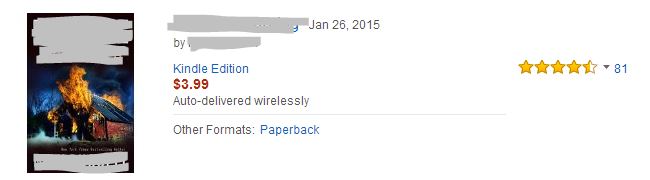
As I pointed out in 2011, the number of reviews you receive on a website like Amazon, paired with each title’s star rating, leverages a lot of weight on new readers.  If all you had to go on was this:

poor reviewsgood reviews

… which book would you be more likely to choose?  The book with more reviews and a higher star rating, of course!  (Of course there are other factors at play to distinguish these two books from each other, including a skillfully designed cover versus a sort of ho-hum cover, as well as the emotional weight of a free book versus a not-quite-free book … but you get the drift.)  And every outlet through which your book is reviewed, whether it’s Amazon or Kirkus or some other website, magazine, or blog, will boost your book’s visibility.  Having a presence is extremely important!

How do I get reviews?

This is where things get complicated.  The short answer is: any way you can.  Query book bloggers that you follow, and authors that you admire, and of course your friends and family.  (They’re your built-in audience, so take advantage of them!  Just, you know, not too much.  You don’t want your reviews to radiate desperation.)  While there’s no one single right or wrong way to go about querying for reviews, do keep in mind that reciprocity is an important part of the publishing world, especially the world of self-published and indie authors, who have to build digital communities and networks for themselves.  It’s a great idea to offer to review another author’s book in exchange for a review of your own; that way, both authors benefit, not to mention avid readers of indie literature!

There are, of course, other reliable places where book reviewers hang out.  Amazon’s top reviewers make up one such group–and the best part is, it’s their job to review new products, and they tend to love it!  Some may have specific product and even genre preferences, but you should definitely consider turning to them when you’re looking to build your reviewer base.  Remember BookPleasures.com, BookReviewsRUs.com, MidwestBookReview.com, ReadersFavorite.com, and ReaderViews.com.  And don’t forget about Goodreads!  We’ve blogged about giveaways in the past (here and here), but it’s worth mentioning again: dedicated, socially-connected readers gravitate to Goodreads, even while avid book-buyers will head to Amazon.  Consider hosting a Goodreads giveaway to bolster both the visibility of your book and the number of reviews!

I only have so much time in the day–where should I spend my time?

The best thing you can do for your self-published book is to keep writing.  The more books you write and publish, the more linkages you will build between texts, and the larger your circle of influence will grow.  But also, you know, you are a writer first and foremost–so in all things your craft should come first, and promotion second.  That being said, self-promotion and merchandising is always going to be work.  Sometimes it will even be hard and thankless work.  In the long run, however, your book’s visibility will benefit if you put in a little time here and there, and chip away at the reviewing machine.

Next wednesday, I’ll be looking at reviews again, but with a more refined microscope: I’ll be examining the blog review–dos and don’ts, and the how to make them happen fiddly bits that didn’t fit into today’s blog.  Stay tuned!

I’m realistic, or I like to think I am.  This topic is bigger than just me and my own thoughts.  I’d like to open the floor to you, dear reader.  If you have any thoughts to share on the topic of merchandising, or questions you’d like answered, send them my way via the comments box below!  I want to hear from you, and I love nothing more than a good excuse to do a little research if I don’t know something off of the top of my head.  Jump on in!

KellyABOUT KELLY SCHUKNECHT: Kelly Schuknecht is the Executive Vice President of Outskirts Press. In addition to her contributions to the Outskirts Press blog at blog.outskirtspress.com, Kelly and a group of talented marketing experts offer book marketing services, support, and products to not only published Outskirts Press authors, but to all authors and professionals who are interested in marketing their books and/or careers. Learn more about Kelly on her blog, kellyschuknecht.com.

Self-Publishing & Merchandising : Extras & Special Editions

Last week, I launched a new blog series on the ins and outs of merchandising with a quick definition.  (“Simply put, merchandising is any and all practices and methods which boost product sales in a retail environment.”)  And definitions are great and all, but we’re here to talk shop.  To get under the skin of merchandising, to inhabit the world of successful merchandisers, we have to tackle each and every aspect of the process–in depth.  This week, we’ll be taking a closer look at two of these aspects: “extras,” and special edition releases of your books.

What are “extras”?

“Extras” are anything you send out into the world related to your work that is not (quite) your book.  Or at least, it’s not your book as most people know it.  They’re the fiddly bits, the sweeteners, the “guess what I got this week?” element of book marketing.  The no-frills approach to book sales is to put your book, and only your book, into the hands of your ideal readers.  But we all know the process is more complicated than that, if we want to make profitable sales.

Identifying our ideal readers is one complicated conglomerate of issues unto itself, and connecting the dots between book and reader yet another (seemingly) hopeless tangle, and transforming the market so that more readers become ideal readers is … well, you get the picture.  The creation, distribution, and controlled availability of “extras” is one highly effective way to unpick some of these knots.  Why?  Because they make your ideal readers feel privileged and affirmed in their good taste, while also serving as a siren call to new readers–a declaration that you, the author, are willing to go the extra mile to bring others alongside you, into the world of your book.  And I’m not just talking about fictional worlds, here: every good book is a world unto itself, a universe even, that enwraps its readers in a shared sense of wonder, urgency, or belief.

“Extras” come in every possible form we can imagine, and sometimes figuring out what “extras” suit our books and our needs best is the larger task.  But simply identifying them can be a challenge, too, so here is a short list of some of the more effective extras that leap to my mind:

  • creating swag, like bookmarks or postcards or tee-shirts, etc, to give away or raffle off at book readings and signings;
  • putting together a regular newsletter, physical or digital, to distribute to eager readers;
  • orchestrating giveaways, scavenger hunts, and other participatory contests to boost interest;
  • offering limited-offer “buy a physical book and unlock free digital content” sorts of specials;
  • publishing select chapters online for free, using interactive services such as WattPad; and
  • hosting quizzes, ask-and-answer sessions, or other author-centric material online using social media networks such as Tumblr.

(This is just to name a few.)  As you can see, many of these “extras” fall into two loose categories: the physical fiddly bits, and the digital fiddly bits.  It’s worth noting that, while focusing our talents into bundles that seem all of a kind–say, pairing a digital “extra” with an ebook release, or a physical “extra” with a physical book launch–may be an effective use of our time, it may not be the sole best way to boost our sales.  Many readers who are highly engaged on social media will treasure a physical book or a physical “extra,” while many readers who hold fast to their physical libraries are ready and willing to branch out and experiment, if they’re invested in you, the author, and your vision of your world.  Strategic cross-fertilization may be the best approach, so make sure you’re providing “extras” on both sides of the digital/physical divide–if possible.

Oh, right, I mentioned special editions too.

That’s right–I haven’t forgotten.  The reason I save this second aspect of merchandising for after my discussion of “extras” is simple: many of the same rules apply.  We’ve written about releasing special editions, whether ebook editions or other kinds of editions as a kind of promotional venture, before.  We’ve even written about releasing special editions for holidays and for Kindles, respectively.  The simple distillation of all of these prior posts might be to say: “The more editions we put out there, the more accessible our books, the more people who will hear of our books, and the more books we will sell.”  The parallels between special editions and “extras” are fairly clear–just substitute “extras” for “editions.”

The key to successful merchandising for the self-published author is to make our readers feel special!  We can make this happen with strategic bundles of “extras,” or by releasing new editions of previously published books.  Both of these merchandising methods are built upon creating and distributing new access points to our works.  Generating special offers that are limited in some way–in respect to time or quantity–whether on swag or giveaways or special editions–heightens the competitive edge to what we’re offering, and makes our books a topic of conversation.  We want to balance ubiquity of our works–making it is available to as many people as possible–with an urgency to acquire it in certain incarnations or circumstances.

Next week, I’ll be examining merchandising through book and jacket design.  I’d like to open the floor to you, dear reader.  If you have any thoughts to share on the topic of merchandising, or questions you’d like answered, send them my way via the comments box below!  I want to hear from you, and I love nothing more than a good excuse to do a little research if I don’t know something off of the top of my head.  Jump on in!

KellyABOUT KELLY SCHUKNECHT: Kelly Schuknecht is the Executive Vice President of Outskirts Press. In addition to her contributions to the Outskirts Press blog at blog.outskirtspress.com, Kelly and a group of talented marketing experts offer book marketing services, support, and products to not only published Outskirts Press authors, but to all authors and professionals who are interested in marketing their books and/or careers. Learn more about Kelly on her blog, kellyschuknecht.com.