Self-Publishing News: 10.22.2019

hello October word abstrtact in wood type

And now for the news!

Some highlights from this month in the world of self-publishing!

Today’s news comes as a set of three!

For Publishers Weekly by Jim Milliot

For Good E-Reader by Michael Kozlowski

For Books + Publishing


We felt it would be fun this week to show how sometimes one particular newsflash can really circle the globe! This week, a report from Bowker revealed some very good and interesting news about publishing: there was a huge jump in self-published titles (or at the very least, trackable self-published titles) from the 2017 publishing year to the 2018 publishing year. (2019 data is not yet available.) Bowker, which in the report self-professes to “[publish] authoritative statistical reports for the publishing industry on a regular basis,” also notes that three specific companies have reached a kind of monopoly on the market, releasing over 90% of all trackable self-published titles in that year. There is some variation in who dominates in each sub-market (ebook versus print, books with ISBNs versus those without), but the overall picture is one that reflects past decadal trends towards big companies eating their way through initially diverse markets. This is certainly a trend we’ll be keeping an eye on in future, and we’ll be back with more updates as soon as Bowker releases reports on the 2019 publishing year!


spa-news

As a self-publishing author, you may find it helpful to stay up-to-date on the trends and news related to the self-publishing industry.This will help you make informed decisions before, during and after the self-publishing process, which will lead to a greater self-publishing experience. To help you stay current on self-publishing topics, simply visit our blog each month to find out the hottest news. If you have other big news to share, please comment below.

icon logo self publishing advisor


In Your Corner: Preparing for NaNoWriMo!

That’s right, it’s almost #NaNoWriMo time!

For those who’ve seen the acronym around but haven’t yet been read in on what the deal is, National Novel Writing Month is an annual tradition among writers looking to kickstart new projects through a dedicated month of drafting. While you can read more about NaNoWriMo’s origin story on the nonprofit organization’s website (www.nanowrimo.org), suffice it to say this has been a big deal for a very long time. As the NaNoWriMo website puts it, “before there was the Beyhive, or Nerdfighters, there were Wrimos” (participants in NaNoWriMo). The community has built up since the early days of the Internet to create a diverse set of resources for those interested in participating—or maybe in learning from the process even if writing 50,000 words in a single month is a bit much.

nanowrimo

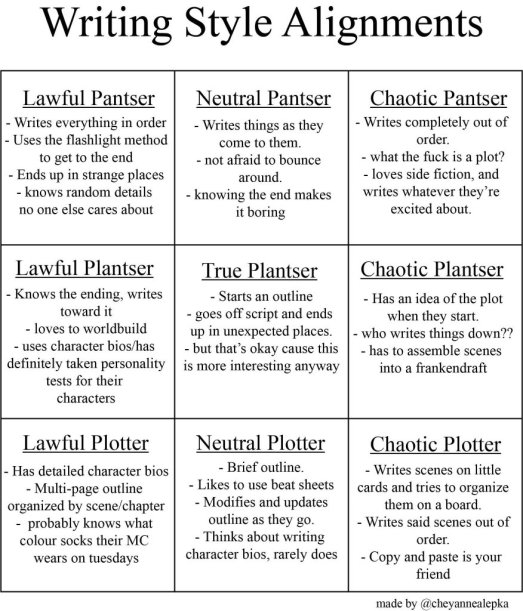
There are two kinds of Wrimos: pantsers and plotters.

Pantsers are those who go through NaNoWriMo “by the seats of their pants” or however that expression goes, and plotters are those who prepare, or plot out their book outline, extensively beforehand. I myself have participated in NaNoWriMo several times, once as a pantser, once as a plotter, and once or twice just casually taking part in the prompts and sprints and group writing sessions without aiming to get to the 50,000 word mark by month’s end. These days I fall somewhere between these Wrimo alignments, as many writers do.
nanowrimo plotter pantser

With only two weeks remaining between now and the beginning of NaNoWriMo (my next post, for context, will arrive on the day before NaNoWriMo begins), I feel as though now is the time to encourage those of you who are plotters or plantsers or otherwise in-betweeners to start digging deep into the resources you will need in the month of November. Even those of you who are pantsers or who are not at all interested in participating in NaNoWriMo on any level might find it valuable to tap into the extensive writing-related resources that Wrimos have compiled over the years. These are the kinds of resources anyone can turn to at any time of year, not just during the official NaNoWriMo period.

First, I want to point you to the NaNo Prep 101 Workshop, which is hosted by the organization that really started it all. It can be completed at any time of year for free and provides tips on the following:

  1. Developing a story idea
  2. Creating complex characters
  3. Constructing detailed plots or outlines
  4. Building a strong world
  5. Organizing your life for and around writing
  6. Finding and managing your time

You can find out more about that workshop here.

I also want to point you to NaNoWriMo’s incredible collection of author pep talks, which include several from self-publishing successes like Andy Weir as well as a number of traditionally published authors whose names you might recognize (James Patterson, anyone? Neil Gaiman? Sue Grafton? No?). Those are all available (again, for free) at the link.

I also really recommend that you spend some time looking into all of the many other excellent resources that writers all over the world have compiled on their own blogs and websites. Every author’s experience is different, and chances are that any author you meet is going to have opinions about the usefulness (or lack thereof) of NaNoWriMo to their own process. It’s pretty definitely proven, though, that there are many amazing books in the world that wouldn’t otherwise have been self-published (or traditionally published for that matter) without that core group of writers and organizers who got together and made NaNoWriMo a thing.

So, will I be participating? I’ll let you know … in two weeks. I honestly haven’t yet made up my mind, and I’m okay with that.

You are not alone. ♣︎

Do you have ideas to share? Please don’t hesitate to drop us a line in the comments section, and I’ll make sure to feature your thoughts and respond to them in my next post!

Elizabeth

ABOUT ELIZABETH JAVOR: With over 20 years of experience in sales and management, Elizabeth Javor works as the Director of Sales and Marketing for Outskirts Press. The Sales and Marketing departments are composed of knowledgeable publishing consultants, customer service reps and book marketing specialists; together, they all focus on educating authors on the self-publishing process to help them publish the book of their dreams. Whether you are a professional looking to take your career to the next level with platform-driven non-fiction or a novelist seeking fame, fortune, and/or personal fulfillment, Elizabeth Javor can put you on the right path.

Self-Publishing News: 10.15.2019

hello October word abstrtact in wood type

And now for the news!

Some highlights from this month in the world of self-publishing!

Bring tissues for this one! David Holmberg over at Forbes brings us this powerful story of Susan Padilla, daughter of an Alzheimer’s patient whose self-published book “Losing Everything: A Family’s Journey With Alzheimer’s” (published under the pseudonym S.P. Murray) hasn’t yet hit the stratosphere in sales–but has had an enormously positive impact on Padilla’s family. Writes Holmberg, “Padilla, a middle-aged human resources manager who works in New York, said the book has sold under 500 copies (mostly through Amazon) with no royalties yet, but her family is ‘very happy I put my feelings on paper.’ She paid her publisher $2500, plus $350 for advertising. For her, though, the benefit was personal, and therapeutic. ‘I kept myself from going crazy by writing this book,’ she said.” Holmberg, who covers retirement-related issues for Forbes, argues that profit shouldn’t be the only factor in consideration when thinking about whether to self-publish or not. “Padilla’s made a valuable contribution to Alzheimer’s literature,” he writes, and she wouldn’t have been able to do so given the traditional publishing industry’s reliance on blockbuster sales to break even. Going indie and self-publishing makes it possible for important books like Padilla’s to get out there and find their readers, even if they’re not selling as many copies as a, say, James Patterson novel. Books with niche audiences, like Padilla’s, are hungry for good books, too. Holmberg’s response to Padilla’s story is both touching and telling: “She’s the reason I say: if you have an instinct toward self-publishing, if it’s something you feel like trying in your retirement years, go ahead and do it. Study the stats, cast a cold eye on conflicting sales figures, but go ahead and do it.” You heard the man!

We never get tired here on Self Publishing Advisor of hearing all of the cool places where self-publishing is making inroads and bringing more exciting stories to light. Self-publishing has been shining a light on important stories all over the world recently, from India and China to Australia and Britain to Nigeria and now, Kenya! At this year’s Nairobi Book Fair, which celebrated its 22nd year in 2019. Mercy Muthoni, the director of CCL-K, which was behind one of the fair’s popular self-publishing programs, says that “[h]er advice to those with the ambition of becoming writers is that self-publishing and e-book world are not short-cuts to quick riches and fame. Excellence must be cultivated, and some of the programmes CLC-Kenya is pursuing can be both instructive and inspirational in the pursuit of excellence and cultivation of a healthy reading and writing culture in Kenya.” Other events at the Kenya Publishers’ Association-sponsored book fair included further discussions of the value and role of self-publishing in providing quality content that can do great work in representing Kenyan stories and culture to the world. We look forward to seeing what else is in store for self-publishing in Kenya!


spa-news

As a self-publishing author, you may find it helpful to stay up-to-date on the trends and news related to the self-publishing industry.This will help you make informed decisions before, during and after the self-publishing process, which will lead to a greater self-publishing experience. To help you stay current on self-publishing topics, simply visit our blog each month to find out the hottest news. If you have other big news to share, please comment below.

icon logo self publishing advisor


Self-Publishing News: 10.9.2019

hello October word abstrtact in wood type

And now for the news!

Some highlights from this month in the world of self-publishing!

We don’t often see self-publishing referenced on Book Riot, one of the foremost book recommendation services out there on the Internet, but this week Enobong Essien really stepped up in this article on the pros, cons, and functions of a book coach. We’ve written about book coaches here on the blog before, but Essien brings a unique approach and voice to the subject. Writes Essien, “If you’re pursuing the self-publishing route, then a book coach could be the difference between a book that never makes it off the shelves to a breakaway Amazon bestseller.” ‘Book Coach’ is in itself an umbrella term of a title for a number of support positions to both traditional and self-published books, including our favorite, the publishing consultant. Essian goes on to answer the all-important question: Do *I* need a book coach? when she writes:

Self-publishing sounds like a great idea. You have full control over your vision, you don’t have to face piles of rejection letters (or more likely emails) and you can get your book out there in a matter of hours if you so wish but more likely months instead of the minimum year and a half of traditional publishing. But it can also be a very lonely road and at the end of it you’re going to want some sales to back up all your efforts, right?

A book coach is a shepherd that will guide you through the ins and outs of the whole process, highlighting both the strengths and weaknesses of your writing and keeping you on track. A good book coach will have some industry experience, even if it’s not necessarily in book coaching, and will therefore have the contacts to refer you to for book cover design, Kindle formatting, and marketing strategies. But, most importantly, they will ensure that what you put out there is a well thought out, well-written, quality book.

Concluding her article with some expert advice on how to become a book coach if being the helper rather than the helped seems more your speed, Essian’s article is an absolute must-read.

One group of authors who might make good use of a book coach or two is the academic community—or so we might assume from reading Rose Ernst’s article for The Good Men Project. While money, writes Ernst, “isn’t the reason academics should consider self-publishing, […] it’s a fantastic side benefit.” But there are more important reasons to consider going indie, Ernst notes, including the fact that academic presses really fail to reach the general audiences that a self-published work can. Self-publishing is also timely, with a much more rapid turnover from manuscript submission to distribution of the finished product, an important facet of the publishing experience for those writing in fast-moving fields where getting ahead of the curve is important to guiding the conversation. Ernst gives academics a template for getting started in publishing, with suggestions for those well-established in the academic sphere but looking to extend and widen their audience.


spa-news

As a self-publishing author, you may find it helpful to stay up-to-date on the trends and news related to the self-publishing industry.This will help you make informed decisions before, during and after the self-publishing process, which will lead to a greater self-publishing experience. To help you stay current on self-publishing topics, simply visit our blog each month to find out the hottest news. If you have other big news to share, please comment below.

icon logo self publishing advisor


Ask the Book Doctor: A Different Way to Divide a Novel?

Question: Is there any technical reason for a novel not to be broken up into parts? I want to break my next novel up in a way that I haven’t really seen before.

Part 1 – Introduction of the main character (the good guy). Provide plot and conflict.

Part 2 – Introduce opposing character (the bad guy)

Part 3 – Good and bad characters clash, and conflict is resolved.

The first twelve chapters focus on the “good guy” perspective. The “bad guy” is introduced in Chapter 13. If I spend the next twelve or so chapters telling the other side of the story (the bad guy’s perspective), will readers forget the plight of the good guy in the first twelve chapters?

I really want to have the two sides (good and evil) make compelling arguments. By breaking up the novel this way, I hope the reader will be conflicted going into the third part of the book. Any thoughts?

blue and silver stetoscope
Photo by Pixabay on Pexels.com

The Book Doctor Says: The reason you can’t find any specific material on the subject of breaking a novel into parts is that (at least to my knowledge) there is no absolute rule regarding it.

The only problem I can perceive is that according to your outline, all the clash occurs in the final part, so what will make readers continue reading through the first two parts? Yes, it says plot and conflict will be provided in Part 1, but if there’s only one character in that part, how can there be conflict? Conflict and tension are the elements that make readers turn pages and keep reading.

That said, I can’t judge the book without seeing it, so if you sense that it is working the way you are writing it, trust your gut and move forward. I have seen good books broken into parts for the characters; Franny and Zoey by J.D. Salinger comes to mind, for one.

Bobbie Christmas, book doctor, author of Write In Style (Union Square Publishing), and owner of Zebra Communications, will answer your questions, too. Read more “Ask the Book Doctor” questions and answers at www.zebraeditor.com. This article is reposted from the Self-Publishing Advisor archives.