I love this piece from Barbara Winard of Travel Awaits, in which she chronicles her own path and progress from childhood as a reader to an adulthood as a travel writer. As she does so, she sets out to answer the all-important question: How can a person, much less a woman, much less a woman past 60, become a successful–and well-paid–travel writer? According to Winard, the answer is rather simple: First, become a reader; second, become a traveler; and third, embrace those unexpected changes that life tends to throw our way. (And let’s admit, after the year we’ve had, change is now something of a constant.) Winard closes her article with a series of lists, including tips for writers and those looking to raise their own profiles as travel-writers, and some reflections on what she might have done differently if the opportunity had presented itself. Spoiler: Winard credits her experiences as they were lived, rather than wished, with a great deal of her own personal evolution. She sees travel writing as a cluster of enriching events that she would rather not have gone without. Her full piece is well worth a look.
There has been plenty of talk over the last decade over the role of platform in empowering and promoting marginalized voices, from communities of color to voices from the LGBT+ community, from the deaf community to women as a whole. Even here on our news blog, we have lifted up and amplified the volume of news relating to the democratizing influence of self-publishing on the larger world of words. In this article from Forbes’ Bianca Barratt, Barratt opens by noting that “However far we like to think gender equity has progressed, the truth remains that the world of books is still very much a man’s one,” and points to statistics reflecting the numbers of men versus women winning literary awards, and the ease with which men (or women posing as men) pass through the agent and manuscript review process, compared to women. With all that has been spoken and written on the subjects of equal pay for equal work and equal advancement for equal contribution, this is (regrettably) far from a fresh topic than it is a retreading of familiar ground with the added message that one possible route to making progress in lifting up the voices of female entrepreneurs is by way of self-publishing. It is somewhat unfortunate that we still require tools such as these in the year 2021, but the good news is that all of us involved in self-publishing might just be in a position to help make a difference.
Substack, an e-newsletter platform, has been mixed up in the conversation about self-publishing from the very beginning, and its rapid expansion in the age of the pandemic has only expanded its presence in that conversation. This may not be quite right, opines Peter Kafka of Vox, who covers the current controversy surrounding Substack’s profit model. Kafka spoke with Jude Doyle, a non-binary influencer who started putting out newsletters through Substack in 2018 but is now choosing to abandon the site in favor of another, nonprofit, newsletter platform. Said Doyle, “Substack isn’t a self-publishing platform [….] It curates its writers. It pays them, sometimes massively, and it makes choices as to who gets paid well and who doesn’t.” It is not, Doyle argues (and Kafka records), truly aligned with the payment model most associated with self-publishing. While straightforward in splitting subscription fees with its authors and its payment processing company, the company also commissions authors to produce content by way of its “Substack Pro” deal, and in that model “the general thrust isn’t any different from other digital media platforms we’ve seen over the last 15 years or so.” From what we can see from the Vox article and others, the argument isn’t so much that the subscription model doesn’t work but that hidden contracts like those offered by “Substack Pro” lack transparency and cast a pall over all authors using the platform, even those legitimately self-publishing via its services. It’s a difficult and complex story to summarize, so we not only recommend reading Kafka’s article but also Megan McArdle’s opinion piece on The Washington Post (Opinion: The Substack controversy’s bigger story) and Annalee Newitz’s post (on Substack about Substack, in the most meta account of all) which helped kick off the entire discussion to begin with (Here’s why Substack’s scam worked so well: They paid a secret group of writers to make newsletter authorship seem lucrative). If you are an author who has been using Substack to self-publish or promote your other self-published work, we absolutely do not mean to cast any possible aspersions on your valuable work. Whether you choose to stick with this particular popular newsletter platform or move to one of its competitors (there will be more news soon from Facebook on this score, and both Medium and Ghost are providing additional color to the dialogue), we want you to receive the credit–and payment–due your hard work.
As a self-publishing author, you may find it helpful to stay up-to-date on the trends and news related to the self-publishing industry.This will help you make informed decisions before, during and after the self-publishing process, which will lead to a greater self-publishing experience. To help you stay current on self-publishing topics, simply visit our blog each month to find out the hottest news. If you have other big news to share, please comment below.
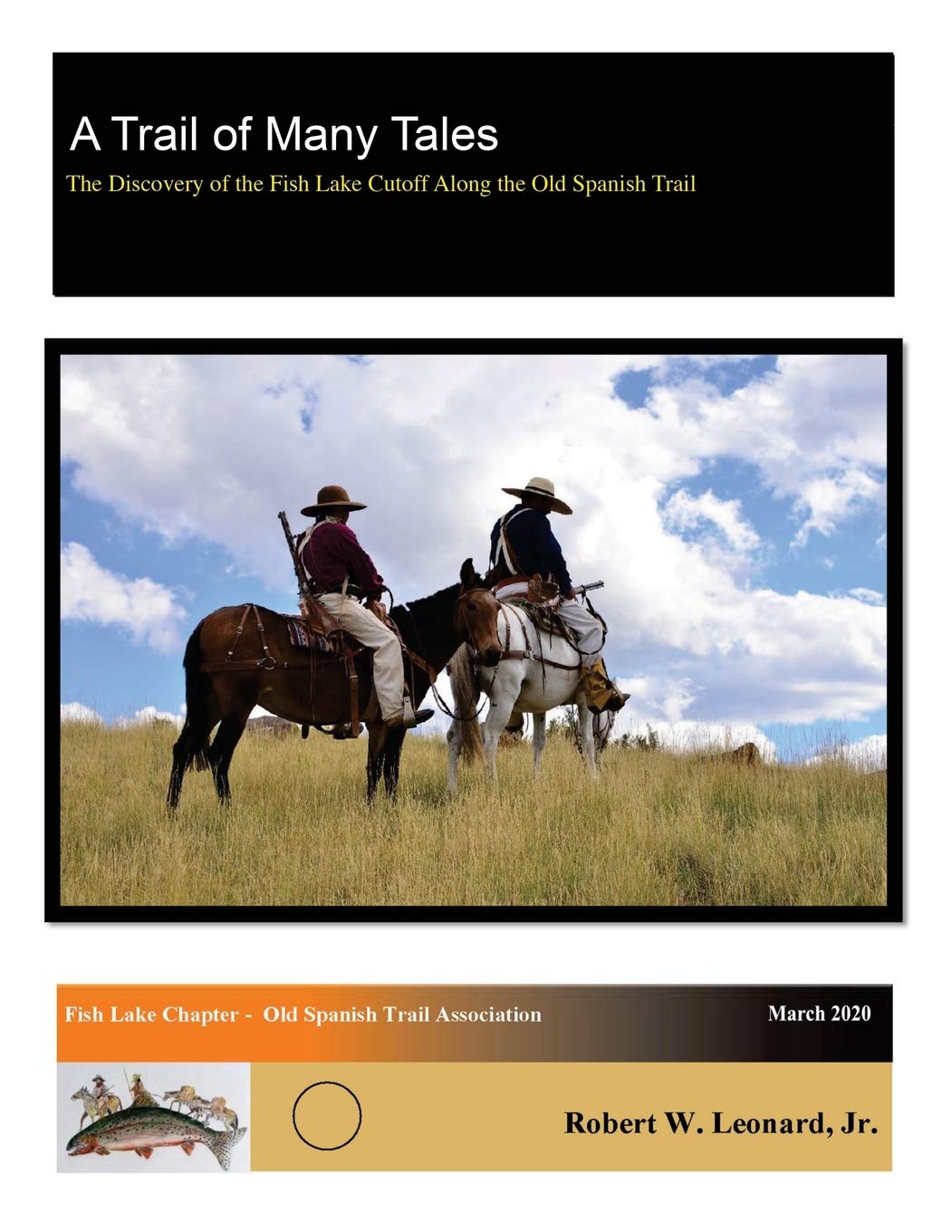
Whether four-legged animals or two-legged humans, trails are followed and retraced by an assortment of creatures through the centuries on the easiest paths through the landscape. They were always on some type of mission whether looking for forage, food, water, or ports of call. Humans, from the 16th through the 19th centuries were most always on some military or commercial enterprise between destination points. The Old Spanish Trail was used for both purposes: Spanish traders from at least 1795 to the railroad surveys of the early-1850s. Commercially, hundreds of mules left Santa Fe carrying woolen goods for the Californios. In return, thousands of horses and mules were herded back to New Mexico and then up the Santa Fe trail to Middle America.
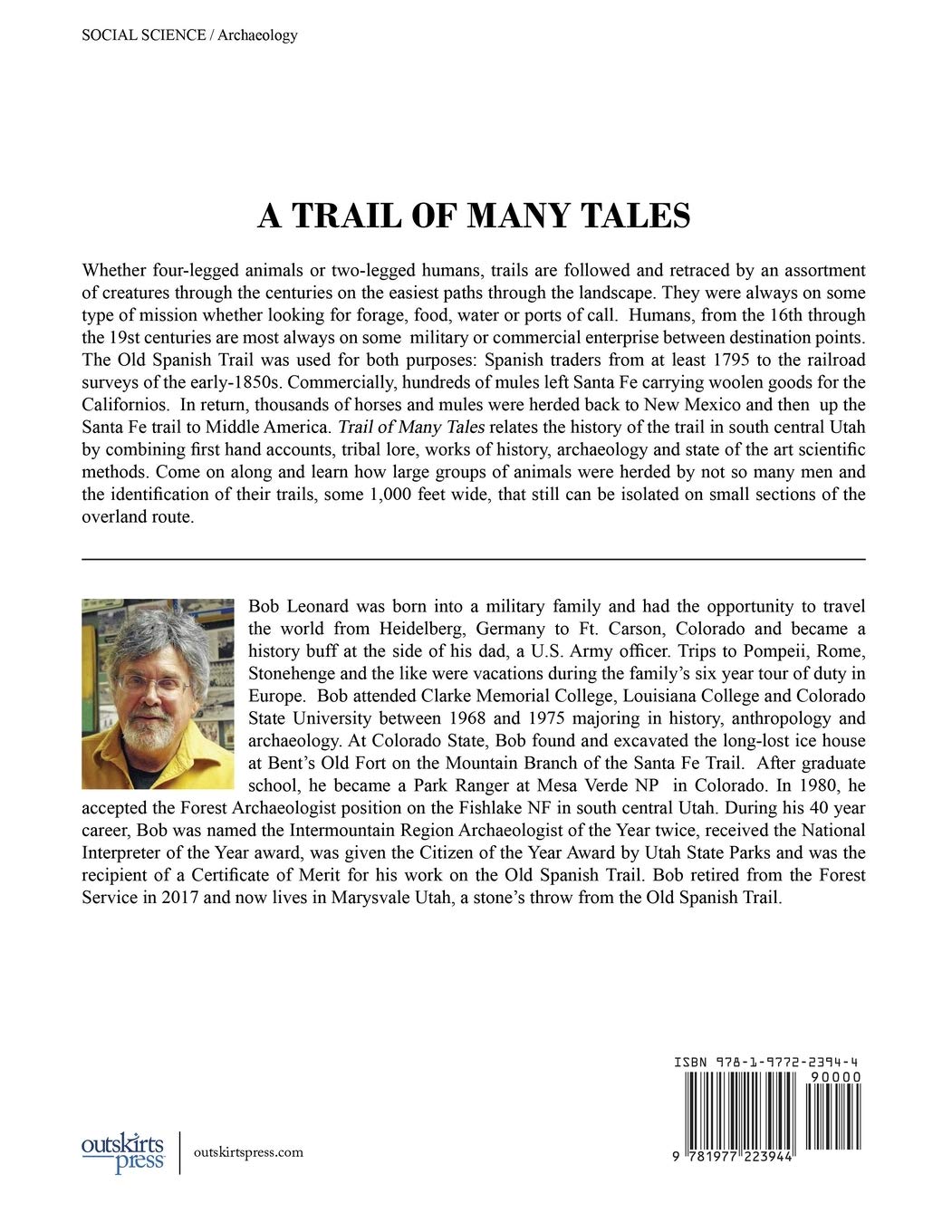
Trail of Many Tales relates the history of the trail in south central Utah by combining first-hand accounts, tribal lore, works of history, archaeology and state of the art scientific methods. Come on along and learn how large groups of animals were herded by not so many men and our identification of their trails, some 1,000 feet wide, that still can be isolated on small sections of the overland route.
REVIEW:
Have you ever spent time obsessing over Wagon Train stories or settlement in the American West–either digitally or as a traveler yourself? Have you spent an absurd amount of time going down the rabbit hole that is Wikipedia when it comes to interesting historical events or social histories? I have, and chances are some of my readers here have done so, too. This book is for you, my rabbit hole and history buff readers!
In structure, A Trail of Many Tales: The Discovery of the Fish Lake Cutoff Along the Old Spanish Trail combines the best features of both academic publications and the sort of widely-used guide books that show up on library shelves. Speaking from my experience checking out books for library visitors, the Falcon Guides book on Italy is extremely popular, but all books of this nature, especially the local or regional ones, are much-looked-for by readers and travelers. This makes Robert W. Leonard, Jr.’s A Trail of Many Tales both extraordinarily practical for those wishing to know more about its story or are hiking in the area, and extremely authoritative and trustworthy from a technical or academic perspective. Photographs pepper sections where they provide both an oft-needed “sense of place” and examples of the sorts of modern remnants of the area’s usage at its several peaks. Everything is properly credited in the academic fashion with short descriptive captions, so the images are both enjoyable from a casual standpoint and compliant with copyright from an academic one. Many of them were taken by the author himself while researching the routes.
The written sections are, I promise you, highly readable due to the author Leonard’s straightforward style of expression, but non-academic readers ought to be able to sense from the outset that the book wasn’t written entirely with them in mind, and that there are some structural differences between the architecture of scholarly publications and commercially produced guides. As an example, the book provides table of contents instead of the more simple chapter listings of creative travelogue nonfiction (I’m thinking here of Travels in Siberia, which I read a couple of years ago, as a popular example of that particular form.) Only the very occasional typo (probably from word processors’ tendency to transpose letters) would indicate that this book didn’t have a bevy of interns and salaried editors scrutinizing every line. There are also some acronyms and unfamiliar terms to those of us not terribly familiar with the sort of technologies available in the 1800s–Terms like swales or the Dixie Harrow project, some Bureau of Land Management and National Forest Service acronyms I didn’t immediately recognize, and some other technical terms that sent me straight to the Index and Appendices included at the very end of the book …. as well as my graduate work at the University of Arizona, where I spent considerable time in various laboratories conducting some writerly research of my own.
Despite its (very occasional) quirks, A Trail of Tales was absolutely engrossing. I got so sucked in by the various histories and experiences of the Old Spanish Trail (acronym: OST) that I stayed up past 3 in the morning reading and re-reading several sections, including the area’s regional pre-Columbus slave trade (horrifying in a True Crime sort of fashion) and its historical importance to the Church of Latter-Day Saints. And let me tell you, I sacrifice my sleep only for the most interesting and readable of books. If I have made any typos in my review, I blame several late nights obsessing over this book. And tree rings. And public land management in America. I have been known to fall asleep even before finishing a single article in home decoration magazines–usually before 10 in the evening–so you get a sense of how this book reeled me right in.
SIDE NOTE: the Laboratory of Tree-Ring Research there is absolutely fabulous as both a building and a research institution. It provides a brief summary of the basics of tree-ring research, including some of the technical terms used in this book, on the “About Tree Rings” page on their website as well as by live virtual tours of the building that help give digital visitors a better sense of the place; the Laboratory also makes available live virtual tours of the building for students. (I’ll admit, since March of 2020 the existence of virtual tours was not a fact that I regularly thought about; since COVID-19 has shut down public access to many, many important places, such as the major museums of Europe, the Smithsonian, and even some restaurants have become much more popular–and useful. Useful to, for example, the future college freshmen wanting to know what sort of campus they’ll choose to land on, once on-site learning picks up again.)
While I do think that there is a great deal to interest a wide readership in A Tail of Trails, I know for certain that travelers–both serious hikers and tourists for history like those who follow any of the Wagon Trail routes to the American West)–as well as researchers and American history buffs will find it of particular importance. Author and fellow-traveler–not to mention researcher–Leonard does a great job of contextualizing the Old Spanish Trail and this book’s specific sections of the OST within the larger history of migration (whether the trafficking of slaves or white settlers and adventurers). I feel like I understand the place, what it means to different people as well as a detailed understanding of what it would be like to stand on a riverbank in Tommy Hollow. I’m so glad this book came to my attention, and to have a chance to read it!
IN SUMMARY:
In A Trail of Many Tales: The Discovery of the Fish Lake Cutoff Along the Old Spanish Trail, author Robert W. Leonard, Jr. leads his readers through the documented history and his own boots-on-the-grounds research of a well-used (historically speaking, at least) shortcut of the Old Spanish Trail. Up until the publication of Leonard’s book, there had been no widespread awareness of this cutoff’s importance or its popularity and its usage as a Pre-Columbus trade route between New Mexico (who supplied, among other things, textiles and mules) and California as well as the traders residing in the Fishlake National Forest’s area (who provided, among other things, Indigenous peoples as slaves for manual labor). The author provides a fascinating look into the world of dendrochronology and other scientific research, and keeps readers hooked by his own compelling obsession with–and research trips to–the cutoff and surrounds. I could not have stumbled across either a more interesting guide book or–bonus feature!–a more thorough and authoritative work of historical or scientific research. A Trail of Tales is a fantastic book.
WHERE TO BUY?
You can find A Trail of Many Tales: The Discovery of the Fish Lake Cutoff Along the Old Spanish Trail by Robert W. Leonard, Jr. wherever good books are sold, including Bookshop.org, Barnes & Nobleand Amazon. You can also find out more about it on the book’s Outskirts Press listing.
WHAT NEXT?
Oh, don’t get me started! I have over twenty items checked out from my local library and a score of non-library books in poorly-organized piles around my physical space … and digital ebook space. Many of these (ten, maybe?) I have already started, but thanks to … (*gestures at all of 2020*) … I have the attention span of a restless cat, so I’m reading them all at once or a bit at a time, sequentially. I don’t have a specific one I’d pull out of that pile quite yet for my next review––but I have a lot of candidates jostling for the space. Very likely I’ll have to keep up a rapid pace with my reviews over the coming months. Thank you for reading my review, and I hope you are able to read this book yourself!
I received a copy of this book in exchange for an honest review.
ABOUT KENDRA M.: With nine years in library service, six years of working within the self-publishing world, as well as extensive experience in creative writing, freelance online content creation, and podcast editing, Kendra seeks to amplify the voices of those who need and deserve most to be heard.
My last post introduced the concept of outlining as a function of planning your next book. We got so far as to be ready to start looking at specific ways of doing so. My goal isn’t to recommend any specific way, but to present you with a buffet of possibilities you can mix and match between, should you like, or that you can research further into the one or few that appeal to you.
METHODS OF OUTLINING
In this section of today’s post, I’m going to highlight some methods that have been thoroughly described elsewhere, with a brief summary description. I highly recommend following the hyperlinks to read the beautiful words and details put together by these phenomenal author advocates!
BULLET POINTS
This is probably the simplest and most straightforward possibilities out there, and a great place to start if you’ve never or rarely ever created an outline, and are just dipping your toe into the process. Bullet points are one of the most motivating kinds of information organization systems out there, as there is a great deal of emphasis on streamlining things down to the bare minimum of crucial points. (In that way it is similar to the sticky-note and index card methods, which I get into later on.) Whether you’re working in print and doing a lot of the editing before you even put pen to paper, or if you’re using some kind of word processor that allows for constant reorganization and editing after the fact, there are huge benefits to this system of outlining. It forces an author to focus on the fundamentals: characters, plot architecture, inciting actions, and the basic scaffolding of the book. Whenever I’ve used this method myself (mostly back in my college days, to be honest) I discovered connections and related ideas as I typed them up, and used the COPY + PASTE functions on my laptop frequently to regroup these ideas into clumps that felt right together. The Australian literary magazine Writer’s Edit has broken its recommended “clumps” (my imperfect word, not theirs) to a series of eleven, including timeline and character design and arcs, voice, chapter organization (and reorganization), and how to survive the dreaded “middle.” The article was written by Kyla Bagnall, and is worth tucking away among your many drafting resources.
STICKY NOTES
To echo what I said earlier in the “Bullet Points” description, keeping things simple has enoooormous benefits to many authors–whether it’s because of your own editing within a word processor or the repeatedly limited space provided by a sticky note pad (and I’m resisting the urge to recommend buying those fantastically huge, easel-sized sticky notes that are used for workshops and breakout activities in professional settings). The physical constraints of sticky notes (and index cards, too, as I discuss below) force an author to slow down and think very deliberately about what to include–and there’s the added benefit that you can essentially rearrange the sticky notes as you discover connections between them, whenever you want (although keep a water-soluble temporary adhesive glue stick with you as you go, since some sticky note pads aren’t exactly known for … sticking). You can even follow the same loose pattern as you would in a bullet point list (or turn a bullet point document into a sticky note outline, if you like to edit down digitally but arrange the points visually).
I have only used this process once, but I loved the flexibility of trying out different visual arrangements: information trees and hierarchies, venn diagrams, and loosely clusters of notes that would break up and reform as the drafting process continued. Any available wall or window will do for your workspace, which makes things quite fun for everyone except for the poor person on window-cleaning duties afterward! Onthe Writing With Sharon Watson blog, Sharon has included some additional ideas for a sticky note method, and there are plenty of beautiful pictures of people at work using it, as with the image at the top of this post. Sharon comes at the subject as an educator tasked with motivating students and teachers alike to tackle creative outlining styles, which I find really interesting.
INDEX CARDS
The Index Card Method can indeed be looked at as a slightly less-fun alternative to sticky notes (especially if no walls or windows are available for outlining), lacking both the adhesive backing and the array of bright colors available that can provide useful color-coding (but here’s a secret … colored index cards exist too! Google them if you haven’t seen them before). A definite benefit to using the cards is that you can easily pack a lot more information on the one piece of heavy paper. (Think of how much information old-school library card catalogs managed to pack onto each Dewey reference card!) I could easily see using a phase-by-phase approach with the bullet point section coming first, full of rough and unrefined ideas, followed by the sticky note rearrangement method, which allows for more intuitive clusters of information to just … fall together. And once an author has nailed down exactly the order and shape of things, it might prove useful to rewrite the sticky note information (and expound on it) onto index cards that can be numbered and ordered in sequence. This saves a lot on storage space–you only have one little stack instead of a huge swathe of your room covered in sticky notes–and also keeps everything close to hand and easy to access when beginning the first draft. You’ll never forget what plot point needs to come next according to your grand scheme of things, because you’ll already have sequenced everything while converting the sticky notes into index cards.
Even if you skip the bullet point document and the sticky note method, index cards can prove mighty useful in the drafting process. I have been invited to guest judge several small-town high school speech and debate tournaments over the years, and it has to be said that the speakers who come with sequenced index cards in hand never seem to waste time trying to dredge up information before their presentation time expires. (I prefer spontaneous speeches for other reasons, but that’s beside the point.) And the point here is that outlining and sequencing your work, whether book or public speech, helps prevent veering off course and rambling. In high school, the suggested outlining structure is incredibly simple:
Introduction
Transition
Point/example 1
Point/example 2
Point/example 3
Transition 2
Conclusion
… and that’s really about it. Your book is unlikely to be structured as simply as a time-restricted speech or an essay on assigned reading, but you get the idea. And if your structure gets overwhelmingly complicated to the point where you seem to lose your place, you might consider going back to the initial bullet point section and the article I reference there. If things seem just impossible to streamline and you’re feeling panicked, it might also be time to look into those apps and computer programs, including the famous Scribner, that lead you through a step-by-step process of converting your outline into something that looks and feels like it makes sense. More on that next.
SCRIVENER/SOFTWARE/APPS
I don’t like picking and choosing programs and apps to recommend based on personal preference (favoritism!), but Scrivener is probably the most widely-heard-of example of what’s out there, although it is now facing increasing competition from apps available for mobile devices and app-based operating systems. First figure out what device or devices you want to be using for the outlining process, because that will in large part determine which specific one you pick. Will you need to go to the Apple App Store, or the Android or Google Play app stores for other devices? Some apps are not built to work across both sides of the Apple vs. Android system divide, so you need to know what you’re going to use going in. And don’t be afraid to look up tutorials on using the platform you’re looking into, on YouTube and elsewhere. YouTube helped me disassemble my bread machine in order to replace the drive belt, so a bit of system description and such will most definitely be present on the great and mighty Internet. Here is a great example of a YouTube tutorial on Scrivener by Literature and Latte that visually explains how to use the software’s outlining function. (Scrivener is often offered at a steep discount during or after National Novel Writing Month, so if you’re interested, definitely keep an eye out for good deals like that.) The video may be four years old as of the date of this post, but it hasn’t changed very much in that time. Don’t be shy about trying your hand out with different app or software trial periods, either! Sometimes you don’t know what will truly help until you’ve spent some quality time with it.
THE HERO’S JOURNEY
Well, I’m several essays into this one post and I still have five more outlining methods that I’m excited to talk about–so I’ve decided to save the final four for my next post (on March 25th) and close out today by briefly mentioning the Hero’s Journey method.
What is the Hero’s Journey? It’s a sort of organizational metaphor originally put forth by the Great and Mighty AKA “appears in loads of composition textbooks” Joseph Campbell. I can’t even touch all the finer points of his epic (bad pun alert!) analysis, which took up much of his professional life, but suffice it to say this is the kind of organizational structure (or “monomyth”) that underlies many (if not most) great stories in the Western canon. Many of you will have probably heard some of his terminology before, so I won’t go into too much detail–and besides, Scott Jeffrey of CEOsage has created a wonderful guide to the Hero’s Journey monomyth and how one can apply it to daily life. If you extrapolate out just a little bit, you can easily see how an author might choose to use the outline of the Hero’s Journey as a kind of template for outlining their own! An author might keep it simple and make use of the three (3) stages of the journey (departure, initiation, and return) or go absolutely wild with the ten (10) more detailed steps that underlie the big three, swapping out the monomyth’s basic steps with the relevant or related bits of your own work in progress. You can get into the weeds of composition and literary theory if you want to by checking out out every book on Campbell from your local library, or you can just start with the basics as described by Jeffrey. You’ll start to see an outline develop before you even know it!
More fun options next time, I promise!
Thinking of you always. ♣︎
Daylight Savings is this Sunday!
Do you have ideas to share? Please don’t hesitate to drop us a line in the comments section, below.
ABOUT ELIZABETH JAVOR: With over 20 years of experience in sales and management, Elizabeth Javor works as the Director of Sales and Marketing for Outskirts Press. The Sales and Marketing departments are composed of knowledgeable publishing consultants, customer service reps and book marketing specialists; together, they all focus on educating authors on the self-publishing process to help them publish the book of their dreams. Whether you are a professional looking to take your career to the next level with platform-driven non-fiction or a novelist seeking fame, fortune, and/or personal fulfillment, Elizabeth Javor can put you on the right path.
This article from Publishers Weekly is a fun one! In it, contributor Drucilla Shultz covers the story behind the self-publication of Sister of the Chosen One, a new indie book co-authored by friends Colleen Oakes and Erin Armknecht. While we highly recommend you read the entirety of Shultz’s excellent article, we’d like to highlight this particular book and article for the relationship behind the book. All too often, in our experience, it feels as though there’s a certain kind of pressure to keep all things relating to a book’s publication (or self-publication) professional rather than personal, when in point of fact one of the great strengths of going indie is that it leaves room for both to coexist–as happened with Sister of the Chosen One. Oakes, specifically, is known for her past publications and for having worked within the traditional publishing paradigm, but when it came to this book the need was there for more flexibility. As Oakes states in Shultz’s article, “every book release feels fresh and different, because not only have you changed as a writer, but your books themselves are representative of your growth.” Both Oakes and Armknecht reflect on the challenges of releasing a new book during a pandemic, and the effect of COVID-19 on their book’s marketing process. Definitely take a peek at Shultz’s piece on PW for the full story.
Here is another fascinating self-published project that comes to us courtesy of COVID-19, as covered by Di’Amond Moore for Georgia Public Broadcasting: photographer Tara Wray, widely known for her previous book Too Tired for Sunshine (and for the hashtag #TooTiredProject that has followed it) is launching a new photo-book by way of going indie that chronicles her experiences during the isolation of COVID-19. The book encapsulates not just those feelings of isolation and separation from the world outside, but also the togetherness and lived-in texture of her life with family (her twin 10-year-old boys are featured among the many photos included). This latest project of Wray’s marks the beginning of a new phase for her original #TooTiredProject in that she is using the opportunity to start Too Tired Press, with Year of the Beast as its first publication. How neat is that–not just going indie but launching a brand new indie press? Consider us fans.
This helpful article hit NerdsMagazine.com shortly after our last news post, but we can’t let another week go by without mentioning its excellent and thoughtful contents, which come to us courtesy of Steve Landry under the magazine’s “Think Geek” section. It offers what Landry calls a “comprehensive guide” to the self-publishing process, and covers everything from “Polish[ing] Your Manuscript to Perfection” at the beginning of the publication process to both marketing “pre-launch” and “post-launch” checklists. If you’re still wondering if self-publishing is right for you, Landry also addresses that question in detail. We highly recommend reading the entire guide as a part of your own pre-publication market research.
Last but certainly not least for this week’s lineup of news articles comes this piece for Food52 and later syndicated on Salon by Cathy Erway. In it, Erway follows the plight and growing popularity of food writer Alicia Kennedy. Early in 2020, Kennedy saw her freelance work vanish seemingly overnight with the downsizing of the market at as a result of the pandemic–but this was not the end of her story, but rather the beginning, with her Substack-based newsletter rising through the rankings to make her one of the most widely-heard voices in food writing during the stressful period, and a profitable side business as well thanks to Substack’s paid subscription option. Writes Erway, “As more food writers and recipe developers become fed up with traditional outlets, both food media “celebrities” […] and freelancers like Kennedy, who felt there were too few opportunities for her work, are finding success in publishing content in newsletters and through other independent channels.” The effect of this shift mirrors that of personal blogs on the industry of food writing in the 90s and early 2000s, which “not only challenged a sleepy traditional media that felt behind the times, but [also] democratized it.” While the current change underway is neither simple nor easy to sum up, Erway’s article proved very thought-provoking indeed for those of us deeply vested in the various routes to indie publication. And Kennedy is only one of a great many “creators of print magazines and direct-to-consumer digital food media” challenging the status quo, writes Erway, by “favoring a more transparent transaction between creator and consumer via subscription.” We like the sound of that.
As a self-publishing author, you may find it helpful to stay up-to-date on the trends and news related to the self-publishing industry.This will help you make informed decisions before, during and after the self-publishing process, which will lead to a greater self-publishing experience. To help you stay current on self-publishing topics, simply visit our blog each month to find out the hottest news. If you have other big news to share, please comment below.
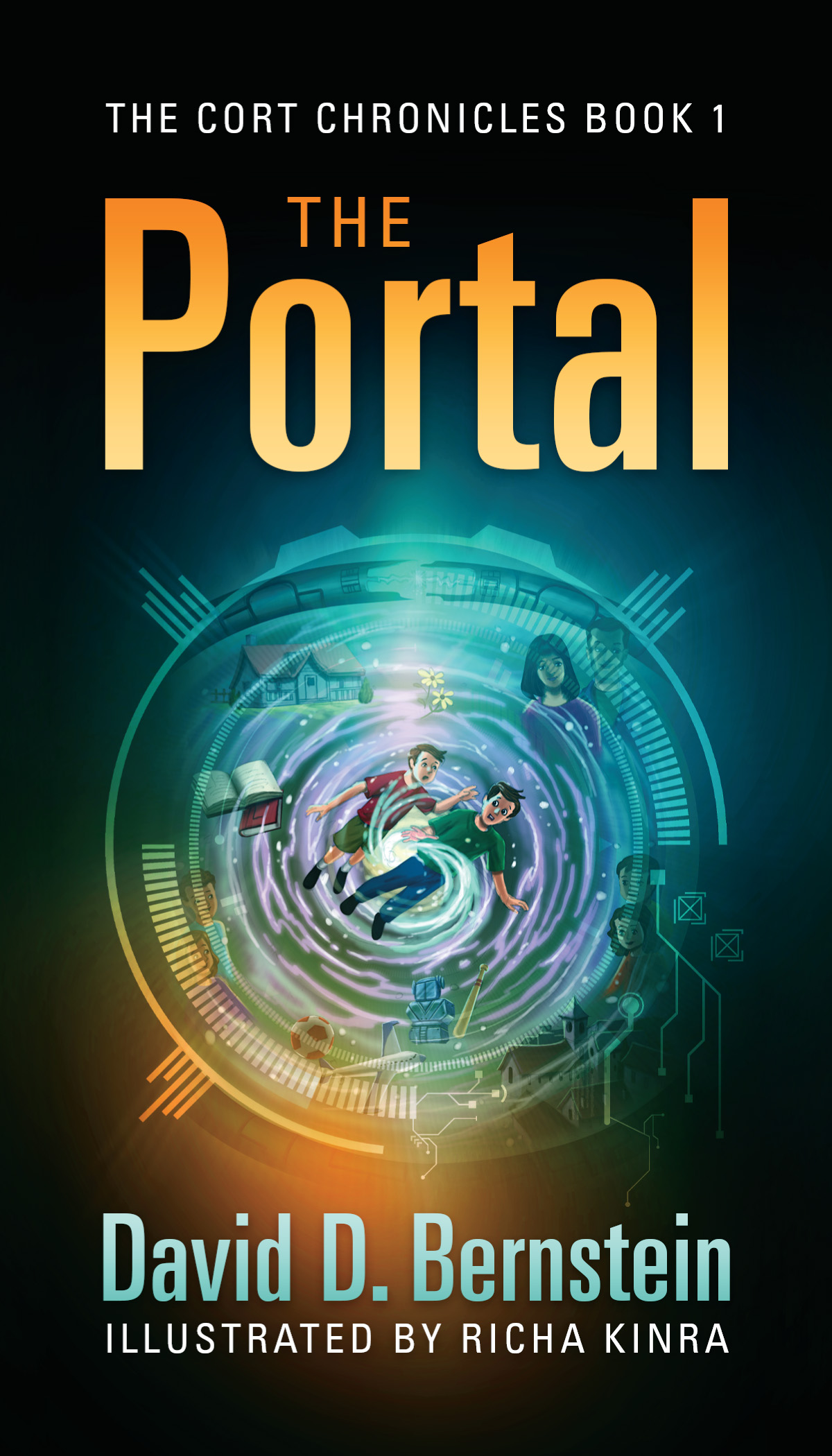
“The Portal” (CORT Chronicles Book 1) by David D. Bernstein; illustrated by Richa Kinra
OFFICIAL DESCRIPTION*:
After falling into a time portal during a Little League baseball game in Trinity, New York, eleven-year-old Andy finds himself transported to a ghostly version of his hometown––101 years in the future. Twisted metal, rotten wood, and garbage litter the seemingly empty streets, but Andy will soon discover that the city is controlled by CORT robots . . . and that this reality is Earth’s possible future. When thirteen-year-old Zack receives a strange letter that guides him through the portal, he and his brother are reunited, and together they must journey through a nightmare world that only they can change. But how can two young boys alter the present by saving the future?
REVIEW:
101 years in the future, thirteen-year-old Zack and eleven-year-old Andy find themselves caught up in a new civil war. After various misadventures including time-traveling portals at baseball fields and old abandoned supermarkets, a three-dimensional letter, and a ruined library full of frightful reminders that they are nowhere near home, the boys team up with future teenage resistance fighter Wendy and her crew. The boys face trial after trial as they begin to figure out what, exactly, is going on in this future: fifty years of cultural memory has vanished, and every possible thing is now manufactured by a shadowy organization––CORT. Children and seniors live segregated lives, with children brainwashed into accepting the new system from toddlerhood. One of the boys is captured, leading to the formation of a rescue party and a cliffhanger ending.
Now, I personally am not the biggest fan of cliffhangers! Many a young adult or middle grade novel has been flung across the room in my house because of an unfinished series leaving readers hooked–and frustrated that they can’t keep going the minute they finish earlier books in the series. (I do not condone the throwing of books, whether print or digital. As a librarian, here is my obligatory reminder to take good care of your precious stories.) Having said all of this, I do know that cliffhangers are an effective tool in an author’s toolbox, and that the mere fact I’m still grumbling about those cliffhangers from the distant past indicates those authors have made good use of this particular tool. Still, I am eager to lay my hands on the next book in this series so that I can learn the ultimate fates of Zack, Andy, and Wendy.
Middle grade readers will probably also be familiar with dystopias–future worlds where the systems governing society and/or government have somehow gone awry and are no longer serving to protect and serve those people who remain. There is always some rather mature themes involved in communicating dystopic ideas, and The Portal is no exception. Parents and readers should be aware that bombs fly and skeletons turn up at the most inopportune times, and yet the reading level or difficulty of this series indicates that it is written for those transitioning from Easy Reader (ER) books into chapter books. I could see this being a hit with the demographic currently (if clunkily) referred to as “struggling readers”: in other words, those children struggling to make the transition in reading level difficulty to the Junior Fiction section of the local school or public library. (I’m thinking of the Dork Diaries audience here.) The combination of an action-driven plot. lower-difficulty language, and eye-catching illustrations set these books apart from your more standard chapter books.
And those illustrations–I really can’t say enough about Richa Kinra’s ability to communicate so much in simple black-and-white pencil sketches. The face of each and every character is just so expressive, and important details within the story well featured. I’ve been drawing and painting since I could hold a pencil (or brush) and I absolutely could not even halfway imitate Kinra’s fantastic work.
What’s not to love? There are action sequences: The bombs! The evil robots! The people running! The purple flames! And there are also the mysteries: Who sent the letter? And how? Where do the seniors and children go? What is CORT really after? How did the resistance first get started? At around 75 pages, Bernstein’s first book in this series only just hints at answers still to come. Despite the occasional typographical hiccup, The Portal reads as a fun, immersive romp. Here’s hoping there are many installments left to come!
IN SUMMARY:
Going into this book, I expected it to be solidly good. I’ve never yet been disappointed by any book picked out by the CIPA EVVY process as a merit or award winner, and The Portal was in keeping with that high expectation. As much a work of fantasy as it is of science fiction, this book is very much written with a middle grade audience in mind, and is packed with the kind of zany adventures junior readers love.
WHERE TO BUY?
You can find The Portal wherever good books are sold, including Bookshop.org, Barnes & Nobleand Amazon. You can also find out more about it on the book’s Outskirts Press listing.
WHAT NEXT?
The next book on my list is rather a pithy one: a nonfiction exploration of both the present and historical past of the Old Spanish Trail, portions of which I happen to be a bit familiar with, but much of which has intrigued me for years! I’m definitely the kind of person that can get lost in a guidebook to (name a national forest or park or monument) or any book along the lines of A Roadside Geology of … book. Much to look forward to!
I received a copy of this book in exchange for an honest review.
ABOUT KENDRA M.: With nine years in library service, six years of working within the self-publishing world, as well as extensive experience in creative writing, freelance online content creation, and podcast editing, Kendra seeks to amplify the voices of those who need and deserve most to be heard.