The Current State of E-Readers | An Author’s Guide (Part II)

Last week, I launched us into a new series about e-readers, and the pros and cons of using each different e-device (don’t worry, this won’t be quite the epic saga that the Beginner’s Guide to Social Media primer turned out to be!).  This week, I’ll be taking a closer look at perhaps one of the most talked-about e-readers of all time, the Kindle.  No doubt you’ve heard a lot about Amazon’s entry into the e-book sphere before, and elsewhere, in part because it was launched by a massive company still on the upswing in popularity, with the built-in infrastructure to ensure a strong debut––and in part because it remains a solid performer, especially in its newer incarnation, the Kindle Fire.
jeff bezos with the kindle
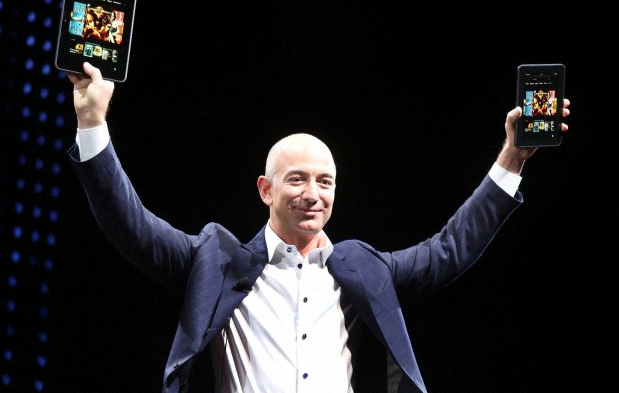
Amazon CEO Jeff Bezos with the new Kindle Fire HD

Just how many people own a Kindle?  A 2014 Forbes article reported that “roughly 43.7 million Kindle devices had been cumulatively sold till the end of 2013,” but, well, Amazon isn’t really talking, except when it’s super proud of itself, so the data Forbes was using may or may not be representative.  Even though in 2014 the Pew Research Center was marking an uptick in e-reader (specifically, Kindle) and everyone seemed, for the most part, highly optimistic about e-readers and therefore e-book distribution, some more recent data seems to indicate a plateauing of that trend … if not a slight reversal.  According to an article by Business Insider contributor James Cook, “for the first time ever the number of tablets shipped has decreased”––and Amazon’s Kindle line has been the hardest hit, with a decrease of some 69.9% in respect to shipments.  That’s a lot.  And the numbers are still so new that few tablet users are speculating yet as to why the Kindle has taken the brunt of the market change.  Is it because users have grown bored, or because Amazon hasn’t reinvented the wheel since the Kindle Fire was released two years (or two lifetimes, in today’s rapid-fire technology-hungry universe)?  But wait––what about the Kindle Paperwhite (the “Kindle 3”)?  Why does nobody seem to be getting on the Paperwhite train?  Is it because people are actively migrating away from Amazon, or from tablet computers, or from e-books?  The numbers seem to be holding mostly steady for e-books downloaded and read, so what’s the deal?

I’ll let you know as soon as I know.

Still, in the meantime, here’s what you need to know about the Kindle (Fire and Paperwhite):

They’re beautiful devices, designed and manufactured specifically to make thumbing through your digital library as tactile and responsive a practice as running a hand across a physical bookshelf––or at least, these e-readers are about as close as you can get without engaging your sense of smell.  (They do, however, make use of your fingertips and your ears as well as your eyes.  There’s some benefit to a multimodal interface, in terms of absorption of information, or so I’ve been told.)

And don’t forget that while sales may have dropped this last year (and significantly), the Kindle and Kindle Fire have out-sold almost every other dedicated e-reading device out there.  There are millions––dozens of millions––of Kindles out there already in use.  So yes, it still remains completely and absolutely worthwhile to sell your book as an e-book edition through the Kindle Store.  The total number of units sold alone should indicate this, but as the aforementioned Pew Research Center report also says, 3 in 10 American adults read an e-book last year, most of them on a tablet or dedicated e-reading device.  That’s a lot of e-books, my friends.  And Jim Tierney over at Loyalty360 reports that Amazon Prime Membership jumped by 53% in 2014––to around 40,000,000 (that’s 40 million) total adults.  And what with the advent of the Kindle Lending Library––a controversial offering, to be sure––Prime subscribers can opt to read certain select e-books for free.  That’s a lot of potential future readers.

Not much has changed when it’s come to the disadvantages of owning a Kindle, except for the fact that Amazon has taken away any grounds for complaint about the graphics, display quality, and user interface.  Their customer support system is pretty nifty, too, and users seem to like it.  No, you still can’t take the Kindle into the bathtub with you, and you probably don’t want to hurl it off the edge of a parking garage unless you actually want to watch it break, but these tablets do qualify as robust, insofar as tablets are allowed to.  Lending books to friends is possible, but still not quite intuitive.  Universities are starting to get on board with letting students use e-book editions for courses, but this still remains an underutilized possibility.  And no, it’s not an actual book you can hold in your hand and sniff for that “old-book” smell.  (But that’s what perfume is for, right?!)

I’m not about to try and sell you on buying a Kindle––or any e-reader, for that matter––but I do think it’s worth oohing and aaahing a little over the modern creature comforts technology has provided us.  An interlinked dictionary that I can access while reading?  Handy.  Highlighting and bookmarking?  Essential.  And much more difficult to “lose” when we’re speaking of a digital item.  And it’s nice, too, to have the option of reading multiple file formats on the same dedicated e-device without having to switch between apps.  PDFs?  No problem.  TXT?  DOC?  The Kindle’s got you covered.  And for now, people aren’t quite tossing them in a blender just to watch sparks fly, so I wouldn’t quite put up the crime scene tape just yet––if Amazon has proven anything, it’s proven just how much it loves to be on top!

Thank you for reading!  If you have any questions, comments, suggestions, or contributions, please use the comment field below or drop us a line at selfpublishingadvice@gmail.com.  And remember to check back each Wednesday for your weekly dose of marketing musings from one indie, hybrid, and self-published author to another. ♠

KellyABOUT KELLY SCHUKNECHT: Kelly Schuknecht is the Executive Vice President of Outskirts Press. In addition to her contributions to the Outskirts Press blog at blog.outskirtspress.com, Kelly and a group of talented marketing experts offer book marketing services, support, and products to not only published Outskirts Press authors, but to all authors and professionals who are interested in marketing their books and/or careers. Learn more about Kelly on her blog, kellyschuknecht.com.

From the Archives: “Using Listmania to Promote your Self-Published Book”

Welcome back to our new Tuesday segment, where we’ll be revisiting some of our most popular posts from the last few years.  What’s stayed the same?  And what’s changed?  We’ll be updating you on the facts, and taking a new (and hopefully refreshing) angle on a few timeless classics of Self Publishing Advisor.

∗∗∗∗∗

[ Originally posted: August 22nd, 2008 ]

If your self published book is available on Amazon.com, there are a lot of ways to promote it.  Since Amazon sales should account for a large percentage of your overall book sales, this site is a good place to concentrate a lot of your efforts.

I’m going to tell you about creating a “listmania” list on Amazon. Have you ever noticed when you browse for something on Amazon, there are lists that are related to that subject that are mentioning other books and/or products?

By strategically listing products on your lists, (including YOURS of course), you can start to generate more traffic to your book listing.

Here’s how YOU can create just such a list:

Sign up for an Amazon Author Connect account if you don’t have one yet. Or sign-in to your current account.

Click on your personal “store” on the top tabs. Then select “Your Profile” from the sub-menu.

You will see lots of things you can personalize, including your bio and your online photograph.

But scroll down and you will see a section called “Listmania!” And this is where you create a listmania list.

Creating a Listmania List is a good way to increase exposure for your book.

Obviously, you want to ensure that your book is on your list.

But the real trick to a successful Listmania list depends upon the OTHER books you put on your list, the ones written by other people.

There are two ways to go about it.

1 – Adding books to your list that are applicable to your subject. The idea behind this concept is easy — if someone reads your list because they were browsing a similar book, they’ll be more apt to buy YOUR book because they’re interested in the subject.

2 – On the other hand, you can add very popular books to your list, since more people may have a chance of seeing it, even if fewer of them will be interested in your book.

I recommend creating multiple lists and trying different tactics to see which is more successful. Amazon lets you track the number of times your list was viewed. Use these numbers to create better lists in the future.

If you have more specific questions about creating a listmania list, the Amazon FAQ will help you.

Amazon Listmania

So here’s the thing: Listmania doesn’t really exist anymore!  Back in 2013, Amazon ceased offering support and guidance on using the Listmania interface, and it was entirely dismantled and rendered unusable over the months following.  (Adrienne Dupree over at Leave The Corporate World Behind even wrote a lovely little lament to mark its final passing.)  And this fact means that, on the one hand, we have to throw the baby out with the bathwater when it comes to our original post … but on the other hand, this presents the perfect opportunity to present you with new and fresh ways of utilizing Amazon for your self-promoting and self-marketing ends (as a self-publishing author).

First, we need to break down exactly what Listmania offered the average author.  Essentially, this featured compiled lists–and this makes sense, given its name–but it was not to be confused with Amazon’s wish lists, gift lists, and registries, or even Goodreads’ Listopia lists (which still exist).  These lists were designed to focus a reader’s attention on products that were similar or in some way related to products that a customer had already been viewing. By strategically listing popular products on your lists, including your own book, you were–in theory–able to generate more traffic to your book listing when people viewed your Listmania lists.  This brings us full circle to that one key word I’ve been lobbing around a lot lately: findability.  An Amazon Listmania list was supposed to render you and your book more findable, but to many people it remained just another one of the giant retailer’s many algorithmic mysteries.

And yet … findability remains important.  There simply are better ways of going about it!

Here are my top 3 recommendations for filling that gaping hole in your heart once occupied by Amazon Listmania:

  1. Start a Pinterest page.  Not just any Pinterest page, mind.  (And I’ve written about Pinterest recently in depth, so I won’t make like a broken record and repeat myself too much here.)  Whip up a Pinterest page (or “pin” to a “board”) where you collect together other books along with other somehow related objects that your ideal reader might want to purchase.  For example, someone who reads Hugh Howey’s Wool might want to pick up some tickets to tour the Titan Missile Museum outside of Tucson, or perhaps some Wool-inspired art prints.
  2. Create a public Amazon Wishlist.  This is easy to do, and it serves much the same function as a Listmania list–only, you’ll have to do a touch more legwork to advertise the list’s existence, since these wishlists aren’t necessarily designed to be searchable.  For more information, hop on over to the Amazon how-to page for wishlists, and peruse at your leisure.  Each wishlist is shareable across any platform you might wish, and you can snag a web link to copy and paste into emails or Twitter, Tumblr, Facebook, Instagram, or any other kind of social media feed you can imagine.
  3. Take a stab at an entirely new social media platform.  The reason why Listmania disappeared is that nobody was using it, or at least, too few people were using it to make it worth Amazon’s efficiently allocated time to advertise and maintain.  It had a function, but it wasn’t one that really connected with Amazon’s user base.  To make yourself findable these days, you must needs throw yourself into the post-millennial age, and go where your readers are.  I’m not necessarily an advocate of just trying anything–you should always do a little cross-demographic market research to see if your readers actually are the sort who use Snapchat or Instagram or Tumblr or Twitter–but as a good friend told me last week, “Just doing what you’ve always done and expecting things to improve is a special kind of lunacy. Sometimes you have to innovate.”  So–innovate, with calm but cautious optimism. ♠
KellyABOUT KELLY SCHUKNECHT: Kelly Schuknecht is the Executive Vice President of Outskirts Press. In addition to her contributions to the Outskirts Press blog at blog.outskirtspress.com, Kelly and a group of talented marketing experts offer book marketing services, support, and products to not only published Outskirts Press authors, but to all authors and professionals who are interested in marketing their books and/or careers. Learn more about Kelly on her blog, kellyschuknecht.com.

News From the Self-Publishing World: 10/05/15

This week in the world of self-publishing:

Often, the highlight of my day is spent reading the stories of others who have come to be involved in the world of self-publishing, and the best interviews often feature someone who has worked in both traditional and self-publishing platforms, or has transitioned from the one to the other.  Why?  Because motives are important.  And that’s one of the reasons why I love this article by author Jordan Dane in an October 4th article for The Oklahomian.  When it comes to experience and expertise, Dane has got you covered; she can speak as an authority when it comes to the differences in creative control, price control, and cash flow between the two modes of publishing.  And that’s just the first page of her article!  She also goes on to address time management, book releases, subsidiary and foreign rights, and the real cost of production––along with many other enlightening comparisons.  Well worth a read!

The big news this week is that we have a new debutante on the self-publishing market: Pronoun.  In an October 4th article for TechCrunch, John Biggs writes that co-founder Josh Brody set out to create a platform that gathers together and combines all of the best features found separately in the self-publishing industry.  Biggs interviewed Brody, who made his name running the publishing statistics engine Booklr, and the result is a combination of press release and rallying cry.  Here’s just a small snippet:

“Pronoun is different because it’s the only platform that gives authors everything they need to create and publish their book, track its performance, and improve its online visibility over time,” said Brody. “Second, we’re the only platform that performs data analysis on the entire book market to help every author position their book for maximum visibility. Third, we bring together a network of professional service providers – editors, cover designers, and publicists – all of whom have been endorsed by authors and vetted by Pronoun. Finally, it’s all free.”

We like free.  But we also really like an exceptional platform, so we’ll be watching closely as Pronoun’s user base grows and the reviews come in.

Have you ever heard of San Diego Comic Con?  If you have, you already know it’s a temporary superhub for all sorts of magical things happening in the worlds of media and entertainment.  If you haven’t, just imagine throwing over a hundred thousand people together who love creating, consuming, and participating in these things––and the conversations that are sparked when industry professionals land in the midst of their most ardent fans, and the networking that follows.  Bleeding Cool contributor Shawn Perry chronicles, in an October 2nd article, an encounter he had with Mark Frankel of Wayward Raven Media, an indie publishing company that specializes in comics.  (I mentioned earlier that I like interviews, right?)  Perry’s piece is perhaps a good representation of how the magic of SDCC isn’t just reserved for supermassive industry giants like Marvel Comics and DC––it can be a happy home for those of us who like to think small, and remain in creative control.  That’s the best kind of news, I think!


BONUS ADDENDUM (as of 10/5/15 at 1:30 PM): In other Comic Con news, the New York Comic Con starts in 3 days, and one of the panels (on Saturday the 10th) is geared specifically toward indie and self-publishing authors and artists!  Here’s the blurb from the Hollywood Reporter website:

ComiXology Submit: The Future of Self-Publishing

Creators who’ve found success through self-publishing on the leading digital comic platform in North America talk about their experiences, and offer tips for newcomers on how to avoid mistakes they made.Room 1A18, 4pm-5pm

If you live in the New York area and have a chance to go, let us know what you think!


As a self-publishing author, you may find it helpful to stay up-to-date on the trends and news related to the self-publishing industry.This will help you make informed decisions before, during and after the self-publishing process, which will lead to a greater self-publishing experience. To help you stay current on self-publishing topics, simply visit our blog every Monday to find out the hottest news. If you have other big news to share, please comment below.

KellyABOUT KELLY SCHUKNECHT: Kelly Schuknecht is the Executive Vice President of Outskirts Press. In addition to her contributions to the Outskirts Press blog at blog.outskirtspress.com, Kelly and a group of talented marketing experts offer book marketing services, support, and products to not only published Outskirts Press authors, but to all authors and professionals who are interested in marketing their books and/or careers. Learn more about Kelly on her blog, kellyschuknecht.com.

The Current State of E-Readers | An Author’s Guide (Part I)

We’ve crossed the Rubicon, dear readers.  There’s no going back, when it comes to the print vs. digital divide, at least if we’re speaking on the commercial level.  There are quite substantial numbers of readers who are introduced to books via their smartphones and computer screens and then move into the musty world of mahogany bookshelves and neighborhood used-book stores … but these numbers represent not so much a desertion of one form for another, but rather the natural progression of addicts who will simply, and always, want more–more good words strung together, more stories in their hands, more eyes to peer through and lives to live in the way that only literature makes possible.

I’m here to speak about e-books and e-readers this week and in the weeks to come.  We’ve just finished a tour-de-force marathon of social media platforms spanning several months, so it’s time for a bit of a change of pace … but without sacrificing our desire to examine trends and patterns and possibilities with the fine eye of a book connoisseur.

ereaders

The data is in, and readers have spoken.  As this infographic (courtesy of Publishing Technology and Nielson BookScan) shows, e-book sales dropped slightly from an all-time high in early 2014, but they’re not going anywhere fast.  (I should also note that the initial speculations for this year seem to indicate continued stability.)  The digital market has matured, and readers are simply spreading their pocket change around, and being more selective as they do so.  Essentially, it’s not just “still” useful to publish your books in digital form, but it’s actually more useful than ever–readers now know how to find what they like, as the information infrastructure–including indexing search engines like Google and Bing, and social media platforms with a literary bent like Goodreads–has matured alongside the market itself.

ebooks vs print

But how does an author, especially an indie, hybrid, or self-published author, go about figuring out how to navigate both the debate and the process?  Well, first, you have to know a little bit about e-books and e-readers themselves.

And so we dive off into the deep end of a new series.  This time I’m going to walk you through the process by examining each big player in the e-reading market (past and present and future, at least so far as I can see it), from Kindles to Nooks to iPads to chips implanted into your brain.  Okay, okay, I’m kidding about that last one … for now.  In all seriousness, I hope that this series will be of use to you as you take next steps into the oft-hazy world of digital publication!

Thank you for reading!  If you have any questions, comments, suggestions, or contributions, please use the comment field below or drop us a line at selfpublishingadvice@gmail.com.  And remember to check back each Wednesday for your weekly dose of marketing musings from one indie, hybrid, and self-published author to another. ♠

KellyABOUT KELLY SCHUKNECHT: Kelly Schuknecht is the Executive Vice President of Outskirts Press. In addition to her contributions to the Outskirts Press blog at blog.outskirtspress.com, Kelly and a group of talented marketing experts offer book marketing services, support, and products to not only published Outskirts Press authors, but to all authors and professionals who are interested in marketing their books and/or careers. Learn more about Kelly on her blog, kellyschuknecht.com.

From the Archives: “Self-published Book Review of the Week: The Science of Life”

Welcome back to our new Tuesday segment, where we’ll be revisiting some of our most popular posts from the last few years.  What’s stayed the same?  And what’s changed?  We’ll be updating you on the facts, and taking a new (and hopefully refreshing) angle on a few timeless classics of Self Publishing Advisor.

∗∗∗∗∗

[ Originally posted: November 7th, 2010 ]

The Science of Life
Ronnie Lee
9781432758639 $34.95

Some things in life can’t be quantified by numbers. “The Science of Life: Philosophical Equations of Physics, Chemistry, Biology, and Religion” is a discussion that seeks to blend science with philosophy and religion, with a unique format from Ronnie Lee, a Chinese poet and philosopher. Giving readers a lot to ponder and think about and discussing major scientific breakthroughs and discoveries, done in a poetic style, “The Science of Life” is a unique experience that will be hard to match.

Susan Bethany
Reviewer

This Book Of Science is a unique volume of poetry full of scientific equations to understand fundamental scientific values of today such as quantum entanglement, gravity, relativity, string theory, genetics and even the origin of life. From Newton to Einstein to Bohr to Schrodinger, this book covers a history of physics, to uncover, inspire and unravel new laws of science to allow the past generation to be understood by the new and future generations to come. The information age has allowed a Golden Age of Science to begin and this book is a fundamental research log for the start of the new era of quantum mechanics, nanotechnology and space exploration. It attempts to align everything in science towards an orderly, easy and efficient method of deduction for a grand unfied theory and a practical logic to make science a success for society to reach its goals and ambitions for wealth, profit and worth. It attempts to unite the laws of life in the simplest way possible; through the heart and mind of a philosopher.


If you’re up on your space-related news, you’ll probably already be aware that two days ago, on the night of September 27th, North America was in a prime location to watch a beautiful three-and-a-half hour total lunar eclipse of a supermoon (that is, a moon that appears larger than normal because it is at its closest approach to earth), and it was also the last blood moon and harvest moon of the year.  Night-sky lovers began celebrating early, on the 19th, by coining a new “day”–that is, International Observe the Moon Day.  (Next year, in 2016, IOtMD will be on October 6th.  Mark your calendars!)

Why do I bring this up?  Well, first and foremost, because I’m a bit of what my family calls a “space enthusiast.”  I love looking at the night sky, and I sometimes find inspiration there–but I also love reading about the night sky, and about the science that makes such stellar displays, well, stellar.  So as my paltry little contribution to this week of astronomical wonder, I thought we might revisit one of our early book reviews, for Ronnie Lee’s The Science of Life.

Since we first posted a review of Lee’s poetry back in 2010, he has released a book trailer through his publisher, Outskirts Press.  (See below.)

And the reviews have certainly come in!  Ronnie Lee himself has posted a comment to his Amazon book page to say:

This is my eighth book and it holds insights into advanced yet simple, new and fundamental laws of classical and quantum physics including entanglement, quantum dots, gravity and relativity. These hold practical inventions that can be created like teleportation, engines and other tools like better cameras and scanners etc. With different approaches in equations and logics, this book shows new perspectives and theories to underline the mechanisms of the physics of the universe. It also hold clues, theories and logics to the origin of life and to some equations to understand AIDS, Cancer and Schizophrenia. By adapting standard rules, equations and logics, the procedure to analyzing complex systems from isolated systems on chemistry, physics and biology to the universe itself can be understood, used and measured to find practicality for human success in science to reach our technological capacity as creators. With a chapter on religion and the importance of moral balance that must be stabilized with the technological reality, we must gain faith and advice from God, allowing truth from the Holy Spirit to guide us for survival, health and worth with Jesus being the path where unjust dangers on Earth must unite with the just peace of Heaven and only through the narrow door can evil gain the wealth of the good through Jesus Christ. The religious story of life has long been told and so has their prophecies. This book may fulfill some prophecies and start some new ones too. It is a book of science for the success of life.

That’s some heady stuff, folks, and I don’t know about you, but I can certainly always appreciate some uplifting commentary on the intersection between science, faith, politics, and art.

lunar eclipse

Whether you pick up a new book this week, or sit on your front porch to watch the waning moon rise and set, I hope you find something new to fall in love with, and new stories to immerse yourself in.  That is what, to me, my “space enthusiast” tendencies do: they help me fall in love, or back in love, with the minutiae of daily life.  ♠

KellyABOUT KELLY SCHUKNECHT: Kelly Schuknecht is the Executive Vice President of Outskirts Press. In addition to her contributions to the Outskirts Press blog at blog.outskirtspress.com, Kelly and a group of talented marketing experts offer book marketing services, support, and products to not only published Outskirts Press authors, but to all authors and professionals who are interested in marketing their books and/or careers. Learn more about Kelly on her blog, kellyschuknecht.com.